
Affidavit of Gertrude Hoppock - 1977
What this is: A 1977 sworn affidavit by Gertrude Hoppock submitting exhibits from her deceased sisters—Adele (Unit 3) and Eleanor (Unit 4)—to the U.S. Senate’s Veterans’ Affairs Committee. The packet helps document their WWI Signal Corps service as “Hello Girls,” worn in uniform, under orders, and deployed with the AEF.
Why it matters: Because the Army classified the operators as “civilian” after the war, primary-source testimonies like this affidavit—and its attached rosters, orders, discharge notices, and press clippings—were crucial evidence in the 1977 legislative effort to secure long-overdue veteran recognition.
What you’ll find here: A concise affidavit plus cross-links to the supporting “Exhibit” pages in GG Archives (A–Z), providing a curated trail from recruitment notices and training to orders, service, and postwar status.
In 1917-1918 My Two Sisters, Adele, and Eleanor Were Students at the University of Washington and Fluent in French and English. They Became Telephone Operators in the Signal Corps. Adele Served in the Third Unit and Eleanor in the Fourth Unit.
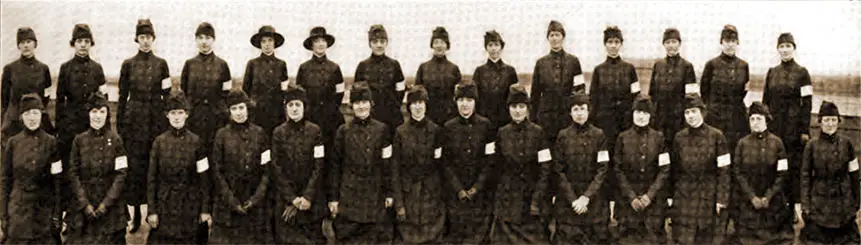
Third Unit of Telephone Operators to Go to France to Serve with General Pershing behind the Allied Lines and Help Carry on the Business of War. The Telephone Review, May 1918. Adele Hoppock was Part of the Third Unit (Not Identified in this Photograph). | GGA Image ID # 19225056a1. Click to View a Larger Image.
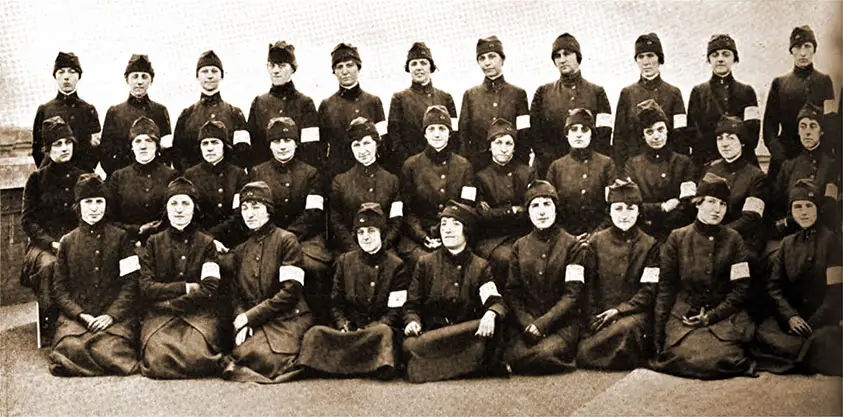
Left Section of the Fourth Unit of Telephone Operators for General Pershing's Army, Trained by the Bell System and Ready for Overseas Service. Photographed on Roof of 195 Broadway, New York, June 13, 1918. They are (left to right): Top Row — Miss Kathleen M. Hyatt, Miss Albertine M. Belhumeur, Miss Evelyn C. La Riviere, Miss Alma H. Hawkins, Miss Mary Marshall, Miss Eugene J. Couture, Miss Emma Riendeau, Miss Lillie H. Noble, Miss Louise Maclin, Miss Vivienne Hamel, Miss Louise L. Armand, Middle Row — Miss Edmee LeRoux, Miss Melanie Van Gastel, Miss Aurelie C. Lucier, Miss Stella M. Viau, Miss Berthe Arlaud, Miss Helen E. Hill, Miss E. Tilleard, Miss Juliette Courtail, Miss Eleanor Hoppock, Mrs. Eileen Munro, Miss Beatrice Francfort, Front Row —Miss Lucienne Bigou, Miss Camille Rieder, Miss Agnes G. Burge, Miss Ruth Couturier, Miss Louise Chaix, Miss Mathilde Ferrie, Miss Leonie Peyron, Miss Georgette Boehrer, Miss Mary Story. The Telephone Review, July 1918. | GGA Image ID # 19283d8c2d. Click to View a Larger Image.
Affidavit of Gertrude Hoppock
State of Washington,
County of King, 88 :
Gertrude Hoppock, being first duly sworn upon oath deposes and states as follows :
1. I presently reside at 1 West Highland Drive, Seattle, Washington 98119.
2. In 1917-1918 my two sisters, Adele and Eleanor were students at the University of Washington and fluent in French as well as English.
When they saw the announcement that the Army was enlisting women fluent in French to be trained as telephone operators in the Signal Corps, both volunteered and were accepted. Adele served in the Third Unit and Eleanor in the Fourth Unit.
Adele Hoppock died in 1967.
Eleanor Hoppock died in 1968.
The attached documents and clippings came from my sisters’ flies.
Gertrude Hoppock.
Subscribed and Sworn to before me this 20th day of May, 1977.
Notary Public in and for the
State of Washington residing at Seattle.
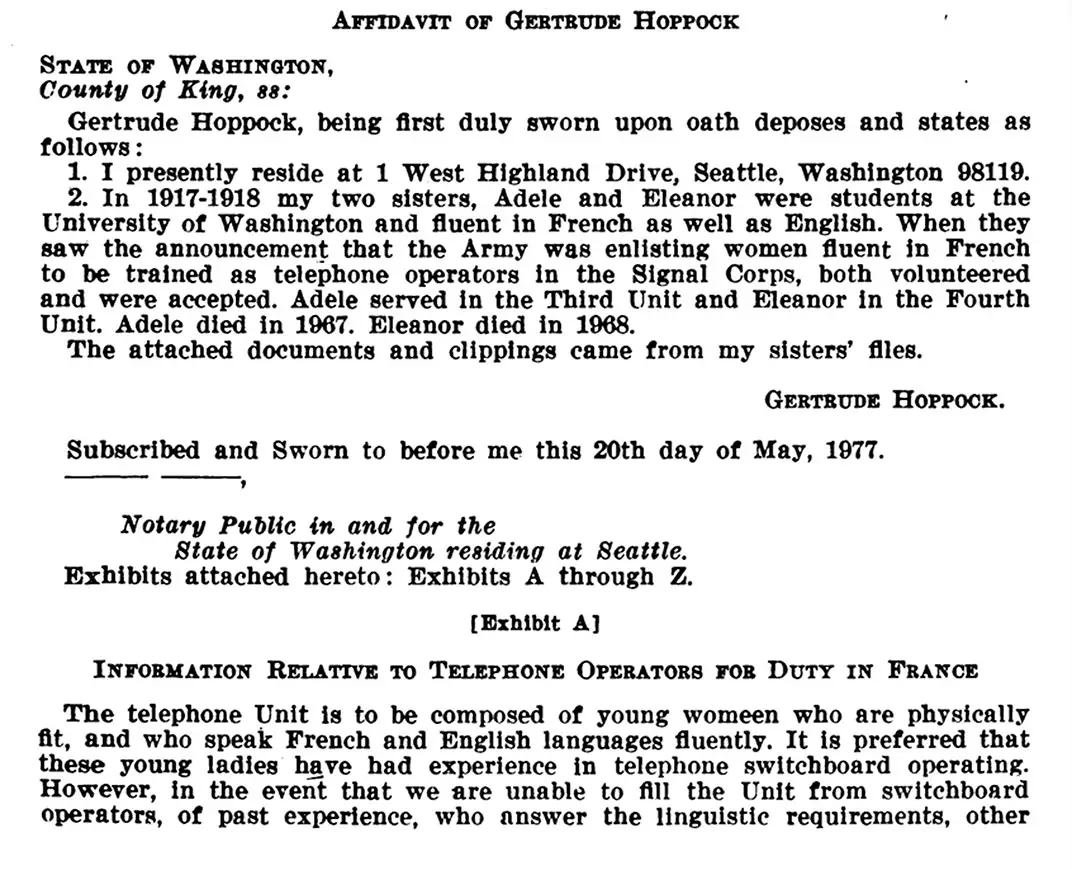
Affidavit of Gertrude Hoppock, Sister of Eleanor and Adele Hoppock, Who Were Part of Units 3 and 4 of the US Army Signal Corps Telephone Operators. Gertrude Provided Testimony With Exhibits From Her Sisters’ Papers Because Both Were Deceased. | GGA Image ID # 236c1eac01. Click to View a Larger Image.
Exhibits attached hereto: Exhibits A through Z.
Introduction & Context
[Exhibit A]: Information Relative to Telephone Operators for Duty in France
Documents & Reference Materials
[Exhibit B]: Application for Membership in Telephone Unit in France - 1918
[Exhibit H]: Commendation of Signal Corps Operators from Pershing - 1918
[Exhibit J]: Extract from Army Commander’s Report of First Army Operations - 1919
[Exhibit K]: Extract from Special Orders No. 2241 - 1919
[Exhibit L]: Extract from Special Orders No. 231 - 1919
[Exhibit M]: Termination of Services - Adele Louis Hoppock - 1919
[Exhibit U]: American Legion Membership Card for Adele Louise (Hoppock) Mills - 1920
[Exhibit V]: Signal Corps Veterans Association Membership Card - 1919
[Exhibit W]: Signal Corps Telephone Operator Request Soldiers Bonus by State of Washington - 1920
Recognition, Legal Status & Legacy
[Exhibit T]: Special Bulletin from the American Legion Post in Seattle - 1920
Press, Public Perception & Cultural Impact
[Exhibit AA (Part 2)]: Telephone Operators Welcomed to Paris - 1918
Personal Stories & Voices
[Exhibit C]: Memo from Capt. E. J. Wesson, US Army - 1918
[Exhibit D]: Memo from Capt. E. J. Wesson, U.S. Army - 1918
[Exhibit E]: Telegram]: Miss Adele Louis Hoppock from Squire - 1918
[Exhibit F]: Telegram]: Adele Louise Hoppock from Squier - 1918
[Exhibit G]: Telegram - Eleanor Hoppock from Squier - 1918
[Exhibit N]: Letter from "Hello Girl" Miss Adele Hoppock - 1918
[Exhibit R]: Wears Uniform of U.S. Signal Corps - 1918
[Exhibit X]: Letter from Major Roy H. Coles to Adele L. Hoppock - 1921
[Exhibit Y]: Letter from Major Coles to Washington State Bonus Board - 1921
[Exhibit Z]: Letter from Adele Hoppock Mills to Senator Vandenburg - 1935
Signal Corps Telephone Operator Units (WWI)
[Exhibit AA (Part 1)]: Seventh Unit of Telephone Operators Demobilizes - 1918
A Good Record
Enlistment for the Signal Corps Telephone Operators’ Unit closed on April 15, 1918. In the five months during which applications were taken, 227 appointments were made throughout the country. Of this number, sixty-nine, or more than 30 per cent, were from the Pacific Coast and were selected and trained for the service by our Company. In the number of appointments by states, New York ranked first with California and Massachusetts tied for second place.
Some idea of the amount of work involved in selecting and training these operators will be obtained from the following figures :
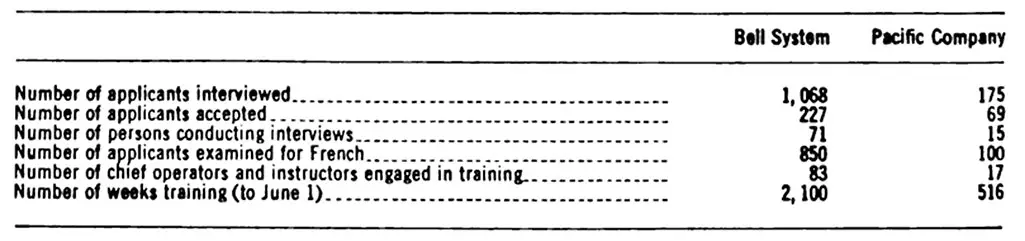
Bell System and the Pacific Company, Table of Number of Applicants Interviewed, Applicants Accepted, Persons Conducting Interviews, Applications Examined for French, Chief Operators and Instructors Engaged in Training, and Number of Week Training. Recognition of VA Benefits, 1977. | GGA Image ID # 19a7d4ee43. Click to View a Larger Image.
The operators selected by this Company have been trained in five groups of eight, thirteen, fourteen, twenty, and fourteen, respectively. All of the groups have been sent East and with the exception of the last, are now in France, operating the telephone lines of the American Expeditionary Forces. Photographs of the first three groups of Pacific Company operators have already been published in earlier issues of this Magazine. The frontispiece in this number is a photograph of the fourth group of Pacific Company operators.
[✨ Most Engaging Content]
- The sister’s voice: Gertrude’s plainspoken affidavit humanizes the legal record—two college seniors at UW with bilingual skills answer Pershing’s call and ship out in regulation Signal Corps uniform.
- Exhibit web: The page links out to recruitment circulars, unit photos, orders, and discharge items that collectively prove military control and conditions of service.
- Unit identity: Adele in Unit 3 and Eleanor in Unit 4 anchors the personal story to the broader AEF telephone network and timeline.
[🖼️ Noteworthy Image]
- Unit 3 departure panel (1918): Contemporary press montage signaling the scale and pace of early deployments.
- Unit 4 rooftop portrait (195 Broadway, NYC): Clear identification of fourth-unit operators (including Eleanor Hoppock) just before embarkation.
- Affidavit scan (1977): A legal snapshot from the Senate hearing record that re-surfaced the operators’ status question.
[📘 Mini Dictionary for Civilians (if Needed)]
- Affidavit: A sworn written statement used as legal evidence.
- Signal Corps: U.S. Army branch responsible for communications (telephone, telegraph, radio) in wartime.
- AEF (American Expeditionary Forces): U.S. forces deployed to Europe in World War I.
- Special Orders: Formal Army directives assigning duties, transfers, or status changes.
[🎓 Essay Prompts for Students]
- How do affidavits like Gertrude Hoppock’s transform personal memory into actionable historical evidence?
- Using the linked “Exhibits,” reconstruct Adele and Eleanor Hoppock’s likely training-to-deployment pathway—what does each document add?
- Discuss how the Hello Girls’ uniforms and orders intersect with international law and the Army’s postwar “civilian” classification.
- Compare the Hoppock affidavit with one operator’s first-person account: where do legal texts and lived experience align or diverge?
[Citation Block (Chicago, APA, MLA + student version)]
Chicago: “Appendix B: Affidavit of Gertrude Hoppock.” In Recognition for Purposes of VA Benefits, Hearing Before the Committee on Veterans’ Affairs, U.S. Senate, 95th Cong., 1st sess., 25 May 1977, pp. 361–380. Washington, DC: U.S. Government Printing Office.
APA: United States Senate. (1977, May 25). Appendix B: Affidavit of Gertrude Hoppock (pp. 361–380). In Recognition for Purposes of VA Benefits. Washington, DC: U.S. Government Printing Office.
MLA: “Appendix B: Affidavit of Gertrude Hoppock.” Recognition for Purposes of VA Benefits, Hearing Before the Committee on Veterans’ Affairs, U.S. Senate, 95th Cong., 1st sess., 25 May 1977, pp. 361–380. U.S. Government Printing Office.
Student: “Affidavit of Gertrude Hoppock (1977),” in U.S. Senate, Recognition for Purposes of VA Benefits, pp. 361–380, via the Gjenvick-Gjønvik Archives (ggarchives.com).
"Appendix B: Affidavit of Gertrude Hoppock, [Sister of Adele and Eleanor Hoppock (Both Deceased)]" in Recognition for Purposes of VA Benefits, Hearing before the Committee on Veterans' Affairs, Unted States Senate, Ninety-Fifth Congress, First Session on S. 247, S. 1414, S. 129, and Related Bills. Washington, DC: US Government Printing Office, 25 May 1977. pp. 361-380
