
Telephone Operators of the AEF -- Roll of Honor - 1919
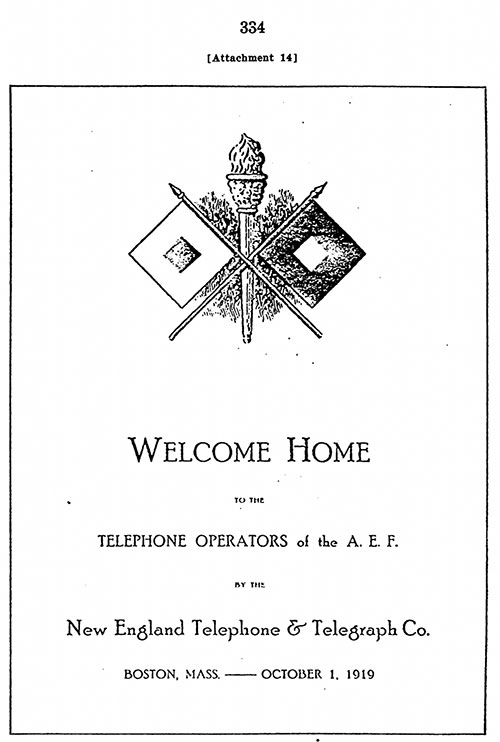
Front Cover, Roster and Program to Welcome Home Telephone Operators of the A. E. F. Associated with the New England Telephone & Telegraph Company of Boston, Massachusetts, 1 October 1919. Recognition for Purposes of VA Benefits, 1977. GGA Image ID # 19a59f10c3
📖 Review & Summary
On October 1, 1919, the New England Telephone & Telegraph Company hosted a formal “Welcome Home” for the U.S. Army Signal Corps telephone operators who trained in its territory and served with the American Expeditionary Forces (AEF). This program booklet (reprinted in the 1977 Senate hearing) preserves a Roll of Honor—a contemporaneous list of operators—along with appreciation notes, a day-of schedule (reception, theater matinée, and dinner), and a tribute poem, “To the Telephone Girl” by Frances A. Johnson.
Beyond ceremony, the booklet explains why the AEF prioritized a robust telephone network and why women operators—already expert in high-volume switchboard work—were the most effective solution. It directly links Bell System training pipelines to wartime communications readiness and recognizes the operators’ service as part of the military record of the war.
Why it matters: The Roll of Honor is a period source that complements later archival rosters. It shows who was celebrated in 1919 and how industry leaders publicly acknowledged these women’s military contributions—an important waypoint on the long path to formal veteran recognition.
Welcome Home to the Telephone Operators of the A.E.F. by the New England Telephone & Telegraph Co. Boston, Mass. — October 1, 1919
Our Roll of Honor
- Melina J. Adam
- I. Eulalie Audette [Eulalie Ida Audet]
- Olive M. Bartlett
- Lillian M. Beebe
- Mary E. Beehan
- Florida Belanger
- Albertine M. Belhumeur [Albertine Anne Marie Belhumer]
- Marie L. Beraud
- Suzanne Beraud
- Christie V. Bickford [Christine Vivian Bickford]
- Harriet Bixby
- Michele F. Blanc
- Beatrice P. Bourneuf
- Emma M. Brousseau
- Estella I. Caron
- Dorothy C. Carr
- Eugenie Couture
- Ruth Coutcrier [Ruth Emma Couturier]
- Jennie M. Crocker
- Jean Cunningham
- Jeanne G. Dandeneau
- Marie A. Dandeneau
- Winifred M. Dwyer
- Mabel B. Ellbey
- Sarah Fairbrother
- Josephine S. Farrell
- Sarah A. Fecteau
- Marie L. Ford
- Mae A. Ganley
- Yvonne Gauthier
- Lydia Gelinas
- Irene Gifford
- Lucy Gingras
- Winifred Hardy
- Irene G. Harrigan
- Helen M. Hayes
- Martha M. Henshaw
- Agnes T. Houley
- Elizabeth G. Hunter
- Ruth Keeping
- Germaine Lamontagne
- Leontine M. Lamoureux
- Rose Langelier
- Evelyn C. La Riviere
- Marie Le Blanc
- Aurelie Lucier
- Germaine F. Lufberry
- A. Maud McMullen
- Abbie E. Mitchell
- Minerva G. Nadeau
- Helen C. Nelson
- Olive L. Oatman
- Eugenie Racicot
- Marie E. Racicot
- Alice Raymond
- Rosanna Raymond
- Minnie R. Richards
- Emma Rindeau
- Florence A. Roberts
- Edith L. Roy [Lena Roy]
- Mary E. Sealey
- M. Olive Shaw
- Annie F. Shuerin [Annie Frances Sheerin]
- Nellie F. Snow
- Mary A. Steele
- Marion C. Swan
- Agnes M. Theriault
- Ida Trahan
- Marie A. Trotier
- Stella M. Viau
- Isabelle Villiers
- Alice Ward
- Anna Wilson
- Elsie L. Wolloff
- Berthe Wuilleumier
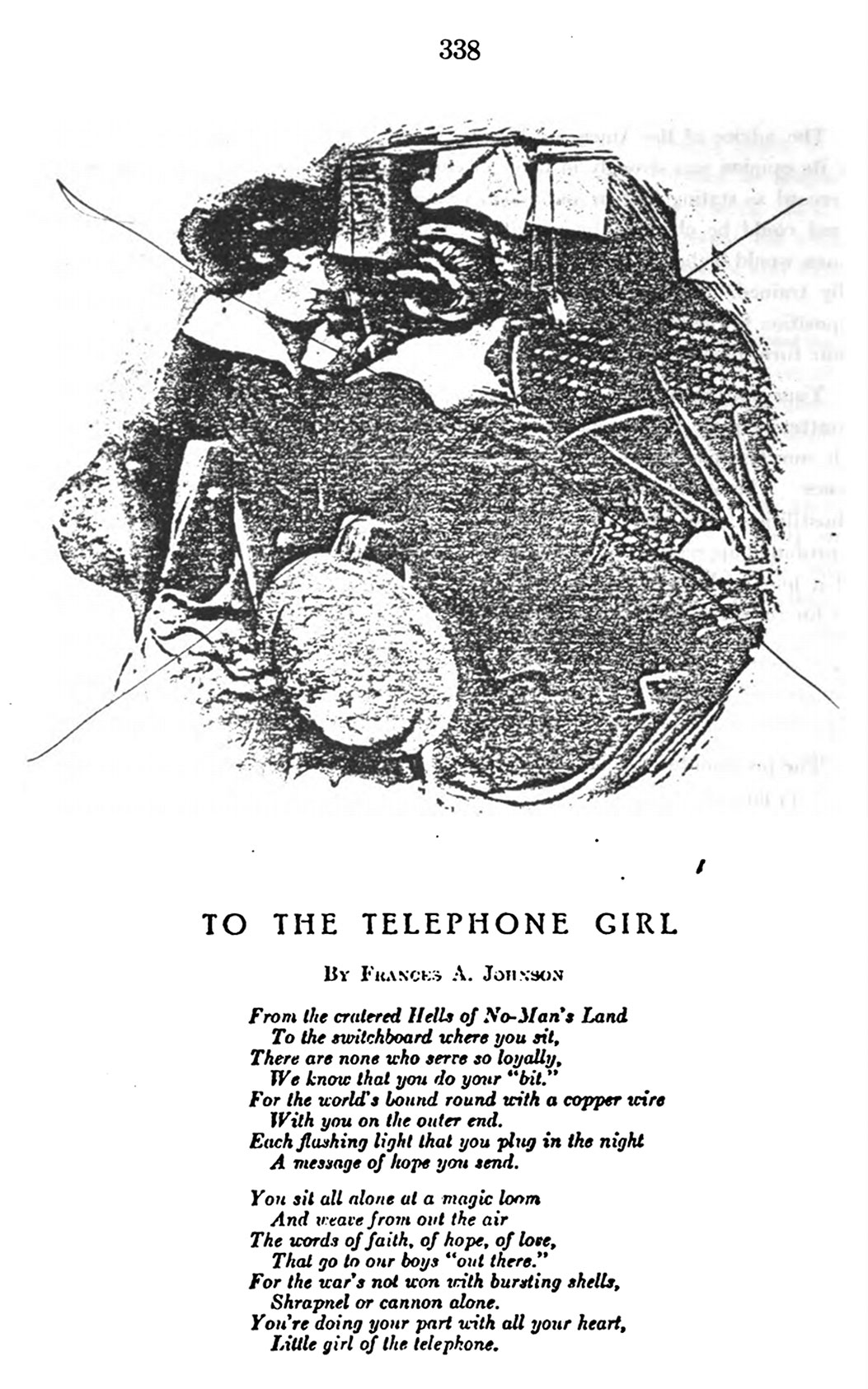
To The Telephone Girl, A Poem by Frances A. Johnson. Recognition for Purposes of VA Benefits, 1977. GGA Image ID # 19a5a19915. Click to View a Larger Image.
TO THE TELEPHONE GIRL
By Frances A. Johnson
From the cratered Hells of No-Mans Land
To the switchboard where you sit,
There are none who serre so loyally.
We know that you do your “bit.”
For the world's bound round with a copper wire
With you on the outer end.
Each flashing light that you plug in the night
A message of hope you send.
Yon sit all alone at a magic loom
And weave from out the air
The words of faith, of hope, of love,
That go to our boys “out there.”
For the war s not won with bursting shells,
Shrapnel or cannon alone.
You're doing yond part with all your heart,
Little girl of the telephone.
Appreciation and Program Notes
The New England Telephone and Telegraph Company welcomes this opportunity to express its appreciation of the patriotic effort of the young women who, trained under its direction, enrolled as telephone operators for service with the American Expeditionary Forces.
It is not necessary to review in detail what was done by them, or to repeat the various testimonials of efficiency presented by, all branches of the American and French armies. It stands as a part of the military history of the war.
The New England contingent was not only trained in telephone operating by the New England Telephone and Telegraph Company, but its members were probably influenced, in some degree at least, by the representations of this Company as to the need of this special service abroad and the patriotic value of volunteer enrollment for it.
One of the first things our American army abroad had to develop was an adequate system of communications. With such a system, the army’s effectiveness was tremendously increased.
Without it, it was difficult, if not practically impossible, to coordinate the various units into an effective fighting force. The telephone dominated all other methods of communication.
Upon it the army chiefs placed their principal reliance not only for service in the lines of communication areas, but also for front line service.
The telephone system, therefore, had to keep pace with the movements of the various army divisions, and in some cases, had to proceed with the advance guard in order to be able to do its full share.
This meant that the American army liad to build up an American telephone system reaching to all parts of France and coordinating with the French and British systems.
The first task was to build this system; the second, to operate it. At first the matter of operation was regarded as a man’s job. This meant that it would take time to train the special force desired and that such a special force would lessen by so much the fighting strength of the army.
Then came the suggestion, at first tentatively and then with growing assurance, that perhaps the operating of these lines might be considered a woman’s job and one for which she would be belter qualified than a man.
The advice of the American Telephone and Telegraph Company wan asked and its opinion was strongly in favor of enrolling women for this work.
It went on record as stating that in its opinion whatever number of women might be required could be obtained by voluntary enrollment and that the work of these women would be better than that of any group of men who would have to be specially trained.
The American Telephone and Telegraph Company presented the proposition to the various companies constituting the so-called Bell family, and we, in our turn, presented it to you.
Your patriotic assumption of this obligation needs no characterization. It is a matter of pride that seventy-five women were enrolled and trained for service with our Company, and that fifty-two actually crossed the ocean and served in France.
The others would have gone, and more if needed, but for the termination of hostilities. Now that all are back home again, this Company desires to express its profound appreciation.
It shares with you the pride of successful achievement and it joins with the rest of the country in expressing to you the country's obligation for the service you rendered in time of need.
The program for October 1 is as follows:
- 11:00 am: Reception, 50 Oliver Street, Boston
- 2:00 pm: Matinee Party, Colonial Theatre, "Hitchy-Koo"
- 7:00 pm: Dinner, Copley-Plaza Hotel
Committee of Arrangements
- Nellie F. Snow
- Elizabeth G. Hunter
- Mary E. Sealey
- Minerva G. Nadeau
- Marion C. Swan
- Estella I. Caron
- Helen M. Hayes
- I. Eulalie Audette
✨ Most Engaging Content
- Roll of Honor as a primary source: A 1919, in-the-moment list of operators honored by name.
- From factory to front line: Clear, readable explanation of why the AEF chose women operators and how Bell training translated into battlefield efficiency.
- The human side of demobilization: A three-part homecoming (reception, matinée, dinner) that personalizes service and sacrifice.
- Poetic tribute: “To the Telephone Girl” reframes switchboard work as frontline support, turning lights on a board into “messages of hope.”
🖼️ Noteworthy Image(s)
- Program Front Cover (1919): The official New England T&T booklet welcoming home the AEF operators—visual proof of public, corporate recognition.
- “To the Telephone Girl” (Facsimile): A period poem that captures contemporary sentiment about the operators’ wartime role.
📘 Mini Dictionary for Civilians
- AEF (American Expeditionary Forces): U.S. armed forces deployed to Europe in World War I.
- Bell System: AT&T and its regional operating companies that trained many U.S. telephone operators.
- Switchboard / “Plugging”: Manual connection of calls by inserting cords into jacks; the core skill of WWI operators.
- Lines of communication: Rear-area networks (telephones, roads, rails) that kept the army coordinated.
- Matinée: An afternoon theater performance—common in welcome-home celebrations of the era.
🎓 Essay Prompts for Students
- How does the 1919 Roll of Honor shape our understanding of the Hello Girls’ service differently than later archival rosters?
- Analyze the New England T&T statement: what does it reveal about private industry’s role in wartime mobilization?
- Close-read “To the Telephone Girl.” How does the poem transform technical labor into wartime heroism?
- Assess the program’s reception–matinée–dinner format as public memory-making. What messages did it send about women’s service?
- Compare this 1919 recognition to the operators’ delayed veteran status. What changed—and what didn’t—in the decades after WWI?
🪶 Citation Block
Chicago: “[Attachment 14] Welcome Home to the Telephone Operators of the A.E.F. (New England Telephone & Telegraph Co., Boston, October 1, 1919),” in Recognition for Purposes of VA Benefits, Hearing Before the Committee on Veterans’ Affairs, U.S. Senate, 95th Cong., 1st sess. (Washington, DC: U.S. Government Printing Office, May 25, 1977), pp. 334–338.
APA: United States Senate. (1977, May 25). [Attachment 14] Welcome Home to the Telephone Operators of the A.E.F. (New England Telephone & Telegraph Co., October 1, 1919). In Recognition for Purposes of VA Benefits (pp. 334–338). Washington, DC: U.S. Government Printing Office.
MLA: “[Attachment 14] Welcome Home to the Telephone Operators of the A.E.F. (New England Telephone & Telegraph Co., Oct. 1, 1919).” Recognition for Purposes of VA Benefits. Hearing Before the Committee on Veterans’ Affairs, U.S. Senate, 95th Cong., 1st sess., U.S. Government Printing Office, 25 May 1977, pp. 334–338.
Student Citation: “[Attachment 14] Welcome Home to the Telephone Operators of the A.E.F. (1919),” in U.S. Senate Hearing Recognition for Purposes of VA Benefits (1977), pp. 334–338. GG Archives reproduction: ggarchives.com.
[Attachment 14] Welcome Home to the Telephone Operators of the A. E. F. by the New England Telephone & Telegraph Co., Boston, Massachusetts, 1 October 1919, in Hearing before the Committee on Venteran's Affairs, United States Senate, Ninety-Fifth Congress, First Session on S. 247, S. 1414, S. 129, and Related Bills, Washington DC: US Government Print Office, 25 May 1977, pp. 334-338.
