
Information Relative to Telephone Operators for Duty in France - 1918
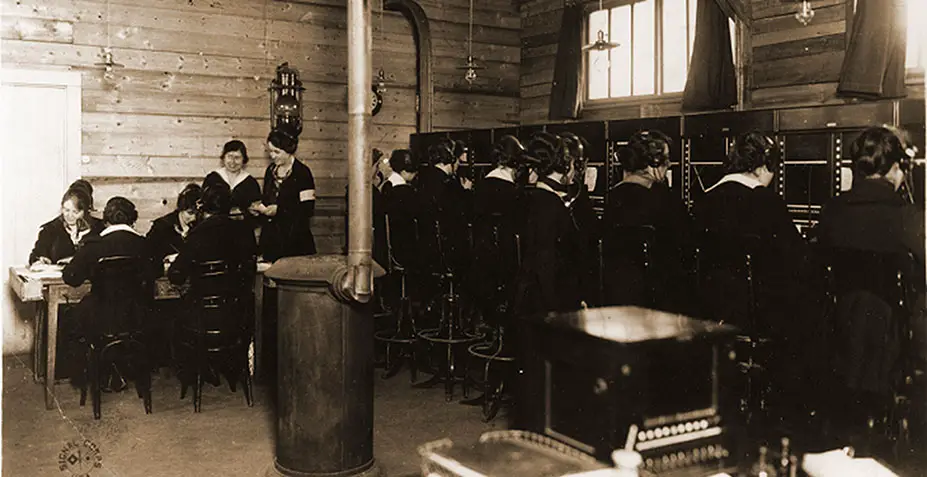
American Girls Serving in the Army Signal Corps as Telephone Operators in France, Colloquially Known as "Hello Girls." Signal Corps Colors Adorn Hats of these New Bilingual Wire Experts. Their Insignia, Too, Are Real and Terrifyingly Complicated. Armbands Indicate the Rank. an Operator, First Class, Wears a White Brassard with a Blue Outline Design of a Telephone Mouthpiece. A Supervisor, Who Rates with a Platoon Sergeant, Wears the Same Emblem with a Wreath around It. The Chief Operator or "top," Has a Wreath, a Mouthpiece, and Blue Lightning Flashes Shooting out above the Receiver—which Is Most Appropriate for a Top. But the Top Says Those Jove-like Lightning Flashes Don't Mean Anything in Particular. To Be Sure, She Will Insist on Discipline, If It's Required, but Thus Far, She Hasn't Had Any Occasion to Let Loose Thunderbolts at the Heads of Her Charges. No, the Girls Will Not Have the First Call at 6:15 and Reveille at 6:30, the Way the Doughboys Do. | GGA Image ID # 1993c5e5c6. Click to View a Larger Image.
📖 Review & Summary
This 1918 notice outlines who could join the U.S. Army Signal Corps telephone operating unit for duty in France and how selection worked. Candidates had to be physically fit, fluent in both French and English, and preferably experienced switchboard operators (with training provided if bilingual candidates lacked prior operating experience).
The document sets pay grades (from $50 for substitutes to $125 for chief operators), specifies rations and quarters comparable to Army nurses, and details transportation and travel entitlements from home to Washington and onward overseas. It also describes a proposed uniform—including campaign hat with Signal Corps hat cord—and emphasizes strict language proficiency, with rejection for misrepresentation. The instructions conclude with reporting, training, and orders procedures, signed by 1st Lt. E. J. Wesson, Signal Corps, U.S.R.
The telephone Unit is to be composed of young women who are physically fit, and who speak French and English languages fluently. It is preferred that these young ladies have had experience in telephone switchboard operating.
However, in the event that we are unable to fill the Unit from switchboard operators, of past experience, who answer the linguistic requirements, other who can speak both languages will be taught at certain points in the United States to operate the telephone switchboard.
No information can be given as to the locality in which this Unit will be stationed other than that it will be placed on duty abroad.
The Unit will be divided into different grades, with salaries as follows: Chief Operators—$125.00; Supervisors—$72.00; Toll Operators—$60.00 Local Operators—$60.00 ; Substitutes—$50.00.
In addition to the pay set forth herein, they will receive rations and quarters as accorded Army nurses. This allowance is ample, and on expenditure on the part of the persons forming this Unit should ordinarily be necessary in this connection.
Transportation will be furnished those selected, from their homes to Washington, and of course from Washington to what other point they are sent.
The uniform will be made of Olive Drab material, the same as that worn by officers and enlisted men of the United States Army. The uniform will consist of campaign hat, with Signal Corps hat cord, long Olive Drab cape, medium length coat, with of course, the necessary modifications, on the same general line as the present army service coat with English walking skirt and tan shoes.
The above uniform has been proposed, but has not been officially accepted. However, it is thought that it will be accepted, with a few minor changes. This will be the only unit composed of women Which will actually wear Army insignia.
This Unit will be very similar to the British Women’s Auxiliary Corps, the Signal Branch of which has gained considerable fame in France.
Instructions
Should your applications meet with approval of this office, you will be sent a blank form which should be filled out and signed by the parties concerned and returned immediately to this office.
The information given on this form will be carefully considered in connection with others received, and final selection of members to form the Unit will be made from these forms.
Those selected will be furnished with further information as to the probable date that they will be required to report in Washington, and if necessary, they will be given a letter to the person in charge of the nearest telephone school for instruction.
As soon as the person is fully prepared for duty, as indicated by the report from the telephone instructor, transportation requests and travel orders will be furnished the persons concerned.
These transportation requests will be presented to the nearest ticket office, and ticket will be exchanged for same. Travel allowance entitles members to one standard lower berth, in the Pullman car, or one seat in the parlor car. depending on the length of the journey. Persons concerned should see that they get everything that their travel orders may call for.
It should be understood by all concerned that it is absolutely necessary for all to be able to speak both the French and English languages fluently.
Such persons that may come to Washington through misrepresentation of their ability to speak French or English will be rejected from the Unit, unless they have been furnished a statement, from this office, subsequent to the date of this letter, to the contrary.
By direction of the Chief Signal Officer.
E. J. Wesson,
1st Lieutenant, Signal Corps, U.S.R.
✨ Most Engaging Content
- Bilingual requirement: Fluency in French and English was mandatory for overseas duty.
- Pay & allowances: $125 (chief operators), $72 (supervisors), $60 (toll/local), $50 (substitutes) plus rations and quarters like Army nurses.
- Travel benefits: Government transport with a standard lower Pullman berth or a parlor car seat when appropriate.
- Uniform details: Olive drab ensemble with Signal Corps hat cord; one of few women's units described as wearing Army insignia.
- Clear process: Application screening, language verification, training orders, then travel and deployment.
🖼️ Noteworthy Image(s)
- Hero image: "American Girls Serving in the Army Signal Corps as Telephone Operators in France" (c. 1918) — already displayed above.
- Document scan (if available): Pages reproducing "[Exhibit A] Information Relative to Telephone Operators for Duty in France" for students to verify salaries, travel allowances, and uniform details.
📘 Mini Dictionary for Civilians
- Brassard
- An armband worn on the sleeve to indicate role or rank.
- Toll operator
- Long‑distance switchboard operator (as opposed to local calls).
- Cantonment
- A military training camp or station.
- Rations and quarters
- Food and lodging provided by the Army.
- Pullman (standard lower berth)
- A sleeping berth on long‑distance trains; "lower" was preferred and costlier.
- Parlor car
- A comfortable, reserved‑seat day coach used on some trains.
- Signal Corps hat cord
- Orange‑and‑white cord distinguishing Signal Corps personnel.
- U.S.R.
- United States Army Reserve (designation used in WWI documentation).
🎓 Essay Prompts for Students
- Why was bilingual fluency essential for Signal Corps operators in France? Use examples from the notice.
- Compare the pay, rations, and quarters described here with other wartime roles for women (e.g., nurses). What does this suggest about priorities?
- How do the travel and uniform details reveal the Army's approach to logistics, discipline, and identity?
- Is this document best used as a primary source (1918 instructions) or in the form reproduced in later hearings? Explain your reasoning.
🪶 Citation Block
Chicago: "Information Relative to Telephone Operators for Duty in France (1918)." Gjenvick-Gjønvik Archives. https://www.ggarchives.com/MIL/HelloGirls/Intro/InformationRelativeToTelephoneOperatorsForDutyInFrance-1918.html (accessed October 2025).
APA: Gjenvick-Gjønvik Archives. (1918). Information Relative to Telephone Operators for Duty in France. Retrieved from https://www.ggarchives.com/MIL/HelloGirls/Intro/InformationRelativeToTelephoneOperatorsForDutyInFrance-1918.html
MLA: "Information Relative to Telephone Operators for Duty in France (1918)." Gjenvick-Gjønvik Archives, https://www.ggarchives.com/MIL/HelloGirls/Intro/InformationRelativeToTelephoneOperatorsForDutyInFrance-1918.html. Accessed Oct 2025.
Student Citation: "Information Relative to Telephone Operators for Duty in France (1918)." GG Archives. Available at: https://www.ggarchives.com/MIL/HelloGirls/Intro/InformationRelativeToTelephoneOperatorsForDutyInFrance-1918.html
"[Exhibit A] Information Relative to Telephone Operators for Duty in France," in Hearing before the Committee on Venteran's Affairs, United States Senate, Ninety-Fifth Congress, First Session on S. 247, S. 1414, S. 129, and Related Bills, Washington DC: US Government Print Office, 25 May 1977, pp. 361-362
