
JAG Decides Women Telephone Operators are Civilian Clerks - 1918
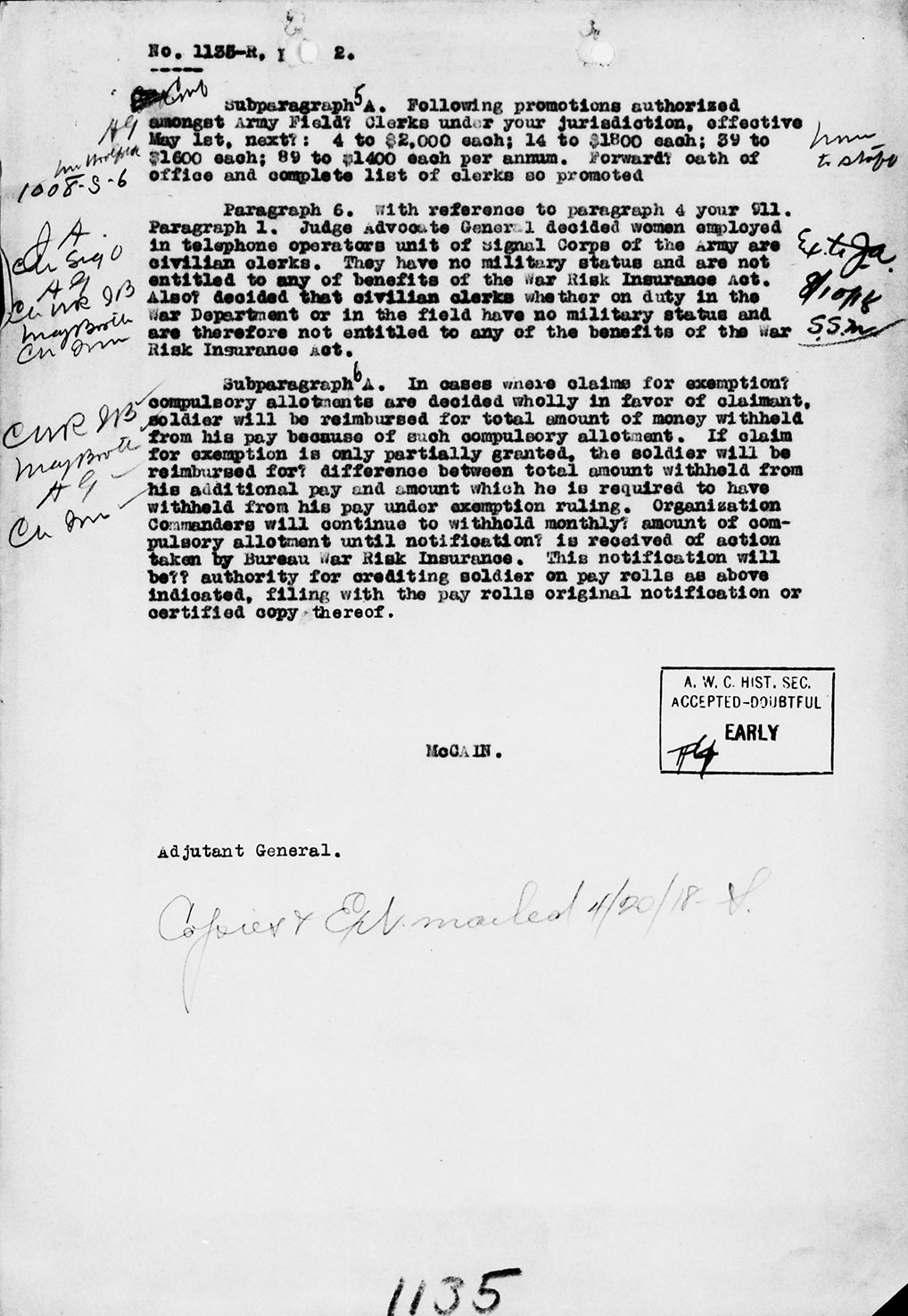
Judge Advocate General Decides Women Telephone Operators (Hello Girls) are Civilian Clerks. Part 2 of 2, Paragraph 6, Cable Number 1135, General Headquarters, A.E.F., 20 April 1918. NAID: 209264345 Textual Records. Part of Record Group 120: Records of the American Expeditionary Forces (World War I) Series: Cablegrams from General John J. Pershing to the Adjutant General. National Archives and Records Administration. | GGA Image ID # 237f65debb. Click to View a Larger Image.
📖 Review & Summary
What this document is: A General Headquarters (GHQ) cable dated (Cable No. 1135-R) reporting the Judge Advocate General's (JAG) legal decision that the U.S. Army Signal Corps' women telephone operators were "civilian clerks," had no military status, and were not entitled to benefits under the War Risk Insurance Act. (Primary text visible on the image; NAID: 209264345.)
What it meant in 1918: The ruling immediately shaped pay, benefits, and protections: operators could not access War Risk Insurance designed for officers and enlisted personnel, even though they wore uniforms and had taken the Army oath.
Legal backdrop: The Army had no statutory authority to enlist women in 1918 (unlike the Navy's Yeoman (F) program), which guided JAG's determination that operators served by contract rather than by enlistment—hence outside the scope of statutory benefits for "officers and enlisted men."
Long-term outcome: After decades of advocacy, Congress in recognized the operators as veterans (GI Bill Improvement Act, resulting in discharges and VA benefits). In , the U.S. Senate passed the "Hello Girls Congressional Gold Medal Act" to honor their service.
Editor's note: The cable accurately cites the Judge Advocate General (JAG) as the decision-maker. The Adjutant General's Office transmitted the decision administratively.
Transcript of Paragraph 6, Cable No. 1135-R
Paragraph 6. With reference to paragraph 4 your 911 Paragraph 1. Judge Advocate General decided women employed in telephone operators unit of signal Corps of the Army are civilian clerks. They have no military status and are not entitled to any of benefits of the War Risk Insurance Act. Also decided that civilian clerks whether on duty in the War Department or in the field have no military status and are therefore not entitled to any of the benefits of the War Risk Insurence act.
📖 Special Research Findings
A) Ramifications of the JAG Decision (1918)
- War Risk Insurance: The decision explicitly denied eligibility under the War Risk Insurance Act, which was built for members of the military and naval forces (officers/enlisted). As civilian clerks, operators could not purchase or receive that government insurance/compensation framework.
- Military status & pay: Without military status, the operators lacked honorable discharges, service records as soldiers, and access to soldier-specific allowances then in effect; their status affected postwar recognition and benefits until 1977.
- "Soldiers' bonus" (Adjusted Compensation): Federal adjusted compensation (Adjusted Service Certificates, 1924) was for veterans of military service. As civilians in 1918, operators were not eligible for those certificates until later recognition as veterans.
- Medals & honors: Contemporary accounts note refusals of Victory Medals and similar recognition prior to veteran status; recognition followed only after the 1977 change.
B) Likely Treatment if Captured by Germany (1918)
International law (Hague Convention IV, 18 October 1907) provided that persons who accompany the armed forces without directly belonging to it—for example contractors and similar personnel—are entitled to prisoner-of-war (POW) status if captured, provided they carry authorization from the army they accompany. U.S. doctrine in the War Department's Rules of Land Warfare incorporated the same principle. In practice, an authorized operator captured near the front would likely be interned as a POW until war's end, rather than tried as a spy—especially if in uniform and properly identified. :contentReference[oaicite:7]{index=7}
If operating out of uniform or without authorization documents in a tactical area, a civilian could face greater risk (detention as a security threat or, in extreme circumstances, charges of espionage). Broadly, WWI belligerents also interned civilians; the ICRC has documented extensive civilian internment regimes during the conflict. :contentReference[oaicite:8]{index=8}
C) Who Made the Decision & Why?
The decision came from the Judge Advocate General's Office (then headed by Maj. Gen. Enoch H. Crowder). The core legal reasoning relied on existing Army statutes and regulations—which did not authorize enlistment of women outside the Nurse Corps—and on the War Risk Insurance framework geared to officers and enlisted personnel. The JAG therefore classified the operators as civilian clerks serving by contract. Congress later considered, but did not adopt, a 1918 House provision to extend War Risk Insurance specifically to telephone/telegraph women—its removal by the Senate left the JAG interpretation in place.
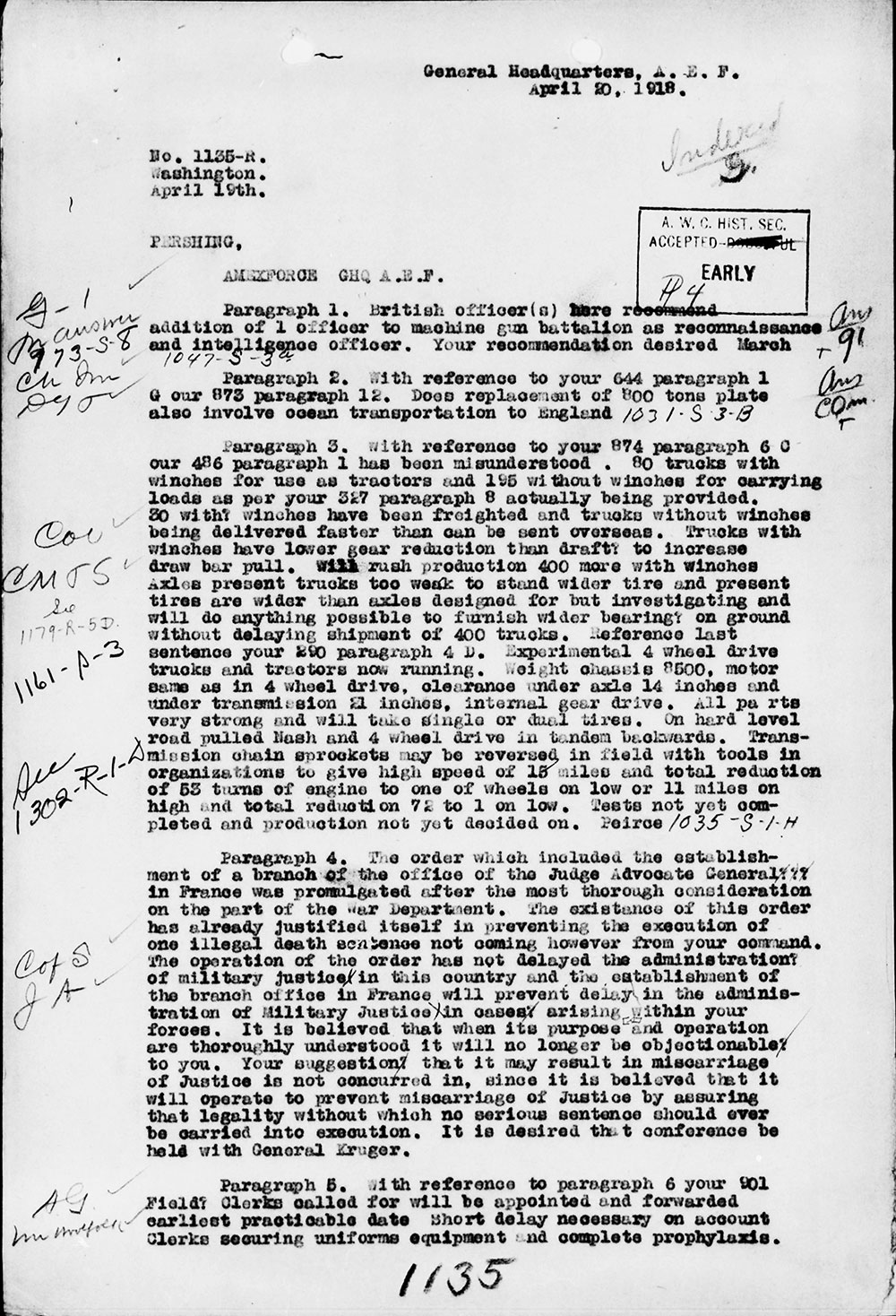
Part 1 of 2, Cable Number 1135, General Headquarters, A.E.F., 20 April 1918. NAID: 209264345 Te xtual Records. Part of Record Group 120: Records of the American Expeditionary Forces (World War I) Series: Cablegrams from General John J. Pershing to the Adjutant General. National Archives and Records Administration. | GGA Image ID # 237f8389c2. Click to View a Larger Image.
✨ Most Engaging Content
"They have no military status and are not entitled to any of benefits of the War Risk Insurance Act." — Cable No. 1135-R, 20 Apr 1918 (JAG decision as relayed via GHQ)
- Uniforms vs. status: Operators drilled, wore uniforms, and took the oath—yet were legally "civilian clerks."
- Navy contrast: Women in the Navy (Yeoman (F)) were enlisted and eligible for benefits; the Army's women operators were not.
- POW protection: With proper authorization, captured operators would have been entitled to POW treatment under the Hague Regulations.
- Aftermath: Veterans' status arrived only in 1977; in 2024 the Senate voted to award a Congressional Gold Medal recognizing the unit.
🖼️ Noteworthy Image(s)
- Hero: Grp120-AdjGenCableToPershing-No1135-R-HelloGirlsStatus-Part2-500.jpg — "JAG decides women telephone operators are civilian clerks," GHQ, 20 Apr 1918. NAID 209264345.
- Companion: Grp120-AdjGenCableToPershing-No1135-R-HelloGirlsStatus-Part1-500.jpg — Cable No. 1135-R, Part 1 of 2. NAID 209264345.
📘 Mini Dictionary for Civilians (if Needed)
- Judge Advocate General (JAG)
- The Army's top legal officer; in 1918, Maj. Gen. Enoch H. Crowder.
- Adjutant General (AG)
- Senior administrative office that issued and received many official cables; it relayed the JAG's legal decisions.
- War Risk Insurance Act (1917)
- Federal program providing insurance/compensation to officers and enlisted in wartime service; not extended to civilian clerks.
- Persons accompanying the armed forces
- Hague law category covering authorized civilians (e.g., contractors) who, if captured, receive POW status.
- Adjusted Service Certificate (1924)
- The federal "bonus" for WWI veterans enacted after the war; eligibility hinged on military service.
🎓 Essay Prompts for Students
- Compare the Army's treatment of the Hello Girls with the Navy's Yeoman (F). How did law and policy shape women's service in 1917–1919?
- Analyze how the Hague Regulations' category of "persons accompanying the armed forces" applied to the Hello Girls, and discuss implications for POW protection.
- Trace the political path from the 1918 JAG decision to the 1977 recognition of veteran status. Which institutions helped or hindered that change?
- Debate whether Congress should have extended War Risk Insurance to the Hello Girls in 1918. What were the strongest arguments for and against?
- Evaluate how legal classifications can diverge from lived experience using the Hello Girls as a case study (uniforms, oath, deployments versus "civilian" status).
🪶 Citation Block (Chicago, APA, MLA + student version)
Primary Source
Chicago: United States Army, American Expeditionary Forces. Cable No. 1135-R, Paragraph 6, General Headquarters, 20 April 1918. Record Group 120, NARA (NAID 209264345). Image: "Grp120-AdjGenCableToPershing-No1135-R-HelloGirlsStatus."
Supporting Sources
APA: International Committee of the Red Cross. (1907). Hague Convention (IV) and Regulations annexed—Art. 13 ("Prisoners of War"). Retrieved from the ICRC IHL database.
APA: War Department. (1917). Rules of Land Warfare (corrected to 1917). Washington, DC: U.S. Government Printing Office.
APA: U.S. Department of Veterans Affairs. (2024, Mar. 6). "Hello Girls" of World War I: Quest for Veteran Recognition.
APA: U.S. Senate. (1924). World War Adjusted Compensation Act (Adjusted Service Certificates). Congressional materials.
APA: TIME. (2019). Not Every Woman Who Served… (on Army/Navy differences; Yeoman (F) received War Risk).
Student (simplified)
Primary: AEF Cable No. 1135-R (Apr. 20, 1918), reporting the JAG's ruling that the Hello Girls were civilian clerks and not eligible for War Risk Insurance (RG 120, NARA; NAID 209264345).
Secondary: ICRC (1907) Hague Regulations Art. 13; War Dept. (1917) Rules of Land Warfare; VA (2024) "Hello Girls" history; U.S. Senate (1924) Adjusted Compensation Act; TIME (2019) on Yeoman (F) benefits.
