
YWCA Dances Relieve Stress For Signal Corps Girls - 1918
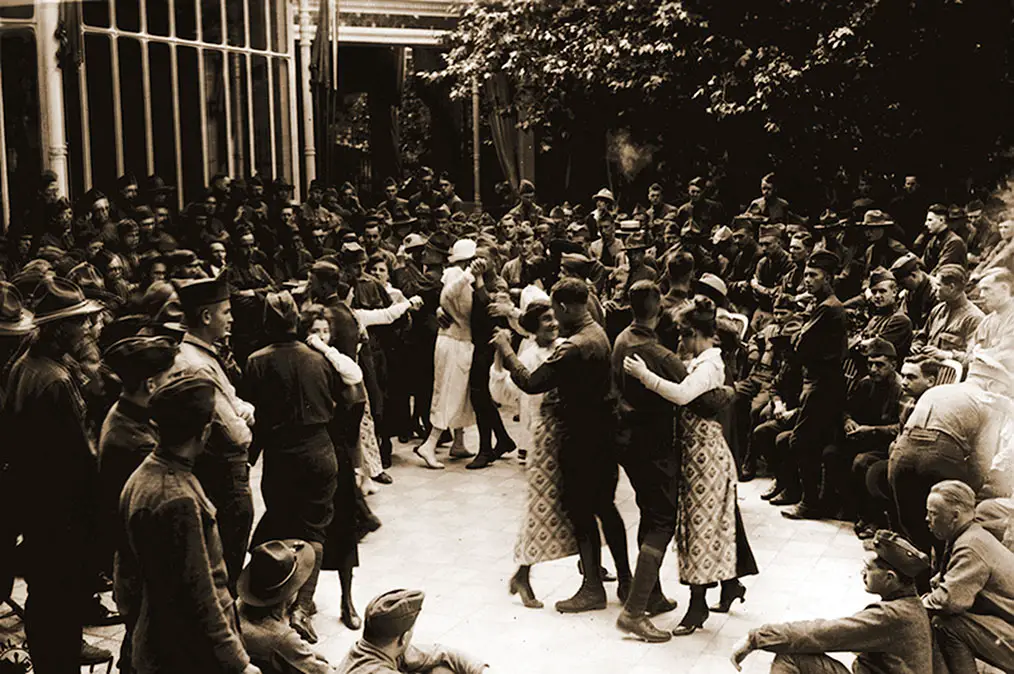
World War 1 Soldiers Dance with YMCA Hostesses, 29 August 1918. National Archives & Records Administration. | GGA Image ID # 19bc83025f. Click to View a Larger Image.
📖 Review & Summary
This 1918 feature highlights a lighter, more human side of wartime service among the U.S. Army Signal Corps telephone operators—the “Hello Girls.” While their daily work demanded precision and endurance, the YWCA found creative ways to lift spirits through music, dancing, and fellowship. These moments of relaxation not only relieved tension but also strengthened morale across the front-line communication network.
At a time when official Signal Corps policy discouraged “parties or frivolity,” the YWCA quietly demonstrated that emotional well-being was as essential to efficiency as discipline. Through simple gatherings under trees, bonfires, and makeshift riverbank dances, the operators—and their soldier counterparts—rediscovered joy amid war’s fatigue. The article also showcases how YWCA and YMCA volunteers extended compassion across cultural lines, welcoming British, French, and American participants alike.
Ultimately, the story illustrates the shared humanity of the Great War’s participants—men and women, soldiers and civilians—reminding readers that victory was sustained not only by courage but also by community.
Touch of Gayety At Roanne Takes Thoughts From War's Horrors.
When the Grand Army of Signal Corps girls were being recruited in New York and throughout the country, one of the warnings given to applicants was that there would be no parties and dances for workers, and "party dresses" were strictly prohibited in packing overseas kits.
Stories of the courage and bravery of these Signal Corps girls have been coming by almost every cable; stories of how these girls worked long hours under unusual strain, and of their loyalty to duty. However, it has only recently become apparent that America has had an inkling of the parties that have afforded recreation and relief from the strain of Signal Corps work, making it possible for the Signal Corps girls to endure the long hours at the switchboard.
The parties were YWCA parties, and despite the "no party" clause in Signal Corps recruiting literature, the recreation proved so beneficial to the workers that Signal Corps authorities highly commended it.
Miss Esther Sleight, of ML Vernon, NY, a YWCA secretary at Roanne, tells of the festivity of some of these parties:
The girls of the Signal Corps often bring their soldier friends, and some of the prettiest parties I have ever attended were hurriedly thrown together in the odd times that these busy girls could spare. We usually had a long table with many candles. The glittering lights through the trees at the other end of the island, with people darting to and fro or dancing on the grass, looked like a fairy scene. After most of the suppers, the crowds gathered on the riverbank and sang old camp songs, made roaring bonfires, and told and sang songs.
"During our French days on the island in August, the W.A.A.C.s came, in significant numbers, and many American soldiers too. One W.A.A.C. came in one day when we were having breakfast under the trees and asked whether it would be possible to bring her brother, who was on leave from the front. She was thrilled to share with him the place that had been her home, and later in the day, her friend came with another Tommy. These four had a regular English tea party, which turned out to be a birthday party for one of the boys.
This 1918 report from The Courier-Journal highlights the YWCA’s morale-boosting efforts for Signal Corps women. Despite early prohibitions on social gatherings, such events were soon recognized as essential to sustaining health and performance among front-line communications staff.
Guests of Many Tongues
There were English, Americans, and French at our parties, and we could not always talk together. One Sunday, I recall a little French refugee girl bringing her violin to our tiny cottage, and we went down to the riverbank where she played for us in a language we could all understand. She shared her sorrows and hopes through the tones of her violin, and the Signal Corps girls all contributed to helping take care of her.
We didn't wait for the boys to come back wounded before we gave them entertainment—Instead, we had partied for them before they went away, and the Signal Corps girls always helped us. We joined with the YMCA women in giving a glorious party for 200 enlisted men who were en route through our island.
A group on crutches came over from the hospital. Some of the soldiers brought their band Instruments, and we had gay music. There were candles on the piano, and a bonfire over by the river where one of our YWCA secretaries successfully made a batch of doughnuts over an open fire.
✨ Most Engaging Content
The most memorable passages describe Miss Esther Sleight’s accounts of twilight gatherings along the riverbank—candles glowing under trees, laughter mingling with violin music, and Signal Corps operators dancing with soldiers before their return to the front. These glimpses of beauty amid hardship capture the resilience of the “Hello Girls” spirit.
Equally engaging is the image of YWCA secretaries making doughnuts over an open fire for recovering soldiers—a symbol of care, simplicity, and normalcy that contrasted sharply with the devastation surrounding them. Such scenes underscore how morale work bridged the emotional gap between home and the front lines.
🖼️ Noteworthy Image(s)
Hero Image: A 1918 photograph of U.S. soldiers dancing with YMCA hostesses illustrates the joyful camaraderie these gatherings fostered. Though informal, such events played a vital role in sustaining morale among both male troops and the women of the Signal Corps, reminding everyone of life beyond duty and danger.
📘 Mini Dictionary for Civilians
- YWCA — Young Women’s Christian Association; provided housing, recreation, and support for women serving in war zones.
- YMCA — Young Men’s Christian Association; organized canteens, entertainment, and welfare programs for soldiers.
- W.A.A.C. — Women’s Army Auxiliary Corps, a British military organization formed during World War I that inspired similar U.S. initiatives.
- Roanne — A French town on the Loire River where U.S. Army Signal Corps and YWCA personnel were stationed.
- Tommy — Informal British term for a common soldier in the British Army.
🎓 Essay Prompts for Students
- Discuss how the YWCA’s approach to recreation helped reduce psychological stress among Signal Corps operators. How did social activities enhance military efficiency?
- Analyze how morale-building efforts like dances and shared meals challenged traditional ideas about women’s behavior in wartime service.
- Compare this article’s depiction of recreation with other wartime welfare efforts by the YMCA, Red Cross, or Salvation Army.
- Consider the symbolism of music and dancing in wartime—what do these acts represent in the broader human experience of conflict?
🪶 Citation Block
Chicago Style: “YWCA Dances Relieve Terrible Strain for Signal Corps Girls.” The Courier-Journal (Louisville, KY), November 24 1918, p. 23.
APA Style: YWCA Dances Relieve Terrible Strain for Signal Corps Girls. (1918, November 24). The Courier-Journal, p. 23.
MLA Style: “YWCA Dances Relieve Terrible Strain for Signal Corps Girls.” The Courier-Journal, 24 Nov. 1918, p. 23.
Student Version: “YWCA Dances Relieve Terrible Strain for Signal Corps Girls” (1918) reveals how music and recreation supported morale among WWI Hello Girls (GG Archives Collection).
"YWCA Dances Relieve Terrible Strain For Signal Corps Girls," in The Courier-Journal, Lousiville, Kentucky, Sunday, 24 November 1918, p. 23.
