
The Adventures of Miss Elizabeth Horsman and Miss Helen Carey - 1918
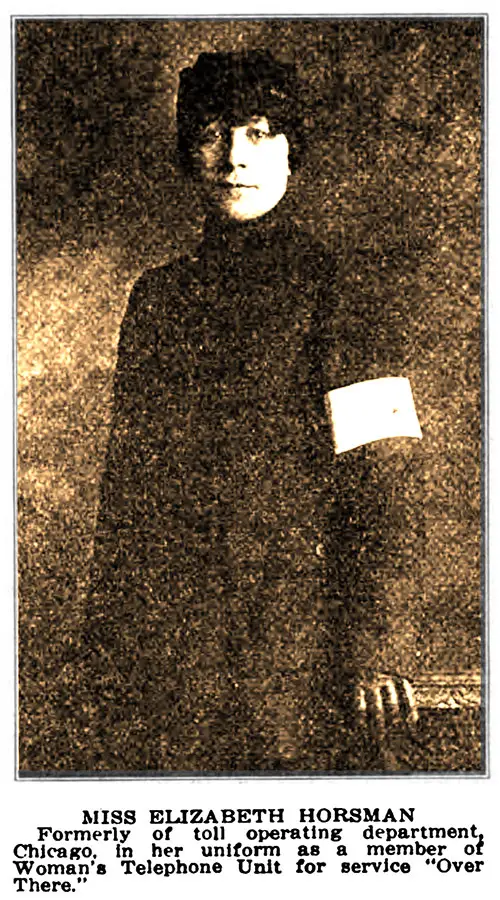
Miss Elizabeth Horsman, Formerly of Toll Operating Department, Chicago, in Her Uniform as a Member of Woman's Telephone Unit for Service "Over There." Bell Telephone News, October 1918. | GGA Image ID # 19a9f0ad1b
📖 Review & Summary
This firsthand account highlights two American women, Miss Elizabeth Horsman and Miss Helen Carey, who served as telephone operators with the U.S. Army Signal Corps during World War I. Drawn from Bell Telephone News (1918), the story captures their enthusiasm, humor, and patriotism while stationed in France and England.
Horsman and Carey represent the “Hello Girls” — young civilian women who volunteered to operate vital military telephone networks linking commanders on the front lines. They were often the first to handle top-secret messages, translating and routing calls in both English and French under stressful conditions. Their cheerful outlook, despite quarantine delays, long hours, and cold rain during inspections, reveals the morale and determination that made the Hello Girls indispensable.
For educators and students, this story illustrates the broader theme of women stepping into military-adjacent service roles during WWI and redefining expectations of patriotism and professionalism. Horsman’s Parisian memories — from seeing President Wilson drive past to experiencing the Armistice celebrations — bring the war’s social and cultural dimensions vividly to life.
"Possibly," said Miss Elizabeth Horsman, of the Chicago toll department," possibly General Sherman was right. Still, war furnished me with the most delightful experience in my life." "Yes," echoed Miss Helen Carey of the same department, "I'm not so particularly impressed with that General's remarks myself anymore.
I think war is perfectly bully in a great many respects!" And why shouldn't she? In July 1918, Miss Carey took the oath of allegiance, went to New York, and sailed away to Liverpool. From there, she moved to France and settled in St. Nazaire, where she remained for eleven months."
And did you have an exciting time?" inquired the awed News reporter respectfully. "Not especially," said Miss Carey. "Of course, it was fun.
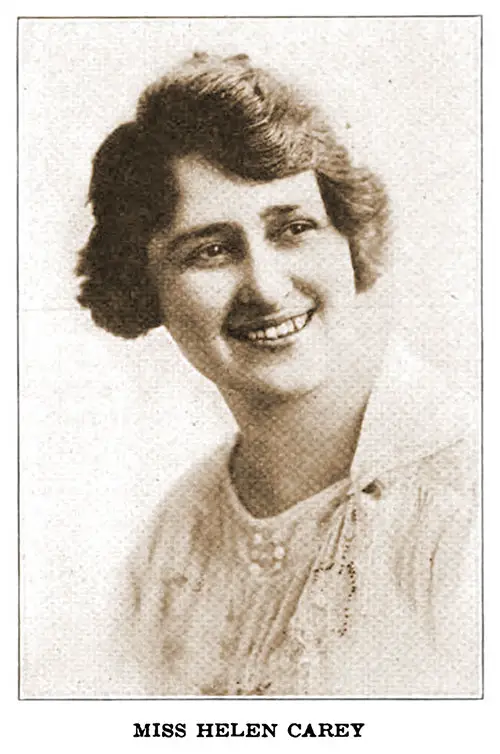
Miss Helen Carey, Signal Corps Telephone Operator. Bell Telephone News, August 1918. | GGA Image ID # 19aa0bcd9e
I helped entertain General Pershing and took leave to visit Paris. Peter Clarke Macfarlane wrote a story about me for the Saturday Evening Post, and I had the opportunity to see all of the battlefronts.
Still, on the whole, my stay in France was tranquil and peaceful." "As was my stay there," Miss Horsman remarked. "True, I was quarantined for three days in England, at Romsey, and that was interesting, but life in Tours, where I was stationed, was not thrilling-- merely lovely and charming.
I thought I would catch a cold the day General Pershing was to inspect my unit. The General was late — he always is, you know—and he kept us standing for over an hour in the rain.
In Paris, where I was stationed for two months, President Wilson lived just around the corner from me, and I would often see him riding about in his automobile.
I was 'simply wild' about Paris—I'm going back someday. On the streets there, the day the armistice was signed, I had my most embarrassing moment. Two Frenchmen recognized my American uniform and kissed me.
I wanted to box their ears, but restrained myself!" Both Miss Horsman and Miss Carey say, and say loudly and emphatically, that the YWCA women overseas were splendid.
Miss Horsman. Miss Carey has been with the Chicago Telephone Company since 1904, and Miss Carey has been with the Company since 1911. In the Chicago Company, there are two other "Overseas Girls," Miss Lydia Erikson and Miss Mabel Lapp.
For the November issue of the BELL TELEPHONE News, every effort will be made to get an expression of their views on France and the work" over there."
✨ Most Engaging Content
The conversational format of the article makes it especially engaging. Readers encounter Horsman and Carey speaking with humor and candor about their experiences, a rare glimpse of personality in wartime reporting. Their remark that “war furnished me with the most delightful experience in my life” captures the optimism and courage that characterized many Hello Girls, even amid uncertainty and hardship.
Another striking moment occurs when Horsman describes being kissed by two jubilant Frenchmen during the Armistice celebrations — a brief, human scene showing both the excitement of peace and the challenges of cultural interaction for women in uniform. Such anecdotes humanize the historical record and open discussion about gender, respect, and national celebration during post-war transitions.
🖼️ Noteworthy Image(s)
- Miss Elizabeth Horsman in Uniform — An early portrait showing the professional military attire adopted by female Signal Corps operators, emphasizing discipline and equality with their male counterparts.
- Miss Helen Carey, Signal Corps Telephone Operator — A formal photograph from Bell Telephone News (August 1918) highlighting the pride these women took in representing American communications abroad.
These portraits document how the U.S. Army presented its first female communications specialists — not as temporary helpers, but as uniformed professionals contributing directly to victory.
📘 Mini Dictionary for Civilians
- Signal Corps — A branch of the U.S. Army responsible for communications, including telegraph, radio, and telephone operations.
- “Over There” — A popular wartime expression referring to Europe, especially France, where American troops served during WWI.
- AEF (American Expeditionary Forces) — The United States armed forces sent to Europe during World War I under General John J. Pershing.
- YWCA — Young Women’s Christian Association, which organized housing, recreation, and support services for women workers and soldiers overseas.
- Armistice — The formal end of hostilities on November 11, 1918, marking victory for the Allies in World War I.
🎓 Essay Prompts for Students
- Women and the War Effort: How did the experiences of Elizabeth Horsman and Helen Carey demonstrate changing opportunities for American women during World War I?
- Voices of Optimism: Why might these women describe war as “delightful” or “perfectly bully”? What does that reveal about morale, perspective, and patriotism?
- Cultural Encounters: Examine Horsman’s story of being kissed by Frenchmen on Armistice Day. What does this moment suggest about gender, respect, and post-war celebration?
- Technology and Gender: Discuss the importance of telephone technology in WWI and how the Hello Girls’ mastery of it challenged traditional ideas of “women’s work.”
- Comparative Research: Compare this account to modern stories of women in the military or communications fields. What progress and parallels can be drawn?
Teachers: These prompts align with curriculum standards in U.S. History, Women’s Studies, and Media & Technology History for grades 8–14.
🪶 Citation Block
Chicago Style:
“Of Interest to Our Girls.” Bell Telephone News (Detroit Edition) 9, no. 3 (October 1918): 12. Reprinted by Gjenvick-Gjønvik Archives. Accessed October 6, 2025. https://www.ggarchives.com/MIL/HelloGirls/Stories/AdventuresOfHorsmanAndCarey-1918.html
APA Style:
Bell Telephone News. (1918, October). Of Interest to Our Girls (Vol. 9, No. 3, p. 12). Detroit, MI: Bell Telephone Company. Reprinted by Gjenvick-Gjønvik Archives (2025). Retrieved from https://www.ggarchives.com/MIL/HelloGirls/Stories/AdventuresOfHorsmanAndCarey-1918.html
MLA Style:
“Of Interest to Our Girls.” Bell Telephone News, vol. 9, no. 3, Oct. 1918, p. 12. Reprinted in Gjenvick-Gjønvik Archives, 2025, https://www.ggarchives.com/MIL/HelloGirls/Stories/AdventuresOfHorsmanAndCarey-1918.html.
Student Citation (Short Form):
“Of Interest to Our Girls,” Bell Telephone News (1918), p. 12, reprinted by GG Archives (https://www.ggarchives.com/MIL/HelloGirls/Stories/AdventuresOfHorsmanAndCarey-1918.html).
“Of Interest to Our Girls,” Bell Telephone News, Detroit Edition, Volume 9, No. 3, October 1919, p.12
