
Chicago Telephone Girls Heroines “Over There” - 1918
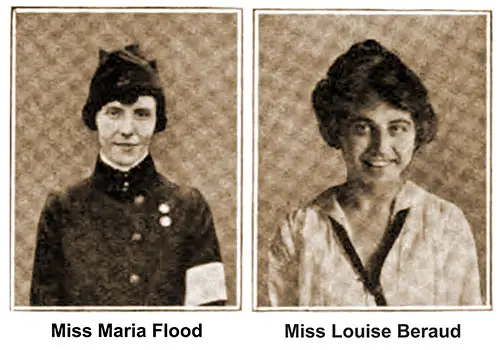
Signal Corps Telephone Operators Miss Maria Flood and Miss Louise Beraud. Bell Telephone News, November 1918. GGA Image ID # 19a69b7e58
📖 Review & Summary
The article “Chicago Telephone Girls Heroines ‘Over There’” from Bell Telephone News (November 1918) captures the bravery of American telephone operators stationed near Verdun during World War I. These women—many trained in Chicago—remained steadfast at their switchboards even as their wooden barracks burned in the Moselle region. Among them were Grace D. Banker, Maria Flood, Louise Beraud, Adele Hoppock, and others whose courage under fire earned admiration from the entire American army.
Their actions exemplify both the dangers and the heroism faced by the U.S. Army Signal Corps telephone operators—known as the “Hello Girls”—who worked under combat conditions to maintain communications for the American Expeditionary Forces. Letters from home reveal not only their professionalism but also their humanity, humor, and patriotism amid destruction.
With the American Army Northwest of Verdun, October 30 (1 p. m.). —American telephone girls on duty here have won the admiration of the whole American army. They remained at their posts in burning wooden barracks in the Moselle region until ordered to quit.
The heroines were Miss Grace D. Banker of Passaic, N. J., chief operator and the first telephone girl to join the American Expeditionary Forces, and Misses Marie Flood, 601 Independence boulevard, Chicago; Louise Beraud of San Antonio, Texas; Adele Hoppock of Seattle, Wash; Helen Hill, also of Seattle; Marie Cooper, Marion Lange, Miss Hunt and Julie Russell of the Y. M. C A., attached to the telephone girl's dormitory.
Misses Cooper, Lang, and Hunt are from San Francisco. Miss Russell is from Detroit, Mich.-—Chicago American.
Miss Flood, who is a niece of Finley Peter Dunne, author of the "Mr. Dooley*' stories, was an operator for the Chicago Telephone Company and the American Telephone and Telegraph Company for about a year before enlisting for overseas service. She lived in Mexico for nine years, speaks Spanish fluently, and was well qualified for service "over there" because of her knowledge of French.
Miss Flood's mother, Mrs. Catherine Flood, stated in a recent telephone conversation that in a letter from her daughter dated October 7th, the opening of the new but ill-fated barracks was described, among other interesting news. Mrs. Flood also says that her daughter is enjoying the work" 'Over There" immensely, and her letters indicate that the American telephone girls are making names for themselves in the great war.
"You ought to see the nice pink and white little 'P.G.V. (German prisoners) we have around cleaning the streets and doing odd jobs," Miss Flood wrote to her sister recently.
"Speaking of P. G.'s and Germans in general, I never realized how much animosity I felt toward them until I laid eyes on the first Boches I had ever seen. It just seems as though there's no end to the hatred it evokes. Paulette calls them 'sales Boches/ meaning 'dirty Germans.' She also calls them pigs. She was in a town invaded by the Germans. She says they killed her little four-year-old sister by injecting some poisoned serum into her."
Miss Flood mentions a recent dance given for the girls by Mrs. John V. Farwell of Chicago, now a Red Cross canteen worker.
Miss Louise Beraud, who is also mentioned in the newspaper dispatch, was a senior at the University of Chicago before enlisting. She was also teaching French and working on settlement projects. When the call came, she volunteered and was trained by the Chicago Telephone Company for service overseas.
✨ Most Engaging Content
The most powerful moment comes from the frontline dispatch describing how the telephone girls stayed at their posts as the barracks caught fire:
“American telephone girls on duty here have won the admiration of the whole American army. They remained at their posts in burning wooden barracks in the Moselle region until ordered to quit.”
This vivid detail symbolizes their extraordinary resolve—women demonstrating the same discipline and valor expected of soldiers on the front lines.
🖼️ Noteworthy Image(s)
Image: Signal Corps Telephone Operators Miss Maria Flood and Miss Louise Beraud. Bell Telephone News, November 1918. | GGA Image ID #19a69b7e58.
Interpretation: This photo embodies the courage and professionalism of America’s first uniformed female military telephone operators—educated, multilingual, and utterly dedicated to their duty under fire.
📘 Mini Dictionary for Civilians
- Signal Corps
- The U.S. Army branch responsible for communications—telegraph, telephone, and radio—during wartime operations.
- “Hello Girls”
- Nickname for the women telephone operators of the U.S. Army Signal Corps who served in France during World War I.
- Moselle Region
- A heavily contested area of northeastern France near the German border where many Signal Corps operators were stationed.
- Barracks
- Military housing for soldiers or support personnel; in this case, wooden structures near combat zones.
- Boches
- A slang term used by Allied soldiers during WWI for German troops; derived from the French insult “sale boche” (“dirty German”).
- AEF
- Abbreviation for the American Expeditionary Forces—the U.S. military contingent serving in Europe under General John J. Pershing.
🎓 Essay Prompts for Students
- How did women like Maria Flood and Grace Banker challenge contemporary gender expectations through their wartime service?
- What can the “Hello Girls” teach modern readers about courage, communication, and leadership under pressure?
- Why do you think these women were not fully recognized as soldiers until decades later, and what does that reveal about postwar America?
- Compare the accounts in this article with later recognition efforts, such as the Hello Girls Congressional Gold Medal Act.
🪶 Citation Block
Chicago: “Chicago Telephone Girls Heroines Over There.” Bell Telephone News (Detroit Edition), Vol. 8, No. 4, November 1918, p. 15.
APA: Chicago Telephone Girls Heroines Over There. (1918, November). Bell Telephone News, 8(4), 15.
MLA: “Chicago Telephone Girls Heroines Over There.” Bell Telephone News, vol. 8, no. 4, Nov. 1918, p. 15.
Student-friendly: “Chicago Telephone Girls Heroines Over There.” Bell Telephone News, November 1918, p. 15. GG Archives, www.ggarchives.com.
“Chicago Telephone Girls Heroines Over There.” In Bell Telephone News, Detroit Edition, Vol. 8, No. 4, November 1918, p. 15.
