
Phone Girls Living High - 1918
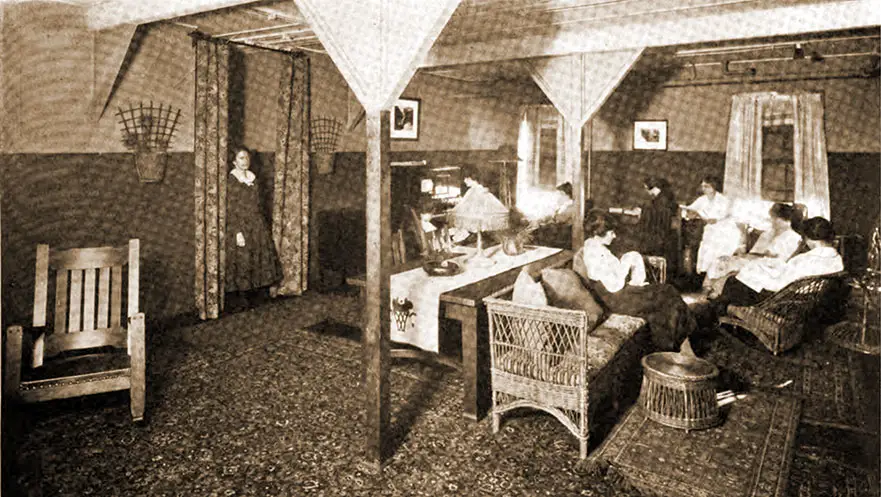
"Won't You Step into My Parlor?" "Off Duty" Girls, Caught by the Camera, Enjoying a Social Hour in the Living Room of Their Home in Camp. The Telephone Review, March 1918. GGA Image ID # 1920c85db5. Click to View a Larger Image.
📖 Review & Summary
The 1918 article “Phone Girls Living High” offers an uplifting glimpse into the daily lives of the U.S. Army Signal Corps women stationed in France during World War I. Written by Sarah Watson, a YWCA “Big Sister” assigned to the unit, the piece highlights the comfort, camaraderie, and resilience of the Hello Girls who were responsible for maintaining the military’s communications lines overseas. Rather than focusing on battlefield peril, this article celebrates their morale, resourcefulness, and the nurturing environment created to sustain these women far from home.
Watson describes living conditions that might surprise modern readers — American telephone operators residing not in barracks or temporary huts, but in elegant French châteaux overlooking scenic rivers. Furnished with fine antiques and supplied with bedding and kitchen essentials by the YWCA, these quarters symbolized the Army’s recognition that the women’s comfort and safety were vital to maintaining reliable service.
The story balances admiration and practicality: these women worked long hours connecting crucial military calls, but their off-duty hours were filled with fellowship, music, and social gatherings. This domestic portrait humanizes the military effort and contrasts sharply with the grim imagery of trench warfare dominating other wartime reporting. It reminds us that victory depended not only on courage at the front but also on efficiency, empathy, and connection behind the lines.
Educational Relevance: The article provides a unique lens into the U.S. military’s evolving approach to gendered service during World War I. It shows how the YWCA, in partnership with the Signal Corps, supported women’s wellbeing and morale, establishing models of welfare work that continued in later conflicts. Teachers and students studying wartime gender roles will find this piece an engaging example of the intersection between civilian aid organizations and the U.S. armed forces.
Unit in France Has Every Luxury.
"Keeping house in France for American 'Hello' girls may be the least romantic work that any American women are doing here, but it is certainly full of variety and most interesting experiences," writes Sarah Watson, a "Big Sister" to the Signal Corps unit with the Y.W.C.A.
In France, according to Miss Watson's letter, which recently was received in this country. Uncle Sara's telephone girls are having the time of their lives. Steaks and chops for their dainty stomachs are not a rarity, as one might expect in this country.
Their living quarters are not in some "ordinary" hotel, but more often in some beautiful chateau on one of France's picturesque rivers.
Miss Watson says the YWCA is responsible for the care of the American telephone girl.
The following description of one of the YWCA homes for the Signal Corps women carries much of the charm of the older French towns.
"Picture to yourself, if you can, one of the oldest, most picturesque towns in France, set on a high hill surrounded by beautiful country, and with far-reaching views, a town of old gray walls, quaint old buildings, and very narrow, wildly twisting streets.
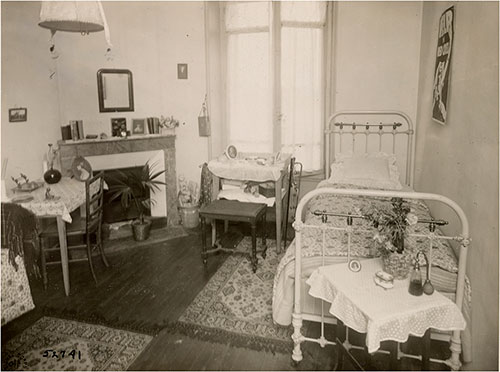
Bedroom in Women's Telephone Operators' Home, Signal Corps, Chaumont, Haute Marne, France. Photograph by Sgt. Abbott, Signal Corps, 19 February 1919. National Archives and Records Administration, 111-SC-52741. NARA ID # 86710687. GGA Image ID # 199af835a8
Imagine yourself walking down one of the narrowest streets until it turns at right angles. At these, situated on the angle, you will find an old gray stone house, where you will most cordially be welcomed by nine Signal Corps girls who are doing the telephone operating in this busy little town, now an important military center.
This quaint old-fashioned house, elaborately furnished inside, has been their home since the end of May 1918. It was already furnished with unusual, fascinating French furniture, and the YWCA added the essentials such as bedding, linen, dishes, etc.
✨ Most Engaging Content
The most captivating aspect of “Phone Girls Living High” lies in Sarah Watson’s vivid description of the contrast between war and domestic tranquility. Amid the destruction that scarred much of France, these women created a miniature home front — complete with furnished salons, social hours, and even the occasional steak dinner. Watson’s tone, light yet deeply appreciative, reframes “service” not as suffering but as purpose-driven independence.
One particularly charming detail is her invitation to “picture to yourself one of the oldest, most picturesque towns in France,” where the operators’ gray stone house sits on a narrow street filled with twisting lanes and old walls. It’s easy to imagine the operators, still in uniform, gathered around a parlor piano or taking tea in the chateau garden between shifts — moments of warmth in a war otherwise remembered for its brutality.
The YWCA’s involvement also stands out as a hallmark of early 20th-century humanitarian work. The organization didn’t merely supervise; it created environments that preserved dignity and fostered community among America’s first female soldiers. That human touch, conveyed through Watson’s gentle humor and eye for detail, makes this article one of the most engaging portraits of the Hello Girls’ overseas experience.
🖼️ Noteworthy Image(s)
“Off Duty” Girls, Caught by the Camera, Enjoying a Social Hour in the Living Room of Their Home in Camp — This heartwarming image, originally published in The Telephone Review (March 1918), captures a relaxed, candid moment among Signal Corps telephone operators during their leisure hours. It serves as a visual counterpoint to the tension of wartime service, showing how friendship, laughter, and domestic rituals sustained morale amid global conflict. The setting resembles a middle-class parlor more than a military barracks, underscoring the YWCA’s success in recreating “home” abroad.
Bedroom in Women’s Telephone Operators’ Home, Chaumont, France — This U.S. Signal Corps photograph from February 1919 (NARA ID #86710687) shows a neatly made bedroom with classic French furnishings — a bed, side table, rug, and lace-curtained window. Such living conditions were atypical of wartime lodging, reflecting how the Army and YWCA sought to maintain cleanliness, order, and comfort for women stationed far from home. The image speaks to the professional pride and human dignity afforded to the Hello Girls — a testament to the respect they earned within the A.E.F.
📘 Mini Dictionary for Civilians (if Needed)
- Signal Corps
- The communications branch of the U.S. Army responsible for telegraphs, telephones, and other wired and wireless communications during World War I.
- Hello Girls
- The nickname for the 223 women of the U.S. Army Signal Corps Telephone Operators Unit who served in France during World War I, operating military switchboards under combat conditions.
- YWCA (Young Women's Christian Association)
- An international organization that provided housing, recreation, and welfare services for women working in wartime, including the Signal Corps telephone operators stationed in France.
- Commissioned Rank Equivalents
- Although officially civilians, the operators were accorded military status in practice: Lieutenant (Junior Grade) for telephone operators, Lieutenant for supervising operators, and Captain for chief operators. Their living arrangements and travel privileges reflected these ranks.
- Château
- A large French country house or estate, often used as billets (living quarters) for American officers and, in this case, for the Signal Corps telephone operators serving overseas.
- Uniform Cost
- Each operator was required to purchase her own uniform, costing approximately $350—an amount equal to six or seven months’ salary for many women at the time. Despite the expense, there are no recorded complaints from the operators, many of whom viewed the cost as an honor and privilege of service.
- Officer-Class Conduct
- The Hello Girls were expected to behave as officers—disciplined, refined, and discreet. Their manners, education, and dedication reinforced the perception of them as members of a new professional class of American women serving abroad.
🎓 Essay Prompts for Students
- 1. Living with Honor Abroad: Discuss how the YWCA’s role in housing the Signal Corps telephone operators reflected the Army’s understanding of these women as officers in all but name. How did their accommodations, uniforms, and conduct redefine what it meant to be a “lady” in wartime?
- 2. The Cost of Service: Consider the financial and personal sacrifices made by the Hello Girls—such as purchasing their own $350 uniforms or accepting pay cuts—to serve in France. What does this reveal about patriotism, class, and gender expectations in early 20th-century America?
- 3. Behind the Lines, Ahead of Their Time: Analyze how the Hello Girls’ professionalism and refinement challenged stereotypes of women’s roles in both civilian and military life. In what ways did their service set precedents for later generations of women in the U.S. Armed Forces?
- 4. A Room of Their Own—at the Front: Explore the psychological importance of the YWCA-maintained “home-like” spaces described in this article. How might comfort, privacy, and community have affected morale and performance among these women working under wartime pressure?
- 5. The Officer Ideal: Compare the responsibilities and expectations of the Hello Girls to those of commissioned male officers during World War I. Should these women have been officially recognized with military rank at the time? Support your answer with evidence from the article and historical context.
🪶 Citation Block (Chicago, APA, MLA + Student Version)
Chicago Style:
“Phone Girls Living High.” Boston Sunday Post, 24 November 1918, p. 2. Reprinted in the Gjenvick-Gjønvik Archives. https://www.ggarchives.com/MIL/HelloGirls/Press/PhoneGirlsLivingHigh-1918.html.
APA Style:
Phone Girls Living High. (1918, November 24). Boston Sunday Post, p. 2. In Gjenvick-Gjønvik Archives. Retrieved from https://www.ggarchives.com/MIL/HelloGirls/Press/PhoneGirlsLivingHigh-1918.html
MLA Style:
“Phone Girls Living High.” Boston Sunday Post, 24 Nov. 1918, p. 2. Gjenvick-Gjønvik Archives, https://www.ggarchives.com/MIL/HelloGirls/Press/PhoneGirlsLivingHigh-1918.html.
Student Citation (Simplified):
“Phone Girls Living High,” Boston Sunday Post, November 24, 1918. Retrieved from GG Archives: https://www.ggarchives.com/MIL/HelloGirls/Press/PhoneGirlsLivingHigh-1918.html.
“Phone Girls Living High” in the Boston Sunday Post, 24 November 1918, p. 2.
