
Hello—Over There! - Our Telephone Girls Take On Paris - 1918
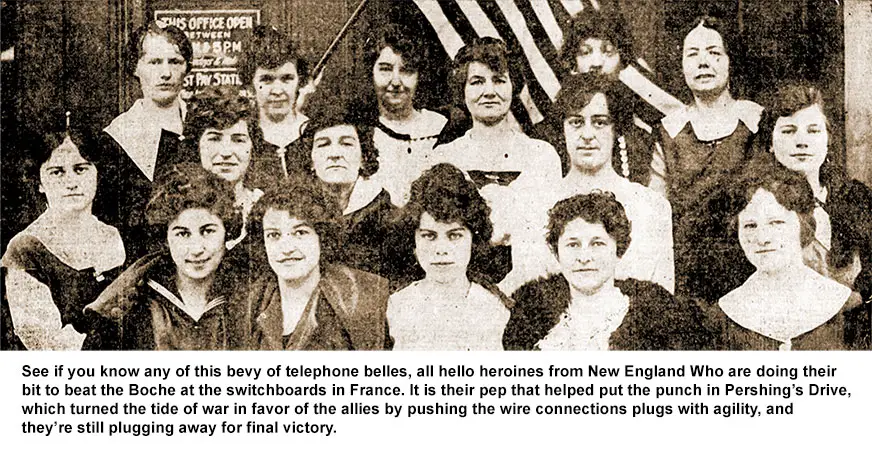
The Telephone Girls of New England “Over There” Have Put Pep Into the Hello Service for General Pershing. Many of the American Girls Work Within Hearing of Bombardments. Caption Above Reads: See if You Know Any of This Bevy of Telephone Belles, All Hello Heroines From New England, Who Are Doing Their Bit to Beat the Boche at the Switchboards in France. It Is Their Pep That Helped Put the Punch in Pershing’s Drive, Which Turned the Tide of War in Favor of the Allies by Pushing the Wire Connections Plugs With Agility, and They’re Still Plugging Away for Final Victory. Boston Sunday Post, 6 October 1918. | GGA Image ID # 19ad53a48c. Click to View a Larger Image.
📖 Review & Summary
The article “Hello—Over There! – Our Telephone Girls Take On Paris” (1918) captures the unique blend of professionalism, discipline, and charm displayed by the American Signal Corps telephone operators serving in France during World War I. Written at the height of the war, it highlights how these “Hello Girls” balanced military duty with a human touch—becoming both indispensable to communications and admired symbols of American womanhood abroad.
Stationed in what the writer calls the “City of Discontent,” the operators lived under strict military discipline yet managed to maintain morale through YWCA-hosted dances, athletic recreation, and mutual camaraderie. The story notes that these women—educated, multilingual, and carefully selected—handled vital communications within range of the front, demonstrating both skill and courage in their daily work.
Chief Operator Mary Snow of Lowell, Massachusetts, served as both leader and role model, ensuring that every operator maintained professionalism under pressure. Her cooperation with Miss Katherine Fox of Oregon University and the YWCA illustrates how women-led organizations worked in tandem to support the American Expeditionary Forces. Their partnership represented a pioneering model of female coordination within a wartime structure long dominated by men.
Through its lively descriptions and human-interest tone, the article portrays not only the importance of women’s military communication roles but also their independence and cultural diplomacy. These operators—called “adored by the French and revered by the Americans”—became ambassadors of both competence and courage, redefining the concept of patriotism and professionalism for women in uniform.
Editor’s Note: The “Mary Snow” mentioned in this article is believed to refer to Nellie F. Snow, Chief Operator of the Third Unit, U.S. Army Signal Corps. Contemporary press reports occasionally misidentified given names of personnel in overseas units.
PARIS, Sept. 17, 1918 (by mail). —American telephone girls reign in the royal state in France. They are adored by the French and revered by the Americans, yet they remain unspoiled.
Ninety-nine operators are in France. Additional units are on the way. Those already here are scattered, though there are two or three large units.
The happiest unit—at least the girls claim they are the happiest unit—is stationed in the City of Discontent, so-called because it is far behind the battle lines. Practically everyone there is anxious to get to the front.
Two dances a week are provided for the girls, one by the YMCA and the other by the YWCA. Additionally, they are the honored guests of all entertainments, including theatre parties. Besides, they have an athletic field of their own, provided by the YWCA.
All the telephone girls in this town are quartered at the Signal Girls Club, a French hotel taken over by the YWCA, especially for their use.
Their life is not all play, however. The girls are under military discipline. Each is allowed four passes a week—two late and two early. The early passes require them to return to the club by 10:30. The late passes will allow them to remain out until midnight.
The military authorities have recognized the girls' presence and their value to the army by granting enlisted men who take them to dances the privilege of returning to quarters forty-five minutes late to take the girls home. Thirty-five minutes are allowed for the trip and ten minutes for the "goodbyes"!'
The girls' reign in a democratic state. They accept the invitations of officers and enlisted men alike. Rank is forgotten, though military courtesy is maintained.
There are so many more men than girls at these dances that the girls are called upon not only to "halve" but to "quarter" their dances so that every man may have at least part of a dance. Every girl is a belle every night of the week.
Not all of the girls are Americans by birth, though they have lived in the United States. They all, however, speak English and French. The chief requirement for service now is that a girl shall be a proficient operator and meet the standards concerning age and character. Only the most refined type of telephone girl is accepted for service over here.
The army not only adores the girls, but it looks out for them and protects them in every way. Every night, one of the quickest and hard-hitting military police of the City of Discontent keeps watch and guards their clubhouse. He is armed with a nightstick and a revolver. Also, he is of Belgian descent and speaks French and Flemish perfectly. He is the most envied man in the town.
Miss Mary Snow of Lowell, Mass., an experienced operator of the Bell Telephone Company, is the chief operator. She is also the commanding officer of the girls and issues the passes, looking after them generally.
She is a fine example of American womanhood. She works in close cooperation with Miss Katherine Fox, who, back home, is the dean of the women's department at Oregon University, and who in France is in charge of the YWCA clubhouse and works with the telephone girls in this division.
Telling of the work of the club telephone girls in France, Miss Snow said:
"The work of the telephone girls here is much as it is at home. Life is different. We work in seven- and eight-hour shifts, depending on the time the work is completed. We have no late-night shifts; however, the work is light then, and the men take it over.
"With ninety-nine girls over here, we, of course, have many types represented, but the group is a remarkably fine one. It includes college girls who came because this offered them the only opportunity to get into war work. They were sent to a telephone school before they came here.
"The girls are under military discipline and observe it wonderfully well. It is hard for a girl who has been accustomed to doing as she pleases to have to secure permission before going for a walk after dark. Still, they are meeting the situation splendidly.
"I would not have missed coming for anything. 'I had hoped to be sent to the front, but though some of our girls are within shell range of the enemy, the army has taken every precaution to protect us. They cannot do enough for us. They are the finest men in the world.
"We are the happiest women in the world, for we were allowed to come to France to do our part in winning the war."
✨ Most Engaging Content
One of the most engaging elements of this article is the depiction of the “Signal Girls Club” — a converted French hotel managed by the YWCA. It provided both comfort and structure for the American operators who worked long, regimented shifts. The image of these women enjoying weekly dances with officers and enlisted men alike, all while living under strict military rules, beautifully captures the balance of discipline and joy that defined their wartime service.
Particularly memorable is the scene describing how men attending these dances were granted an extra 45 minutes to return to quarters — “thirty-five minutes for the trip and ten minutes for goodbyes.” This charming detail reveals not only the admiration these women inspired but also the respect they commanded within the army’s hierarchy.
The closing words from Chief Operator Mary Snow stand out as both poignant and patriotic: “We are the happiest women in the world, for we were allowed to come to France to do our part in winning the war.” Her statement perfectly encapsulates the spirit of the Hello Girls — proud, professional, and deeply committed to service.
🖼️ Noteworthy Image(s)
Image: “See if you know any of this bevy of telephone belles, all Hello Heroines from New England who are doing their bit to beat the Boche at the switchboards in France. It is their pep that helped put the punch in Pershing’s Drive, which turned the tide of war in favor of the Allies by pushing the wire connection plugs with agility—and they’re still plugging away for final victory.”
Source: Boston Sunday Post, 6 October 1918. The photograph depicts New England telephone operators, nicknamed “Hello Heroines,” whose skill and spirit paralleled that of the U.S. Army Signal Corps “Hello Girls” serving overseas.
Significance: This image captures the pride and competitive patriotism that swept through America’s telephone industry during World War I. It symbolically unites the women working “Over Here” with those “Over There,” emphasizing how both groups—civilian operators in Boston and military Signal Corps women in France—shared the same mission: keeping communication lines open for victory. The playful caption, infused with wartime slang like “beat the Boche,” reflects the morale-boosting spirit of home-front journalism and the growing recognition of women’s technical contributions to modern warfare.
📘 Mini Dictionary for Civilians
- YWCA (Young Women’s Christian Association): An international organization providing social services, housing, and recreation for women, including overseas support for female war workers.
- Signal Corps: The U.S. Army branch responsible for communications, including telegraphy, telephony, and visual signaling.
- Pass: A military permit granting a service member or worker temporary leave or permission to be off-duty.
- City of Discontent: A nickname for a military town far from the front lines, where soldiers and personnel longed for active duty.
- Enlisted men: Soldiers who are not commissioned officers; the backbone of the army’s rank structure.
🎓 Essay Prompts for Students
- How did the Hello Girls challenge early 20th-century perceptions of women’s roles in the military and workplace?
- In what ways did the collaboration between the YWCA and the U.S. Signal Corps reflect the broader social progress of women during World War I?
- Consider the morale and social aspects described in this article — how did recreation and cultural exchange contribute to the effectiveness of the Hello Girls abroad?
- Compare Mary Snow’s leadership style to that of other pioneering women of the era, such as nurses or factory supervisors during the war. What common traits do you see?
🪶 Citation Block
Chicago Style:
Arthur E. Hungerford. “Hello—Over There! Our Telephone Girls Take On Paris.” The Mountain States Monitor (Denver: The Mountain States Telephone and Telegraph Company), pp. 15 & 19. Originally written for the New York Tribune.
APA Style:
Hungerford, A. E. (1918). Hello—Over There! Our telephone girls take on Paris. The Mountain States Monitor, 15–19.
MLA Style:
Hungerford, Arthur E. “Hello—Over There! Our Telephone Girls Take On Paris.” The Mountain States Monitor, Denver, 1918, pp. 15–19. Originally published in the New York Tribune.
Student Version:
Hungerford, Arthur E. “Hello—Over There! Our Telephone Girls Take On Paris.” The Mountain States Monitor, 1918, pp. 15–19.
Arthur E. Hungerford, "Hello-Over There!" in The Mountain States Monitor, Denver: The Mount States Telephone and Telegraph Company, pp. 15 & 19. Originally Written for the New York Tribune.
