
Tribute to American Telephone Operators in France - 1919
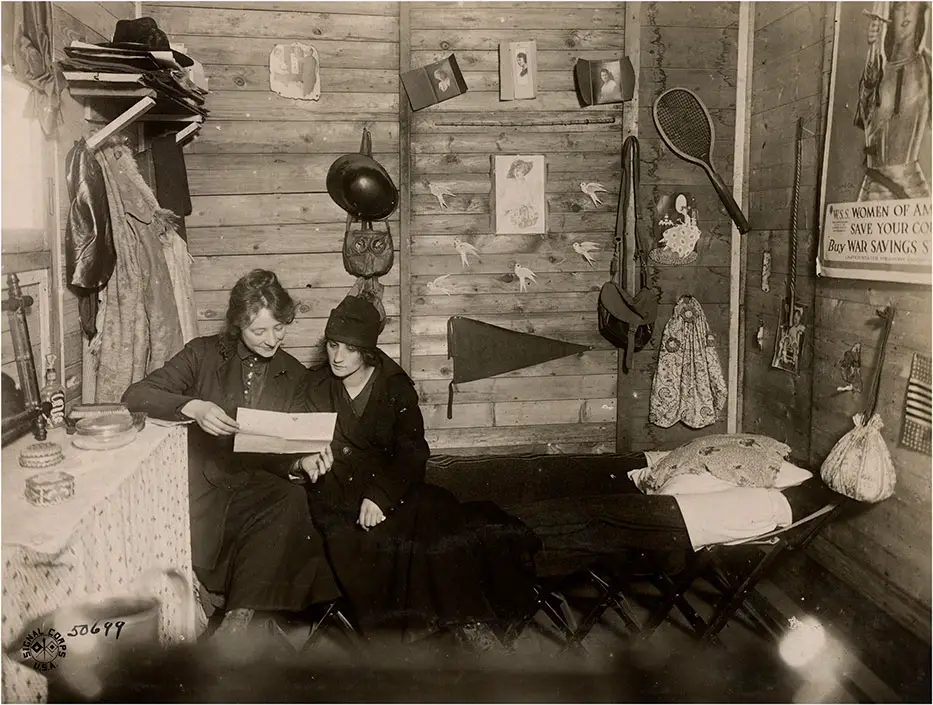
Where Telephone Girls Live in France. (L to R) Sisters Louise and Raymonde Breton Are Able to Spend a Little Time Together. Despite Unpapered Walls, This Room in France in Portable Barracks Has Something of Air of a College Dormitory with a Joan of Arc Recruiting Poster on the Wall on the Right. It Is a Billet for Signal Corps Telephone Operators in Neufchateau. Photograph by Signal Corps AEF, 1918. National Archives and Records Administration, 111-SC-50699. NARA ID # 86707156. | GGA Image ID # 198f2fdf10. Click to View a Larger Image.
📖 Review & Summary
This 1919 feature from Southern Telephone News offers a heartfelt postwar tribute to the “Hello Girls,” the U.S. Army Signal Corps telephone operators whose skill and discipline kept Allied communications functioning through the most critical campaigns of World War I. Rather than focusing on battlefield danger, this piece highlights gratitude—describing how commanding officers, from General Pershing to junior lieutenants, praised the women’s precision, reliability, and good humor in the face of relentless work.
Compiled into a Christmas booklet of commendations, the letters of appreciation from across the A.E.F. became both a morale symbol and an early record of women’s professionalism under fire. The article captures the respect these operators earned from every branch of service—Army, Navy, Medical Corps, and Engineers—cementing their legacy as essential soldiers of communication. The presentation of the booklet during a holiday dinner funded by Bell System employees added a poignant human touch to one of the Signal Corps’ proudest achievements.
What it meant to have our American girls over in France, operating an American telephone system, built by Americans, for the use of pure American troops may be inferred from the following incident:
A very busy officer lifted his receiver to place a call, and when he heard, “Number, please?” in the old familiar way, he shouted, “Thank God!” so loudly and devoutly that everybody laughed, including the operator at the other end of the line.
In token of their appreciation of the work and services of these operators, letters of commendation were written by officers of high rank in all branches of the service, including the commander-in-chief of the American Expeditionary Forces.
As Christmas approached, these letters were collected and copies made by the officers and soldiers at the headquarters of the Chief Signal Officer, A. E. F., for presentation to each operator, believing that they would wish to preserve them permanently as a memento. They formed a booklet of thirty-six letters in full and extracts from twenty-two others.
In addition, the booklets contain a complete list of all the operators, with their home addresses and unit numbers, photographs of General Pershing, Major General Harbord, and Brigadier General E. Russel, and pictures of the central offices at Tours and Toul.
There are letters from the commander-in-chief, General Pershing, and officers in all branches of the service under him throughout the war area, including generals, colonels, majors, captains, chiefs of air service, engineers, officers of the tank corps, the medical service and the Marines, as well as letters from the commander of the naval forces in France and the American consul.
These booklets were presented at a special Christmas dinner held for the operators at each A.E.F. exchange where they worked. The dinner referred to was made possible by a contribution of $464.49 from employees of the Bell System in this country through the YWCA.
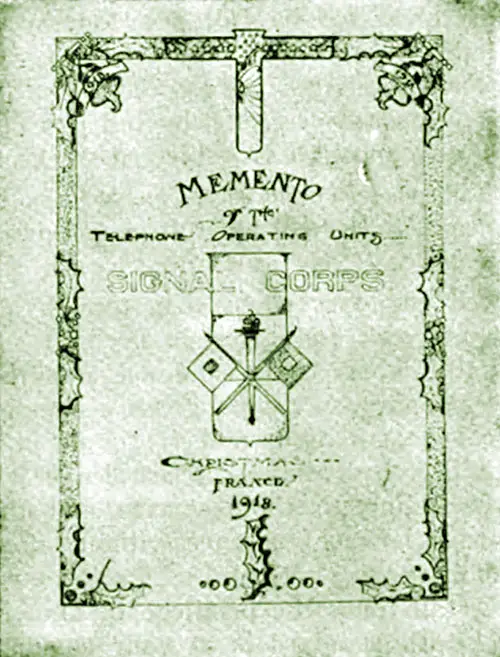
Cover Design of the Book of Complimentary Letters. Momento of the Telephone Operating Unit of the Signal Corps Christmas 1918 in France. Southern Telephone News, May 1919. GGA Image ID # 19847fa24f
Editorial Note: The original Memento of the Telephone Operating Unit of the Signal Corps—the Christmas 1918 booklet described in this article—is now among the rarest surviving artifacts connected to the “Hello Girls.” Produced in France and distributed to each operator, it contained official letters of commendation from General Pershing, Major General Harbord, Brigadier General Russel, and other officers of the American Expeditionary Forces. Few copies are known to exist today; most remain in private family collections or institutional archives. Its preservation and digitization provide modern researchers with a tangible record of the first generation of American women soldiers formally praised by their commanding generals.
The first letter in the volume is a "Foreword" by Lieutenant Roy H. Coles, executive officer of the Signal Corps of the A. E. F. It extends Christmas greetings to the operators on behalf of the officers of the Signal Corps. It expresses the pride that they felt in being associated with the operators, and the pleasure they took in doing everything in that holiday season to make the occasion more pleasant for them.
Referring to the booklet, the letter says:
"It is presented to you with the thought that it will prove to be a valued and lasting memento of a period of efficient, honorable service, which it is hoped has been as agreeable and pleasant for you as it has been for those with whom you have been working.
"We rejoice with and congratulate you on the sentiments expressed in the various letters of commendation contained herein, and can only add that they echo ours but feebly."
General Pershing's Praise.
Following this is an extract from the report made to the Secretary of War by General Pershing, in which he says, under the heading of commendation :
"The officers and men and young women of the Signal Corps have performed their duties with a large conception of the problem and with a devoted and patriotic spirit to which the perfection of our communications daily testifies."
Major General J G. Harbord, in command of the S O. S., in his remarks of appreciation of the service rendered by the telephone operators, spoke of their efficiency, which "made the telephone service of the U. S. Signal Corps a model of speed and accuracy known throughout the entire allied army." He said, "They have filled a most important need in the A. E. F., in a very creditable way, which makes us all very proud."
Brigadier General Edgar Russel's Commendation
The words of Brigadier General E. Russel, chief signal officer, A. E. F., are also of significance. He wrote to the operators on November 12, the day after the armistice was signed:
"The bringing of women telephone operators to France for service with the American Expeditionary Forces had no precedent, and for this reason, the experiment was watched with unusual interest. It pleases me a great deal to say that by your ability, efficiency, devotion to duty and the irreproachable and business-like conduct of your affairs, personal and official, you have not only justified the action taken in assembling you, but have set a standard of excellence which could hardly be improved upon and which has been responsible, in no small measure, for the success of our system of local and long distance telephone communication."
Praise From Other Officers
What struck many of the officers abroad, especially, was the cheerfulness of the operators in the face of heavy work and strenuous times, when the demands on them were such as to tax endurance and patience to the utmost.
As it was the operators who provided the connecting links between all the various departments and branches of the American Expeditionary Forces, it is not surprising that every branch and department in turn put itself on record in the little Christmas booklet as expressing gratification and praise to the switchboard soldiers.
Letter after letter told of the same high courage, patriotic motives, and always of their excellent work. If anyone were to doubt the accomplishments of the telephone operators in France, let him refer to the operators' Christmas booklet, every page of which adds another link to the long chain of evidence.
Their work was wide in scope and contributed to the efficiency and speed, and, what is more, to the good nature of the individuals in every department of the French government.
That is why the operators were presented with Christmas greetings from the American Expeditionary Forces in France, accompanied by the heartiest good wishes from all.
In the words of Major General Mason M. Patrick, chief of the air service, Paris, "Quick service and intelligence shown in its performance have characterized our telephone system since you came. Our thanks to you and to each one of you, a merry Christmas."
✨ Most Engaging Content
The most memorable section describes an overworked officer who, upon hearing the familiar American voice of a female operator saying “Number, please?”, exclaimed “Thank God!”—a moment that perfectly symbolizes the emotional connection these women represented for troops abroad. It shows how morale, communication, and national identity intertwined through the sound of the American voice across the lines.
Equally compelling is the story of the Christmas booklet itself—thirty-six full letters and twenty-two excerpts, bound together and given as a holiday keepsake to every operator. This tangible recognition from Pershing, Harbord, and Russel not only validated their service but created one of the first documentary acknowledgments of women’s contributions to the U.S. military. It remains a powerful artifact of gratitude and respect.
🖼️ Noteworthy Image(s)
Hero Image: A 1918 Signal Corps photograph showing the living quarters of the Hello Girls in Neufchâteau, France—two sisters, Louise and Raymonde Breton, sharing a modest barracks room adorned with a Joan of Arc recruiting poster. The setting captures the mix of military austerity and feminine pride that characterized the women’s service. Despite unpapered walls, the atmosphere feels like a college dormitory—symbolic of camaraderie and purpose amid war.
Additional Image: The Southern Telephone News reprint of the Memento of the Telephone Operating Unit cover design offers a rare look at the Christmas 1918 booklet presented to each operator. The combination of art-nouveau styling and military symbolism bridges two worlds—American commercial design and wartime gratitude—making it one of the most important visual survivals of the Hello Girls’ collective recognition.
📘 Mini Dictionary for Civilians
- A.E.F. — American Expeditionary Forces, the United States military force sent to Europe in 1917–1919 under General John J. Pershing.
- S.O.S. — Services of Supply, the logistical branch of the A.E.F. responsible for transport, communication, and base operations.
- Chief Signal Officer — The senior communications commander of the U.S. Army, overseeing all telegraph and telephone operations.
- Billet — Temporary living quarters for military personnel, often in requisitioned civilian buildings or portable barracks.
- Memento Booklet — A commemorative publication distributed to Signal Corps operators containing official commendations and Christmas greetings.
🎓 Essay Prompts for Students
- What role did morale and communication play in sustaining the American Expeditionary Forces, and how did the Hello Girls contribute to both?
- Analyze how the 1918 Christmas booklet functioned as both an official commendation and a symbolic recognition of women’s service.
- Compare the military praise recorded in this article with later public recognition of the Hello Girls in 1977. How did perceptions of military gender roles evolve?
- Discuss the significance of personal connection and national identity in wartime communication, as reflected in the “Thank God!” anecdote.
🪶 Citation Block
Chicago Style: “Tribute to American Telephone Operators in France.” Southern Telephone News, Vol. 7, No. 5 (May 1919): 25, 27.
APA Style: Tribute to American Telephone Operators in France. (1919, May). Southern Telephone News, 7(5), 25–27.
MLA Style: “Tribute to American Telephone Operators in France.” Southern Telephone News, vol. 7, no. 5, May 1919, pp. 25–27.
Student Version: “Tribute to American Telephone Operators in France” (1919) honors the U.S. Army Signal Corps Hello Girls for their exemplary service in WWI, reprinted in Southern Telephone News, May 1919 (GG Archives Collection).
"Tribute to American Operators in France," Atlanta: Southern Group of Bell Telephone Companies, Vol. 7, No. 5, May 1919, pp. 25, 27.
