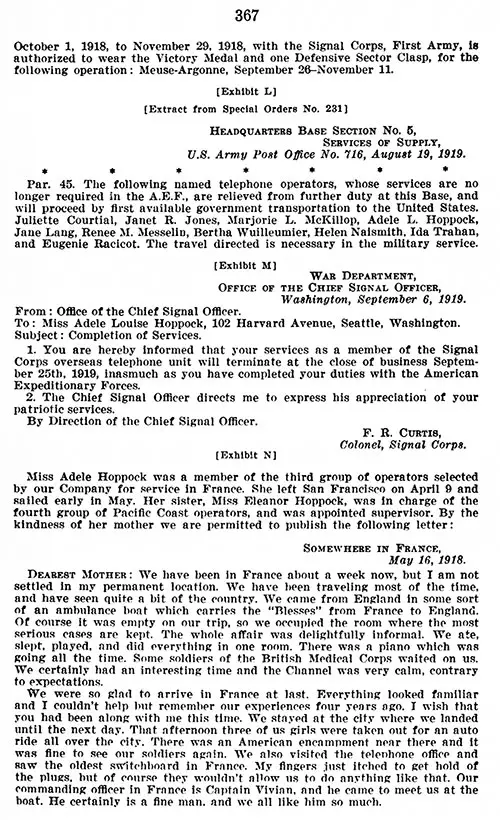

Exhibit L - Extract from Special Orders No. 231 (Demobilization Phase) - 1919
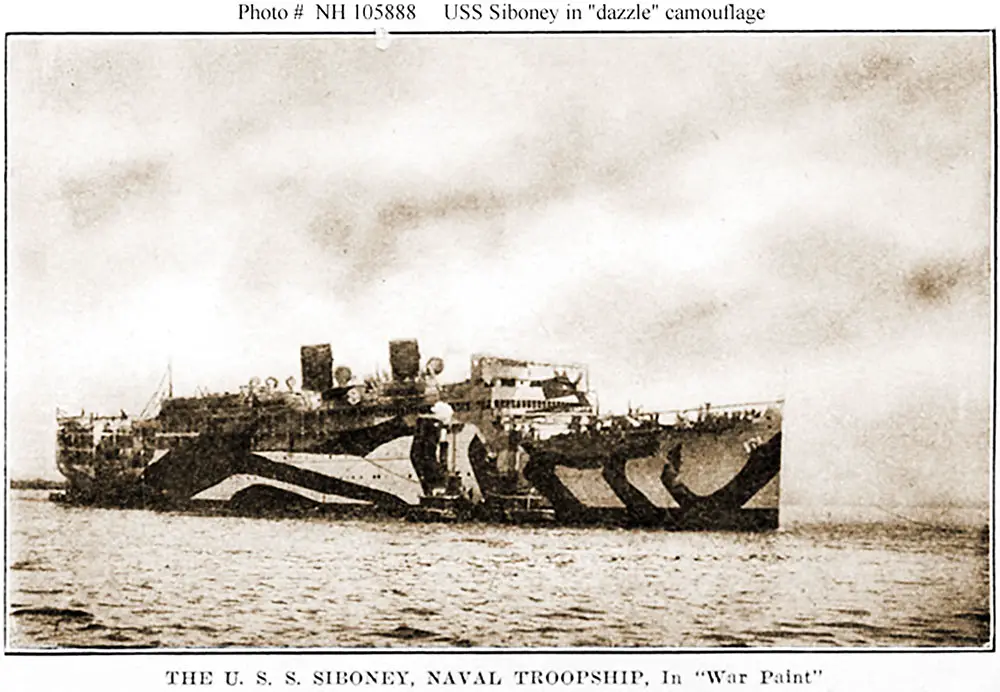
The USS Siboney, Shown Here in WWI Dazzle Camouflage War Paint, Was One of the Many Troopships That Left Brest, France, During August 1919 for New York. Naval History and Heritage Command Photo NH 105888. | GGA Image ID # 237c7d44bd. Click to View a Larger Image.
📖 Review & Summary
What this is: A demobilization-phase extract (19 Aug 1919) from Special Orders No. 231, Headquarters Base Section No. 5 (S.O.S., A.P.O. 716, Brest/Cherbourg). It lists named Signal Corps Telephone Operators—including Adele L. Hoppock—whose services were “no longer required” in the A.E.F. and directs them to return to the United States by first available government transport.
Why it matters: It’s concrete, primary-source proof showing who the operators were, where they were processed (Base Section No. 5), and that their travel was ordered as a military necessity. It ties individual women to the A.E.F.’s post-Armistice logistics pipeline.
How to read it: Note the formal order chain (Base Section → S.O.S. → A.P.O.), the explicit “services no longer required” phrasing typical of demobilization, and the directive language (“will proceed… first available government transportation”). Together, they place these operators inside the Army’s personnel and movement system at war’s end.
📖 Special Orders No. 231
Special Orders No. 231, issued on August 19, 1919, by Headquarters Base Section No. 5, Services of Supply (S.O.S.), contains a list of directives regarding the processing of troops at the end of World War I. The orders specify procedures for creating lists of personnel (including officers, enlisted men, and civilian employees) and forwarding them to headquarters.
The main provisions of the order include:
Alphabetical lists: Detachment, company, troop, and battery commanders were required to create and submit alphabetical lists of all their personnel.
Information included: The lists had to contain the following details for each individual: surname, Christian name, rank, and organization or designation.
Status of absent personnel: The lists also had to indicate the whereabouts and status of any absent personnel.
Purpose: This directive was part of the massive logistical effort to demobilize and return troops and other personnel home following the war's conclusion. It enabled the military to maintain accurate records of its personnel during the final stages of the conflict and the subsequent return to the U.S.
Repatriation of Female Telephone Operators
Special Orders No. 231, Headquarters Base Section No. 5, Services of Supply (S.O.S.), issued in 1919, details the honorable discharge and repatriation of female telephone operators, including the famous "Hello Girls". Base Section No. 5 was headquartered in Brest, France, and was a key port for the return of American troops after World War I.
Key facts about the order and the context:
Context: After the armistice of November 11, 1918, the S.O.S. managed the logistics of repatriating hundreds of thousands of American troops from France. August 1919 fell in the midst of this large-scale demobilization.
What was Base Section No. 5? Established in November 1917, Base Section No. 5 oversaw the ports of Brest and Cherbourg, France. Brest was a crucial deep-water port and a major embarkation point for U.S. troops returning home.
What were the "Hello Girls"? These were American female switchboard operators who served with the U.S. Army Signal Corps in France. They played a vital role in communications for the American Expeditionary Forces (AEF).
Content of the order: The order listed the names of the telephone operators who were to be honorably discharged and returned to the United States. This was part of the general demobilization of forces and personnel that occurred after the war ended.
[Exhibit L]
[Extract from Special Orders No. 231]
Headquarters Base Section No. 5,
Survices of Supply
U.S. Army Post Office No. 716,
August 19, 1919.
*******
Par. 45. The following named telephone operators, whose services are no longer required in the A.E.F., are relieved from further duty at this Base, and will proceed by first available government transportation to the United States. Juliette Courtial, Janet R. Jones, Marjorie L. McKillop, Adele L. Hoppock, Jane Lang, Renee M. Messelin, Bertha Wuilleumier, Helen Naismith, Ida Trahan, and Eugenie Racicot. The travel directed is necessary in the military service.
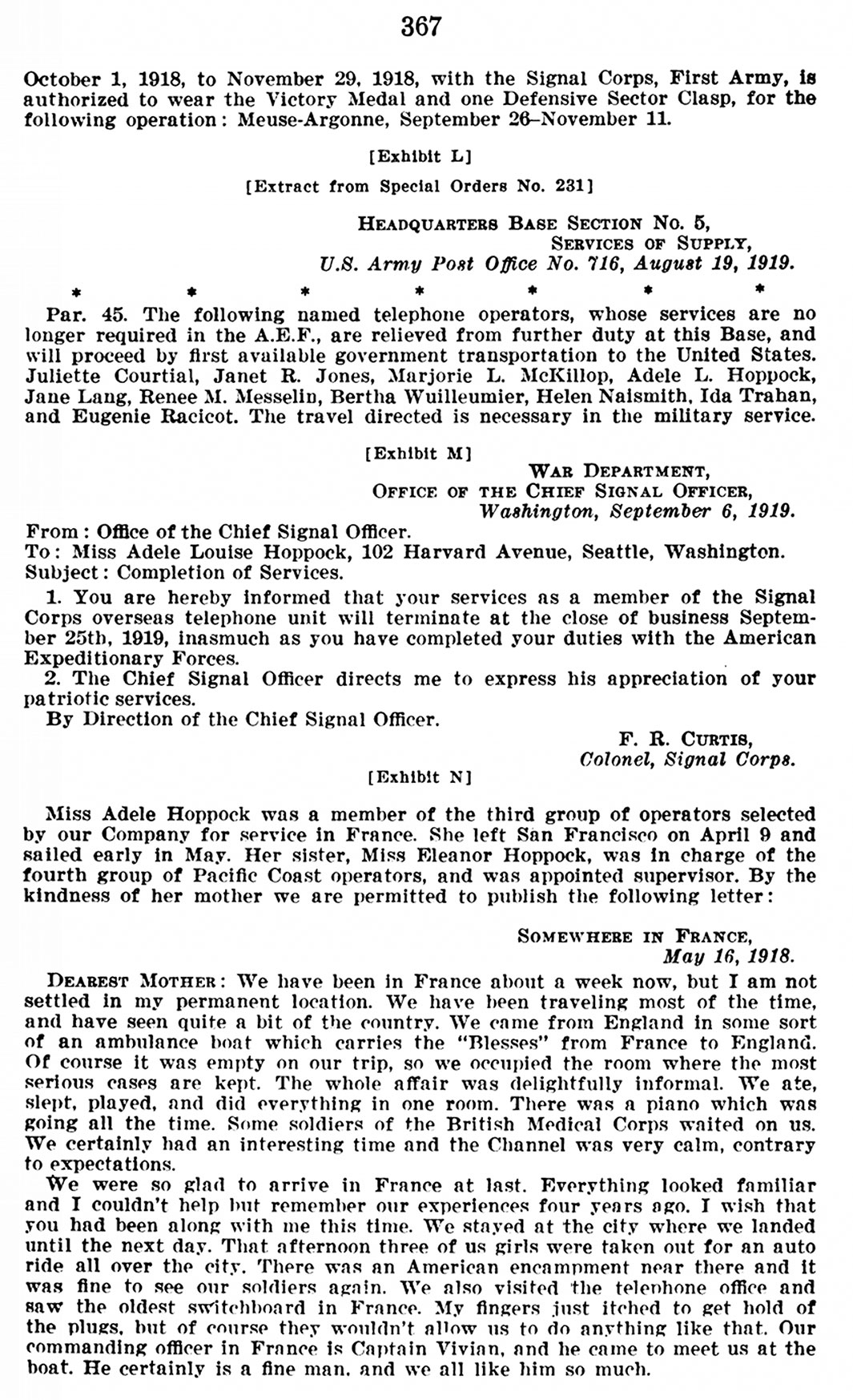
Exhibits L, M, and N, in Recognition for Purposes of VA Benefits, Hearing before the Committee on Veterans' Affairs, United States Senate, Ninety-Fifth Congress, First Session on S. 247, S. 1414, S. 129, and Related Bills. Washington, DC: US Government Printing Office, 25 May 1977. | GGA Image ID # 237077ba74. Click to View a Larger Image.
✨ Most Engaging Content
- Name-by-name return: The order records ten operators (e.g., Juliette Courtial, Janet R. Jones, Marjorie L. McKillop, Adele L. Hoppock)—a rare, compact roster snapshot.
- Military necessity: “The travel directed is necessary in the military service” confirms their movements were not discretionary.
- Demobilization in motion: Dated August 1919 at Base Section No. 5, it places the Hello Girls at one of the A.E.F.’s busiest embarkation hubs as the force wound down.
📘 Mini Dictionary for Civilians
- Base Section No. 5 (S.O.S.)
- A major U.S. Army logistics area in France (notably Brest/Cherbourg) for embarkation, supply, and return transport.
- S.O.S. (Services of Supply)
- The A.E.F. organization that managed logistics, transportation, depots, and personnel processing.
- A.P.O. 716
- Army Post Office number associated with Base Section No. 5—appears on orders and mail to locate units administratively.
- Special Orders
- Formal, numbered directives that move people, assign duties, authorize travel, or change status.
🎓 Essay Prompts for Students
- Paper trails & power: How do Special Orders encode authority, identity, and movement at scale during demobilization?
- From front to port: Reconstruct an operator’s likely path from First Army duties to Base Section No. 5 and homeward transport.
- Status vs. function: Read this order beside award/commendation documents—what does each reveal (or not) about the operators’ military standing?
- Logistics narrative: Explain how terse administrative language (e.g., “no longer required,” “will proceed”) captures the human reality of going home.
🪶 Citation Block
- Chicago: United States. Senate. Committee on Veterans’ Affairs. Recognition for Purposes of VA Benefits: Hearing… Washington, DC: U.S. Government Printing Office, 1977, p. 367. “[Exhibit L].”
- APA 7th: United States Senate, Committee on Veterans’ Affairs. (1977, May 25). Recognition for purposes of VA benefits… (p. 367). U.S. Government Printing Office. “[Exhibit L].”
- MLA 9th: United States, Congress, Senate, Committee on Veterans’ Affairs. Recognition for Purposes of VA Benefits… U.S. Government Printing Office, 1977, p. 367. “[Exhibit L].”
- Student (plain English): “[Exhibit L],” in Recognition for Purposes of VA Benefits, U.S. Senate Committee on Veterans’ Affairs (95th Cong., 1st Sess.), May 25, 1977, p. 367.
"[Exhibit L]: Affidavit of Gertrude Hoppock: Extract from Special Orders No. 231, 19 August 1919," in Recognition for Purposes of VA Benefits, Hearing before the Committee on Veterans' Affairs, United States Senate, Ninety-Fifth Congress, First Session on S. 247, S. 1414, S. 129, and Related Bills. Washington, DC: US Government Printing Office, 25 May 1977. p. 367.
