
Exhibit D - Hoppock - Memo from Capt. E. J. Wesson, U.S. Army - 1918
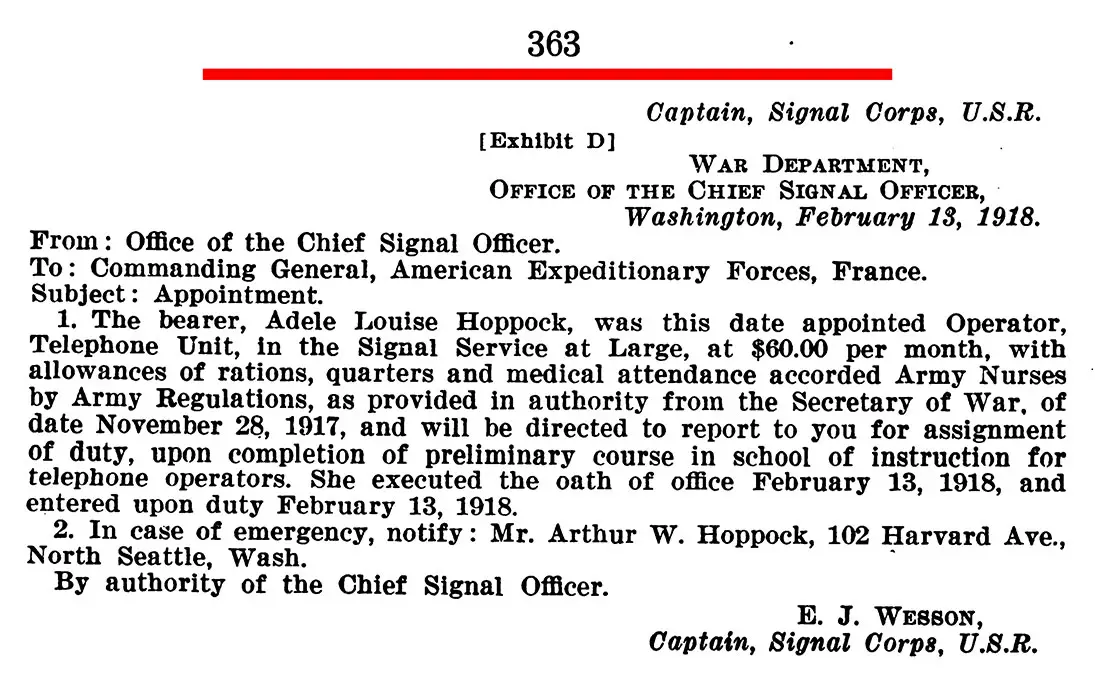
Exhibit D: Affidavit of Gertrude Hoppock: Memo from Capt. E. J. Wesson, US Army, 13 February 1918, in Recognition for Purposes of VA Benefits, Hearing before the Committee on Veterans' Affairs, United States Senate, Ninety-Fifth Congress, First Session on S. 247, S. 1414, S. 129, and Related Bills. Washington, DC: US Government Printing Office, 25 May 1977. | GGA Image ID # 23769075c7. Click to View a Larger Image.
📖 Review & Summary
This official memorandum, dated February 13, 1918, was signed by Captain E. J. Wesson of the U.S. Army Signal Corps and formally appointed Adele Louise Hoppock as a Telephone Operator in the newly organized Signal Service at Large. Earning $60 per month with Army-nurse-level allowances for rations, quarters, and medical care, Hoppock’s appointment acknowledged women as essential to frontline communication—though still outside official military rank.
The memo, addressed to the Commanding General of the American Expeditionary Forces in France, marked a turning point: it transformed civilian telephone professionals into uniformed participants in the U.S. war effort. Each phrase—down to “entered upon duty February 13, 1918”—cements the Hello Girls’ service as military in every respect but legal status.
For educators, the document connects administrative language to the broader struggle for women’s recognition in the armed forces. For genealogists and historians, it provides verifiable evidence of individual enlistment in one of the first gender-integrated communications units in American military history.
[Exhibit D]
War Department,
Office of the Chief Signal Officer,
Washington, February 13, 1918.
From : Office of the Chief Signal Officer.
To: Commanding General, American Expeditionary Forces, France.
Subject: Appointment.
1. The bearer, Adele Louise Hoppock, was this date appointed Operator, Telephone Unit, in the Signal Service at Large, at $60.00 per month, with allowances of rations, quarters and medical attendance accorded Army Nurses by Army Regulations, as provided in authority from the Secretary of War, of late November 28, 1917, and will be directed to report to you for assignment of duty, upon completion of preliminary course in school of instruction for telephone operators. She executed the oath of office February 13, 1918, and entered upon duty February 13, 1918.
2. In case of emergency, notify : Mr. Arthur W. Hoppock, 102 Harvard Ave., North Seattle, Wash.
By authority of the Chief Signal Officer.
E. J. Wessen,
Captain, Signal Corps, U.S.R.
Allowances of Rations, Quarters, and Medical Attendance for Army Nurses, 1918.
In 1918, Army nurses received allowances for rations, quarters, and medical care as part of their service, though they were not yet considered commissioned officers and did not have equivalent pay and status
. A federal act of July 9, 1918, raised their base pay and formalized the provision of these allowances.
Rations and subsistence
Army nurses received an allowance for food, referred to as "maintenance" or "subsistence," which was included in their compensation.
When serving overseas, they were provided with meals, although the quality could vary. In some cases, nurses had to supplement their army rations with purchased food.
For example, casual nurses awaiting transport in France in late 1918 were assigned to a separate mess hall. Food was served to them at tables, but tablecloths were not used due to the difficulty of laundry.
In one instance, Belgian rations were found to be inadequate for British Nursing Sisters serving in a hospital in Bruges, indicating that overseas rations were not always consistent or sufficient for nurses' needs.
Quarters and housing
Nurses were entitled to government-provided quarters.
The quality and type of housing varied widely depending on the location and conditions of service.
Stateside camps: Student nurses stationed at Camp Grant lived in nurses' quarters, subject to strict rules like curfews and inspections.
Overseas: Nurses were housed in whatever facilities were available. This could mean renovated buildings, temporary barracks, or even sections of hospital trains.
Brest, France, 1919: Casual nurses awaiting demobilization were housed in barracks that could be a significant distance from latrines and showers.
Medical attendance
Army nurses were entitled to medical care during periods of illness.
Medical conditions, particularly the 1918 influenza pandemic, posed a significant threat to nurses. Of the 134 Army Nurse Corps deaths during World War I, 127 were from influenza and pneumonia.
In 1918, there was no effective medical treatment for the influenza virus.
Nurses primarily managed patients' symptoms, and care for sick nurses would have followed the same symptomatic protocols.
Pay and other allowances in 1918
An act passed on July 9, 1918, increased the base pay for Army nurses to $60 per month plus maintenance.
Additional pay was authorized for foreign service ($10 per month) and for chief nurses ($30 per month).
Nurses received an additional $5 per month for every three years of completed service.
They were also entitled to transportation and expenses when traveling under orders.
At the time, Army nurses were considered part of the Army but held no official commissioned rank, despite their professional and managerial responsibilities.
Qualifications of the Army nurses included female, white, unmarried, 25–35 years of age, 3-year commitment, and graduation from a civilian nurse training school.
✨ Most Engaging Content
The phrase “with allowances of rations, quarters and medical attendance accorded Army Nurses by Army Regulations” captures both progress and limitation. It placed women alongside nurses—acknowledging their service—yet withheld the full rights and rank of soldiers. That single line encapsulates decades of gender policy debate within the U.S. Army.
Equally striking is the note naming Hoppock’s father, “Mr. Arthur W. Hoppock… in case of emergency.” The human touch amid bureaucratic formality reminds readers that behind every Signal Corps document stood real families preparing for wartime separation and uncertainty.
🖼️ Noteworthy Image(s)
- Typed Memo from Capt. E. J. Wesson (1918) – The original War Department memorandum that authorized Adele Hoppock’s appointment to the Telephone Unit, preserved as Exhibit D in the 1977 Senate hearings.
This visual traces the Hello Girls’ path from paperwork to public acknowledgment, revealing how clerical formalities evolved into celebrated service.
📘 Mini Dictionary for Civilians
- Signal Service at Large: Branch of the U.S. Army Signal Corps created to manage communications beyond standard units.
- Army Nurse Allowances: Entitlements for rations, quarters, and medical care granted to nurses—and here extended to telephone operators.
- Oath of Office: Formal pledge taken by all Army employees and officers before assuming duty.
- U.S.R.: United States Army Signal Reserve—officers commissioned for specialized wartime service.
- Commanding General, A.E.F.: General John J. Pershing, commander of U.S. forces in Europe during WWI.
🎓 Essay Prompts for Students
- Administrative Recognition: How does this memo demonstrate early, unofficial acknowledgment of women’s military service?
- Language and Power: Analyze the wording of the memo—how does bureaucratic tone reflect gender hierarchy within the 1918 Army?
- Comparative History: Contrast Wesson’s 1918 memo with his 1950 letter to Mrs. Anderson. How did his understanding of the Hello Girls’ significance change over time?
- Social Context: What does the reference to “allowances accorded Army Nurses” reveal about women’s roles and public perception of professionalism during WWI?
- Archival Practice: Why are typed memoranda like this vital for historians verifying the service of under-recognized groups?
🪶 Citation Block
Chicago: “Exhibit D: Affidavit of Gertrude Hoppock: Memo from Capt. E. J. Wesson, U.S. Army, 13 February 1918.” In Recognition for Purposes of VA Benefits, Hearings before the Committee on Veterans’ Affairs, U.S. Senate, 95th Cong., 1st sess., 25 May 1977, p. 363. Washington, DC: Government Printing Office. Reprinted by Gjenvick-Gjønvik Archives (2025).
APA: U.S. Senate Committee on Veterans’ Affairs. (1977, May 25). Exhibit D: Affidavit of Gertrude Hoppock: Memo from Capt. E. J. Wesson, U.S. Army (1918, Feb 13). In Hearings on S. 247, S. 1414, S. 129 and Related Bills (p. 363). Washington, DC: GPO. Reprinted by Gjenvick-Gjønvik Archives (2025).
MLA: “Exhibit D: Affidavit of Gertrude Hoppock: Memo from Capt. E. J. Wesson, U.S. Army.” 13 Feb. 1918. Hearings before the Committee on Veterans’ Affairs, 95th Cong., 1st sess., Washington: GPO, 1977, p. 363. Reprinted in Gjenvick-Gjønvik Archives, 2025.
Student Citation (Short Form): “Exhibit D: Memo from Capt. E. J. Wesson (1918).” U.S. Senate Veterans’ Affairs Hearings, p. 363. Reprinted by GG Archives (ggarchives.com).
Bibliography
"Exhibit D: Affidavit of Gertrude Hoppock: Memo from Capt. E. J. Wesson, US Army, 13 February 1918," in Recognition for Purposes of VA Benefits, Hearing before the Committee on Veterans' Affairs, United States Senate, Ninety-Fifth Congress, First Session on S. 247, S. 1414, S. 129, and Related Bills. Washington, DC: US Government Printing Office, 25 May 1977. p. 363.
Stimson, Julia C., "Part Two: The Army Nurse Corps, Chapter 1: In the United States," in The Medical Department of the United States Army in the World War, Volume XIII, Part Two, The Army Nurse Corps, US Governement Printing Office, Washington, DC, 1927. AMEDD Center of History & Heritage. URL: https://achh.army.mil/history/book-wwi-volxiii-ancch01rev/
