
Exhibit F—Telegram to Adele Louise Hoppock from Squier - 1918
![[Exhibit F—Telegram]: Affidavit of Gertrude Hoppock: Telegram from Squire/Wesson, US Army, 5 April 1918.](../../../CVimages/MIL/HelloGirls/CongressionalHearings/95th-S247-S1414-S129/1977-05-25/364f-TelegramFromSquireToAdeleHoppock-1918-04-05.jpg "GGA Image ID # 23777d10b1. Click to View a Larger Image.")
[Exhibit F—Telegram]: Affidavit of Gertrude Hoppock: Telegram from Squire/Wesson, US Army, 5 April 1918, in Recognition for Purposes of VA Benefits, Hearing before the Committee on Veterans' Affairs, United States Senate, Ninety-Fifth Congress, First Session on S. 247, S. 1414, S. 129, and Related Bills. Washington, DC: US Government Printing Office, 25 May 1977. | GGA Image ID # 23777d10b1. Click to View a Larger Image.
📖 Review & Summary
The 1918 Exhibit F Telegram represents the final stage of Adele Louise Hoppock’s mobilization into the U.S. Army Signal Corps Telephone Operators Unit. Sent by Major General George Owen Squier, Chief Signal Officer of the Army, this telegram directed Hoppock to report to the American Telephone and Telegraph Company in New York City for formal instruction in military telephony.
Combined with earlier correspondence from Captain Ernest Wessen, this document illustrates the Army’s tight coordination with private telecommunications companies to rapidly train women for front-line communications service in France. The language of the order — “Under authority of the Secretary of War … you will proceed” — formalized their status under military jurisdiction, even if not yet fully recognized as enlisted personnel.
Educational Relevance: This primary source offers students a window into WWI bureaucratic processes, women’s military integration, and civil-military collaboration between AT&T and the U.S. Army Signal Corps.
[Exhibit F—Telegram]
Washington, D.C., April 5, 1918.
Adele Louise Hoppock,
c/o Mr. C. B. Allsop, Pacific Telephone and Telegraph Co.,
San Francisco, Calif.
Under authority of Secretary of War dated April Seventh 1917. You will proceed to New York City reporting by Saturday April Thirteenth to R. F. Estabrook, American Telephone and Telegraph Co., 195 Broadway, for instruction in telephony. You will apply to the nearest quartermaster or recruiting officer for transportation. The travel directed is necessary in the military service. Transportation allowances to be accorded you same as prescribed for Army nurses in Army regulations. You will preserve copy of this order.
Squier,
Chief Signal Officer Per Wessen.
623PM
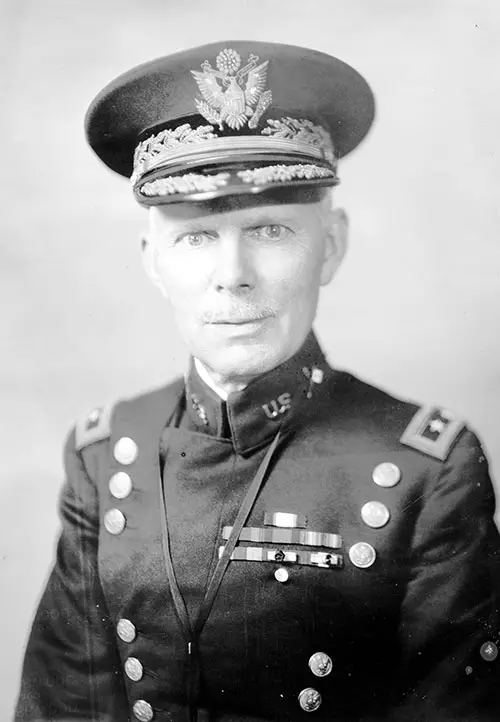
Major General George Owen Squire, US Army Chief Signal Officer 1917-1923. DoD Photo #200615, n.d. | GGA Image ID # 236a2ebef4
Major General George Owen Squier
George Owen Squier, born on March 21, 1865 in Dryden, Michigan, graduated from the U.S. Military Academy in 1887. A scientist with a doctorate from Johns Hopkins University, he served in the Signal Corps, including four years in London as military attaché, until May 1916 when he was named to head the Aviation Section.
As early as 1907 he had been interested in military aviation and helped prepare specifications for the first military plane. He was prominent in the buildup of air power for World War I.
He also provided necessary emphasis to passage of the Aviation Act calling for 40,000 planes at a cost of $640 million, the largest single appropriation in U.S. history up to that time. Squier moved up to Chief Signal Officer in February 1917 and was still in charge a year later as the Air Service expanded from 65 officers and 1,100 men to 12,000 officers and 135,000 men. Squier retired December 31, 1923 and died in Washington, D.C. on March 24, 1934.
He was awarded the Distinguished Service Medal in 1919, with the following citation:
“Maj. Gen. George O. Squier, United States Army, for exceptionally meritorious and distinguished service. As Chief Signal Officer he has demonstrated scientific attainments of the highest order. His researches and contributions to the scientific equipment of the Signal Corps are noteworthy. The Signal Corps under him has been an extremely progressive and efficient organization.”
Source: USAF Biography
Ernest Wessen
"Wessen" likely refers to Ernest Wessen, the head of the recruiting center for the U.S. Army Signal Corps during World War I, known for his role in recruiting the "Hello Girls" (the Signal Corps Female Telephone Operators Unit). Wessen, who, in his capacity as civilian personnel recruiter at the War Department, organized the telephone units upon receipt of a requisition telegram from General John J. Pershing/Major General George Owen Squier.
Details about Ernest Wessen:
Role: Ernest Wessen was the head of the recruiting center for the Signal Corps.
Context: He was involved in the efforts to recruit women for telephone operator positions, which became known as the "Hello Girls," for the U.S. Army Signal Corps during World War I.
Historical Significance: His work was crucial in building the necessary human resources for the Signal Corps' vital communication operations during the war, as these operators were sworn into the U.S. Army.
✨ Most Engaging Content
The closing instruction — “You will preserve copy of this order” — adds a human touch to a military directive that changed lives. This simple line transforms a routine telegram into a keepsake of history, a document that linked civilian women to global events of World War I.
🖼️ Noteworthy Image(s)
- Telegram to Adele Hoppock (1918): The original document ordering her transfer from San Francisco to New York for AT&T instruction — evidence of the Hello Girls’ formal mobilization.
- Maj. Gen. George Owen Squier: Visionary Chief Signal Officer who oversaw aviation and communications expansion during World War I.
📘 Mini Dictionary for Civilians
- Quartermaster: An Army officer responsible for transport and logistics, including travel arrangements and supplies.
- Chief Signal Officer: Head of the Army branch managing telegraph, telephone, and radio communications.
- AT&T Training: Civilian telephone instruction adapted for wartime use to train operators in Army communications protocols.
- Authority of the Secretary of War: Formal language establishing the legal basis of military orders in World War I.
- Telephony: The technology and practice of operating telephones for real-time voice communication across distances.
🎓 Essay Prompts for Students
- Evaluate how this telegram reflects the U.S. Army’s reliance on private industry during World War I. What does it suggest about the relationship between the military and AT&T?
- Discuss the tone and structure of the telegram. How does official bureaucratic language confer authority and legitimacy to the Hello Girls’ roles?
- Analyze Major General Squier’s leadership style and its impact on women’s integration into communications service during WWI.
- Consider why preserving copies of orders like this was important for later recognition of veteran status. What does this say about documentation and gender in military history?
🪶 Citation Block
Chicago: “[Exhibit F — Telegram]: Affidavit of Gertrude Hoppock: Telegram from Squier/Wessen, U.S. Army, 5 April 1918.” Hearing Before the Committee on Veterans’ Affairs, U.S. Senate, 95th Cong., 1st Sess., on S. 247, S. 1414, and S. 129 (1977), p. 364.
APA: United States Senate. (1977, May 25). Exhibit F — Telegram from Squier/Wessen to Adele Hoppock (1918). Hearing before the Committee on Veterans’ Affairs (95th Cong., 1st Sess.), p. 364. U.S. Government Printing Office.
MLA: “[Exhibit F — Telegram]: Affidavit of Gertrude Hoppock: Telegram from Squier/Wessen, U.S. Army, 5 Apr. 1918.” Hearing before the Committee on Veterans’ Affairs, U.S. Senate, 95th Cong., 1st Sess., 1977, p. 364.
Student Citation: “[Exhibit F — Telegram from Maj. Gen. Squier to Adele Hoppock (1918)]” in Recognition for Purposes of VA Benefits, U.S. Senate Hearing, 95th Congress (1977), p. 364. Retrieved from the Gjenvick-Gjønvik Archives (ggarchives.com).
"[Exhibit F—Telegram]: Affidavit of Gertrude Hoppock: Telegram from Squire/Wesson, US Army, 5 April 1918," in Recognition for Purposes of VA Benefits, Hearing before the Committee on Veterans' Affairs, United States Senate, Ninety-Fifth Congress, First Session on S. 247, S. 1414, S. 129, and Related Bills. Washington, DC: US Government Printing Office, 25 May 1977. p. 364.
