
Affidavit of Marjorie L. McKillop - 1977
📖 Review & Summary
What this is: A sworn affidavit (1977) by Marjorie L. McKillop, a Unit 4 Signal Corps telephone operator, documenting her WWI service, from enlistment and oath in Seattle to frontline-adjacent communications duty in France.
Key details: McKillop describes interviews and oath before Major Newell (Seattle), training with Pacific Telephone & Telegraph (San Francisco) and AT&T (New York), receiving regulation Army uniforms and Signal Corps insignia, embarkation via Southampton, disembarkation at Le Havre (July 1918), assignment with six operators there until the Armistice, then reassignment to Paris for the Peace Conference and later Brest.
Why it matters: The affidavit provides procedural evidence—oath, orders, uniforms, command oversight, YWCA housing in theater—used in the 1977 Senate hearings to argue that the Hello Girls served under military status and conditions, despite being retroactively classified as civilians.
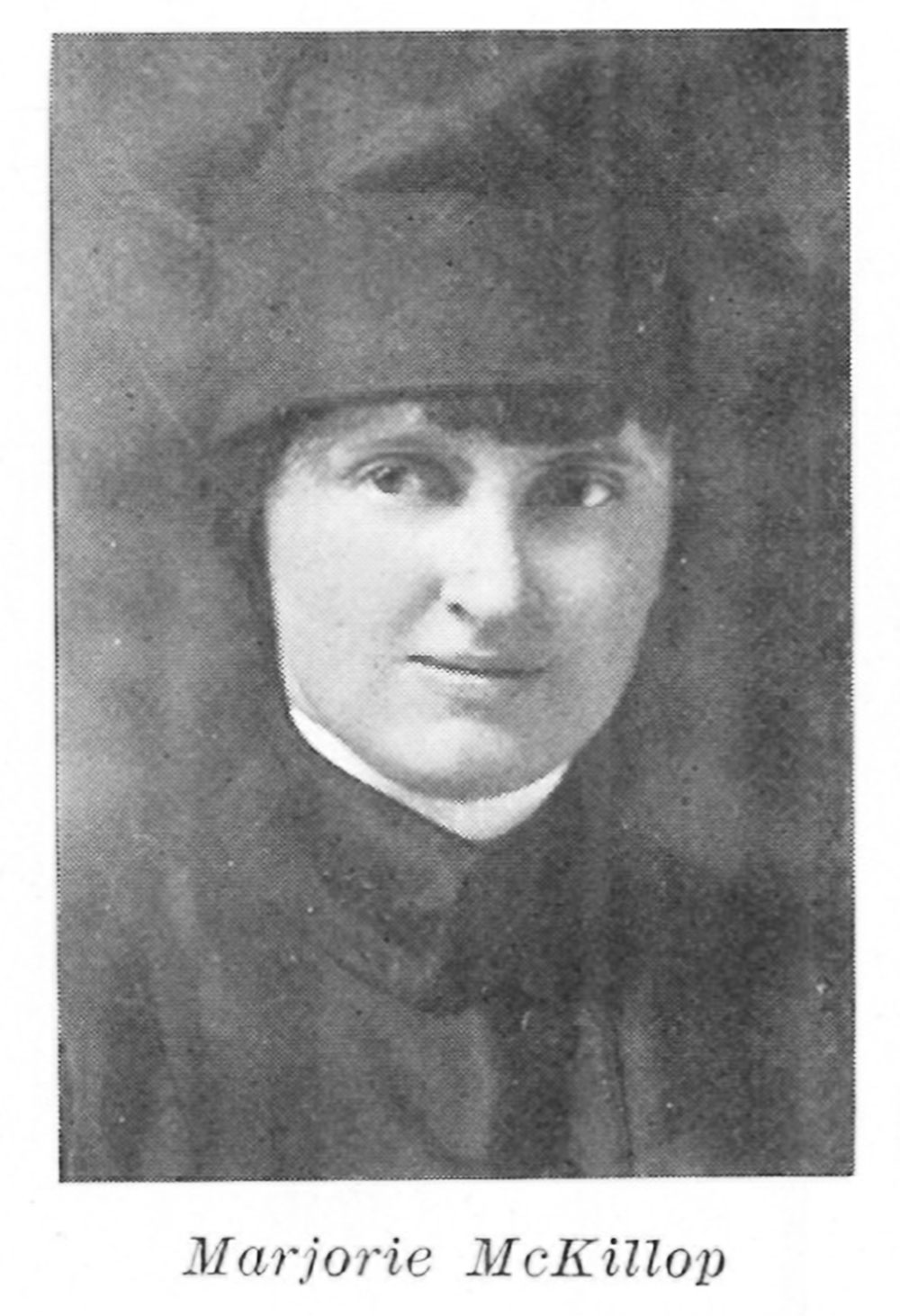
Marjorie McKillop, Telephone Operator in Unit Four of the US Army Signal Corps, 1918. Photo by Tyee Yearbook, 1919. | GGA Image ID # 236fafdca9. Click to View a Larger Image.
Marjorie Leslie McKillop served in Unit 4 of the Signal Corps Telephone Operators. She was ordered with six other operators to Le Havre, where she was stationed until the Armistice.
Affidavit of Marjorie L. McKillop
State of Washington,
County of King, as:
Marjorie L. McKillop, being first duly sworn upon oath, deposes and states as follows :
1. I presently reside at 1000 East Boston Street, Apartment 33, Seattle, Washington 98102. [From] 1917-1918, I was a student at the University of Washington. I was a senior majoring in French.
Sometime in February 1918, I became aware that the United States Army was recruiting French-speaking telephone operators for service in the United States Army Signal Corps in France. There had probably been notices in the French department at the University, but I became aware also from a close friend of mine, Adele Hoppock.
Adele had volunteered and been accepted and enlisted as a member of the Third Unit of telephone operators. I have attached a copy of the University of Washington Daily with the announcement in it that Adele had been accepted for enlistment as a telephone operator.
2. As a child, I had lived in Quebec, Canada, and I had always taken French in school, so I had a very fluent knowledge of the French language.
3. I had an interview with Major Newell, an Army Reserve officer who was working at Pacific Telephone & Telegraph Company in Seattle.
After the interview, I was asked to take a physical examination which I did, and I was ultimately accepted for service with four other girls from the University of Washington. We took the oath of allegiance and were sworn in by Major Newell in February 1918. I have attached another copy of the front page of the University of Washington Daily newspaper which indicates this.
4. I had left Seattle in February as a member of the Fourth Unit of telephone operators. We were ordered to report to Pacific Telephone & Telegraph headquarters in San Francisco, California, for training.
We were assigned to duty in suburban exchanges, it being thought that such telephone experience would approximate that which we would find in France.
In San Francisco, we were boarded out with French-speaking families to improve our French. I, with my schoolgirl French, insulted my hostess.
After about two months of training in San Francisco, we were ordered to report to the American Telephone & Telegraph headquarters in New York City for further training.
Here we were measured and outfitted for our Army uniforms. They were navy blue in color with regulation Army buttons, officers' metal collar insignia, and hats with the orange and white hat cord of the Signal Corps and metal Signal Corps officers' insignia.
After some training, we were ordered to proceed to Hoboken for transport to France. We sailed via Southampton, England, and eventually disembarked at Le Havre in July 1918.
5. We were sent to Tours for assignment. I was ordered with six other operators to Le Havre, where I was stationed until the Armistice. While there, housing was provided in a private house under the auspices of two sisters, YWCA workers from New York City.
6. After the Armistice in November 1918, I was transferred to Paris for service at the peace conference, and I was later transferred to Brest. I was returned to the United States in [the] late summer, 1919.
7. From the time of my enlistment in Seattle in February 1918. until my discharge from the service in 1919, I believed that I was a soldier in the United States Army Signal Corps. I was treated as such by everyone with whom I came into contact, and every other operator, to my knowledge, felt the same way I did.
8. I've always been proud of my service in the United States Army and have always felt that we were entitled to recognition of our service, which we have never received. I still feel this way today.
Majorie L. McKillop.
Subscribed and sworn to before me this 7th day of May, 1977.
March M. Hugh,
'Notary Public in and for the
State of Washington residing at Seattle.
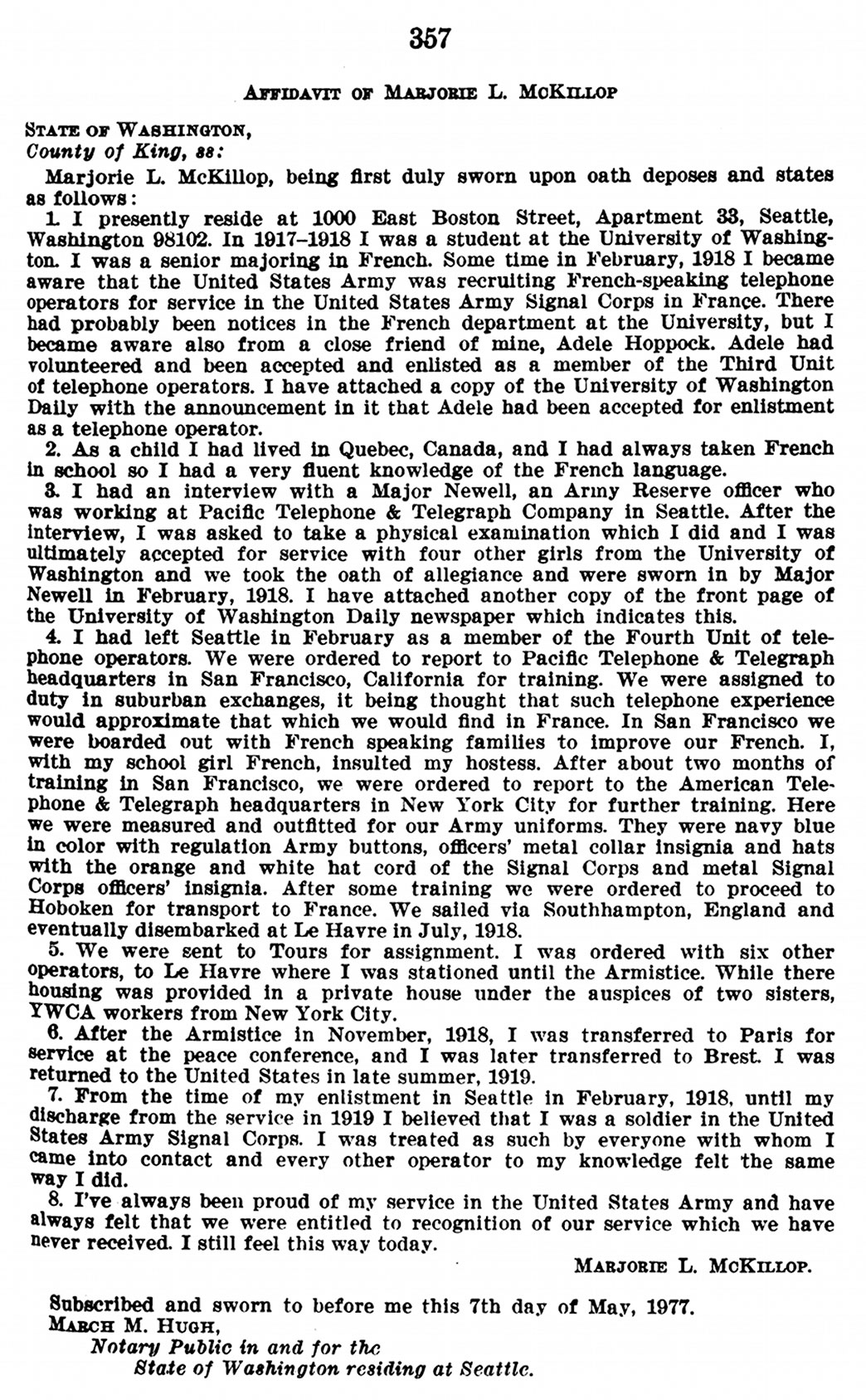
Affidavit of Marjorie L. McKillop, in Recognition for Purposes of VA Benefits, Hearing before the Committee on Veterans' Affairs, United States Senate, Ninety-Fifth Congress, First Session on S. 247, S. 1414, S. 129, and Related Bills, 1977. GGA Image ID # 19aa258f5e. Click to View a Larger Image.
✨ Most Engaging Content
- Student to soldier: UW senior in French, recruited through campus notices and peer networks (Adele Hoppock).
- From classroom to switchboard: Targeted training across suburban exchanges to simulate expected French line conditions.
- Uniforms & insignia: Navy-blue dress, Army buttons, “U.S.” and Signal Corps flags—outward markers of service and status.
- Le Havre hub: Seven-woman detachment sustaining heavy port traffic through the Armistice; later redeployed to Paris/Brest.
- Identity & recognition: She “considered herself a soldier,” mirroring the unit’s shared understanding of duty and discipline.
🖼️ Noteworthy Image
- Marjorie McKillop (Tyee Yearbook, 1919): Clean, period portrait linking the affidavit to her Unit 4 roster identity.
- Affidavit scan (1977): The evidentiary document used in Senate hearings—ideal for researchers verifying claims.
📘 Mini Dictionary for Civilians
- Port of Le Havre: Major French embarkation/debarkation center for AEF logistics and communications.
- YWCA Hostess: Stateside organization providing welfare/housing support to U.S. personnel and women workers overseas.
- Peace Conference duty: Post-Armistice assignments supporting the communications load during the 1919 Paris negotiations.
🎓 Essay Prompts for Students
- How do McKillop’s details about oath, uniforms, and orders reinforce the case for military—as opposed to civilian—status?
- What does the Le Havre detachment suggest about the AEF’s reliance on women operators in port logistics and network reliability?
- Compare McKillop’s trajectory with other Unit 4 testimonies: where do experiences converge or diverge (training, risk, duties)?
- Analyze the role of the YWCA in sustaining morale and operations for the Hello Girls; how did welfare support enable technical performance?
🪶 Citation Block
Chicago: “Appendix B: Affidavit of Marjorie L. McKillop.” In Recognition for Purposes of VA Benefits, Hearing Before the Committee on Veterans’ Affairs, U.S. Senate, 95th Cong., 1st sess., 25 May 1977, p. 357. Washington, DC: U.S. Government Printing Office.
APA: United States Senate. (1977, May 25). Appendix B: Affidavit of Marjorie L. McKillop (p. 357). In Recognition for Purposes of VA Benefits. Washington, DC: U.S. Government Printing Office.
MLA: “Appendix B: Affidavit of Marjorie L. McKillop.” Recognition for Purposes of VA Benefits, Hearing Before the Committee on Veterans’ Affairs, U.S. Senate, 95th Cong., 1st sess., 25 May 1977, p. 357. U.S. Government Printing Office.
Student: “Affidavit of Marjorie L. McKillop (1977),” in U.S. Senate, Recognition for Purposes of VA Benefits, p. 357, via the Gjenvick-Gjønvik Archives (ggarchives.com).
"Appendix B: Affidavit of Majorie L. McKillop," in Recognition for Purposes of VA Benefits, Hearing before the Committee on Veterans' Affairs, United States Senate, Ninety-Fifth Congress, First Session on S. 247, S. 1414, S. 129, and Related Bills. Washington, DC: US Government Printing Office, 25 May 1977. p. 357
