
Exhibit M - Termination of Services - Adele Louis Hoppock - 1919
📖 Review & Summary
What this is: A War Department letter dated 6 September 1919 informing Adele Louise Hoppock that her service with the Signal Corps overseas telephone unit will terminate at the close of business 25 September 1919.
Why it matters: The letter’s impersonal phrasing—especially, “The Chief Signal Officer directs me to express his appreciation of your patriotic services”—captures the bureaucratic tone of rapid demobilization and the gap between lived service and official recognition.
Key details: Origin: War Department, Office of the Chief Signal Officer (Washington, DC); addressee: Miss Adele L. Hoppock (Seattle, WA); signatory: Col. F. R. Curtis, “by direction.” The document later served as part of the evidence trail in the 1977 Senate hearing recognizing the Hello Girls.
Foreword
The directive for the U.S. Army Signal Corps to terminate its overseas telephone unit by September 25, 1919, was part of the rapid demobilization that followed the end of World War I. After the armistice was signed in November 1918, the Army dramatically scaled back its forces, including the communication infrastructure established during the war.
This directive primarily affected the Signal Corps Female Telephone Operators Unit, also known as the "Hello Girls".
Context of the Signal Corps telephone unit termination
- The "Hello Girls": During the war, General John J. Pershing requested the deployment of female telephone operators to France to improve communication on the Western Front. Many of these women were recruited from civilian telecommunication companies, were bilingual in English and French, and were sworn into the U.S. Army Signal Corps.
- Wartime duties: The women served near the front lines, managing telephone switchboards that connected U.S. Army headquarters with troops. Their efficiency and expertise were critical to the Allied effort.
- Post-war demobilization: Once the war was over, the Signal Corps and the rest of the army began a rapid demobilization process.
- Denial of veteran status: After their service ended, the "Hello Girls" were categorized as civilian contract employees and initially denied veteran status and benefits, a fight that would last for decades. They finally received veteran status in 1977.
[Exhibit M]
War Department,
Office of the Chief Signal Officer,
Washington, September 6, 1919.
From : Office of the Chief Signal Officer.
To: Miss Adele Louise Hoppock, 102 Harvard Avenue, Seattle, Washington. Subject : Completion of Services.
1. You are hereby informed that your services as a member of the Signal Corps overseas telephone unit will terminate at the close of business September 25th, 1919, inasmuch as you have completed your duties with the American Expeditionary Forces.
2. The Chief Signal Officer directs me to express his appreciation of your patriotic services.
By Direction of the Chief Signal Officer.
F. R. Curtis,
Colonel, Signal Corps.
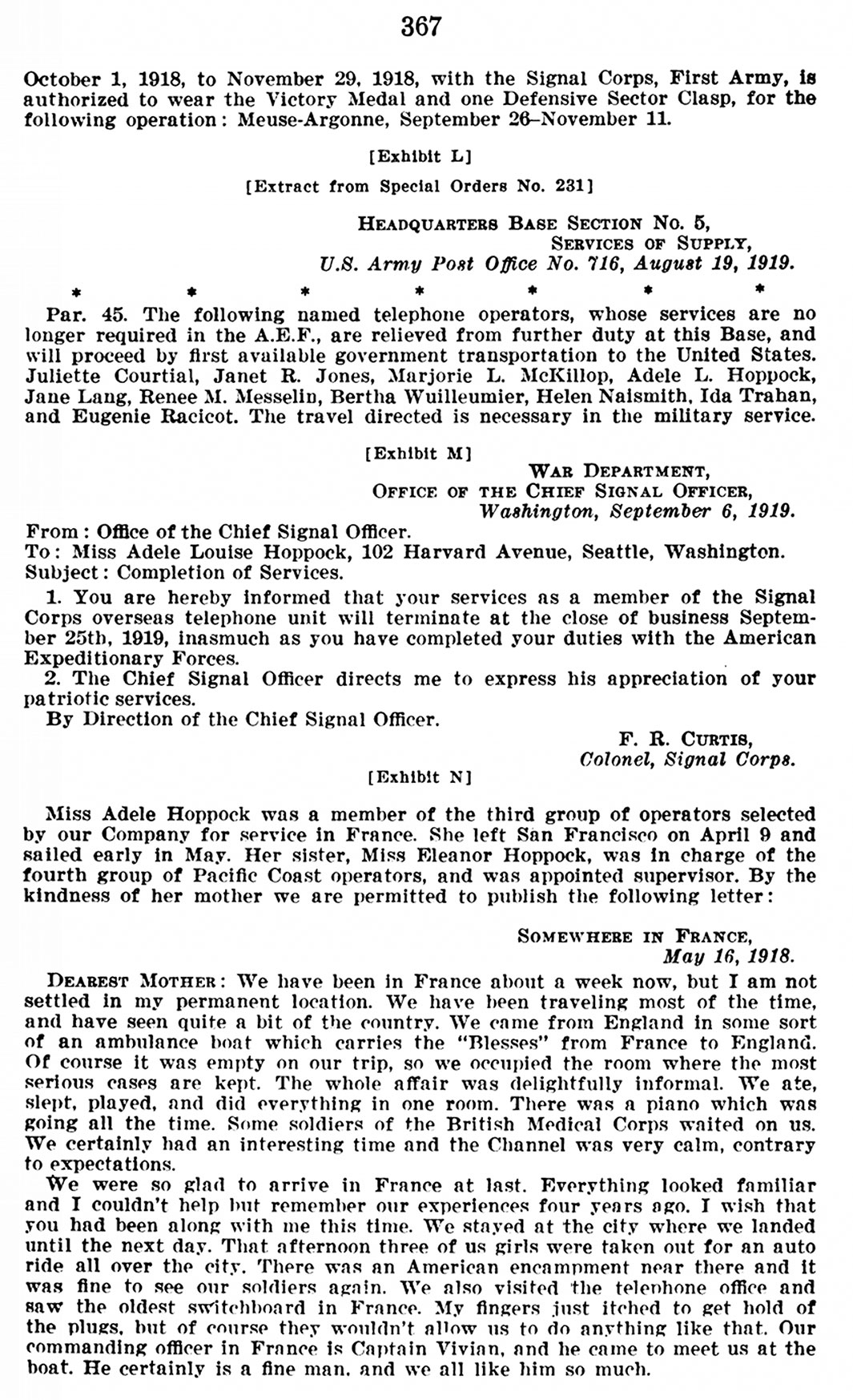
Exhibits L, M, and N, in Recognition for Purposes of VA Benefits, Hearing before the Committee on Veterans' Affairs, United States Senate, Ninety-Fifth Congress, First Session on S. 247, S. 1414, S. 129, and Related Bills. Washington, DC: US Government Printing Office, 25 May 1977. | GGA Image ID # 237077ba74. Click to View a Larger Image.
✨ Most Engaging Content
- Cold type, warm service: A single paragraph ends a year of near-frontline communications work, closing with appreciation conveyed strictly “by direction.”
- Demobilization in miniature: The letter condenses the larger 1919 drawdown into one administrative act—efficient, final, and emotionally distant.
- Evidence that endured: This page later helped operators demonstrate the nature and dates of their service during the 1977 recognition effort.
🖼️ Noteworthy Image(s)
- Original letter scan: Focus on the War Department letterhead, Washington date line (6 Sept 1919), addressee block for Seattle, and the closing formula “By Direction of the Chief Signal Officer” above Col. F. R. Curtis’s signature.
- Hearing-page reproduction (if shown on this page): The exhibit compilation page that groups Exhibits L, M, N together anchors provenance and shows where the termination appears in the official record.
📘 Mini Dictionary for Civilians
- Demobilization
- The rapid drawdown and discharge of military personnel after the Armistice (Nov. 1918), peaking through mid- to late-1919.
- Office of the Chief Signal Officer (OCSO)
- The Army office overseeing communications—telephony, telegraphy, radio, and line construction.
- “By direction” (closing formula)
- Indicates the signer is conveying orders or sentiments on behalf of a superior rather than personally.
- Termination vs. Discharge
- Many operators received “service termination” notices rather than military discharges—an administrative distinction that later complicated veteran-status claims.
🎓 Essay Prompts for Students
- Language of authority: How do phrasing and sign-offs (e.g., “by direction”) shape public memory of women’s military labor?
- Paperwork vs. valor: Compare this termination letter with Pershing’s November 1918 commendation. What tensions emerge between praise and policy?
- Timing and thanks: In what ways did the speed of demobilization influence institutional recognition—or erasure—of contributions?
- Evidence and advocacy: Explain how administrative notices like this one became crucial in the 1977 Senate hearing that recognized the Hello Girls.
🪶 Citation Block
- Chicago (Notes/Bibliography): United States. Senate. Committee on Veterans’ Affairs. Recognition for Purposes of VA Benefits: Hearing Before the Committee on Veterans’ Affairs, United States Senate, Ninety-Fifth Congress, First Session on S. 247, S. 1414, S. 129, and Related Bills. Washington, DC: U.S. Government Printing Office, 1977, p. 367. (“Exhibit M—Termination of Services—Adele Louis Hoppock, 6 September 1919.”)
- APA 7th: United States Senate, Committee on Veterans’ Affairs. (1977, May 25). Recognition for purposes of VA benefits: Hearing before the Committee on Veterans’ Affairs, United States Senate, Ninety-Fifth Congress, First Session on S. 247, S. 1414, S. 129, and related bills (p. 367). U.S. Government Printing Office. (“Exhibit M—Termination of Services—Adele Louis Hoppock, 6 September 1919.”)
- MLA 9th: United States, Congress, Senate, Committee on Veterans’ Affairs. Recognition for Purposes of VA Benefits: Hearing Before the Committee on Veterans’ Affairs, United States Senate, Ninety-Fifth Congress, First Session on S. 247, S. 1414, S. 129, and Related Bills. U.S. Government Printing Office, 1977, p. 367. “Exhibit M—Termination of Services—Adele Louis Hoppock, 6 September 1919.”
- Student (plain English): “Exhibit M—Termination of Services—Adele Louis Hoppock, 6 Sept 1919,” in Recognition for Purposes of VA Benefits (U.S. Senate Committee on Veterans’ Affairs Hearing, 95th Congress, 1st Session), p. 367. Washington, DC: U.S. Government Printing Office, 1977.
"[Exhibit M]: Affidavit of Gertrude Hoppock: Termination of Services - Adele Louis Hoppock, 6 September 1919," in Recognition for Purposes of VA Benefits, Hearing before the Committee on Veterans' Affairs, United States Senate, Ninety-Fifth Congress, First Session on S. 247, S. 1414, S. 129, and Related Bills. Washington, DC: US Government Printing Office, 25 May 1977. p. 367.
