
Birth of the AEF Signal Corps Girls - 1918
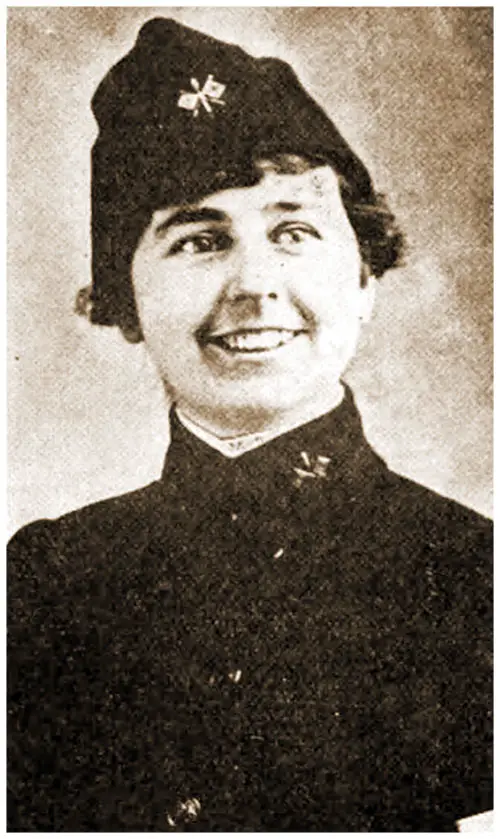
Telephone Girl Gets Distinguished Service Medal in Germany. Miss Grace D. Banker, of Passaic, N. J., Was Recently Decorated with the Distinguished Service Medal at Coblenz. Germany, by Lieut. Gen. Liggett, Commander of the First Army, for Her Exceedingly Meritorious and Distinguished Service in Keeping the Telephone System Open during Operations against the St. Mihiel Salient at and North of Verdun. She Is the Chief Operator of the Army Telephone Service in Germany. Southern Telephone News, July 1919. | GGA Image ID # 19826e577e
📖 Review & Summary
What this page does: it stitches together early notices, training reports, rosters, uniform specifications, and on-the-ground vignettes to show how the U.S. Army Signal Corps' women telephone operators—soon nicknamed the "Hello Girls"—came to be.
Beginning with Gen. John J. Pershing's November 1917 cable requesting fluent bilingual operators, the Army recruited experienced switchboard workers, subjected them to rigorous testing (technical, psychological, security), and began advanced training on 12 January 1918.
The first contingents sailed in March, wearing War College–prescribed uniforms and ranking brassards, and quickly proved indispensable at AEF exchanges near the front. YWCA homes in Paris and Tours supported their welfare; contemporary press accounts and trade journals documented their speed, accuracy, and composure under pressure.
Together these fourteen brief pieces capture the unit's birth—the needs it met, the standards it set, and the expectations it changed.
Foreword
The emergence of the AEF Signal Corps women, affectionately called the "Hello Girls," marked a transformative chapter in World War I. These trailblazing women took on critical roles as telephone operators, connecting military units and facilitating vital communication on the front lines.
Selected for their technical skill, fluency in French, and exceptional professionalism, they became indispensable to the war effort. These women exhibited courage and resilience from the rigorous selection process to their deployment in France.
Their contributions bridged communication gaps and challenged societal perceptions about women's capabilities and roles in wartime.
This introductory piece is a compilation of fourteen early stories about the Hello Girls.
Gen. Pershing Cables Request
Therefore, in early November, Gen. Pershing, commander of the American Expeditionary Forces, made a momentous decision. He sent a cablegram to the Signal Corps of the United States Army, recommending that, due to the immense difficulty in obtaining properly qualified men, a force of women telephone operators speaking French and English equally well should be organized and sent to France.
He required three chief operators at $125 a month, nine supervising operators at $72 a month, 24 long-distance operators at $60 a month, 54 operators at $60 a month, and 10 substitute operators at $50 per month for a total of 100. All should have the allowances of Army nurses and should be uniformed.
With his expertise in recruiting emergency groups of trained workers, Capt. E. J. Wesson, the civilian personnel section of the Signal Corps, was given charge of the proposed unit—meanwhile, Capt. W. S. Vivian was tasked with ensuring the housing and general welfare of the operators in France, a crucial role in the unit's success.
Girls Needed in France
The Army Signal Corps is offering a unique opportunity for young women to serve in a non-traditional role. We will direct the formation of a unit of 150 telephone operators, able to speak both French and English, for immediate service in France.
The operators, enlisted for the duration of the war, will be given the allowances of quarters and rations accorded to many nurses, ensuring their comfort and well-being and pay, and will wear the same uniform.
In seeking recruits for the new service, the announcement of the chief signal officer says:
“Young ladies physically fit with command of the French and English language, desirous of obtaining these positions should apply by mail to Room 826 Mills Building annex, Washington.’’
Telephone Operators Wanted
Applications are for the immediate services of telephone operators for department service in Washington, D. C. The necessity is urgent, and applications will be received until further notice. The salaries will range from $66 to $72. Applicants will be required to answer only two questions: the amount of education, which will count for 30 points, and the experience, which will count for 70 points, making 100 counts in all.
Competitors will be rated based on the sworn statement in their application and upon the corroborative evidence provided by the commission. Applicants must have the equivalent of six grades of common school. They must have had at least one year’s experience as an operator in a large central office or at least two years’ experience in any other branch exchange. Applications should be executed appropriately, excluding the medical and county officers’ certificates, and filed with the Civil Service Commission in Washington, D.C.
The original notice was placed by the US Civil Service Commission in 1918 to hire women for telephone operator positions during World War I. The monthly salary of $66 to $72 was comparable to the average entry-level office position at the time.
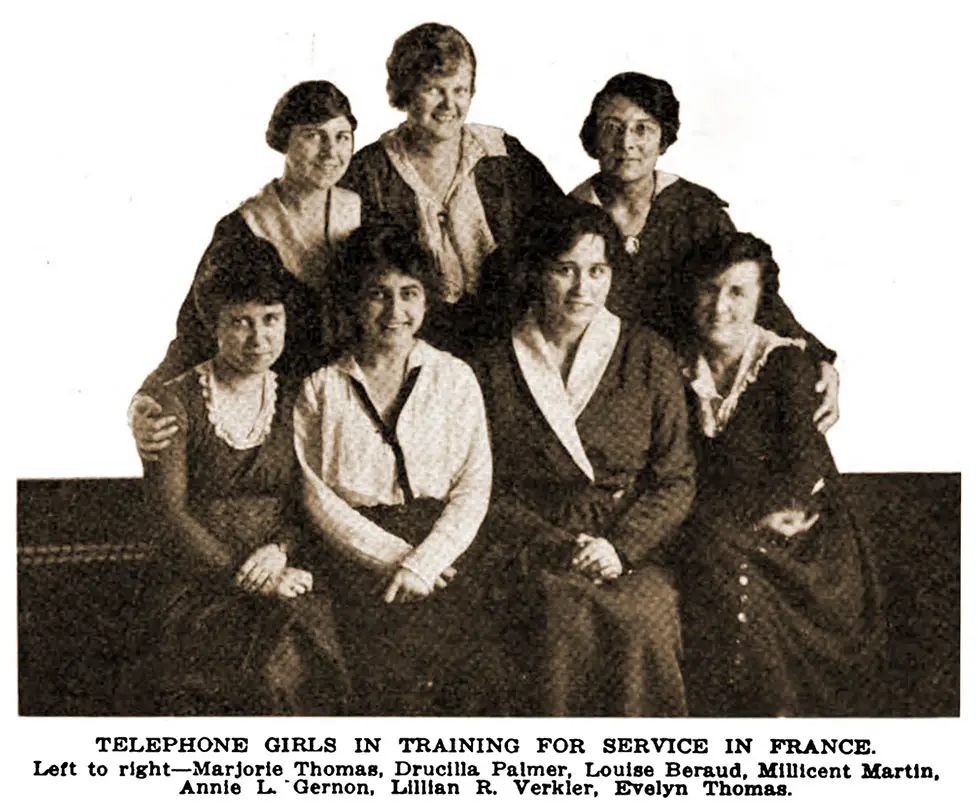
Telephone Girls in Training for Service in France. Left to Right: Marjorie Thomas, Drucilla Palmer, Louise Béraud, Millicent Martin, Annie L. Gernon, Lillian R Verkler, Evelyn Thomas. Bell Telephone News, March 1918. | GGA Image ID # 19a7c3a9d5. Click to View a Larger Image.
Small Percentage Qualified
Thinking it might be possible to obtain telephone operators with equal command of both languages in parts of the country with large numbers of French inhabitants, an effort was first made to get the group from Montreal, Canada, and Louisiana.
The announcement was placed in French-Canadian papers, and 300 to 400 women applied. Out of these, only 6 could be considered.
The announcement was then made to the country's press and telephone companies. A list of 2,400 applications was received, which yielded the names of 2 experienced operators who could speak both languages and 25 possible éligibles.
To this date, 7,600 applications have been received. In addition to the 100 that have been sent over, 150 fully equipped soldiers are now in training schools to meet a possible demand, and a list of 400 as a reserve force is on file.
Rigid Tests Required
Upon filling out the application blanks, which asked for facts about age, nationality, knowledge of French and English, previous telephone experience, and health and demanded a promise to serve for the duration of the war, the candidate whose answers indicated satisfactory qualifications was examined by the manager of the local telephone company, who had been authorized by the Signal Corps.
A full report on the applicant's ability and character was submitted to a board of experts in New York. A psychologist administered tests to prospective operators similar to those used by the Army to examine officers.
Also, since the work the unit would perform was of a confidential military nature and would give the members important knowledge of the movements of troops, Secret Service agents thoroughly investigated their loyalty and motives for applying for service.
Began Training 12 January 1918
On January 12, the first group entered the training schools to be trained in advanced telephony. Practice was then given in the largest private branch exchange in New York, followed by three days' work in cantonment telephone exchanges to familiarize themselves with military terms.
During the training period, the women were given military drills every day. Officers of the Signal Corps delivered lectures on the duties of that branch of the Army and its traditions.
The importance of the lines of communication in modern warfare was explained, and the various duties of the divisions of the Signal Corps were outlined. Women surgeons gave talks on personal hygiene.
On March 2, the first contingent sailed, and later in the month, American officers in France were agreeably surprised by hearing over the military telephone operators who used American terms, gave splendid service, and could translate the message of a French officer to an American officer, or vice versa. A second group sailed on March 16, and a third during the latter part of April. They were stationed in groups of 10 in American bases of supplies and points of embarkation.
The members of the Woman's Telephone Unit were required to pass strict health examinations. They were also inoculated and vaccinated like American soldiers.
Out of 60 girls who were inoculated, not one fainted. An officer who has seen many soldiers meet the same experience said this was most unusual.
The War College designed and prescribed the uniform. It consisted of a navy blue serge coat and skirt, strictly tailor-made; a tailored shirtwaist of navy blue palm beach cloth or similar material; and a straight-brimmed hat of blue felt, with the official orange and white hat cord of the Signal Corps.
The brassard on the left sleeve of the coat is made of white whipcord or doeskin. It bears small devices indicating the status of the chief operator, supervisor, and operator.
"It would be impossible to brigade an American troop without these girls," Captain Wesson, who has recruited the unit, states. "They will astound the people over there by their work efficiency. "
In Paris, it takes 40 to 60 seconds to complete one telephone call. Our girls are equipped to handle 300 calls an hour. The English Women's Army Auxiliary Corps, the "WAACA," is doing similar work, but they are not equipped with fluent French knowledge, and the American system of telephony has always been better than the European one.
Uniforms for Operators
Telephone operators are needed for duty abroad with the American forces. Young women who are physically fit, speak both French and English fluently, and are willing to be sent abroad are needed.
It is preferred that they have experience operating telephone switchboards, but an opportunity to learn this will be offered in case an insufficient number apply who are skilled in both telephony and French.
The women selected will wear olive-drab uniforms like those worn by officers and men in the army. The unit of telephone operators now being organized is the only unit composed of women who will wear army insignia.
The uniform will include the army campaign hat with the signal corps hat cord, a long olive-drab cape, a medium-length coat on the same general lines as the present army service coat, an English walking skirt, and tan shoes.
The salaries offered range from fifty dollars for substitutes, sixty dollars for local operators and toll operators, and seventy-two dollars for supervisors, to a hundred and twenty-five dollars for chief operators, plus, in each instance, rations and quarters as accorded army nurses.
Transportation will be furnished from their homes to Washington and, of course, from Washington to the point abroad they will be sent.
Operators for France
The first group of thirty-three operators, the pioneers of a new era in military communications, is ready for service in France. They will be attached to the Signal Corps and report to the Chief Signal Officer, occupying a unique and esteemed position in the American military organization.
The group, in adherence to international law, includes one chief operator, four supervisors, and twenty-four operators. The War College at Washington specified the blue uniforms and the hat on which the Signal Corps hat cord is worn. The devices embroidered on the white brassard indicate the operators' ranking, as the operators are non-combatants.
The brassard worn by a junior operator has a black telephone transmitter embroidered on it. The brassard of a supervisor has a laurel wreath underneath the transmitter, and the brassard of a chief operator has the two symbols mentioned, surmounted by a streak of lightning in yellow.
The second unit includes thirty-seven young women recruited from Atlantic to Pacific telephone exchanges.
Although ten states are represented in the second unit, New York, Illinois, and California furnished most of its members. The Chicago women awaiting orders to go are Millicent Martin, Helen R. Orb, Drusilla Balmer, Evelyn Thomas, and Marjorie Thomas.
Girls Join Signal Corps
A new unit of Signal Corps telephone operators comprises twenty-eight young women in charge of Miss Nellie F. Snow, chief operator, formerly a chief operator for the New England Telephone & Telegraph Company in Lowell, Mass. Two supervisors are attached to the unit: Miss Marie L. Beraud of West Hoboken, N. J., and Miss Elizabeth E. Roby of Chicago.
Seven members of the unit are from California, six from Massachusetts, five from Illinois, four from New York State, three from New Jersey, and one each from Washington, Minnesota, and Ohio.
The operators are:
- Miss Marie B. Belanger of Rochester, New York
- Miss Suzanne M. Beraud of West Hoboken, New Jersey
- Miss Michele F. Blanc of Boston, Massachusetts
- Miss Marie L. Bousquet of San Francisco, California
- Miss Suzanne Coheleach of Astoria, Long Island, New York
- Miss Lucille de Jersey of Covina, California
- Miss Miriam de Jersey of Covina, California
- Miss Frances des Jardins of New York, New York
- Miss Maria Flood of Chicago, Illinois
- Miss Yvonne M. Gauthier of Lowell, Massachusetts
- Miss Louisette N. Gavard of Newark, New Jersey
- Miss Blanche Grand-Maitre of Minneapolis, Minnesota
- Miss Adele L. Hoppock of Seattle, Washington
- Miss Bertha M. Hunt of Berkeley, California
- Miss Margaret Hutchins of New York, New York
- Miss Janet R. Jones of Newark, Ohio
- Miss Hope Kervin of San Francisco, California
- Miss A. Maude McMullen of Fitchburg, Massachusetts
- Miss Margaret H. Milner of Berkeley, California
- Miss Eugenie Racicot of Lowell, Massachusetts
- Miss Dorothy L. Sage of Evanston, Illinois
- Miss Martha Steinbrunere of San Francisco, California
- Miss Bertha J. Verkler of Chicago, Illinois
- Miss Lillian R. Verkler of Chicago, Illinois
- Miss Berthe Wuilleumier of Boston, Massachusetts
How the Signal Corps Organized 100 Girls
Army Telephone Operators in France Speak Both English and French
The Division on Woman's War Work, Committee on Public Information, issues the following:
Owing to the problems that the use of two languages presented to the American troops in France and the necessity of accurate intercommunication between the American and French Armies, the Signal Corps has sent 100 trained women telephone operators abroad who speak both French and English fluently, to work in military telephone exchanges in bases of supplies and points of embarkation. In 1917, male operators and French women were used for this work. Neither group proved satisfactory.
Classified in Groups
The group of 100 is mostly composed of French girls who have come to America or American girls who have lived in France. The unit was sent in groups of 3, each with about 30 girls. Groups Nos. 1 and 2 are made up of experienced telephone operators.
Group No. 3 consists of girls who have been given intensive emergency training in telephony. These girls, for the most part, come from New York State. California and Massachusetts sent the next largest numbers. Seventy-two percent are Americans; 28 percent are foreign-born—French, Belgian, Canadian, English, Swiss, and Dutch East Indian.
Under existing laws, wives of Army officers and enlisted men liable for duty abroad are not eligible for membership in this unit.
An unauthorized statement, which appeared in many papers, said that a unit of telephone girls was to be organized and that many women whose husbands were officers had thus found a way to go abroad. This statement occasioned an enormous number of applications and met with an emphatic denial from the Signal Corps.
Personnel of the Unit
The personnel of the Woman’s Telephone Unit follows :
- Melina J. Adam
- Margaret Anderson
- Eulalie I. Audet
- Grace Banker
- Julie Barrere
- Emma Marie Brousseau
- Almería Capistran
- Bertha A. Carrel
- Mrs. Inez Crittenden
- Josephine Davis
- Cordelia Dupuis
- Sara Fecteau
- Marie Louise Ford
- Anna C. Fox
- Esther Fresnel
- Marie A. Gagnon
- Lydia C. Gelinas
- Charlotte Gyss
- Darnaby Henton
- Martina Heymen
- Denise Ingram
- Ethel Keyser
- Florence F. Keyser
- Marie S. La Blanc
- Leontine Lamoureux
- Nellie Martin
- Mrs. Pauline McDermott
- Kathleen Mitchell
- Minerva G. Nadeau
- Helen A. Naismith
- Frances Bigelow Paine
- Drucilla Palmer
- Laurence Helene Pechin
- Bertha Plamondon
- Suzanne Prevot
- Minnie R. Richards
- Katharine Robinson
- Olive M. Shaw
- Marion A. Taylor
- Evelyn Thomas
- Isabelle Villiers
- Ethelyn White
- Mrs. Clara Whitney
- Margaret S. Bleyers
- Jeanne Bouchet
- Martha L. Carrel
- Louise Essirard
- Anna Laborde
- Louise Le Breton
- Raymonde Le Breton
- Marie Antonette Neyrat McEntyre
- Renee Messelin
- Marie Ponsolle
- Georgette Schaerr
- Albertine Aarents
- Edith Dodson
- Martha Libert
- Estelle I. Caron
- Jean Cunningham
- Anallen Jackson
- Agnes M. Theriault
- Winifred Hardy
- Elizabeth Hunter
- Alice V. Ward
- Helen F. Perreten
- Dee Van Balkom
- Suzanne M. Béraud
- Louisette H. Gavard
- Margaret Hutchins
- Lucille De Jersey
- Bertha M. Hunt
- Margaret H. Milner
- Martha Steinbruner
- Marie Floyd
- Dorothy L. Sage
- Bertha H. Verkler
- Lillian V. Verkler
- Yvonne M. Gauthier
- Eugenie Racicot
- Maude McLowell
- Michele F. Blanc
- Marie B. Belanger
- Marie L. Bousquet
- Suzanne Coheleach
- Frances Des Jardine
- Blanche Grand Maitre
- Adele L. Hoppock
- Janet R. Jones
- Hope Kerkin
- Miriam De Jersey
Girl Operators Replace Jackies
Great Lakes, Illinois Naval officials have concluded that girls make better telephone operators than men. Therefore, the twenty-one yeomen acting as operators will be succeeded by fifteen expert "hello girls."
Where the sailors worked in three shifts day of seven men each, the girls did the same work in three shifts of five.
The girls were selected from the best operators at the Chicago Telephone Company's city exchanges. They have just completed a two-week period of special training for the particular needs of the naval telephone business.
They are employed as civilian workers and are not enlisted as "yeomanettes." The twenty-one yeomen whose places they are taking will soon be sent for active service as seamen aboard ship, which is a second reason for employing girls, to follow Secretary Daniels' order to eliminate "land sailors" wherever possible.
The girls' first shift went to work Saturday night, August 24, immediately after the naval station's central telephone office was transferred from its quarters in the administration building to the new post office building near the main gate.
The new exchange has an up-to-date twelve-position switchboard. The girls will handle the calls of 46,000 enlisted men and officers.
The average is 12,600 calls every twenty-four hours, and the maximum is about 15,000 a day. The station has 525 telephones.
Our Girls Over There
To the 100 girls from America now serving as military telephone operators in France, 150 more in training schools here may soon be added, leaving a reserve force of 400 more on file out of about 8,000 applications. The young women who have been accepted for this work have undergone tests as severe as those to which a soldier at the front is subjected. These tests included physical endurance tests, mental acuity assessments, and simulations of wartime communication scenarios, demonstrating the dedication and commitment of these women to their roles.
Operating from telephone exchanges just a stone's throw from the front lines, these brave women must possess a unique blend of courage and composure, even in the face of danger.
'"These girls," said Capt. E. J. Wesson, who recruited the unit, "will astound the people there by their efficiency. In Paris, it takes forty to sixty seconds to complete one call. Our girls are equipped to handle 300 calls an hour."
Reports from the war department in France are testament to the rapid progress of the American Hello girls. They are excelling in a task as challenging as navigating the back of the front-line trenches, a feat that fills us with pride.
The first group of operators entered a training school in Chicago on January 12 for instruction in advanced telephony. This comprehensive training included in-depth lessons on telecommunication systems, signal processing, and troubleshooting techniques. They received practice in the largest New York exchanges and were tried at military cantonments. The course also included talks on personal hygiene, ensuring that these women were not only skilled in their technical roles but also maintained their health and well-being in the challenging wartime conditions.
The first contingent sailed on March 2. Other groups sailed in March and April and were stationed at supply depots and debarkation bases.
In addition to speaking French and English fluently, every one of these girls has passed a loyalty test. This test was designed to ensure that they could be trusted with sensitive military information, a testament to the high level of trust and responsibility placed on these women in their roles as military telephone operators.
The uniform consists of a navy blue serge coat and skirt, a navy blue Palm Beach cloth shirtwaist, and a straight-brimmed hat of blue felt with the regulation orange and white cord of the signal corps. The white cord on the left sleeve designates the rank, such as operator, supervisor, chief operator, and so on.
Independents Help Signal Corps Recruiting
Extract from the Report of the Secretary of the Eastern Independent Traffic Association to the National Convention by H. E. Bradley
The Keystone Telephone Company of Philadelphia, in a generous gesture, offered to use its school room. This allowed us to start two classes in local operating work on March 11 with 30 girls.
One class was held on Monday, Wednesday, and Friday evenings, and the other on Tuesday, Thursday evenings, and Saturday afternoons.
The first session opened at seven and was dismissed at 9:30. Despite the late hours, the girls' dedication was evident as most had assembled by 6 o'clock at all succeeding sessions, and we almost had to drive them away from the school.
After two weeks of instruction in this evening school, the girls' hard work paid off. 11 of them passed a rigid examination in local operating with an average of 90 percent or better, two had a perfect rating of 100 percent, and several others came very close to the mark. This success is a testament to the effectiveness of our training program.
After five weeks of instruction in long-distance work, they were sworn in on May 9 and are now part of the Signal Corps. On May 15, they were put into the exchanges of the United Telephone & Telegraph Company to acquire experience under all sorts of operating conditions.
Some are in the large exchanges, while some are on rural lines, and they have been moved about until all are familiar with all kinds of equipment.
Their training is about finished, and they will soon be going over, where Captain Vivian, a seasoned veteran in telephone operations, will take them in hand. As they trained according to the rules published by the United States Independent Telephone Association, we have every reason to believe that he will be proud of them.
Over 200 operators are now in France, and these units are currently closed, but I have no doubt that if more are called for, the Independents will be asked to furnish their share.
In the beginning, I stated that the various committees had failed to make detailed reports of their work to our Washington office. Today, Mr. MacKinnon's office should have on file a complete and thorough record of every man or woman who has entered any branch of government service from an Independent telephone company. This meticulous record-keeping ensures transparency and accountability in our operations.
Only by keeping such a record could he intelligently present a report showing this organization's activities to the proper officials.
Chicago Girls for France
Over the vitally important war telephone lines of the United States army "over there" soon will echo the voices of Chicago girl operators.
A number of these girls are finishing intensive training for work at a suburban Chicago Telephone Company station. Within a short time, they will depart for the east on a ship bound for France.
Misses Marjorie Thomas, Drucilla Palmer, Louise Beraud, Mellicent Martin, Annie L. Gernon, Lillian R. Verkler, and Evelyn Thomas are among the young women.
The first requirement for a volunteer is that she speaks French fluently. Five of the seven named have lived in France for two to five years, and the two others studied the language at the University of Chicago.
They will be the only women in France to wear regulation uniforms, with hat cords and arm brassards.
Evidence of their patriotism in volunteering for the service is offered by what they are giving up here.
One surrenders a position with a real estate firm paying more than most men her age earn; another has an established studio of art; one has a lucrative private secretaryship; and another is in her senior year at the University of Chicago, with private tutoring engagements.
"We are fitted for the work and want to do our bit," they say.
As previously announced, the Signal Corps is making a call for girls to go to France. Here is a sample of what the American operators may hear :
“Les deux fils sont en contact; isolez No. 1, ferons de meme ici ; nous permettra employer fil No. 2 en attendant enlevement du contact.”
Meaning in wire parlance :
"Both wires in contact; free No. 1; will do same here. This will enable us to work on wire No. 2 while a defect is being removed."
The girls must also learn that to "faire un branchement" is to tap a wire, among many other things that don't come through the local exchange on ordinary days.
The American telephone lines in France connect not only the country's military forces but also directly with the French government system, and unless the operator has a very good command of French, she need not try the job.
The Government wants resourceful and initiative girls who can "go it alone" if need be. Over a hundred girls have already been accepted for the work. As soon as the girls can be found, they will be trained, either at home or in a training center, and then sent over to help win the war.
The girls will wear a uniform prescribed by the War College and will say farewell to all other kinds of dresses from the day they start work until it's over Over There. Operators will wear a white brassard with a black telephone transmitter on it. Supervisors will have a gilt laurel wreath under the transmitter, and the chief operator will have the gilt lightning belts of the Signal Corps.
Operators will get $60 a month, supervisors $72, and chief operators $125. In addition to the pay, rations and quarters will be given.
All chief operators in local telephone exchanges will give information to applicants, and blanks can be procured for application from the Chief Signal Officer of the army, Room 826 Mills Building Annex, Washington.
Hundred French-Speaking Operators Wanted—Rush!
The success of General Pershing’s heavy blows against the Hun line has been materially aided by the almost superhuman resourcefulness of men in the United States Signal Corps. This is the story brought back from France by every returning officer.
The telephone branch of the Signal Service has covered itself with glory, time and again. The “Stars and Stripes” in a recent issue featured a front-page story whose headlines give some idea of the stirring account that followed:
Is everybody Safe? No, Not Exactly, but Holding On. Soldiers of the Telephone Precede Infantry in Hill 230 Attack.
Wires Alone Keep Pace
"Brigade Terrible" Runs Ahead of Guns and Supplies, but Can't Lose Signal Corps It is not only in the battle areas that the Signal Corps' telephone units are giving distinguished service, for a vast network of American telephone lines links every outpost to every center of the vast United States military and naval organization in Europe.
At present, the Signal Corps needs 100 additional men who speak French fluently for service as switchboard operators. French-speaking men without previous experience in telephony will be accepted, trained in this country, and sent to France without delay.
This is an unusual opportunity for men eager to be in at the finish of Kaiserdom. It gives them a chance to join a highly specialized arm of the service and to "go over" without months of training and waiting on this side.
Applications should be sent immediately, by telegram or letter, to the Chief Signal Officer, Washington, D. C. They should state the applicant's name, age, and qualification—the ability to converse in French is paramount—together with his present status in the draft and the name and address of his draft board.
The Phonettes
They’re here and there. They say “seventy-five” instead of “sixty-fifteen” as the French do. They say “Hold the wire” instead of “Attendez un moment”; “General Pershing” instead of “le General Peurchigne,” and “Thahnkew!” instead of “Mairrsee!” In short, it seems like home to hear them talking over the wires.
The original 33 of the phonettes’ expeditionary forces have done their jobs well. Equally at home in French and English, they juggle the two languages with marvelous dexterity without disturbing a backcomb. Their work is important. We wonder how we got along without them all this time.
But, best of all, they never say, “A dollar and a half extra, please! You talked with the young lady for three-quarters of an hour overtime.”
In the first place, they only attend to calls on army business. In the second, there aren’t any dollar-and-a-halfs in France. So they haven’t had a chance to deliver that irritating message of bygone days.
Our relations are wholly pleasant. We thank them.—The Stars and Stripes, published in France.
Girls in France Protest Nicknames
The YWCA War Work Council announced that American telephone girls in France have registered the same kind of protest against nicknames that soldiers have.
The War Department has transmitted its protest against the “hello girls” appellation. According to an official statement, the unit will be known as the Woman’s Telephone Unit of the American Signal Corps.
The YWCA has opened two homes for these girls: one at 32 Rue Hamelin, Paris, formerly the Hotel Ferras, in charge of Mrs. Lulu Erick Taylor of Detroit, and the other at Tours, formerly the Hotel Moderne, in charge of Miss Elizabeth F. Fox of New York.
The girls operate typical American telephone exchanges installed by American telephone men and handle all telephone connections between headquarters and the different bases for the American Expeditionary Forces.
The YWCA War Work Council, under the supervision of the Commission on Training Camp Activities, established the homes and foyers provided for the girls.
Condolences to Grace D. Banker on Father's Death
The chapter extends sympathy to our "soldier," Grace Banker, who lost her father in July. Grace has been in France at General Headquarters for six months and is proudly wearing her first service stripe. The Signal Corps girls are winning all sorts of praise for their good work, and Grace, as head supervisor of the first unit, deserves the greater part of the praise.
Fredericka Belknap's brother has been stationed at G. H. Q. for several months and reports that Grace looks unusually well. The girls are located in a very attractive Hostess House, equipped with every convenience. American girls are so scarce in France that they are more than popular with the officers at Headquarters, and they eagerly attend the occasional dances that the girls give.
In the last report, Grace said she had been "renewing her youth" by bicycling with the aforementioned Gamma Phi brother. Letters from home are eagerly welcomed, and she would dearly love to hear from Gamma Phis. Address her, Chief Operator Grace D. Banker, Telephone Unit, U. S. Signal Corps, General Headquarters, A. P. O. 706, American Expeditionary Forces, France.
Conclusion
The legacy of the AEF Signal Corps women is one of resilience, service, and trailblazing achievement. Through their linguistic abilities, technical expertise, and unwavering dedication, these pioneering women upheld the highest standards of professionalism while operating under challenging wartime conditions. Their efforts contributed to Allied success in World War I. They opened doors for future generations of women in the military and other male-dominated fields. Their story remains a testament to the power of determination, skill, and the human spirit in overcoming adversity and impacting history.
✨ Most Engaging Content
Quick Timeline (1917–1918)
- 8 Nov 1917: Pershing cables Washington requesting 100 bilingual women operators with nurse-equivalent allowances.
- 12 Jan 1918: First class begins advanced telephony training; military drills and hygiene lectures included.
- 2 Mar 1918: First contingent sails; second on 16 Mar; a third follows in late April.
- Mid-1918: Additional units organized; recruitment expands nationwide via telephone companies and independents.
"Decoding the Uniform" (at a glance)
- Hat cord: Signal Corps orange & white.
- Brassard devices: black transmitter (operator); + laurel (supervisor); + lightning bolts (chief operator).
- Cut & color: navy/olive-drab service coat & skirt; long cape for field wear.
Performance & Bilingual Edge
- American operators handled ~300 calls/hour, translating on the fly between French and English procedure.
- Contemporary accounts contrasted U.S. throughput with Paris exchanges (often 40–60 sec per completed call).
Support & Welfare
- YWCA homes at 32 Rue Hamelin (Paris) and Tours served as safe, stable bases between shifts.
🖼️ Noteworthy Image(s)
- Hero (used above): Grace D. Banker receiving the DSM, Coblenz, 1919. Suggested alt: "Chief Operator Grace D. Banker receives the Distinguished Service Medal from Lt. Gen. Liggett, Coblenz, 1919."
- Recommended supporting images (if available in GG Archives):
- Training room or PBX positions (stateside), to visualize pre-deployment instruction.
- Close-up of Signal Corps brassards (operator/supervisor/chief) to illustrate rank devices.
- AEF exchange near the front (Meuse–Argonne / St. Mihiel) to show proximity to operations.
- YWCA home exterior/interior (Paris or Tours) for welfare context.
- For social cards: use a 1200×630 crop centered on the medal presentation; keep rank insignia and faces in-frame.
📘 Mini Dictionary for Civilians
- AEF (American Expeditionary Forces): U.S. forces in Europe during WWI under Gen. John J. Pershing.
- GHQ: General Headquarters of the AEF; hub for planning and communications.
- Signal Corps: Army branch responsible for all communications (telephone, telegraph, radio, visual).
- PBX (Private Branch Exchange): Manual switchboard system used to route calls within an organization.
- Central office: A telephone company exchange that connects local subscribers to each other and to long distance.
- Brassard: An armband worn on the sleeve indicating assignment/rank; operators wore distinct Signal Corps devices.
- Hat cord: Colored cord encircling the service hat; orange & white denoted the Signal Corps.
- WAAC (UK): Women's Army Auxiliary Corps (British); sometimes referenced in contemporary U.S. accounts for comparison.
- Foyer (YWCA): A staffed residence & social center supporting women workers near bases and cities in France.
🎓 Essay Prompts for Students
- Origins & Need: Using Pershing's cable and early recruiting notices, explain why bilingual women operators were mission-critical to the AEF.
- Selection & Testing: Evaluate the recruitment pipeline (technical experience, language, psychological and security vetting). How did this shape unit culture and performance?
- Uniforms & Status: What did brassards and hat cords communicate about role and rank? How did uniforms affect public perception and operators' identity?
- Throughput vs. Doctrine: Discuss how manual switchboard performance influenced AEF command-and-control during major operations (e.g., St. Mihiel, Meuse–Argonne).
- Welfare & Morale: Analyze the YWCA's role in making sustained high-performance work possible for the operators.
- Language & Trust: Consider how translation at the switchboard affected the speed, accuracy, and security of orders between U.S. and French commands.
🪶 Citation Block (Chicago, APA, MLA + student version)
Cite This Page (GG Archives)
Chicago (Notes/Bibliography)
Gjenvick-Gjønvik Archives. "Birth of the AEF Signal Corps 'Hello Girls' (1918)." Hello Girls: Introduction & Context. Menomonee Falls, WI: GG Archives, 2025. Accessed [Month Day, Year]. https://www.ggarchives.com/MIL/HelloGirls/Intro/BirthOfTheAEFSignalCorpsGirls-1918.html.
APA 7
Gjenvick-Gjønvik Archives. (2025). Birth of the AEF Signal Corps "Hello Girls" (1918). In Hello Girls: Introduction & Context. https://www.ggarchives.com/MIL/HelloGirls/Intro/BirthOfTheAEFSignalCorpsGirls-1918.html
MLA 9
Gjenvick-Gjønvik Archives. "Birth of the AEF Signal Corps 'Hello Girls' (1918)." Hello Girls: Introduction & Context, GG Archives, 2025, https://www.ggarchives.com/MIL/HelloGirls/Intro/BirthOfTheAEFSignalCorpsGirls-1918.html. Accessed [Day Mon. Year].
Student Quick-Cite
"Birth of the AEF Signal Corps 'Hello Girls' (1918)." GG Archives. https://www.ggarchives.com/MIL/HelloGirls/Intro/BirthOfTheAEFSignalCorpsGirls-1918.html (accessed [Month Day, Year]).
Source Crosswalk (Sections → Bibliography)
| Sec. | Section Title | Bib Ref | Notes |
|---|---|---|---|
| 1 | Foreword | — | Editorial framing. |
| 2 | Gen. Pershing Cables Request | B9 (+ Docs) | Summarized in How the Signal Corps Organized 100 Girls (B9); primary doc also lives in Docs (Pershing cable, 8 Nov 1917). |
| 3 | Girls Needed in France | B2 | Telephone Engineer, Jan 1918, p. 4. |
| 4 | Telephone Operators Wanted | US Civil Service Commission, 1918 | |
| 5 | Small Percentage Qualified | B9 | Application volumes, bilingual requirements, and yields. |
| 6 | Rigid Tests Required | B9 | Technical, psychological, and loyalty/SS vetting. |
| 7 | Began Training 12 January 1918 | B9 | Training start date; drills, hygiene lectures, PBX practice. |
| 8 | Uniforms for Operators | B3 | Telephone Engineer Management, Feb 1918, p. 91. |
| 9 | Operators for France | B5 | Telephone Engineer Management, Apr 1918, p. 204. |
| 10 | Girls Join Signal Corps | B6 | Telephone Engineer Management, May 1918, p. 259. |
| 11 | How the Signal Corps Organized 100 Girls | B9 | Core synthesis article (Aug 1918, pp. 69–70). |
| 11a | Classified in Groups | B9 | Breakdown of Groups 1–3; composition and language mix. |
| 11b | Personnel of the Unit | B9 (+ B6) | Roster details mainly from B9; some names echoed in B6 unit notice. |
| 12 | Girl Operators Replace Jackies | B10 | Telephone Engineer, Nov 1918, p. 196 (Great Lakes naval exchange story). |
| 13 | Our Girls Over There | B7 | Telephone Engineer Management, Jul 1918, p. 49. |
| 14 | Independents Help Signal Corps Recruiting | B8 | Telephone Engineer, Aug 1918, p. 68. |
| 15 | Chicago Girls for France | B4 | Telephone Engineer Management, Mar 1918, p. 130. |
| 16 | Hundred French-Speaking Operators Wanted—Rush! | B11 | Telephone Engineer, Nov 1918, p. 233. |
| 17 | Wires Alone Keep Pace | B15 | Telephony Nov 2, 1918, p. 16. |
| 18 | The Phonettes | B12 | The Stars and Stripes excerpt as reprinted in Telephone Engineer, Nov 1918, p. 233. |
| 19 | Girls in France Protest Nicknames | B13 | Telephone Engineer, Nov 1918, p. 233; includes YWCA homes note. |
| 20 | Condolences to Grace D. Banker on Father's Death | B14 | Crescent of Gamma Phi Beta, Oct 1918, p. 450. |
| 21 | Conclusion | — | Editorial wrap-up. |
Bib legend (B# → your 14-item list):
- B1 — Southern Telephone News, Jul 1919 (DSM image/caption; used as page hero).
- B2 — Telephone Engineer, Jan 1918, p. 4 ("Girls Needed in France").
- B3 — Telephone Engineer Management, Feb 1918, p. 91 ("Uniforms for Operators").
- B4 — Telephone Engineer Management, Mar 1918, p. 130 ("Chicago Girls for France").
- B5 — Telephone Engineer Management, Apr 1918, p. 204 ("Operators for France").
- B6 — Telephone Engineer Management, May 1918, p. 259 ("Girls Join Signal Corps").
- B7 — Telephone Engineer Management, Jul 1918, p. 49 ("Our Girls Over There").
- B8 — Telephone Engineer, Aug 1918, p. 68 ("Independents Help Signal Corps Recruiting").
- B9 — Telephone Engineer Management, Aug 1918, pp. 69–70 ("How the Signal Corps Organized 100 Girls").
- B10 — Telephone Engineer, Nov 1918, p. 196 ("Girl Operators Replace Jackies").
- B11 — Telephone Engineer, Nov 1918, p. 233 ("Hundred French-Speaking Operators Wanted—Rush!").
- B12 — The Stars and Stripes excerpt as reprinted in Telephone Engineer, Nov 1918, p. 233 ("The Phonettes").
- B13 — Telephone Engineer, Nov 1918, p. 233 ("Girls in France Protest Nicknames").
- B14 — The Crescent of Gamma Phi Beta, Oct 1918, p. 450 ("Condolences ...")
- B15 — "Wires Alone Keep Pace: ‘Brigade Terrible’ Runs Ahead of Guns and Supplies, but Can’t Lose." Telephony Nov 2, 1918, p. 16.
Bibliography
Chicago (Notes & Bibliography)
- "Telephone Girl Gets Distinguished Service Medal in Germany." Southern Telephone News (July 1919).
- "Girls Needed in France." Telephone Engineer (January 1918): 4.
- "Uniforms for Operators." Telephone Engineer Management (February 1918): 91.
- "Chicago Girls for France." Telephone Engineer Management (March 1918): 130.
- "Operators for France." Telephone Engineer Management (April 1918): 204.
- "Girls Join Signal Corps." Telephone Engineer Management (May 1918): 259.
- "Our Girls Over There." Telephone Engineer Management (July 1918): 49.
- "Independents Help Signal Corps Recruiting." Telephone Engineer (August 1918): 68.
- "How the Signal Corps Organized 100 Girls." Telephone Engineer Management (August 1918): 69–70.
- "Girl Operators Replace Jackies." Telephone Engineer (November 1918): 196.
- "Hundred French-Speaking Operators Wanted—Rush!" Telephone Engineer (November 1918): 233.
- "The Phonettes." Telephone Engineer (November 1918): 233. Reprinted from The Stars and Stripes (France).
- "Girls in France Protest Nicknames." Telephone Engineer (November 1918): 233.
- "Condolences to Grace D. Banker on Father's Death." The Crescent of Gamma Phi Beta 18, no. 4 (October 1918): 450.
- "Wires Alone Keep Pace: ‘Brigade Terrible’ Runs Ahead of Guns and Supplies, but Can’t Lose." Telephony 75, no. 18 (November 2, 1918): 16.
