
Pershing Eliminates French Speaking Operators Requirement, 6 June 1918
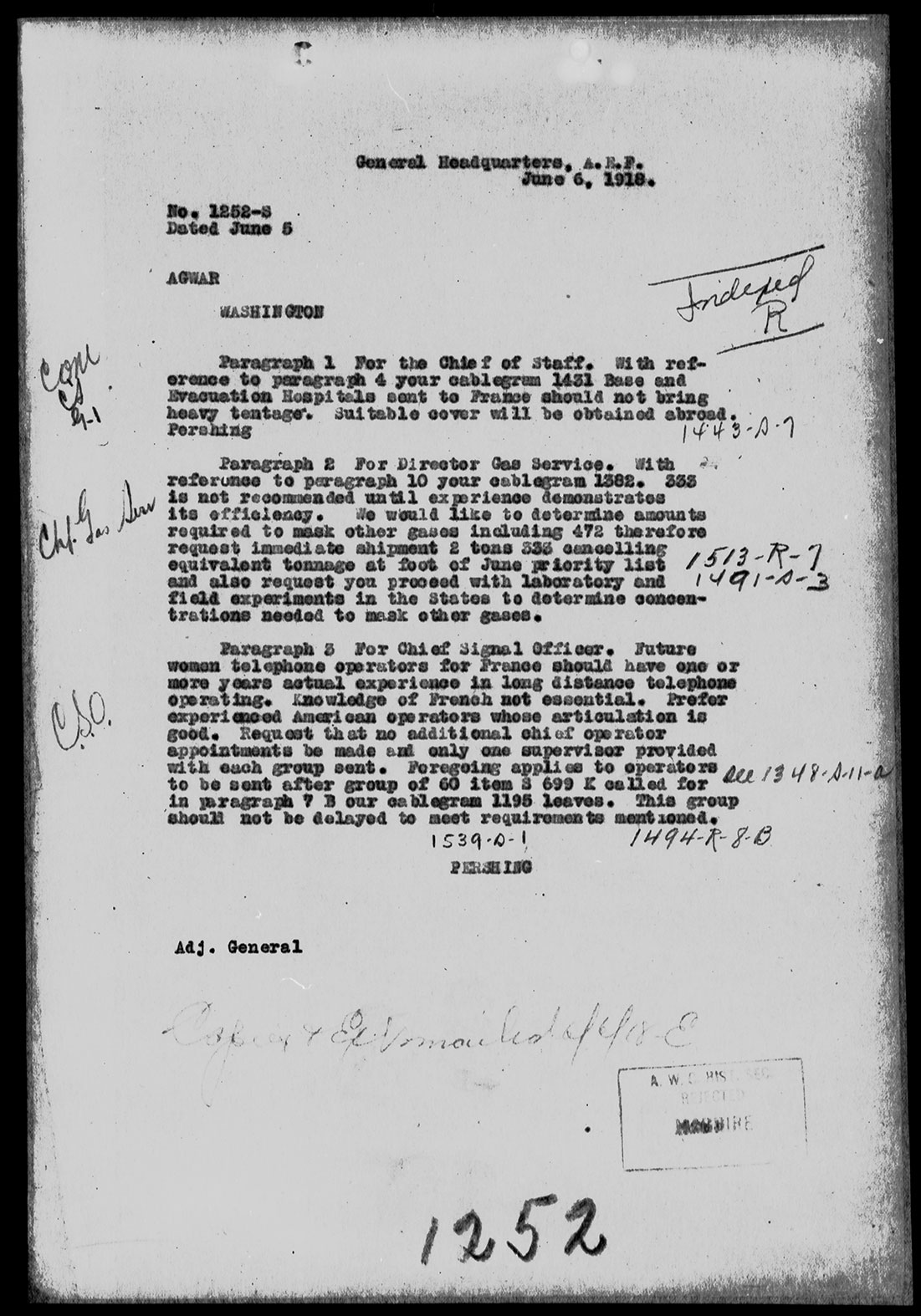
M930 Cablegrams, From Pershing GHQ AEF to AGWAR, Washington DC, Paragraph 3 Pertains to Women Telephone Opeartors. Cablegram 1252, 6 June 1918. National Archives and Records Administration. NAID: 209252151. Part of M930 - Cablegrams Exchanged Between General Headquarters, American Expeditionary Forces, and the War Department, 1917-1919. | GGA Image ID # 237cdacdf9. Click to View a Larger Image.
📖 Review & Summary
What this is: A wartime cablegram from Gen. John J. Pershing’s General Headquarters (GHQ), A.E.F., dated (No. 1252), directing the U.S. Army’s Chief Signal Officer to change recruiting criteria for women telephone operators sent to France.
- Key change: Knowledge of French is “not essential.”
- Experience required: Operators should have one or more years of long-distance central office operating experience; prioritize experienced American operators with good articulation.
- Staffing structure: “No additional chief operator” appointments; send only one supervisor per group.
- Urgency preserved: The policy applies to groups after a 60-operator draft already called; do not delay that outgoing group.
Why it matters: The directive shows a mid-campaign pivot from French-fluency to proven switchboard speed and clarity—evidence that battlefield communications demanded seasoned long-distance operators more than language skills (with bilingual needs handled in parallel).
General Headquarters, A.E.F. June 6, 1918. No. 1252-S Dated June 5 AGWAR WASHINGTON
Paragraph 1 For the Chief of staff. With reference to paragraph 4 your cablegrem 1431 Base and Evacuation Hospitals sent to France should not bring heavy tentage. Suitable cover will be obtained abroad. Pershing
Handwritten Notation 443-1-7
Paragraph 2 For Director Gas Service. With reference to peragraph 10 your cablegram 1382. 333 is not recommended until experience demonstrates its efficieney. We would like to determine amounts required to mask other gases including 472 therefore request immediate ahipment 2 tons 333 cancelling equivalent tonnage at foot of June proority list and also request you proceed with laboratory and field experiments in the States to dotermine doncen- trations needed to mask other gases.
Handwritten Notation: 1513-R-7 1491-P-3
Paragraph 3 For Chief Signal Officer. Future womon telephone operators for Prance should have one or more years actual experience in long distance telephone C.O. operating. Knowledge of Fronoh not essential. Prefor experienced American operators whose articulation is good. Request that no additional chief operator appointments be made and only one supervisor provided with each group sent. Foregoing applies to operators to be sont after group of 60 item S 699 K called for in paragraph 7 B our eablegram 1195 leaves. This group shoul not be delayed to meet requiroment ts mentioned
PERSHING
Handrwitten Notations: see 1348-A-11-a | 1539-P-1 | 1494-R-8-B
Unrestricted
✨ Most Engaging Content
- The pivot line: “Knowledge of French not essential.” A concise signal that proficiency at American long-distance switchboards had become the decisive qualification.
- Lean leadership model: “No additional chief operator… only one supervisor” points to flatter management and faster deployment.
- Operational tempo: “Should not be delayed”—the 60-operator draft moves immediately, underscoring tempo over red-tape.
🖼️ Noteworthy Image(s)
- GHQ cablegram facsimile: The scanned page (Cablegram No. 1252, 6 June 1918) highlights Paragraph 3 to the Chief Signal Officer—the paragraph that removes the French-language requirement and resets experience criteria.
- Margin annotations: Handwritten routing/noting marks (e.g., “see 1348-A-11-a”) visually attest to internal staff handling and dissemination.
See the page’s cablegram image and caption for full archival details and source line.
📘 Mini Dictionary for Civilians
- GHQ (General Headquarters)
- The top A.E.F. command under Gen. John J. Pershing in France.
- Chief Signal Officer
- Army official overseeing communications (wires, switchboards, radio) and personnel.
- Long-Distance C.O. Operating
- Switchboard work on trunk lines connecting distant cities—valued for speed, accuracy, and clear articulation.
- Supervisor / Chief Operator
- Experienced operator roles overseeing shift discipline, training, and complex traffic at a switchboard exchange.
🎓 Essay Prompts for Students
- Policy under pressure: How does the 6 June 1918 cable illustrate the A.E.F.’s ability to pivot recruiting standards in response to front-line communications needs?
- Skills vs. language: Argue whether speed/clarity or bilingualism would matter more during St. Mihiel or Meuse-Argonne—use concrete operations to support your claim.
- Org design: What do the “no additional chief operator / one supervisor per group” instructions reveal about the A.E.F.’s preferred switchboard management structure?
- Evidence literacy: Using the cable’s wording and marginal notes, explain how primary-source format and annotations shape our understanding of wartime decision-making.
🪶 Citation Block
- Chicago (Notes/Bibliography): United States. American Expeditionary Forces. General Headquarters. Cablegram No. 1252, June 6, 1918, para. 3, to AGWAR (Washington, D.C.), re: women telephone operators. National Archives and Records Administration, M930 Cablegrams.
- APA 7th: United States. American Expeditionary Forces, General Headquarters. (1918, June 6). Cablegram No. 1252 (para. 3 to AGWAR, Washington, D.C., women telephone operators). National Archives and Records Administration, M930 Cablegrams.
- MLA 9th: United States, American Expeditionary Forces, General Headquarters. Cablegram No. 1252. 6 June 1918. NARA, M930 Cablegrams, para. 3 to AGWAR, Washington, D.C., concerning women telephone operators.
- Student (plain English): “Cablegram No. 1252 (June 6, 1918), Paragraph 3 to the Chief Signal Officer,” General Headquarters, A.E.F., in the National Archives (M930 Cablegrams). It says future women operators for France must have long-distance experience and that knowing French isn’t required.
