
Blue Triangle Follows the Switchboard - 1919
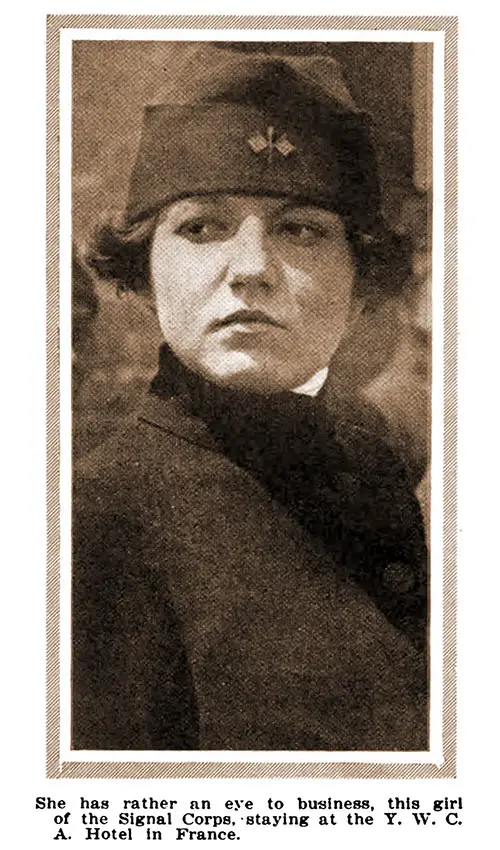
This Girl of the Signal Corps, Has an Eye for Business. She Is Staying at the YWCA Hotel in France. Southern Telephone News, April 1919. | GGA Image ID # 198285c62a
📖 Review & Summary
The 1919 article “Blue Triangle Follows the Switchboard” celebrates the partnership between the U.S. Army Signal Corps telephone operators—the “Hello Girls”—and the Young Women’s Christian Association (YWCA) during and after World War I. Written by Marjorie Kinnan for Southern Telephone News, it reveals how the YWCA’s “Blue Triangle” provided vital support, housing, and moral encouragement for these pioneering women serving overseas.
Operating within earshot of enemy artillery, the Signal Corps women maintained the lifelines of communication for the American Expeditionary Forces while the YWCA ensured their welfare in a foreign land. This article captures the shared resourcefulness, discipline, and humanity that defined both organizations, as well as the unprecedented recognition of women as part of the U.S. military system. It remains a striking example of early 20th-century gender advancement and wartime cooperation between civic and military institutions.
Foreword
The conclusion of World War I marked a historic milestone, as women were officially recognized as part of the military for the first time. Among these trailblazers were the telephone operators of the Signal Corps, whose critical work behind the front lines exemplified courage, discipline, and dedication. Operating within earshot of enemy artillery, these women were more than communicators—they were soldiers under the same military discipline as their male counterparts. Their contributions were made possible by their resilience and the support of the Young Women's Christian Association (YWCA), which ensured their physical welfare and living arrangements amidst the chaos of war. This collaboration between the Signal Corps and the YWCA demonstrated resourcefulness and mutual respect, highlighting women's essential role in military operations and support systems during wartime.
For the first time in history, a great war was successfully concluded, with women officially recognized as part of the army. This recognition marked a significant shift in the role of women in war, a moment of historical importance.
The women telephone operators of the Signal Corps, often overlooked in the shadow of the nurses, have played a remarkable role. Their units, located a mere twelve miles behind the firing line, faced the same dangers as those within range of the Teuton guns, a testament to their bravery and resilience.
These women, often referred to as 'girls ', were not just telephone operators, but soldiers under the same military rule as the Sammies in the trenches. They adhered to strict discipline, reporting to their chief operator and earning the nation's trust with the 'U. S.' symbol on their collars.
It is interesting to know that housing these units was also officially entrusted to women. The government asked the Young Women's Christian Association, which is prepared for such service with its equipment, personnel, and fifty-two years of experience in housing women, to look after every unit's physical welfare in France.
This was achieved in every instance, though obtaining lodgings, servants, and rations in headquarters towns was almost impossible. The fearful cost of bare necessities made it a real problem to keep expenses within reach of the women, who shared all house expenses on a cooperative basis. Their resourcefulness in managing these challenges is truly admirable.
The $15 per week, which is usually averaged to live, was considered a genius achievement by the interested army men, who had had to pay as much as $7 for a single dinner in Paris.
"Hominess" a Feature
The houses were almost always attractive old French establishments, sometimes with the quaintest of gardens and gorgeous shrubbery.
Even the officers flocked to the side of the grate fire and absorbed the undeniable air of American "hominess." Again, the place was only a set of rooms, but the unit's home was the best obtainable, whatever its nature.
In many cases, it was better than the officers stationed in a town declared possible to obtain, as in one village very near the front, just before the last big drive, where the YWCA secretary in charge of the unit to be moved there, got hold of a splendid house, a feat which had been proclaimed impossible.
Incidentally, this particular finding of lodgings made it possible to have the unit close to the action. It put through such perfect connections that a good share of the incredible drive's success is credited to these women telephone operators.
Now the Signal Corps is in Germany with the Army of Occupation—and there is the YWCA, too, which has just reported the establishment of two hostess houses "somewhere in Germany" for the use of American women canteen workers and Signal Corps girls who have advanced with the A. E. F.
Since the signing of the armistice, a Signal Corps girl's life has been restless and shifting, as she found herself moved from one town to another, from France to Germany and back again, without choice or warning.
She was sent to Paris to the Peace Conference or Coblenz—it was the fortune of war. But so long as the Y. W. .C A. went with her, she found herself not totally without comforts. At Christmas, she fared well, for two telephone companies sent Christmas money for parties and chocolates and such feminine luxuries as beauty pins.
One of these companies sent the money through its employees, who gave up a stock dividend to provide all the units abroad with an American Christmas.
The YWCA's first work with the Signal Corps came about by accident. In its hurry and rush of detail, the government was unable to procure housing facilities for the first unit to go abroad. The unit did not know when it was to embark and so could not get lodgings as scattered individuals.
The girls were to be housed in warehouses on Hoboken's docks while waiting to sail—an uncomfortable arrangement. Miss Vera Schaefer of the Industrial Department of the Young Women's Christian Association, who had had many telephone girls in her club work, heard of this condition and received permission to bring the unit to the YWCA's National Training School, where it provided cots and cleanliness and food, at any rate.
When this same unit was due to arrive in France, the officers in charge of billeting it desperately went to the Hotel Petrograd, the YWCA hostess house in Paris. They asked to have the girls taken care of there.
As a result of its quick-measure assistance, the government decided that women were the best providers for women's needs and that the YWCA was the most efficient provider on the list of women who would do so.
Conclusion
The women of the Signal Corps, supported by the YWCA, embodied a new era of military service and gender roles, proving their invaluable worth in the face of immense challenges. From maintaining flawless communication lines during pivotal military campaigns to navigating the difficulties of wartime housing, these women displayed extraordinary resolve and ingenuity. The YWCA's role in providing comfort, community, and practical support ensured these trailblazers could perform their duties effectively, even in the most adverse conditions. Together, they set a precedent for women's military involvement and laid the groundwork for greater opportunities in the future, leaving a legacy of courage, innovation, and service.
✨ Most Engaging Content
e section describing how the YWCA stepped in to house the first unit of telephone operators when government resources failed is particularly moving.
The unit was to be housed in warehouses on Hoboken’s docks… Miss Vera Schaefer of the YWCA heard of this condition and provided cots, cleanliness, and food at the National Training School.”
This vivid anecdote shows how women’s organizations filled critical logistical gaps and proved indispensable to the war effort. It’s an early demonstration of female-led crisis management and inter-agency cooperation long before women held formal leadership roles in the armed forces.
🖼️ Noteworthy Image(s)
Marjorie Kinnan, Signal Corps Telephone Operator, YWCA Hotel, France (1919)
Caption: “This Girl of the Signal Corps, Has an Eye for Business. She Is Staying at the YWCA Hotel in France.”
Source: Southern Telephone News, April 1919, Vol. 7, No. 4, p. 15.
Significance: Represents the human face of wartime professionalism and the “Blue Triangle” YWCA’s role in maintaining dignity and normalcy amid chaos.
📘 Mini Dictionary for Civilians
- Blue Triangle
- The emblem of the Young Women’s Christian Association (YWCA), symbolizing the development of Spirit, Mind, and Body. During World War I, it identified YWCA facilities and hostels that served women supporting the war effort overseas.
- Signal Corps
- A branch of the U.S. Army responsible for all military communications, including telegraph, telephone, and radio. During WWI, it employed women telephone operators—nicknamed the “Hello Girls”—to connect critical calls for the Allied forces.
- Billet
- A military term for temporary housing or quarters assigned to personnel. For the Signal Corps women, billets often consisted of converted homes, hotels, or barracks near the front lines.
- A.E.F.
- Short for the American Expeditionary Forces—the U.S. troops sent to Europe under General John J. Pershing during World War I (1917–1919).
- Hostess House
- A YWCA-operated facility providing safe lodging, food, and social activities for American women serving abroad, including nurses, canteen workers, and Signal Corps operators.
- Sammies
- A popular nickname for American soldiers in World War I, derived from “Uncle Sam.”
- Army of Occupation
- The force of Allied troops, including Americans, who remained in Germany after the Armistice of 1918 to enforce peace terms and maintain order.
- Teuton Guns
- A period term referring to German artillery during World War I, derived from the ancient “Teutons,” a Germanic tribe.
🎓 Essay Prompts for Students
-
Historical Impact: How did organizations like the YWCA shape the welfare and working conditions of female military personnel during World War I?
-
Gender and Service: In what ways did the Signal Corps telephone operators redefine what it meant to be a soldier in 1918–1919?
-
Civic Partnership: What lessons can modern humanitarian organizations learn from the YWCA’s wartime support model?
-
Primary Source Analysis: Compare Blue Triangle Follows the Switchboard with other 1918–1919 press accounts of the “Hello Girls.” What patterns of public perception emerge?
🎓 Essay Prompts for Students
Historical Impact: How did organizations like the YWCA shape the welfare and working conditions of female military personnel during World War I?
Gender and Service: In what ways did the Signal Corps telephone operators redefine what it meant to be a soldier in 1918–1919?
Civic Partnership: What lessons can modern humanitarian organizations learn from the YWCA’s wartime support model?
Primary Source Analysis: Compare Blue Triangle Follows the Switchboard with other 1918–1919 press accounts of the “Hello Girls.” What patterns of public perception emerge?
Based on the article by Marjorie Kinnan, Blue Triangle Follows the Switchboard, in Southern Telephone News, Atlanta: Southern Group of Bell Telephone Companies, Vol. 7, No. 4, April 1919, p. 15.
