
Affidavit of Enid M. Pooley - 1977
[📖 Review & Summary]
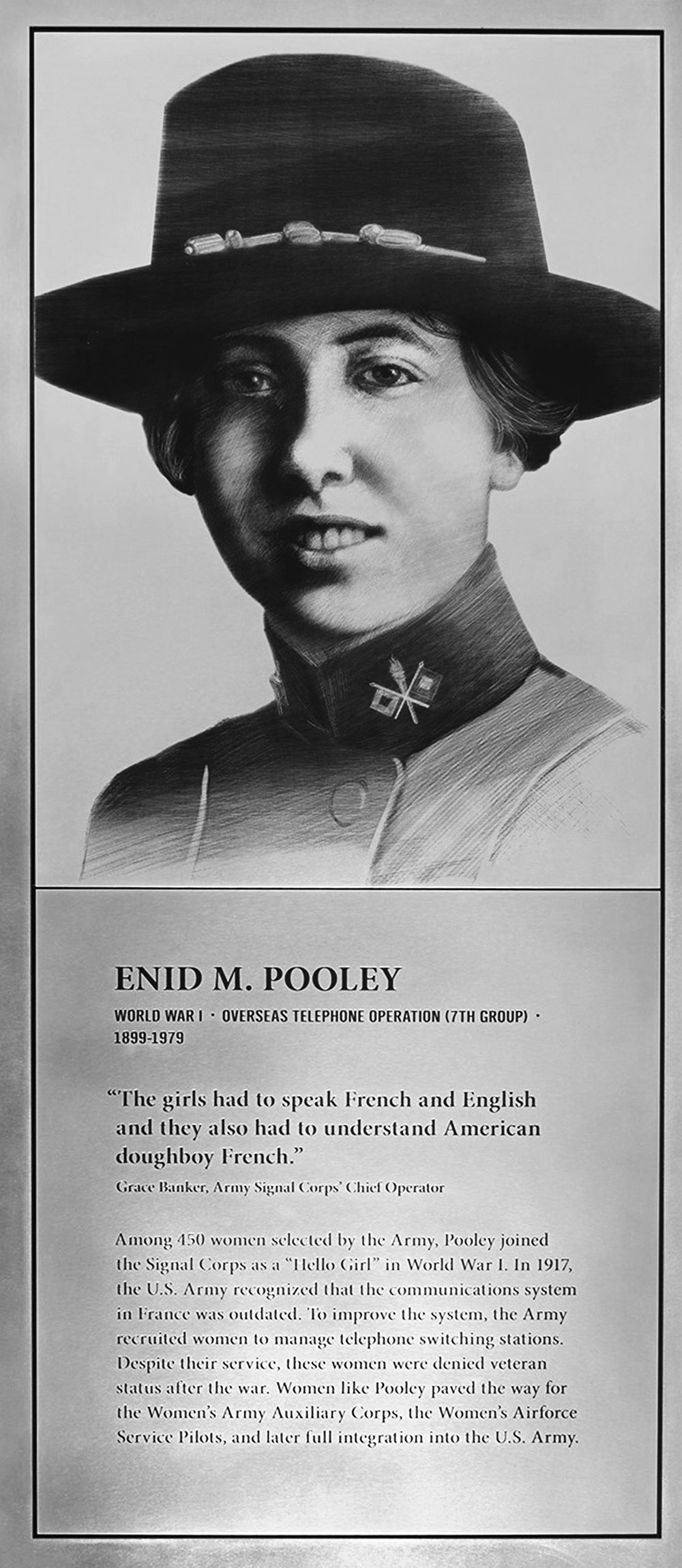
Engraving of Enid Mack Pooley, a Member of the 7th Unit of Telephone Operators who were Trained but the War Ended before They Were Sent Overseas. Plaque from the National Museum of the United States Army. | GGA Image ID # 236fa3c86d. Click to View a Larger Image.
Mrs. Enid M. Pooley, who was Miss Enid A. Mack in 1918, was a part of Unit 7 of the Signal Corps Telephone Operators Group, commonly referred to as the "Hello Girls." She was discharged in December 1918 from the army after the war ended before going overseas.
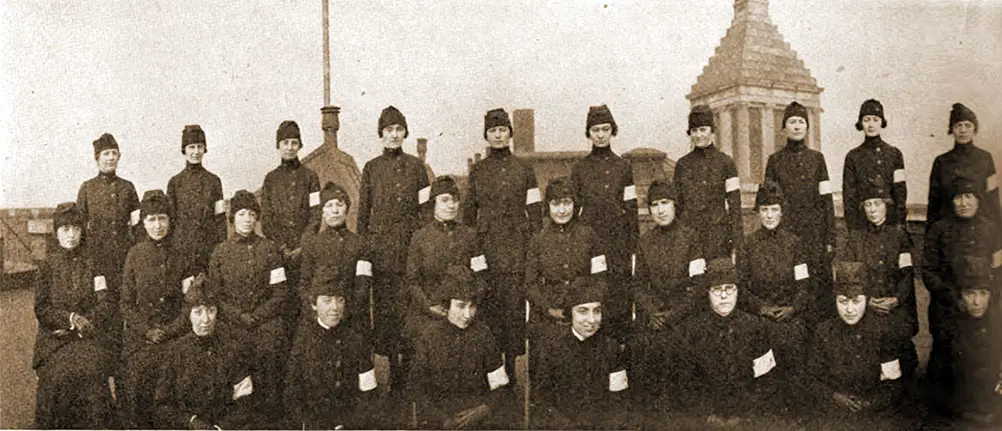
Left Side of Panoramic Group Photograph, Seventh Unit of Telephone Operators of the Signal Corps. The Telephone Review, January 1919. Miss Enid A. Mack, Seattle, WA Was the Left-most Person in the Front Row. GGA Image ID # 19850f1d1c. Click to View a Larger Image.
Affidavit of Enid M. Pooley
State of Washington,
County of King, ss:
Enid M. Pooley, being first duly sworn on oath deposes and states as follows:
- I presently reside at 1413 Laframboise Street, Enumclaw, Washington 98022. In 1918 I was Enid A. Mack and was a student at the University of Washington. My mother was born in Lille, France, and French was a second language to me. As a part-time job, while I was attending the University, I worked for Puget Sound Power and Light at their 7th Avenue and Olive Way offices as a relief telephone operator.
- Early in 1918, I became aware that the United States Army Signal Corps was looking for volunteers for a women's Army unit responsible for operating telephone switchboards. Knowledge of the French language was a prerequisite. I immediately applied to Major Newell, a reserve Signal Corps officer who was still working for Public Telephone & Telegraph Company in Seattle. Although the minimum age for operators was 23 and I was only 19, an exception was made finally because, in addition to speaking fluent French, I also spoke fluent German.
- I had several interviews with Major Newell, and after I was informed by him that I was being considered for service, I was required to take an Army physical examination. I cannot recall where in Seattle the examination took place. On April 11, 1918, I was informed that I had been accepted, and shortly thereafter, I was sworn into the Army, taking the oath of allegiance, which was administered by Major Newell.
- Pursuant to Army orders, I was sent to San Francisco with a number of other operators for training in the San Francisco offices of Pacific Telephone & Telegraph. We were scattered around to local long-distance and suburban exchange offices. I personally was trained at the San Mateo and Burlingame offices. We stayed in San Francisco for approximately two months. We were responsible for finding our own housing, but we were compensated on a per diem basis by the Army in addition to our standard pay of $60 per month.
- Toward the end of July, our unit, the Seventh Unit, was transferred to New York City for further training at the offices of American Telephone & Telegraph. While in New York, we were required to purchase our uniforms. These were navy blue in color, and we had one for summer and one for winter wear. The uniforms had the regulation United States Army buttons on them with officers’ insignia consisting of a metal “U.S.” and signal corps flags on the collars. We had broad-brimmed navy blue hats with the signal corps had cord around them, and we were also given dark blue over-seas caps piped with the orange and white Signal Corps colors. These caps also had the regulation Signal Corps metal insignia on them. We were given some training in New York City, and I was transferred with some other operators for further training at the Philadelphia offices of Pennsylvania Telephone & Telegraph. Although I was fluent in the French language, I was held in the United States while operators with no knowledge of French were sent to France simply because they had more experience in operating telephone switchboard equipment. Finally, in early November 1918, we were assembled once more in New York City, and our baggage was loaded onto transports. We were in the process of loading when the Armistice was declared on November 11, 1918. While in New York, we were housed at the Prince George Hotel.
- I received a discharge from the service as a telephone operator on December 19, 1918, to be effective as of December 26, 1918.
- I could have been sent to my place of enlistment, which was Seattle, Washington, but I decided instead to seek a job in New York City. I found a job at the First National City Bank, at which I remained for about a year. Early in 1920, I wrote to the Army indicating that I was now ready to return to Seattle and asked the Army to pay for my transportation. To my surprise, the Army did pay for it, and I returned to Seattle. I did not appreciate the fact that as far as the Army was concerned, I had not served in the United States Army until I applied for my naturalization papers about a year later. I was a British citizen, and I assumed that my service in the Army of the United States would entitle me to citizenship. I applied for my naturalization papers based on my Army service documents. To my surprise, the judge told me that I had only been a civilian employee and that I had not served in the Army. It was not until several years later that I received my United States citizenship through the conventional methods.
- From the time that Major Newell administered the oath of allegiance in Seattle in April 1918 until that time, I had fully considered myself to have been a soldier in the United States Army. Major Newell had assured me that I was in the Army, as had every other Army officer with whom I had ever come into contact. We were treated in every way as if we were soldiers in the Army and subject to the same discipline as any other soldier.
- Over the past 58 years, I’ve written to my congressmen many times about this matter, and while I’ve always received polite replies, nothing has ever been done to rectify the situation. I strongly feel that an injustice has been done to me personally and to the other women who served their country honorably as members of the Signal Corps Telephone Operating Units. Our numbers are dwindling fast. If anything is to be done for us, it has to be done now.
Enid M. Pooley.
Subscribed and sworn to before me this 5th day of May, 1977.
Robert F. Abramson,
Notary Public in and for the
State of Washington residing at Enutnclaw.
Exhibits attached hereto :
- Exhibit A : Notice of appointment dated April 11, 1918.
- Exhibit B : Notice of discharge dated December 19, 1918.
[Exhibit A: Notice of appointment dated April 11, 1918.]
War Department,
Office of the Chief Signal Officer,
Washington, April 11, 1918.
From : Office of the Chief Signal Officer.
To : Commanding General, American Expeditionary Forces, France.
Subject: Appointment.
1. The bearer, Enid A. Mack, was this date appointed Operator, Telephone Unit, in the Signal Service at Large, at $60.00 per month, with allowances of rations, quarters, and medical attendance accorded Army Nurses by Army Regulations, as provided in authority from the Secretary of War, of date November 28, 1917, and will be directed to report to you for assignment of duty, upon completion of a preliminary course in a school of instruction for telephone operators. She executed the oath of office on April 11th, 1918, and entered upon duty on April 11th, 1918.
2. In case of emergency, notify : Mrs. Isabel Mack, 912 West 42nd Street, Seattle, Washington.
By authority of the Chief Signal Officer.
E. J. Wesson,
Captain, Signal Corps, U.S.R.
[Exhibit B: Notice of discharge dated December 19, 1918.]
War Department,
Office of the Chief Signal Officer,
Washington, December 19, 1918.
From : Office of the Chief Signal Officer
To: Enid A. Mack, 912 West 42nd St., Seattle, Washington.
Subject: Discharge.
1. You are hereby informed that your services as a member of the Signal Corps Female Telephone Unit will terminate effective December 26, 1918. This action Is imperative as It has been definitely determined that no additional telephone operators will be required overseas.
2. The Chief Signal Officer directs me to express his appreciation of your pátriotic efforts, your hard and faithful work while undergoing instruction, and the loyal and cheerful manner with which you have served under conditions particularly trying.
By direction of the Chief Signal Officer.
R. Henry Lake, Captain, Signal Corps.
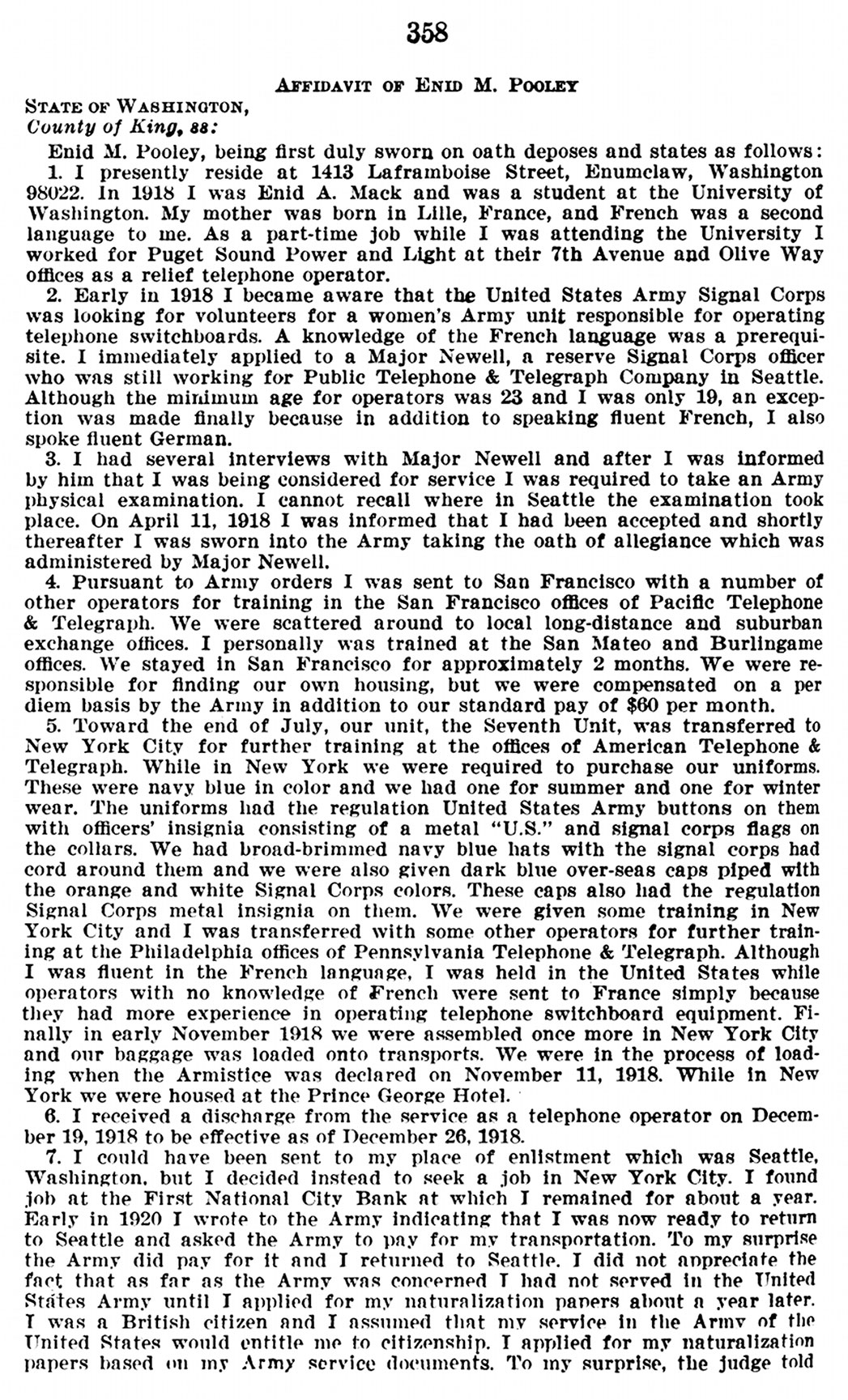
Part 1, Appendix B: Affidavit of Enid M. Pooley (Née Mack), Recognition for Purpose of VA Benefits, Hearing Before the Committee on Veterans' Affairs, United States Senate, Ninety-Fifth Congress, First Session, on S. 247, S. 1414, S. 129, and Related Bills, 25 May 1977. US Government Printing Office, 1977. GGA Image ID # 19a2ee6903. Click to View a Larger Image.
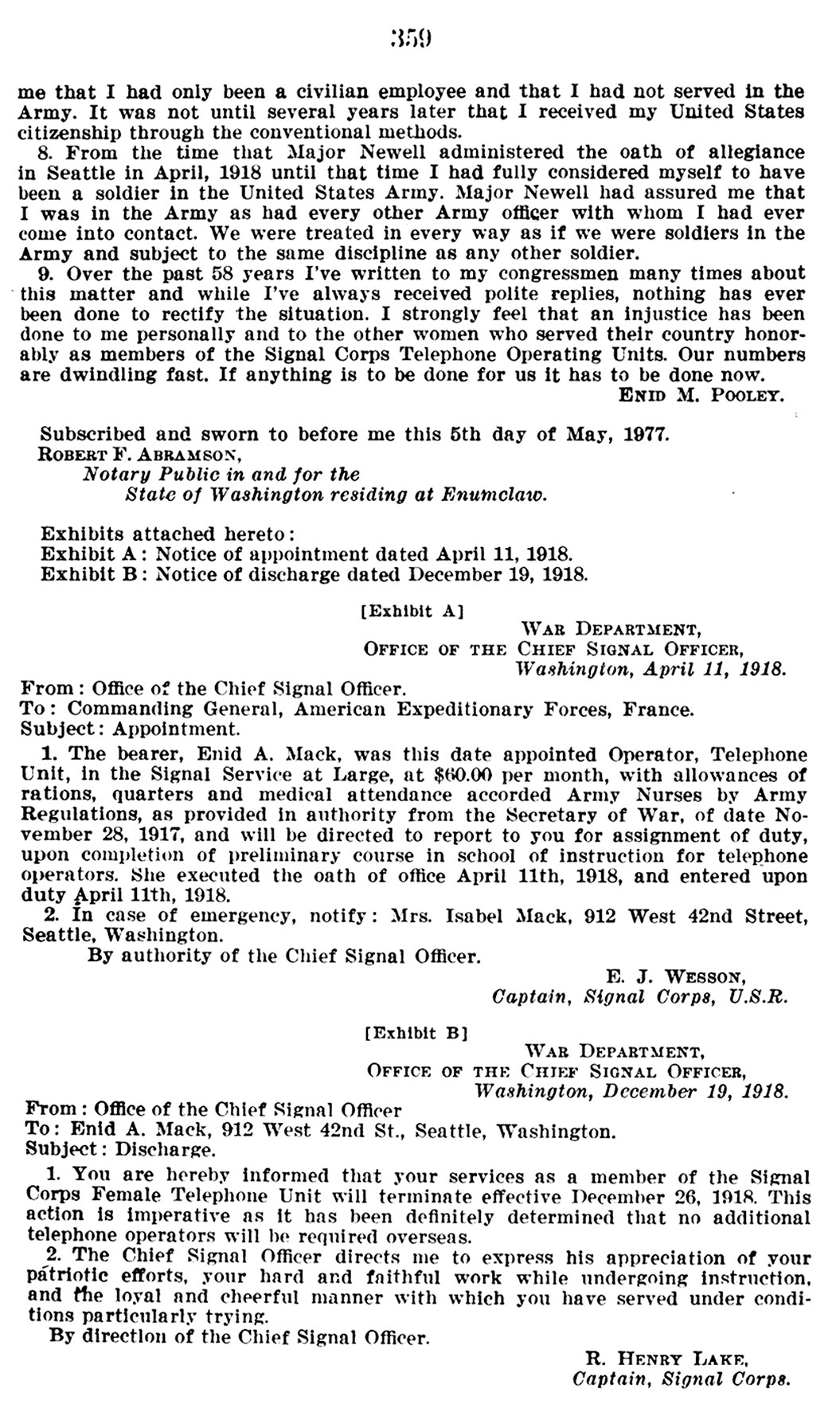
Part 2, Appendix B: Affidavit of Enid M. Pooley (Née Mack), Recognition for Purpose of VA Benefits, Hearing Before the Committee on Veterans' Affairs, United States Senate, Ninety-Fifth Congress, First Session, on S. 247, S. 1414, S. 129, and Related Bills, 25 May 1977. | GGA Image ID # 237c517ef4. Click to View a Larger Image.
✨ Most Engaging Content
- Oath in Seattle, April 1918: Her acceptance and swearing-in under a Reserve Signal Corps officer anchor the claim of military service.
- Uniform & insignia purchase in New York: Detailed description (U.S. buttons, “U.S.” and Signal Corps flags on collars, overseas cap with orange/white piping) shows regulation attire and Army identity in practice.
- Training pipeline: San Mateo & Burlingame boards (PT&T), followed by AT&T/Philadelphia training—evidence of a formal Army–Bell System partnership.
- Armistice at the gangway: Baggage loaded and transports ready when 11/11 halted Unit 7’s departure—an emblematic moment for the “almost deployed.”
- Civic aftermath: Attempted naturalization on the basis of “Army service” revealed the Army’s civilian classification, highlighting the core injustice later addressed by Congress.
🖼️ Noteworthy Image(s)
- Engraving of Enid A. Mack (Pooley), Unit 7 (1918): Puts a face to the affidavit and underscores Unit 7’s readiness despite the Armistice.
- Unit 7 panoramic group (January 1919, The Telephone Review): Visually documents the cohort trained for deployment—vital for understanding scope, scale, and composition.
📘 Mini Dictionary for Civilians
- Overseas Cap: Soft, foldable cap worn with U.S. Army uniforms; Signal Corps caps were piped in orange and white.
- Signal Corps Insignia: Crossed signal flags (red and white) over a torch, indicating service in Army communications.
- Per Diem: Daily allowance for lodging/meals when traveling or training away from home station.
- Unit 7: Seventh cohort of female telephone operators—fully trained and staged but demobilized before sailing after the Armistice.
🎓 Essay Prompts for Students
- How does Pooley’s description of oath, uniform, and discipline complicate the Army’s “civilian” classification of the Hello Girls?
- What does Unit 7’s near-deployment reveal about mobilization timelines, training pipelines, and the shock of the Armistice?
- Compare Pooley’s experience with those who served overseas: where do the risks and obligations overlap, and where do they diverge?
- Evaluate how documentation (appointment/discharge letters) functioned as legal evidence in the 1977 recognition effort.
🪶 Citation Block
Chicago: “Appendix B: Affidavit of Enid M. Pooley.” In Recognition for Purposes of VA Benefits, Hearing Before the Committee on Veterans’ Affairs, U.S. Senate, 95th Cong., 1st sess., 25 May 1977, pp. 358–359. Washington, DC: U.S. Government Printing Office.
APA: United States Senate. (1977, May 25). Appendix B: Affidavit of Enid M. Pooley (pp. 358–359). In Recognition for Purposes of VA Benefits. Washington, DC: U.S. Government Printing Office.
MLA: “Appendix B: Affidavit of Enid M. Pooley.” Recognition for Purposes of VA Benefits, Hearing Before the Committee on Veterans’ Affairs, U.S. Senate, 95th Cong., 1st sess., 25 May 1977, pp. 358–359. U.S. Government Printing Office.
Student Citation: “Affidavit of Enid M. Pooley (1977).” GG Archives. https://www.ggarchives.com/MIL/HelloGirls/Docs/AffidavitOfEnidMPooley-1977.html
"Appendix B: Affidavit of Enid M. Pooley," in Recognition for Purposes of VA Benefits, Hearing before the Committee on Veterans' Affairs, United States Senate, Ninety-Fifth Congress, First Session on S. 247, S. 1414, S. 129, and Related Bills. Washington, DC: US Government Printing Office, 25 May 1977. pp. 358-359
