
Exhibit K - Extract from Special Orders No. 2241 (Victory Medal) - 1919
📖 Review & Summary
What this is: An official Special Orders extract (12 Aug 1919) authorizing Telephone Operator Adele Louise Hoppock (U.S. Signal Corps) to wear the World War I Victory Medal with one Defensive Sector clasp and campaign credit for the Meuse–Argonne Offensive (26 Sept–11 Nov 1918).
Why it matters: It’s primary-source proof that Hello Girls were recorded in Army orders as present “under competent orders” in a named combat area, directly tying an operator’s service to America’s largest WWI operation.
Read it like a historian: Note the cross-references: General Orders No. 53 (30 June 1919) establishes the award criteria; the First Army Area date range anchors her eligibility; and the named operation (Meuse–Argonne) documents campaign participation, not just general service.
Understanding the Victory Medal and Clasp
World War I Victory Medal: This U.S. service medal was authorized by Congress in 1919 to recognize military service during World War I.
Battle Clasps: These were worn on the ribbon of the Victory Medal to denote participation in specific major ground campaigns.
Meuse-Argonne Clasp: This specific clasp indicates participation in the Meuse-Argonne Offensive, the largest and deadliest operation of the American Expeditionary Forces during the war. The offensive involved over a million American soldiers.
Defensive Sector Clasp: This clasp was awarded for general defense service, which did not involve a specific battle, or for service in a battle that did not have its own designated clasp.
[Exhibit K]
[Extract from Special Orders No. 2241]
Headquarters Base Section No. 5,
Services of Supply.
U.S. Army Post Office No. 716,
August 12, 1919.
*******
Par. 37. Under the provisions of General Orders No. 53, War Department, dated June 30, 1919, Adele Louise Hoppock, Telephone Operator, U.S. Signal Corps, having participated, under competent orders in First Army Area from October 1, 1918, to November 29, 1918, with the Signal Corps, First Army, is authorized to wear the Victory Medal and one Defensive Sector Clasp, for the following operation : Meuse-Argonne, September 26-November 11 [1918].
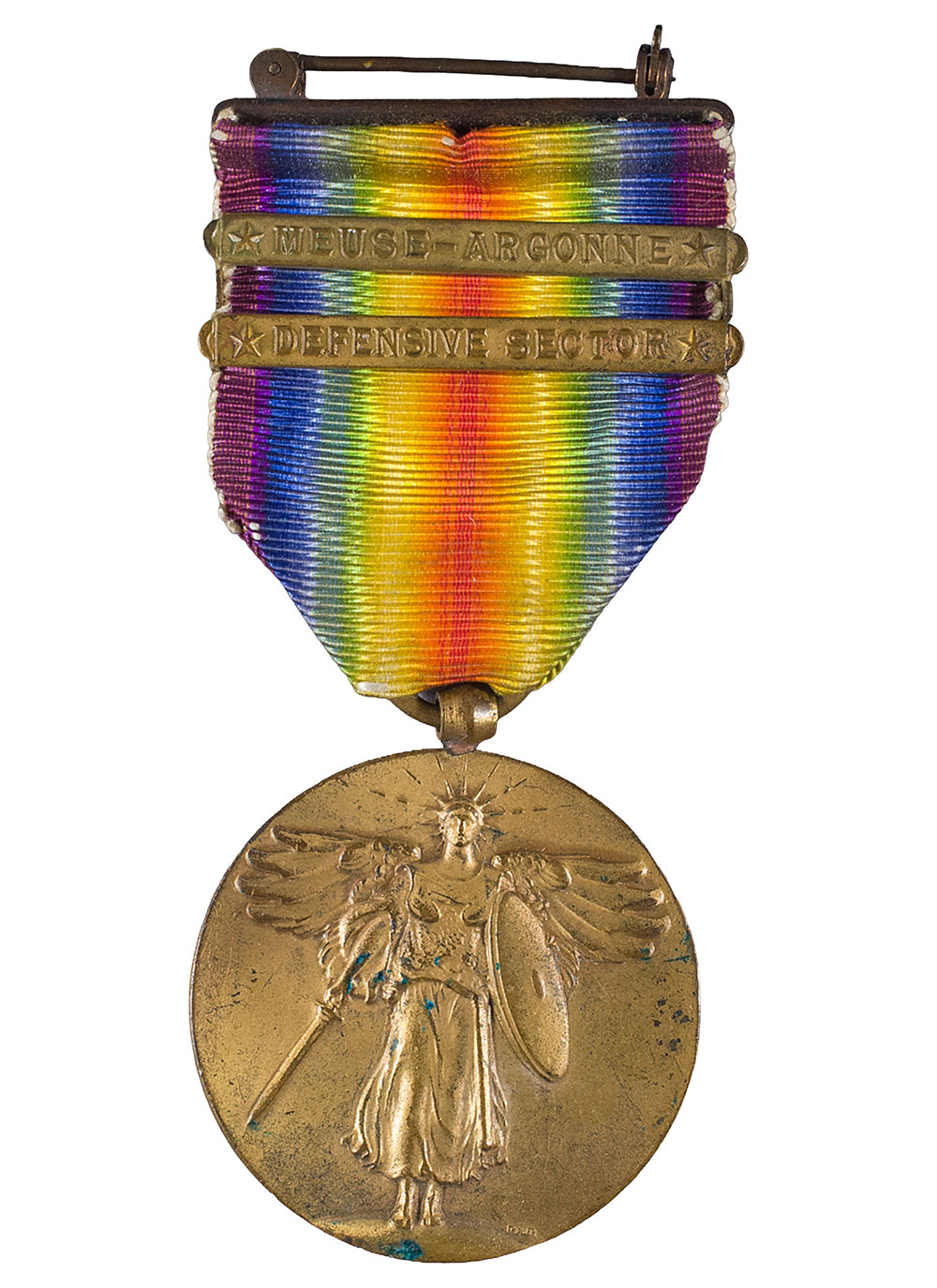
The World War I Victory Medal’s Front Side Depicts an Armored Angel With a Sword and Shield. Designed by James Earle Fraser, a Prominent American Sculptor from New York City under the Direction of the Commission of Fine Arts. The Medal is Attached to a Double Rainbow Riboon, A Pattern Used Across the 14 Allied Nations. The Victory Medal was Originally Intended to be Established by an Act of Congress. The Bill Authorizing the Victory Medal Never Passed. The Military Established it Through General Orders. The War Department Published Orders in April 1919. The Victory Medal was Awarded to Military Personnel for Service Between 6 April 1917 and 11 November 1918. | GGA Image ID # 237014614a. Click to View a Larger Image.
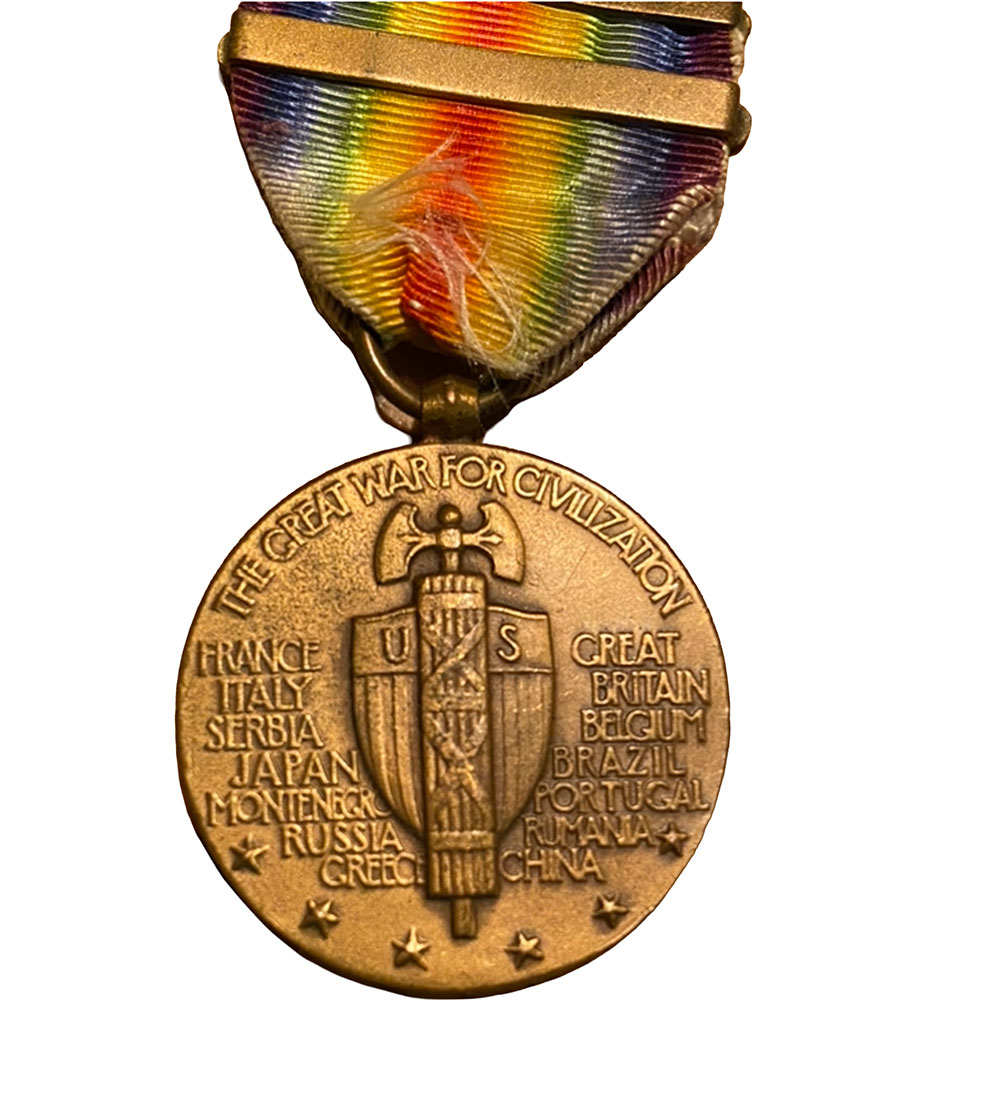
The Reverse Side of the World War I Victory Medal Lists the Names of Those Countries That Fought Alongside the United States. Accompanying the Medal Are Bars, Placed on the Rainbow Ribbon to Signify Specific Acts or Duties During the War. the Great War for Civilization - Victory Medal for World War I With a Listing of the Allied Nations (France, Italy, Serbia, Japan, Montenegro, Russia, Greece, Great Britain, Belgium, Brazil, Portugal, Romania, and China. | GGA Image ID # 23704ce034. Click to View a Larger Image.
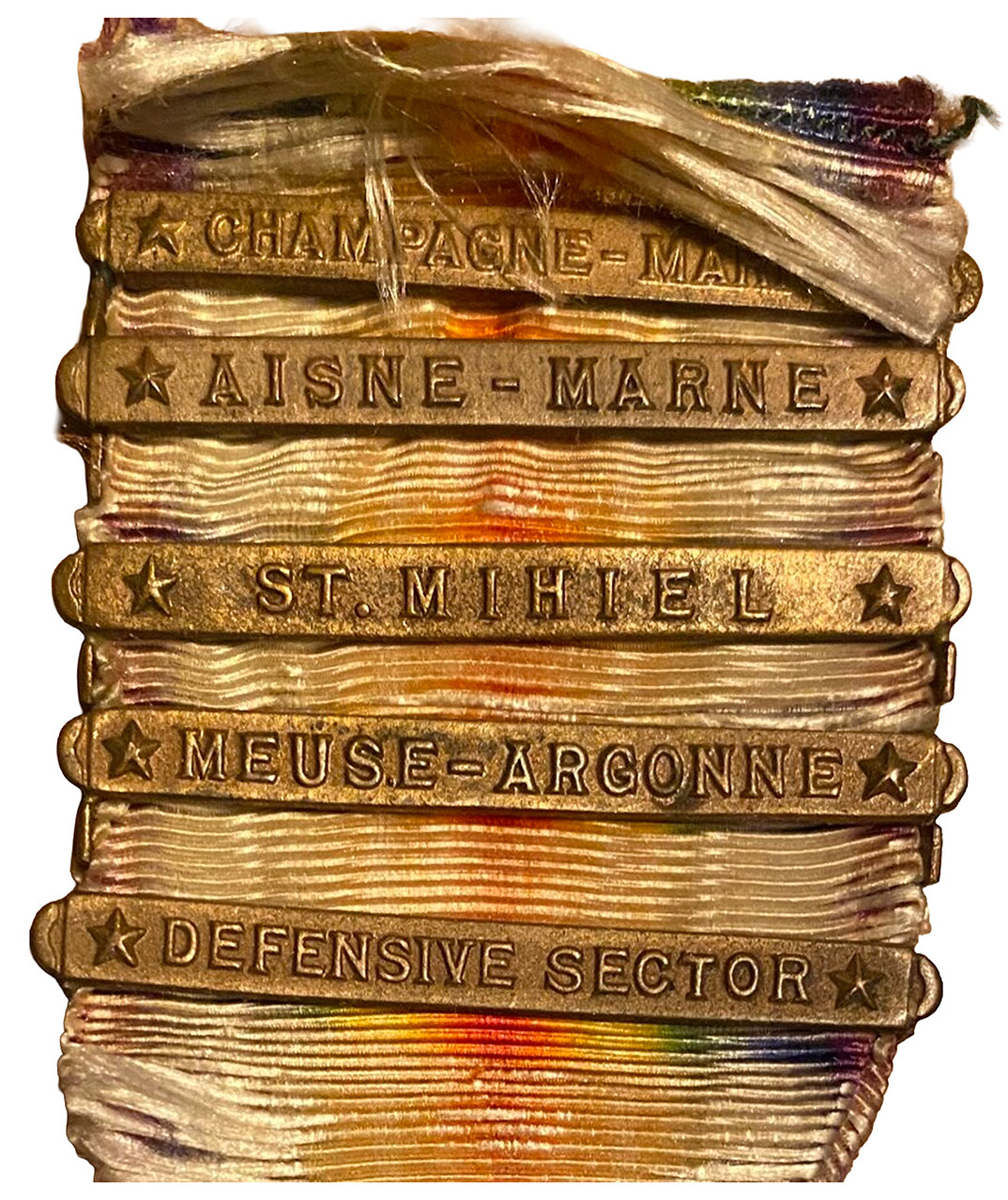
Campaign Clasps Were Attached to the Ribbon to Denote Specific Battles or Duties. This Image Include Battle Clasps for Champagne-Marne, Aisne-Marne, St. Mihiel, Meuse-Argonne, The World War I Victory Medal "Defensive Sector" Battle Clasp was awarded for general defense service in a specific area during World War I, rather than for participation in a particular battle recognized by a different campaign clasp. It was also given for service in certain areas without involving specific named battles, including service in England, France, Italy, Siberia, and European Russia between specific dates. This bronze clasp features the words "Defensive Sector" with stars at each end and was awarded to U.S. military personnel who served under competent orders in qualifying areas. | GGA Image ID # 23704ffd4b. Click to View a Larger Image.
| Army Battle Clasps | ||||||
|---|---|---|---|---|---|---|
| Major Ground Conflict | Start Date | End Date | ||||
| Aisne | 27 May 1918 | 5 June 1918 | ||||
| Aisne-Marne | 18 July 1918 | 6 August 1918 | ||||
| Cambrai | 12 May 1917 | 4 December 1917 | ||||
| Champagne-Marne | 15 July 1918 | 18 July 1918 | ||||
| Lys | 9 April 1918 | 27 April 1918 | ||||
| Meuse-Argonne | 26 September 1918 | 11 November 1918 | ||||
| Montdidier-Noyon | 9 June 1918 | 13 June 1918 | ||||
| Oise-Aisne | 18 August 1918 | 11 November 1918 | ||||
| St. Mihiel | 12 September 1918 | 16 September 1918 | ||||
| Somme-Defensive | 21 March 1918 | 6 April 1918 | ||||
| Somme-Offensive | 8 August 1918 | 11 November 1918 | ||||
| Vittorio-Veneto | 24 October 1918 | 4 November 1918 | ||||
| Ypres-Lys | August 19, 1918 | November 11, 1918 | ||||
✨ Most Engaging Content
- Orders tell the story: One paragraph links a named operator, a combat area, and a specific campaign—concise, verifiable recognition.
- Meuse–Argonne credit: The most extensive A.E.F. offensive becomes a line-item on a Hello Girl’s record.
- Awards framework: The Victory Medal + clasps show how the Army formalized service into enduring, wearable history.
📘 Mini Dictionary for Civilians
- Victory Medal (WWI)
- U.S. service medal established in 1919 to recognize WWI military service; clasps identify campaigns or duties.
- Defensive Sector Clasp
- A ribbon bar awarded for qualifying service in specified sectors (not tied to a single named offensive).
- Meuse–Argonne Offensive
- The largest American operation of WWI (Sept–Nov 1918), involving 1M+ U.S. troops.
- Under Competent Orders
- Army phrasing that service took place under official, authorized assignment—key to award eligibility.
🎓 Essay Prompts for Students
- Pins & paperwork: How do medals and orders transform lived experience into official memory?
- Evidence chain: Use the language in Exhibit K to reconstruct where, when, and how an operator served.
- Recognition vs. role: Compare this orders extract to postwar debates over the operators’ military status.
- Campaign semantics: What’s the difference between Defensive Sector and a named offensive clasp, and why does it matter?
🪶 Citation Block (Chicago, APA, MLA + student version)
- Chicago: United States. Senate. Committee on Veterans’ Affairs. Recognition for Purposes of VA Benefits: Hearing… Washington, DC: U.S. Government Printing Office, 1977, pp. 366–367. “[Exhibit K].”
- APA 7th: United States Senate, Committee on Veterans’ Affairs. (1977, May 25). Recognition for purposes of VA benefits… (pp. 366–367). U.S. Government Printing Office. “[Exhibit K].”
- MLA 9th: United States, Congress, Senate, Committee on Veterans’ Affairs. Recognition for Purposes of VA Benefits… U.S. Government Printing Office, 1977, pp. 366–367. “[Exhibit K].”
- Student (plain English): “[Exhibit K],” in Recognition for Purposes of VA Benefits, U.S. Senate Committee on Veterans’ Affairs (95th Cong., 1st Sess.), May 25, 1977, pp. 366–367.
"[Exhibit K]: Affidavit of Gertrude Hoppock: Extract from Special Orders No. 2241, 12 August 1919," in Recognition for Purposes of VA Benefits, Hearing before the Committee on Veterans' Affairs, United States Senate, Ninety-Fifth Congress, First Session on S. 247, S. 1414, S. 129, and Related Bills. Washington, DC: US Government Printing Office, 25 May 1977. p. 366-367.
