
Exhibit H - Commendation of Signal Corps Operators from Pershing - 1918
📖 Review & Summary
What this document is: A brief, formal commendation attributed to Gen. John J. Pershing, dated 20 November 1918, praising “the officers and men and the young women of the Signal Corps” for the devotion and professionalism reflected in the A.E.F.’s wartime communications.
Why it matters: Coming at the end of combat operations, the statement acknowledges female Signal Corps telephone operators (“Hello Girls”) alongside male personnel in a single sentence of credit—evidence that their performance was visible to A.E.F. leadership and tied to battlefield effectiveness.
How to read it: Although succinct and embedded within a larger report, the language links tactical outcomes (“perfection of our communications”) to operator work at headquarters, depots, and advanced sectors. This complements later letters and unit mementos that expanded upon their contributions.
Foreword
General John J. Pershing did not issue a single, unified commendation to all Signal Corps operators in 1918, but rather offered praise through several communications and approved individual citations for exemplary service. His appreciation for the "Hello Girls," as the operators were known, was well-documented throughout the year.
Requests for Female Operators
Pershing initiated the program for female telephone operators due to frustrations with the existing system. In November 1917, he requested skilled, French-speaking women, recognizing that American women held a strong majority of telephone operator positions back home and possessed superior speed and skill at the switchboards compared to the men available for the task. He authorized their recruitment, training, and deployment under the Signal Corps, viewing it as an emergency need.
General Praise for Their Service
Throughout 1918, Pershing publicly and privately praised the service of the female operators.
Essential to victory: Their work was critical to the Allied effort, establishing reliable and rapid communication between headquarters and the front lines. The operators were known for their speed, discipline, and efficiency.
"Real soldiers": Following an inspection of the operators, Pershing declared, "Those girls are real soldiers!". This was a powerful endorsement of their courage and professionalism, especially as many worked near the front lines under the constant threat of enemy fire.
Justifying the "experiment": After the Armistice, an officer in the Signal Corps wrote to the women, likely with Pershing's approval, that the decision to bring them to France was unprecedented. He noted, "by your ability, efficiency, devotion to duty... you have not only justified the action taken in assembling all of you, but have set a standard of excellence which could hardly be improved upon".
Individual Recognition
Pershing signed dozens of special commendations for individual operators for their "exceptionally meritorious and conspicuous services" in the "Advance Sections," close to the front lines.
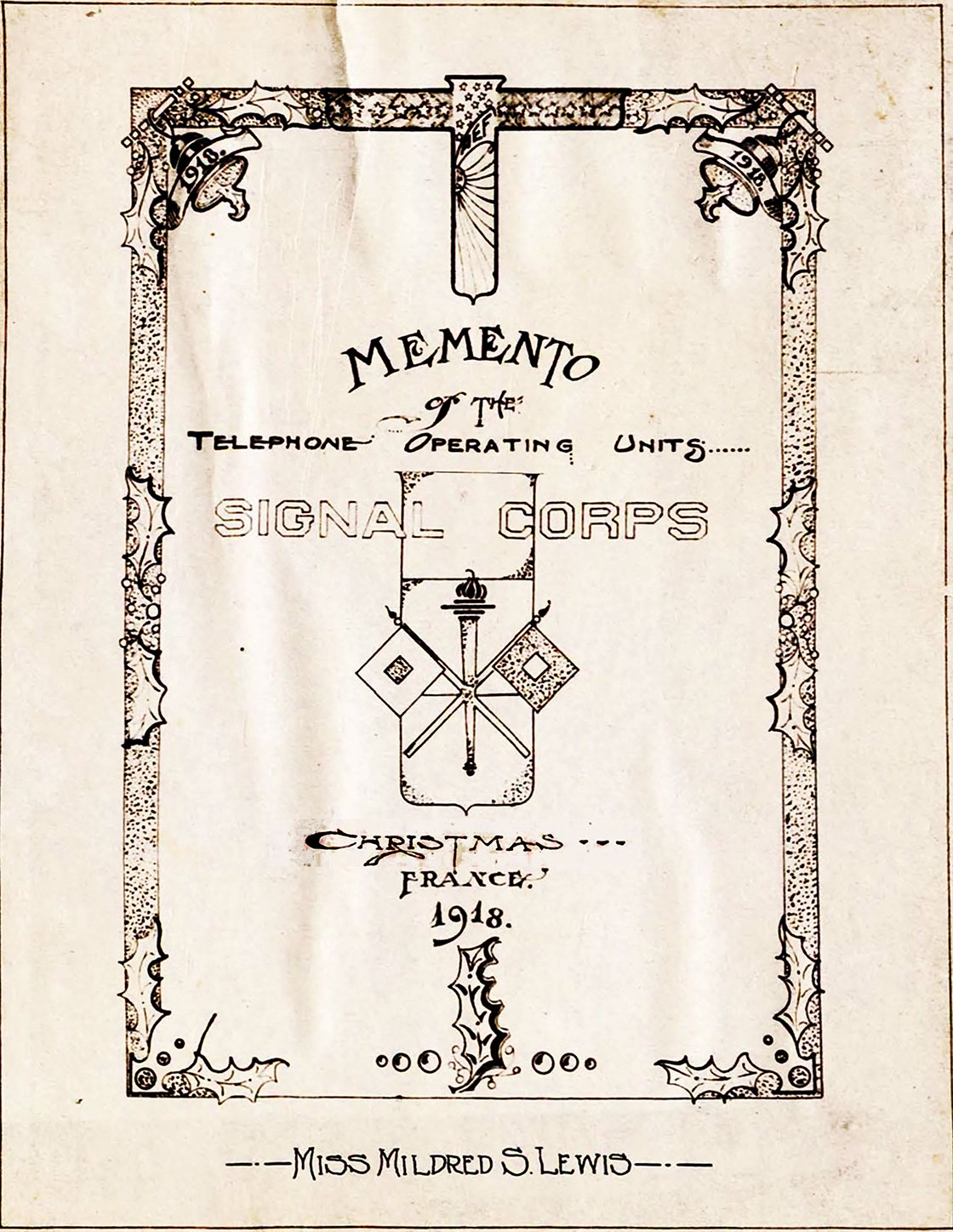
Front Cover, Memento of the Telephone Operating Units, Signal Corps, Christmas, France, 1918, Miss Mildred S. Lewis. Exhibit H: Commendation of Signal Corps Operators. Image Shows Fancy Typography and a Festive Christmas Frame Border. The Name Miss Mildred S. Lewis, a Unit 5 Operator, Appears at the Bottom Below the Frame Suggesting These Booklets Were Individualized. Dark Brown Ink on Light Brown or Tan Paper. | GGA Image ID # 2379031906. Click to View a Larger Image.
Acknowledged in Signal Corps Memento
Following the war's conclusion, officers of the Signal Corps created a memento for the "Hello Girls," documenting and praising their efforts. The memento included letters of thanks from the officers, building upon Pershing's initial requests and praise for the women's critical role in the war effort. The Memento book given to the Hello Girls included letters and photographs from high-ranking officers, expressing gratitude for the efforts of the Telephone Operating Unit of the Signal Corps.
[Exhibit H]
Extract from Report Made to the Secretary of War, Washington, D.C.
As of November 20, 1918.
Under the heading of Commendation—
* * * * * * *
The officers and men and the young women of the Signal Corps have performed their duties with a large conception of the problem and with a devoted and patriotic spirit to which the perfection of our communications daily testify.
John J. Pershing,
Commander-in-Chief, A.E.F.
![Page 364 that Included [Exhibit H—Commendation]: Affidavit of Gertrude Hoppock: "Commendation from Pershing, 20 November 1918,"](../../../CVimages/MIL/HelloGirls/CongressionalHearings/95th-S247-S1414-S129/1977-05-25/364h-CommendationFromJohnJPershingToWomenOfSignalCorps-1918-11-20.jpg "GGA Image ID # 2370e6819c. Click to View a Larger Image.")
[Exhibit H—Commendation]: Affidavit of Gertrude Hoppock: "Commendation from Pershing, 20 November 1918," in Recognition for Purposes of VA Benefits, Hearing before the Committee on Veterans' Affairs, United States Senate, Ninety-Fifth Congress, First Session on S. 247, S. 1414, S. 129, and Related Bills. Washington, DC: US Government Printing Office, 25 May 1977. | GGA Image ID # 2370e6819c. Click to View a Larger Image.
Context of the quote
The "Hello Girls": Officially known as the Signal Corps Female Telephone Operators Unit, these women were recruited by General Pershing to solve the critical communication challenges on the Western Front. French telephone systems had been destroyed, and male soldiers lacked both the language skills and speed for effective operation.
Recruitment: The Army sought bilingual women with telephone operation experience. Out of over 7,000 applicants, about 223 were selected and sworn into the U.S. Army.
Wartime service: The Hello Girls worked long hours, sometimes near the front lines, and were essential for connecting American, French, and British forces. Their superior speed and accuracy in operating switchboards were a key factor in improving battlefield communications.
Pershing's praise: The general's commendation recognized the Hello Girls' crucial role in the American Expeditionary Forces' (AEF) operations. For example, he gave them a commemorative booklet on Christmas Day 1918.
Post-war treatment: Despite their vital military service, the women were officially classified as civilian contractors and denied veteran status and benefits upon their return.
Fight for recognition: The Hello Girls, led by operators like Merle Egan Anderson, fought for decades for official recognition of their service.
Legacy: After a 60-year struggle, President Jimmy Carter signed legislation in 1977 that finally granted the surviving Hello Girls full veteran status.
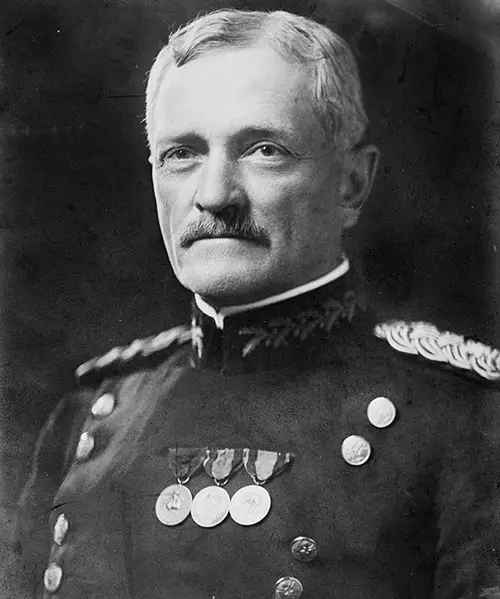
Gen. J. J. Pershing. The Photograph Shows General John J. “Black Jack” Pershing (1860-1948), Who Served as Head of the American Expeditionary Forces in World War I. He Wears Medals From the Indian Campaign, the Spanish-American War, and the Philippine-American War. Photo by Bain News Service. Library of Congress LCCN 2014701072. | GGA Image ID # 23711b74a7
John J. Pershing
John J. Pershing was the commanding officer of the American Expeditionary Forces (AEF) during World War I, a role he held from 1917 to 1920. Pershing is credited with transforming the U.S. Army from a small force into a large, disciplined fighting force of over 2 million men, which played a decisive role in defeating the Central Powers by late 1918. He insisted on keeping the American forces as a distinct, unified command rather than integrating them into Allied armies, which proved to be a successful strategy.
Key aspects of Pershing's leadership of the AEF:
- Independent American Force: Pershing advocated for a separate, unified American army to fight the war.
- Rapid Expansion: Under his command, the U.S. military grew exponentially, from 130,000 men to over 2 million in just 18 months.
- Modern Warfare: Pershing implemented modern tactics and organization within the AEF, focusing on combined arms and artillery.
- Decisive Battles: He led the AEF in several critical battles, including the Battle of St. Mihiel and the Meuse-Argonne Offensive, which helped break German resistance and lead to the Armistice.
- Impact of his command: Victory in World War I: The AEF's participation was crucial to the Allied victory in the war.
- Mentorship for Future Leaders: Pershing mentored the generation of generals who would lead the U.S. Army during World War II, such as George C. Marshall.
- Shaped Military Policy: His leadership and the successes of the AEF influenced future U.S. military policy and helped establish the U.S. as a global military power.
[✨ Most Engaging Content]
- The single sentence that says it all: Pershing’s note places the “young women of the Signal Corps” on equal footing in acknowledging wartime communications performance.
- Timing: Dated 20 November 1918—nine days after the Armistice—this functions as a capstone recognition of work sustained through the St. Mihiel and Meuse–Argonne operations.
- Chain of impact: From switchboard discipline and bilingual speed to reliable lines, the operators’ behind-the-scenes labor translated directly into command-and-control readiness.
🖼️ Noteworthy Images
- Memento cover (Christmas 1918): A personalized booklet given to operators that echoes the spirit of Pershing’s commendation and preserves contemporary praise in print.
- Report page excerpt (1977 hearing): The exhibit reproduction anchors provenance by showing where the commendation was cited within the congressional record.
- Portrait of Pershing: Period press image situating the commendation within the A.E.F.’s top-level command context.
📘 Mini Dictionary for Civilians
- A.E.F. (American Expeditionary Forces)
- The U.S. Army formation deployed to Europe during World War I under Gen. John J. Pershing.
- Signal Corps
- U.S. Army branch responsible for communications (telephony, telegraphy, radio), line construction, and message handling.
- Telephone Operating Unit
- Groups of trained switchboard operators—many bilingual—assigned to U.S. and allied exchanges in France and Germany.
- Advanced Section
- Operating areas closer to the front where communications linked corps/army HQs to forward units.
🎓 Essay Prompts for Students
- Reading between the lines: How does a single-sentence commendation function as historical evidence of women’s military labor? What can and can’t it prove?
- Cause and effect: Trace how operator skills (speed, multilingual accuracy, discipline) would influence A.E.F. decision-making during St. Mihiel or Meuse–Argonne.
- Recognition vs. status: Compare Pershing’s praise with postwar classification of operators as “civilian.” What does this tension reveal about policy and precedent?
- Memory & artifacts: Evaluate the role of unit mementos, affidavits, and hearings (1977) in shaping the modern legacy of the Hello Girls.
🪶 Citation Block
- Chicago (Notes/Bibliography): United States. Senate. Committee on Veterans’ Affairs. Recognition for Purposes of VA Benefits: Hearing Before the Committee on Veterans’ Affairs, United States Senate, Ninety-Fifth Congress, First Session on S. 247, S. 1414, S. 129, and Related Bills. Washington, DC: U.S. Government Printing Office, 1977, p. 364. (“Exhibit H—Commendation.”)
- APA 7th: United States Senate, Committee on Veterans’ Affairs. (1977, May 25). Recognition for purposes of VA benefits: Hearing before the Committee on Veterans’ Affairs, United States Senate, Ninety-Fifth Congress, First Session on S. 247, S. 1414, S. 129, and related bills (p. 364). U.S. Government Printing Office. (“Exhibit H—Commendation.”)
- MLA 9th: United States, Congress, Senate, Committee on Veterans’ Affairs. Recognition for Purposes of VA Benefits: Hearing Before the Committee on Veterans’ Affairs, United States Senate, Ninety-Fifth Congress, First Session on S. 247, S. 1414, S. 129, and Related Bills. U.S. Government Printing Office, 1977, p. 364. “Exhibit H—Commendation.”
- Student (plain English): “Exhibit H—Commendation.” In Recognition for Purposes of VA Benefits, Hearing of the U.S. Senate Committee on Veterans’ Affairs (95th Congress, 1st Session), May 25, 1977, p. 364. Washington, DC: U.S. Government Printing Office.
"[Exhibit H—Commendation]: Affidavit of Gertrude Hoppock: Commendation from Pershing, 20 November 1918," in Recognition for Purposes of VA Benefits, Hearing before the Committee on Veterans' Affairs, United States Senate, Ninety-Fifth Congress, First Session on S. 247, S. 1414, S. 129, and Related Bills. Washington, DC: US Government Printing Office, 25 May 1977. p. 364.
