
Peace Secrets Elude Miss Maria Flood - 1919
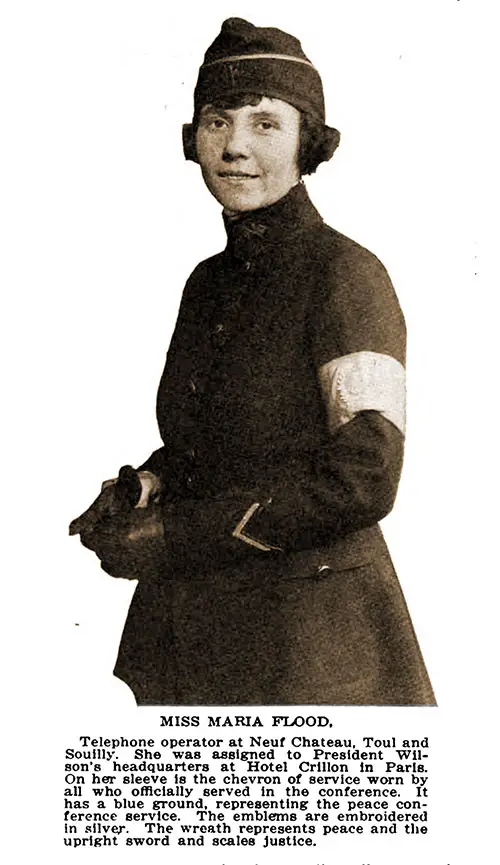
Miss Maria Flood, Telephone Operator at Neufchateau, Toul and Souilly. She Was Assigned to President Wilson's Headquarters at Hotel Crillon in Paris. On Her Sleeve Is the Chevron of Service Worn by All Who Officially Served in the Conference. It Has a Blue Ground, Representing the Peace Conference Service. The Emblems Are Embroidered in Silver. the Wreath Represents Peace and the Upright Sword and Scales Justice. Bell Telephone News, May 1919. GGA Image ID # 19a6febee9
📖 Review & Summary
The 1919 feature “Peace Secrets Elude Miss Maria Flood” celebrates the integrity and professionalism of Maria (Marie) Flood of Chicago, a U.S. Army Signal Corps telephone operator who served with distinction in France. Written shortly after her return to the United States, the article highlights Flood’s remarkable composure and discretion during her service at the Paris Peace Conference, where she handled calls for President Woodrow Wilson and other world leaders.
Refusing to “listen in” on conversations, even when the most powerful figures in the world were on the line, Flood exemplified the trust placed in America’s Hello Girls. Her commitment to duty was forged under fire—literally—at Souilly, a forward communications post only seven miles from Verdun, frequently targeted by enemy artillery and air raids. After the Armistice, she was transferred to Paris, where she managed the switchboard at the Hotel Crillon, headquarters for the American delegation.
Beyond her technical skill, the article underscores the gender-defying professionalism of the Signal Corps women who, under military discipline, operated with precision and moral responsibility. Flood’s story encapsulates the transition from wartime necessity to peacetime recognition—illustrating how the “Hello Girls” symbolized the expanding public and professional roles of women in early twentieth-century America.
Educational Relevance: This narrative provides an excellent case study for students exploring World War I communications, women’s labor history, or journalistic portrayals of female service. For genealogists and historians, it is a humanizing portrait of the ethical backbone behind the Army’s most critical communication networks.
Lack of Curiosity a Virtue of Parley’s Telephone Girl.
Even Where Mr. Wilson Called Miss Maria Flood of Chicago, Finley Peter Dunne’s Niece Failed to “Listen In,” She Says
New York, 12 April 1919
Either Eve gave the whole world a bum bunch on this woman and curiosity stuff of Chicago telephone girls are exceptions to the rule. And it’s easily proved.
On the Dutch line ship Rotterdam, which docked here yesterday with approximately two thousand troops from Michigan and Wisconsin, was Miss Maria Flood of Chicago, for one year telephone operator at the headquarters of the 1st army at Souilly and lately telephone operator on the peace conference switchboard.
Miss Flood didn’t come back with any medals, but she ought to have some. Maybe there are none that quite cover her case, but Congress or somebody ought to provide a few.
Should know the “Inside”
“So you were operator at the peace conference?” queried the reporter. “Gee, you ought to know a lot of inside stuff about the peace conference.”
“Inside stuff?” asked Miss Flood blankly.
“Sure,” said the reporter. “All the unreported telephone conversations between Mr. Wilson and Clemenceau and Admiral Benson and General Pershing, you know. Didn’t they ever talk over the phone?”
“Oh, yes. I remember on day President Wilson called in and asked me to get Admiral Benson on the wire for him.”
“Yes?”
“Well, I did.”
“And, what?”
Failed to “Listen In”
But it was hopeless. With the whole world wondering what was to be done with the German fleet, President Wilson talked to Admiral Benson over the telephone and the operator from Chicago didn’t even “listen in.” Eve got her sex slandered, that’s all.
“Didn’t you listen in even once while things that might be affecting the future of a dozen nations were being said over the wires?
“Not even once,” declared Miss Flood.
“Honest?”
“Honest. Cross my heart and hope to die.”
As a telephone operator, Miss Flood is a wonder, but as a source of inside information, she’s a “flivver.” And she is a niece of Pinley Peter Dunne, too.
Not Her Only Virtue
Lack of curiosity is not Miss Flood’s only virtue, however. Being a telephone operator at the headquarters of the 1st Army at Souilly may not mean much to the average person, but the initiated say Souilly wasn’t the pleasantest place in the world to run a switchboard or anything else.
It was only seven and one-half miles from Verdun and it was more or less constantly under fire. It was seldom that the German airmen filed at night to drop a few bombs on Souilly. It was from there that General Pershing directed the operations of the St. Mihiel drive.
Miss Flood served at Souilly for nearly a year, being sent to Paris to work at the peace conference switchboard after the armistice went into effect. She was one of several American telephone girls who stuck to their posts one October night at Souilly when the place was set on fire.
✨ Most Engaging Content
“Didn’t you listen in even once while things that might be affecting the future of a dozen nations were being said over the wires?” asked a reporter.
“Not even once,” declared Miss Flood. “Honest. Cross my heart and hope to die.”
This exchange, humorous and striking, captures the moral strength and humility of the Hello Girls. Even amid the temptations of proximity to power, Flood’s refusal to eavesdrop on President Wilson’s peace negotiations stands as a defining act of trustworthiness in military communications history.
📘 Mini Dictionary for Civilians
- Souilly: A key military base near Verdun, France, serving as headquarters for General John J. Pershing during major 1918 offensives.
- Chevron of Service: An embroidered insignia worn on the uniform sleeve denoting official participation in a specific campaign or service.
- Peace Conference: Refers to the 1919 Paris Peace Conference, where Allied leaders negotiated the Treaty of Versailles after World War I.
- First Army Headquarters: The U.S. Army’s command unit in France, responsible for directing major combat operations on the Western Front.
- “Listen in”: Period slang for eavesdropping on a private telephone conversation, considered unethical for operators.
🎓 Essay Prompts for Students
- How does Maria Flood’s conduct at the Peace Conference reflect early twentieth-century expectations of women’s professionalism and ethics?
- Compare the wartime experiences of Signal Corps operators like Flood with other women serving abroad during World War I. What does this suggest about evolving gender roles?
- Discuss how the press portrayed the “Hello Girls.” Were these portrayals accurate representations of their work, or filtered through societal norms of the time?
- Explore how communication technology shaped military operations during World War I, and why telephone operators were vital to battlefield success.
🪶 Citation Block
Chicago: “Peace Secrets Elude Her.” The Kansas City Star, April 12, 1919, p. 4.
APA: The Kansas City Star. (1919, April 12). Peace Secrets Elude Her. p. 4.
MLA: “Peace Secrets Elude Her.” The Kansas City Star, 12 Apr. 1919, p. 4.
Student Citation: “Peace Secrets Elude Miss Maria Flood” (1919). The Kansas City Star, p. 4. Retrieved from the Gjenvick-Gjønvik Archives (ggarchives.com).
“Peace Secrets Elude Her,” in The Kansas City Star, Saturday, 12 April 1919, p. 4.
