
Exhibit E—Telegram - Miss Adele Louis Hoppock from Squire - 1918
![[Exhibit E—Telegram]: Affidavit of Gertrude Hoppock: Telegram from Squire/Wesson, US Army, 20 February 1918](../../../CVimages/MIL/HelloGirls/CongressionalHearings/95th-S247-S1414-S129/1977-05-25/364e-TelegramFromMajGeneralSquireToAdeleHoppock-1918-02-20.jpg "GGA Image ID # 237724d13f. Click to View a Larger Image.")
[Exhibit E—Telegram]: Affidavit of Gertrude Hoppock: Telegram from Squire/Wesson, US Army, 20 February 1918, in Recognition for Purposes of VA Benefits, Hearing before the Committee on Veterans' Affairs, United States Senate, Ninety-Fifth Congress, First Session on S. 247, S. 1414, S. 129, and Related Bills. Washington, DC: US Government Printing Office, 25 May 1977. GGA Image ID # 237724d13f. Click to View a Larger Image.
📖 Review & Summary
The 1918 Exhibit E Telegram marks a defining moment in the creation of the U.S. Army’s Women’s Telephone Unit — the official appointment of Adele Louise Hoppock for temporary duty under Major General George Owen Squier, Chief Signal Officer. The telegram authorized her travel from Seattle to San Francisco to report to the Pacific Telephone & Telegraph Company — formalizing the Army’s collaboration with private telecommunications firms during World War I.
This short directive illustrates how military bureaucracy adapted civilian infrastructure to wartime needs. By granting allowances comparable to those of Army Nurses and assigning per diem travel pay, Squier effectively established the operational and logistical framework that would govern the first Hello Girls deployment overseas.
Educational Relevance: This document provides a tangible example of how women were mobilized for technical service through military-civilian cooperation. It’s ideal for courses in World War I history, women’s studies, or communications technology in warfare.
[Exhibit E—Telegram]
Washington, D.C., February 20, 1918.
Miss Adele Louise Hoppock,
Seattle, Wash.
Under authority of Secretary of War, dated April Seventh 1917, you will proceed to San Francisco, Calif., reporting upon arrival to C. B. Allsopp, Pacific Telephone and Telegraph Co., 835 Howard Street, for temporary duty. You will apply to the nearest quartermaster or recruiting officer for transportation. The travel directed is necessary in the military service. Transportation allowances to be accorded you same as prescribed for Army nurses in Army regulations while on temporary duty at San Francisco Calif. You will be allowed a per diem allowance of four dollars for first thirty days.
Squier,
Chief Signal Officer per Wessen.
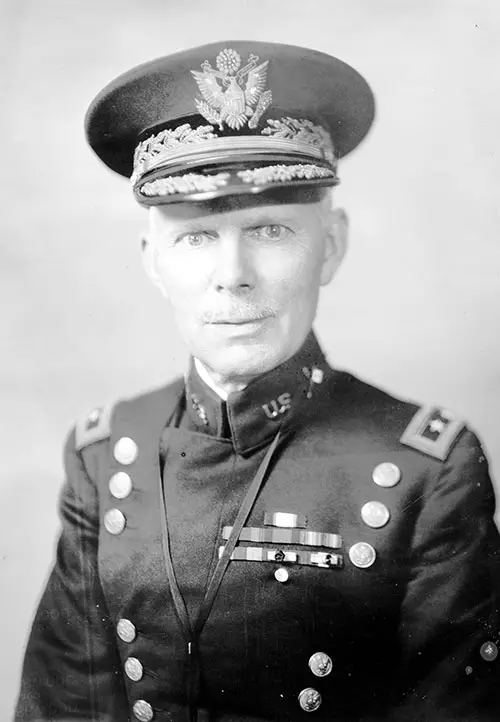
Major General George Owen Squire, US Army Chief Signal Officer 1917-1923. DoD Photo #200615, n.d. | GGA Image ID # 236a2ebef4
"Squire Chief Signal Officer" refers to Major General George Owen Squier, who served as the Chief Signal Officer of the U.S. Army from February 1917 until his retirement in 1923.
George Owen Squier, born on March 21, 1865 in Dryden, Michigan, graduated from the U.S. Military Academy in 1887. A scientist with a doctorate from Johns Hopkins University, he served in the Signal Corps, including four years in London as military attaché, until May 1916 when he was named to head the Aviation Section.
A scientific and technical leader, Squier was instrumental in developing the <0xC2><0xA0> Army's first aircraft and advocating for the creation of the Aeronautical Division, the precursor to the U.S. Air Force. He also championed the development of wired radio, which he later renamed Muzak, after his active military service.
Key Contributions and Roles
Pioneer in Aviation
Squier was deeply involved in the early days of military aviation, helping to prepare specifications for the first military aircraft and serving as the first military passenger on an airplane in 1908.
Chief Signal Officer
During World War I, Squier was promoted to Major General and served as the Chief Signal Officer, overseeing significant growth in the <0xC2><0xA0> Air Service.
Tech Visionary
Squier invented and patented multiplexing, a technique to send multiple signals over the same wire, and created Wired Radio, the precursor to Muzak.
Founder of the Air Force's Precursor
Under his leadership, the Aeronautical Division of the U.S. Signal Corps was established in 1907, making it the first organizational ancestor of the U.S. Air Force.
✨ Most Engaging Content
The line, “Under authority of Secretary of War … you will proceed to San Francisco,” captures the moment civilian women officially became part of the U.S. Army’s global communications network. This single directive transformed a professional telephone operator into a uniformed service member — a quiet but historic milestone in military gender integration.
🖼️ Noteworthy Image(s)
- Telegram to Adele Hoppock (1918): The original Western Union form authorizing her travel for Army Signal Corps duty — a vital primary source showing bureaucratic phrasing and military logistics of the era.
- Maj. Gen. George Owen Squier Portrait: The Chief Signal Officer who championed technical modernization and authorized the women’s telephone units that became the Hello Girls.
📘 Mini Dictionary for Civilians
- Chief Signal Officer: The Army officer in charge of military communications, including telegraph, telephone, and early aviation units.
- Temporary Duty (TDY): A military assignment away from a service member’s permanent station — often short-term and travel-related.
- Per Diem Allowance: Daily financial compensation for meals and lodging while traveling under official orders.
- Pacific Telephone & Telegraph Company: A regional Bell System affiliate that trained and supplied operators for Army Signal Corps service.
- Telegram Authorization: An official coded message used to transmit military orders quickly before wide adoption of secure telephone lines.
🎓 Essay Prompts for Students
- Discuss how Major General Squier’s telegram reflects the integration of civilian technology workers into military service during World War I.
- Compare the travel and pay provisions in the telegram to those of male soldiers. What does this reveal about early gender equity within the U.S. Army?
- Analyze how formal documents like this helped legitimize the Hello Girls as de facto service members long before they received veteran recognition.
- Explain the significance of private-public cooperation between AT&T and the U.S. Army Signal Corps in shaping wartime communications strategy.
🪶 Citation Block
Chicago: “[Exhibit E — Telegram]: Affidavit of Gertrude Hoppock: Telegram from Squier/Wessen, U.S. Army, 20 February 1918.” Hearing Before the Committee on Veterans’ Affairs, U.S. Senate, 95th Cong., 1st Sess., on S. 247, S. 1414, and S. 129 (1977), p. 364.
APA: United States Senate. (1977, May 25). Exhibit E — Telegram from Squier/Wessen to Adele Hoppock (1918). Hearing before the Committee on Veterans’ Affairs (95th Cong., 1st Sess.), p. 364. U.S. Government Printing Office.
MLA: “[Exhibit E — Telegram]: Affidavit of Gertrude Hoppock: Telegram from Squier/Wessen, U.S. Army, 20 Feb. 1918.” Hearing before the Committee on Veterans’ Affairs, U.S. Senate, 95th Cong., 1st Sess., 1977, p. 364.
Student Citation: “[Exhibit E — Telegram from Maj. Gen. Squier to Adele Hoppock (1918)]” in Recognition for Purposes of VA Benefits, U.S. Senate Hearing, 95th Congress (1977), p. 364. Retrieved from the Gjenvick-Gjønvik Archives (ggarchives.com).
"[Exhibit E—Telegram]: Affidavit of Gertrude Hoppock: Telegram from Squire/Wesson, US Army, 20 February 1918," in Recognition for Purposes of VA Benefits, Hearing before the Committee on Veterans' Affairs, United States Senate, Ninety-Fifth Congress, First Session on S. 247, S. 1414, S. 129, and Related Bills. Washington, DC: US Government Printing Office, 25 May 1977. p. 364.
