
Affidavit of Helen Bixby Moore - 1977
📖 Review & Summary
What this is: A 1977 sworn affidavit by Helen Bixby Moore describing her World War I service as a U.S. Army Signal Corps telephone operator. She recounts swearing the oath in New York, receiving regulation uniforms and insignia, training on long-distance boards, and duty at Tours (Embarkation Section) and Paris (General Headquarters) where she operated the switchboards for General John J. Pershing and Herbert Hoover.
Why it matters: The affidavit is a primary source from the Senate’s 1977 hearings on whether the “Hello Girls” were soldiers or civilians. Moore’s narrative—uniform issue, Army rules and court-martial jurisdiction, assignments under orders—directly supports the argument for military status and veteran recognition.
Context note: The affidavit references crossing to Le Havre with the “5th unit.” Contemporary rosters and period photos list Helen Bixby in the 6th Unit. GG Archives retains both accounts to document the historical record and the complexities of unit labeling across sources.
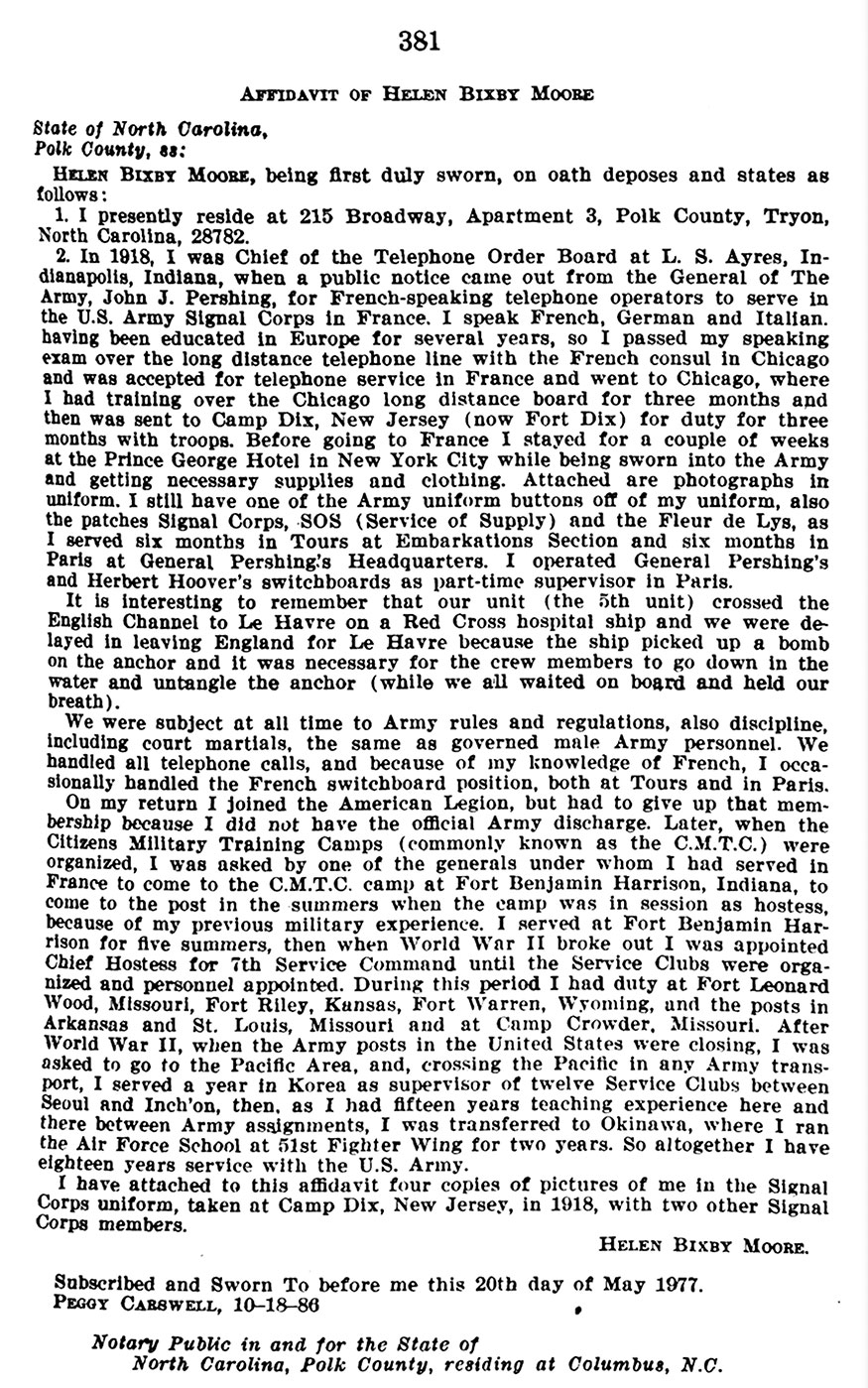
Appendix B: Affidavit of Hellen Bixby Moore," in Recognition for Purposes of VA Benefits, Hearing before the Committee on Veterans' Affairs, United States Senate, Ninety-Fifth Congress, First Session on S. 247, S. 1414, S. 129, and Related Bills. Washington, DC: US Government Printing Office, 25 May 1977. GGA Image ID # 19a7cc7f09. Click to View a Larger Image.
Affidavit of Helen Bixby Moore
State of North Carolina,
Polk County, ss:
Helen Bixby Moore, being first duly sworn, on oath deposes and states as follows:
1. I presently reside at 215 Broadway, Apartment 3, Polk County, Tryon, North Carolina, 28782.
2. In 1918, I was Chief of the Telephone Order Board at L. S. Ayres, Indianapolis, Indiana, when a public notice came out from the General of The Army, John J. Pershing, for French-speaking telephone operators to serve in the US Army Signal Corps in France.
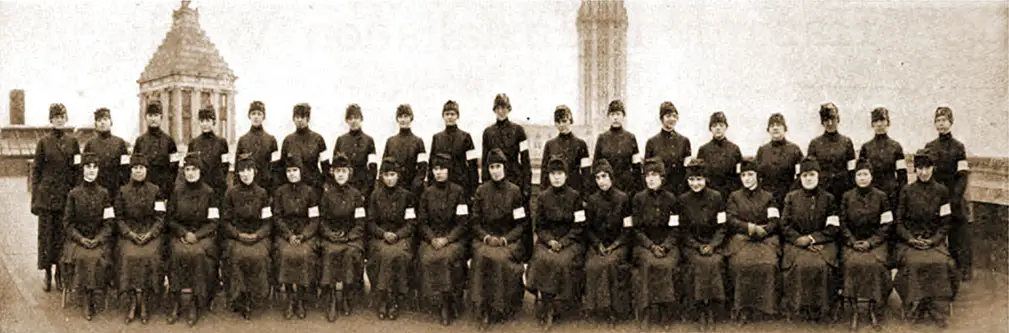
Sixth Unit Shares in Telephone Work in France. Telephone Operators Doing Overseas Service in France "Plug In" for Victory. Left to Right — Back Row: Miss Ellen Disbrowe, Mrs. Mary Steele, Miss Jane E. Conroy, Miss Elizabeth Anne Brown, Miss Anne May Ostrander, Miss Mabel Lapp, Miss Anna Campbell, Miss Louise Gordon, Miss Helma Greenlund, Miss Corah Bartlett, Miss M. Beryl Broderick, Miss Lydia E. Erickson, Miss Rosemary de Montauzan, Miss Abbie Mitchell, Miss Agnes Houley, Miss Helen Bixby, Miss Hazel Hammond, Miss Anna Swanson. Left to Right — Front Row: Miss Delta Hagan, Miss Eliz. Horsman, Miss Maude Johnson, Miss Margaret Olker, Miss Mary Story, Miss Frances Laney, Miss Isabelle Macdonald, Miss Oleda Joure, Miss Marion C. Swan, Miss Mae Ganley, Miss Hortense Levy, Miss Elsie Wolloff, Miss Bernadette Doucette, Miss Minnie Goldman, Miss Ruth Boucher, Miss Stella Russell, Miss Celia Grimeke. The Telephone Review, October 1918. | GGA Image ID # 192443f5fd. Click to View a Larger Image.
I speak French, German and Italian, having been educated in Europe for several years, so I passed my speaking exam over the long-distance telephone line with the French consul in Chicago and was accepted for telephone service in France and went to Chicago, where I had trained over the Chicago long-distance board for three months and then was sent to Camp Dix, New Jersey (now Fort Dix) for duty for three months with troops.
Before going to France, I stayed for a couple of weeks at the Prince George Hotel in New York City while being sworn into the Army and getting necessary supplies and clothing. Attached are photographs in uniform.
I still have one of the Army uniform buttons off of my uniform, also the patches Signal Corps, SOS (Service of Supply), and the Fleur de Lys, as I served six months in Tours at Embarkations Section and six months in Paris at General Pershing’s Headquarters. I operated General Pershing’s and Herbert Hoover’s switchboards as a part-time supervisor in Paris.
It is interesting to remember that our unit (the 5th unit) crossed the English Channel to Le Havre on a Red Cross hospital ship. We were delayed in leaving England for Le Havre because the ship picked up a bomb on the anchor, and the crew members needed to go down in the water and untangle the anchor (while we all waited on board and held our breath).
We were subject at all times to Army rules and regulations, also discipline, including court-martials, the same as governed male Army personnel. We handled all telephone calls, and because of ray knowledge of French, I occasionally handled the French switchboard position, both at Tours and in Paris.
On my return, I joined the American Legion but had to give up that membership because I did not have the official Army discharge. Later, when the Citizens Military Training Camps (commonly known as the CMTC) were organized, I was asked by one of the generals under whom I had served in France to come to the CMTC camp at Fort Benjamin Harrison, Indiana, to come to the post in the summers when the camp was in session as hostess, because of my previous military experience.
I served at Fort Benjamin Harrison for five summers; then, when World War II broke out, I was appointed Chief Hostess for 7th Service Command until the Service Clubs were organized and personnel appointed.
During this period, I had duty at Fort Leonard Wood, Missouri, Fort Riley, Kansas, Fort Warren, Wyoming, and the posts in Arkansas and St. Louis, Missouri, and at Camp Crowder, Missouri.
After World War II, when the Army posts in the United States were closing, I was asked to go to the Pacific Area, and, crossing the Pacific in an Army transport, I served a year in Korea as supervisor of twelve Service Clubs between Seoul and Inch’on, then, as I had fifteen years teaching experience here and there between Army assignments, I was transferred to Okinawa, where I ran the Air Force School at 51st Fighter Wing for two years. So altogether, I have eighteen years of service with the US Army.
I have attached to this affidavit four copies of pictures of me in the Signal Corps uniform, taken at Camp Dix, New Jersey, in 1918, with two other Signal Corps members.
Helen Bixby Moore.
Subscribed and Sworn To before me this 20th day of May 1977.
Peggy Carswell, 10-18-80 9
Notary Public in and for the State of
North Carolina, Polk County, residing at Columbia, NC.
✨ Most Engaging Content
- Swearing-in & uniform: Moore’s clear details on the oath, “U.S.” and Signal Corps collar devices, hats, patches (SOS, Signal flags, Fleur-de-lys) demonstrate Army control and identity.
- At GHQ Paris: Operating Pershing’s and Hoover’s boards powerfully situates Hello Girls at the heart of AEF command communications.
- Career of service: Her postwar Army-related service (CMTC and WWII service club leadership) shows a lifelong arc of military-adjacent contribution.
🖼️ Noteworthy Image
- Affidavit scan (1977): Visual evidence of the Senate hearing record in which Moore details her service and Army discipline.
- Sixth Unit group photograph (1918): A period image that identifies Helen Bixby among the operators shortly before or during overseas duty.
📘 Mini Dictionary for Civilian]
- GHQ (General Headquarters): Central command for the American Expeditionary Forces in France.
- SOS (Services of Supply): AEF organization responsible for logistics, depots, embarkation, and support.
- Court-martial: A military court with authority to try members of the armed forces under military law.
- Signal Corps insignia: Crossed flags device denoting service in the Army’s communications branch.
🎓 Essay Prompts for Students
- How do Moore’s descriptions of uniforms, orders, and discipline function as evidence of military status in a legal setting?
- Compare the Sixth Unit group photo with Moore’s affidavit: what do images add—or complicate—when reconstructing unit identity and deployment?
- Analyze the operational significance of bilingual operators at GHQ Paris: where did human skill intersect with wartime technology?
- Trace Moore’s postwar Army-related service: how does it shape our understanding of women’s evolving roles in U.S. military support structures?
Citation Block (Chicago, APA, MLA + student version)
Chicago: “Appendix B: Affidavit of Helen Bixby Moore.” In Recognition for Purposes of VA Benefits, Hearing Before the Committee on Veterans’ Affairs, U.S. Senate, 95th Cong., 1st sess., 25 May 1977, p. 381. Washington, DC: U.S. Government Printing Office.
APA: United States Senate. (1977, May 25). Appendix B: Affidavit of Helen Bixby Moore (p. 381). In Recognition for Purposes of VA Benefits. Washington, DC: U.S. Government Printing Office.
MLA: “Appendix B: Affidavit of Helen Bixby Moore.” Recognition for Purposes of VA Benefits, Hearing Before the Committee on Veterans’ Affairs, U.S. Senate, 95th Cong., 1st sess., 25 May 1977, p. 381. U.S. Government Printing Office.
Student: “Affidavit of Helen Bixby Moore (1977),” in U.S. Senate, Recognition for Purposes of VA Benefits, p. 381, via the Gjenvick-Gjønvik Archives (ggarchives.com).
"Appendix B: Affidavit of Hellen Bixby Moore," in Recognition for Purposes of VA Benefits, Hearing before the Committee on Veterans' Affairs, United States Senate, Ninety-Fifth Congress, First Session on S. 247, S. 1414, S. 129, and Related Bills. Washington, DC: US Government Printing Office, 25 May 1977. p. 381
