
The Hello Girls: America's First Women Soldiers (2017)
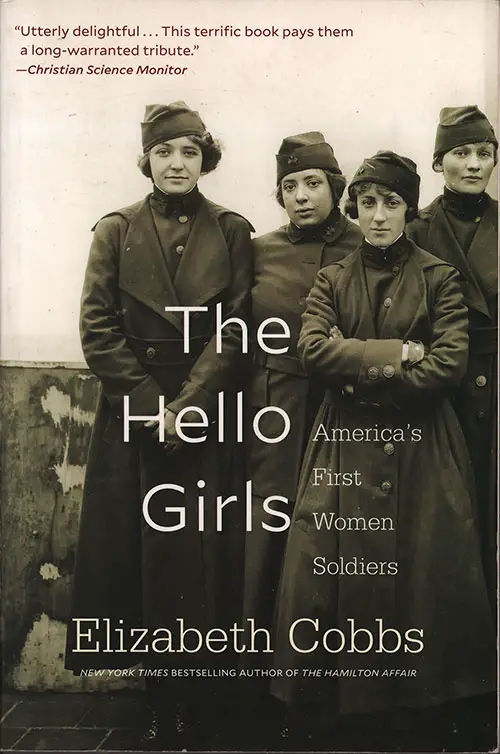
Front Cover, The Hello Girls, America's First Women Soldiers by Elizabeth Cobbs, 2017. | GGA Image ID # 2369743b76
📖 Foreword
Elizabeth Cobbs’ The Hello Girls: America’s First Women Soldiers is the definitive scholarly account of the U.S. Army Signal Corps female telephone operators in World War I. Drawing on archival research, Cobbs highlights their recruitment, their technical expertise with switchboard communications, their deployment to France, and their decades-long fight for recognition as veterans.
This book is essential for teachers and students studying gender roles in wartime, genealogists tracing family service in WWI, and military historians examining communications in the American Expeditionary Forces. It also bridges women’s suffrage history with military history, showing how these women were part of broader social change.
📖 Review & Summary
In The Hello Girls: America's First Women Soldiers (Harvard University Press, 2017), historian Elizabeth Cobbs reconstructs the recruitment, training, deployment, and postwar struggle for recognition of the U.S. Army Signal Corps telephone operators. Blending personnel files, military orders, news coverage, and personal papers, Cobbs follows operators from stateside switchboard tests to critical boards at GHQ and First Army during St. Mihiel and the Meuse–Argonne offensives.
The study clarifies how the Army's need for bilingual, technically expert operators collided with administrative categories that labeled them "civilian," shaping pay, risk, and wartime legal status. Cobbs also tracks the through-line from service "under orders and in uniform" to the late-20th-century push for veterans' status—connecting battlefield communications to citizenship and suffrage.
Recommended for upper-level high school and university courses in U.S. women's history, military history, and technology & society. For lesson extensions, pair chapters on 1918 operations with GG Archives primary sources (Pershing cables, rosters, and affidavits).
From the Back Cover
In 1918, the U.S. Army Signal Corps sent 223 women to France at General Pershing’s explicit request. They were masters of the latest technology: the telephone switchboard.
While suffragettes picketed the White House and President Wilson struggled to persuade a segregationist Congress to give women of all races the vote, these courageous young women swore the army oath and settled into their new roles.
Elizabeth Cobbs reveals the challenges they faced in a war zone where male soldiers wooed, mocked, and ultimately celebrated them.
The army discharged the last Hello Girls in 1920, the year Congress ratified the Nineteenth Amendment. When they sailed home, they were unexpectedly dismissed without veterans’ benefits and began a sixty-year battle that a handful of survivors carried to triumph in 1979.
Summary
"In World War I, telephones linked commanding generals with soldiers in muddy trenches. A woman in uniform connected almost every one of their calls, speeding the orders that won the war. Like other soldiers, the "Hello Girls" swore the Army oath and stayed for the duration. A few were graduates of elite colleges. Most were ordinary, enterprising young women motivated by patriotism and adventure, eager to test their mettle and save the world.
The first contingent arrived in France just as the German Army trained "Big Bertha" on Paris, bombarding the frightened city as the new women of the U.S. Army struggled through unlit streets to find their billets. A handful followed General Pershing to the gates of Verdun and the battlefields of Meuse-Argonne.
When the switchboard operators sailed home a year later, the Army dismissed them without veterans' benefits or victory medals. The women commenced a sixty-year fight that a handful of survivors carried to triumph in 1979.
This book shows how technological developments encouraged an unusual band to volunteer for military service at the precise moment that feminists back home championed a federal suffrage amendment. The same desire to participate fully in the life of their country animated both groups, and both struggled after 1920 to reap the rewards of victory.
Their experiences illuminate ways in which sex-role change was embraced and resisted throughout the twentieth century, and the ways that men and women struggled together for gender justice."--Provided by publisher
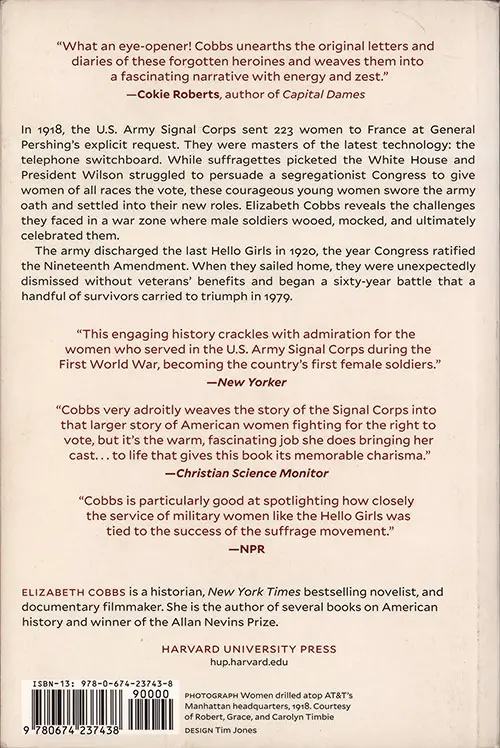
Back Cover, The Hello Girls, America's First Women Soldiers by Elizabeth Cobbs, 2017. | GGA Image ID # 2369a0f1dc
CONTENTS
Prologue
- Americas Last Citizens
- Neutrality Defeated, and the Telephone in War and Peace
- Looking for Soldiers and Finding Women
- We’re Going Over
- Pack Your Kit
- Wilson Adopts Suffrage, and the Signal Corps Embarks
- Americans Find Their Way, Over There
- Better Late Than Never on the Marne
- Wilson Fights for Democracy at Home
- Together in the Crisis of Meuse-Argonne
- Peace without Their Victory Medals
- Soldiering Forward in the Twentieth Century
Epilogue
Notes
Acknowledgments
Index
Illustrations
About the Author
Elizabeth Cobbs is a historian, New York Times bestselling novelist, and documentary filmmaker. She is the author of several books on American history and winner of the Allan Nevins Prize. Elizabeth earned her Ph.D. in American history at Stanford University. She holds the Melbern Glasscock Chair at Texas A&M University.
📘 Mini Dictionary for Civilians
- AEF (American Expeditionary Forces)
- U.S. forces in Europe during WWI under Gen. John J. Pershing.
- GHQ (General Headquarters)
- Top-level command hub where orders flowed through switchboards to field units.
- Signal Corps
- Army branch responsible for communications—telephones, telegraphs, radios, visual signals.
- Magneto (field phone)
- Hand-cranked telephone used in the field; operators bridged these circuits via switchboards.
- Chief Operator
- Senior supervisor responsible for discipline, routing quality, and team readiness.
- War Risk Insurance
- WWI program offering insurance/benefits to eligible service members; operators' eligibility was contested.
- JAG (Judge Advocate General)
- The Army's top legal office; wartime rulings affected operators' status and benefits.
- Meuse–Argonne & St. Mihiel
- Major 1918 offensives where rapid, reliable telephone traffic enabled coordinated operations.
- Port of Embarkation, Hoboken
- Main U.S. port for WWI troop and personnel departures to Europe.
🎓 Essay Prompts for Students
- Document Analysis (HS/Undergrad): Using Cobbs's account and a GG Archives Pershing cable, explain how operational needs shaped recruiting criteria for women operators.
- Status & Law (HS/Undergrad): Compare the operators' oath, uniforms, and command conditions with the legal classification that labeled them "civilian." What does this reveal about wartime bureaucracy?
- Technology & Gender (Undergrad): Argue how telephone technology in 1917–1919 both opened and constrained women's military roles.
- Memory & Recognition (Undergrad/Grad): Trace the long campaign for veterans' status. How do affidavits and postwar orders in GG Archives corroborate or complicate Cobbs's narrative?
- Comparative Narrative (HS/Undergrad): Contrast this scholarly monograph with a youth title (e.g., Grace Banker and Her Hello Girls). How do audience and purpose shape historical interpretation?
🪶 Citation Block
Cite the Book
- Chicago (Notes & Bib.) — Elizabeth Cobbs, The Hello Girls: America's First Women Soldiers (Cambridge, MA: Harvard University Press, 2017).
- APA (7th) — Cobbs, E. (2017). The Hello Girls: America's first women soldiers. Cambridge, MA: Harvard University Press.
- MLA (9th) — Cobbs, Elizabeth. The Hello Girls: America's First Women Soldiers. Harvard UP, 2017.
Cite This GG Archives Page
- Chicago — Paul K. Gjenvick, "The Hello Girls: America's First Women Soldiers (2017) — Review & Resources," Gjenvick-Gjønvik Archives (GG Archives), accessed [Day Month Year], https://www.ggarchives.com/MIL/HelloGirls/Books/TheHelloGirls-2017.html.
- APA (7th) — Gjenvick, P. K. (n.d.). The Hello Girls: America's First Women Soldiers (2017) — Review & resources. GG Archives. Retrieved [Month Day, Year], from https://www.ggarchives.com/MIL/HelloGirls/Books/TheHelloGirls-2017.html
- MLA (9th) — Gjenvick, Paul K. "The Hello Girls: America's First Women Soldiers (2017) — Review & Resources." GG Archives, https://www.ggarchives.com/MIL/HelloGirls/Books/TheHelloGirls-2017.html. Accessed [Day Month Year].
Replace bracketed dates with your access date when citing the web page.
Library of Congress Catalog Listing
- Title: The Hello Girls : America's first women soldiers / Elizabeth Cobbs.
- By: Cobbs, Elizabeth,, Author
- Published: Harvard University Press, Cambridge, Massachusetts ; London, England, [2017]
- Variant title: America's first women soldiers
- Language: English
- Publisher: Harvard University Press, Cambridge, Massachusetts ; London, England
- Library of Congress subjects
- United States. Army. Signal Corps--History--20th century
- United States. Army--Women--History
- World War, 1914-1918--Communications
- Telephone operators--United States--History--20th century
- World War, 1914-1918--Participation, Female
- Women soldiers--United States--History--20th century
- Women veterans--United States--History--20th century
- Women soldiers--Legal status, laws, etc.--United States
- Sex discrimination against women--United States--History--20th century
- World War, 1914-1918--Regimental histories--United States
- Women--Suffrage--United States--History--20th century
- Document type: Book
- Physical description: 370 pages,14 unnumbered pages of plates ; 22 cm
- Bibliographic notes: Includes bibliographical references and index
- ISBN: 9780674971479
- LCCN: 2016038111
- Classification - LC: D639.T4 C63 2017
- Classification - Dewey: 940.4173082
