
Three More Michigan Girls For “Over There” - 1918
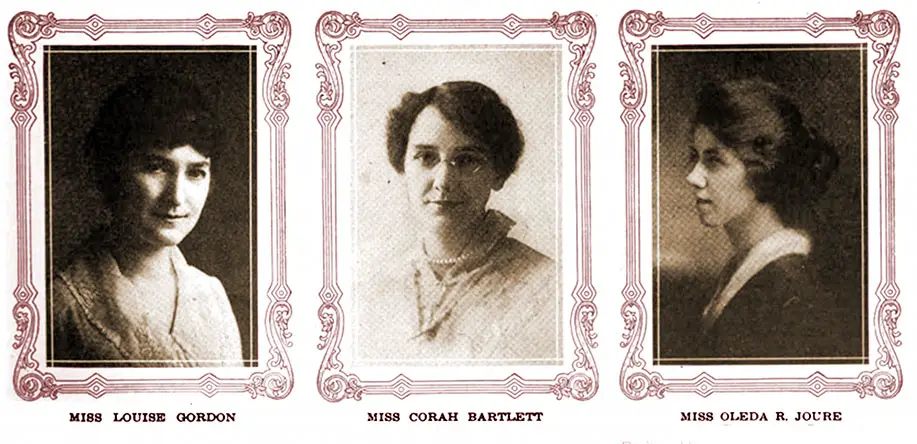
Miss Louise Gordon, Miss Corah Bartlett, and Miss Oleda R. Joure. Bell Telphone News, October 1918. GGA Image ID # 19a68aeaa5. Click to View a Larger Image.
📖 Review & Summary
This cheerful 1918 feature from Bell Telephone News showcases the enthusiasm and community spirit surrounding the women of the Michigan State Telephone Company who volunteered for the U.S. Army Signal Corps’ “Hello Girls” service. The article highlights three new recruits—Miss Louise Gordon, Miss Corah Bartlett, and Miss Oleda R. Joure—whose experience, professionalism, and dedication made them ideal candidates for overseas duty.
While written in a lighter, hometown tone, the piece demonstrates the growing admiration for these skilled operators who bridged the civilian and military worlds with competence and grace. Each woman’s biography reflects the professional standards required for selection—years of supervisory and instructional experience, leadership roles, and proven reliability. Through such vignettes, readers at home saw their neighbors joining a global effort, transforming familiar telephone work into patriotic service.
Three more young women of the Michigan State Telephone Company have entered the Women's Telephone Unit for service in France.
The company has employed Miss Louise Gordon of Detroit for fifteen years. She was the manager at Litchfield for several years and the chief operator at Hillsdale for two years. When she volunteered to go overseas, she was an instructor in the Detroit toll training department. After arriving in New York, Miss Gordon was appointed operator in charge.
Miss Corah Bartlett has served the company for nine and a half years and has been the chief operator at both Hillsdale and Jackson.
When she enlisted in the unit, she was the district traffic supervisor of the Eastern District, State Division. Still, she had been on a leave of absence for some time due to the illness and death of her mother.
Miss Oleda R. Joure has been with the company for nearly four years and was chief operator at Marine City. When she left, a delegation of Marine City businessmen presented her with a purse of fifty dollars.
✨ Most Engaging Content
The most engaging aspect of this short article is its tone of local pride and admiration. In just a few paragraphs, it conveys the human side of wartime service—the farewell gestures, the professional excellence, and the sense of community support. The anecdote of Marine City’s business leaders presenting Miss Oleda Joure with a $50 purse captures both gratitude and recognition that these young women were representing Michigan abroad.
The story also subtly illustrates how telephone companies, especially in the Midwest, became recruitment pipelines for the Signal Corps. Women who had trained under Bell System standards were seen as disciplined, trustworthy, and already skilled in the technical precision that military communications demanded.
🖼️ Noteworthy Image(s)
Group Portrait: The accompanying photograph of Miss Louise Gordon, Miss Corah Bartlett, and Miss Oleda R. Joure embodies the article’s celebratory tone. Smiling, poised, and wearing their civilian attire, they appear both professional and approachable—symbols of the “home front” contribution that seamlessly blended with front-line service. For readers in 1918, this image conveyed optimism and competence amid the anxieties of war.
📘 Mini Dictionary for Civilians
- “Over There” — A popular phrase of World War I referring to American service overseas, made famous by George M. Cohan’s patriotic song of the same name.
- Signal Corps — The U.S. Army branch responsible for communications, including telephone, telegraph, and radio operations.
- Bell Telephone News — An internal company publication produced by Bell System affiliates that often featured employee achievements and wartime contributions.
- District Traffic Supervisor — A management position overseeing telephone operators and ensuring smooth service within a regional network.
🎓 Essay Prompts for Students
- How did local newspapers and company newsletters contribute to shaping public perception of women’s wartime service?
- Compare this 1918 morale piece with later press coverage that emphasized danger and sacrifice. What does this reveal about shifting wartime narratives?
- Discuss the importance of professional experience and corporate training in preparing women like these for success in the Signal Corps.
- How did community gestures, such as Marine City’s farewell gift, reinforce the connection between home and front-line service?
🪶 Citation Block
Chicago Style: “Three More Michigan Girls For ‘Over There.’” Bell Telephone News, Vol. 8, No. 3 (October 1918), p. 5.
APA Style: Three More Michigan Girls For “Over There.” (1918, October). Bell Telephone News, 8(3), 5.
MLA Style: “Three More Michigan Girls For ‘Over There.’” Bell Telephone News, vol. 8, no. 3, Oct. 1918, p. 5.
Student Version: “‘Three More Michigan Girls For ‘Over There’’ (1918) profiles Michigan telephone operators volunteering for the Signal Corps in World War I (Bell Telephone News, October 1918, GG Archives Collection).”
"Three More Michigan Girls For 'Over There,'" in Bell Telphone News, Detroit: Bell Telephone Company, Vol. 8, No. 3, October 1918, p. 5.
