
Signal Corps Telephone Unit Application - 1918
📖 Review & Summary
What this page shows: the 1918 application process for the U.S. Army Signal Corps telephone unit—later known as the “Hello Girls.” Candidates were recruited for bilingual skill (English–French), vetted, and put through telephone instruction, language exams, and military drill prior to assignment.
Primary source highlight: Exhibit B reproduces the questionnaire sent to Adele Louis Hoppock (later Unit 3), including prompts about health, language attestations, willingness to undergo instruction, and commitment to serve for the period of the war.
Why it matters: The application evidences how the Army built a modern, bilingual communications corps—screening for discipline, speed, accuracy, and voice under pressure—attributes that made the AEF’s command network workable in France.
Note: The language requirement was dropped after Unit 4. See Pershing Eliminates French-Speaking Requirement — 6 June 1918
Foreword
To join the U.S. Army's Signal Corps telephone unit in France during 1918, women applied to become "Hello Girls," requiring fluency in both English and French and undergoing a stringent selection process that included investigations and military drill. General Pershing requested these bilingual women to alleviate communication issues on the Western Front. While there isn't a specific application form available, the process involved responding to recruitment efforts, passing tests, and demonstrating patriotic motivations to serve the war cause.
How the 1918 Application Worked
For context, see: Information Relative to Telephone Operators for Duty in France (1918) · How the Signal Corps Organized 100 Girls (1918) · Third Unit Arrives in France (1918)
The Application Process
Public Recruitment: Advertisements were placed for bilingual women, with a significant number of applicants from the United States and Canada.
Selection Criteria: Applicants underwent a tough selection process.
Investigations: Individual investigations were conducted by the Secret Service to assess applicants.
Military Training & Testing: Candidates were given military drill and tests, similar to those for officer candidates.
Patriotic Motivation: Women who applied cited patriotic reasons for wanting to serve and help the war effort.
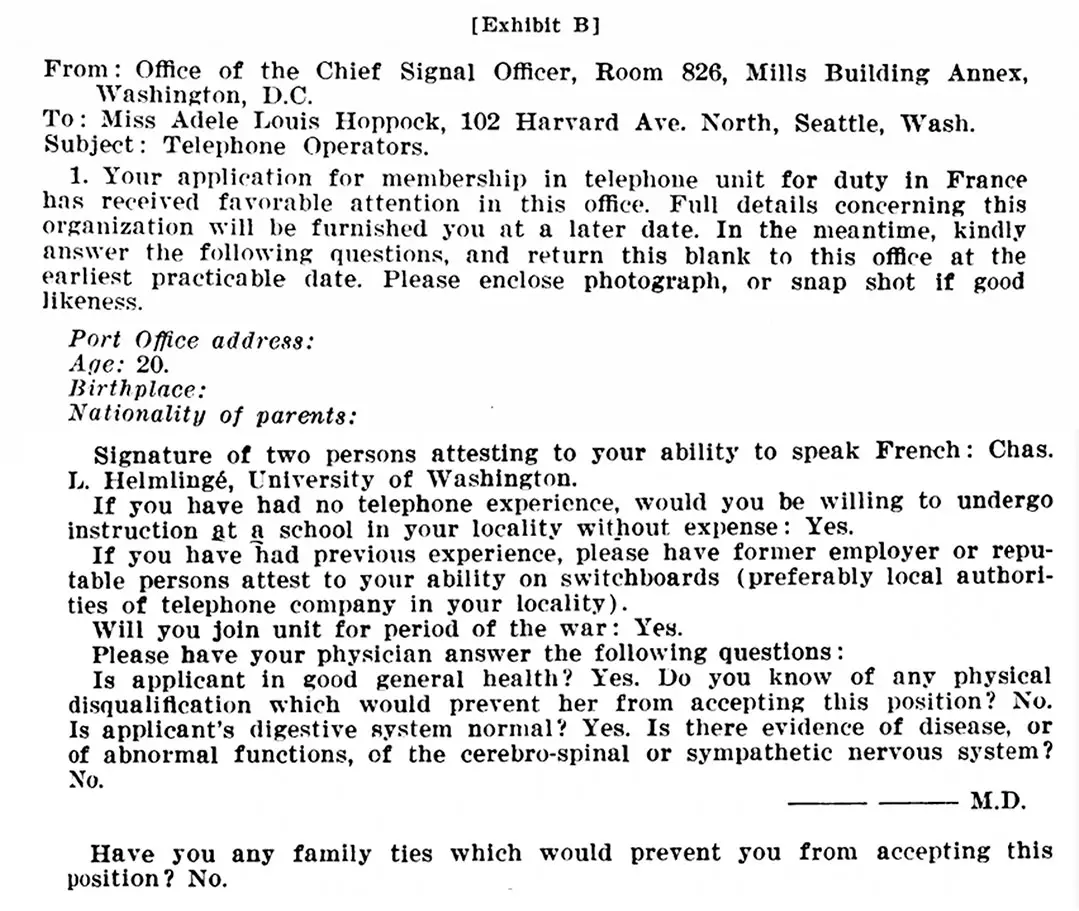
Exhibit B: Application for Membership in Telephone Unit, Adele Hoppock, 1918. Recognition for Purposes of VA Benefits, 1977. GGA Image ID # 19ab71dc01. Click to View a Larger Image.
Exhibit B includes some of the responses to the application question by Miss Adele Louis Hoppock. Adele completed her training and was part of the Third Unit of telephone operators to arrive in France.
From : Office of the Chief Signal Officer, Room 826, Mills Building Annex, Washington, D.C.
To: Miss Adele Louis Hoppock, 102 Harvard Ave. North, Seattle, Wash. Subject : Telephone Operators.
1. Your application for membership in telephone unit for duty in France has received favorable attention in this office. Full details concerning this organization will be furnished you at a later date. In the meantime, kindly answer the following questions, and return this blank to this office at the earliest practicable date. Please enclose photograph, or snap shot if good likeness.
Post Office address:
Age: 20.
Birthplace:
Nationality of parents:
Signature of two persons attesting to your ability to speak French: Chas. L. Helmlingé, University of Washington.
If you have had no telephone experience, would you be willing to undergo instruction fit a school in your locality without expense: Yes.
If you have had previous experience, please have former employer or reputable persons attest to your ability on switchboards (preferably local authorities of telephone company in your locality).
Will you join unit for period of the war: Yes.
Please have your physician answer the following questions :
Is applicant in good general health? Yes.
Do you know of any physical disqualification which would prevent her from accepting this position? No.
Is applicant’s digestive system normal? Yes.
Is there evidence of disease, or of abnormal functions, of the cerebro-spinal or sympathetic nervous system?
Have you any family ties which would prevent you from accepting this position? No.
✨ Most Engaging Content
- Language attestations: candidates needed third-party signatures verifying French proficiency.
- Health & stamina: physician’s responses on fitness, nerves, digestion—evidence of operational demands.
- Instruction pledge: even without prior telephone experience, applicants pledged to train at a local school.
- Service commitment: “Will you join unit for period of the war?”—a clear wartime obligation.
- From form to field: Adele L. Hoppock’s path—from application to Unit 3 deployment in France.
🖼️ Noteworthy Image(s)
- Exhibit B spread: “Application for Membership in Telephone Unit” (Adele L. Hoppock), 1918.
📘 Mini Dictionary for Civilians
- Attestation: a signed statement by a qualified person confirming a skill (e.g., French fluency).
- Telephone instruction: short, intensive courses run by Bell System companies for switchboard work.
- Drill: basic military training (formations, marching, conduct) used to instill discipline and cohesion.
🎓 Essay Prompts for Students
- Using Exhibit B, identify which questions indicate the Army’s top priorities for operator performance and safety. Justify your picks.
- Compare this 1918 application with modern military intake: what stays the same (fitness, vetting), what differs (skills/technology)?
- Trace Adele L. Hoppock’s journey from Exhibit B to Unit 3 in France. How does this form foreshadow her later assignments?
🪶 Citation Block (Chicago, APA, MLA + student)
Chicago: “Exhibit B: Application for Membership in Telephone Unit in France (1918), Adele Louis Hoppock.” In Recognition for Purposes of VA Benefits, Hearing Before the Committee on Veterans’ Affairs, U.S. Senate, 95th Cong., 1st sess., 25 May 1977, pp. 362–363. Washington, DC: U.S. Government Printing Office.
APA: United States Senate. (1977, May 25). Exhibit B: Application for Membership in Telephone Unit in France (1918), Adele Louis Hoppock (pp. 362–363). In Recognition for Purposes of VA Benefits. Washington, DC: U.S. Government Printing Office.
MLA: “Exhibit B: Application for Membership in Telephone Unit in France (1918), Adele Louis Hoppock.” Recognition for Purposes of VA Benefits, Hearing Before the Committee on Veterans’ Affairs, U.S. Senate, 95th Cong., 1st sess., 25 May 1977, pp. 362–363. U.S. Government Printing Office.
Student: “Application for Membership in Telephone Unit in France (1918), Adele L. Hoppock,” in U.S. Senate, Recognition for Purposes of VA Benefits, pp. 362–363, via GG Archives.
"[Exhibit B]": Application for Membership in Telephone Unit in France - 1918, Miss Adele Louis Hoppock, in Hearing before the Committee on Venteran's Affairs, United States Senate, Ninety-Fifth Congress, First Session on S. 247, S. 1414, S. 129, and Related Bills, Washington DC: US Government Printing Office, 25 May 1977, pp. 362-363.
