
Exhibit V - Signal Corps Veterans Association Membership Card - 1919
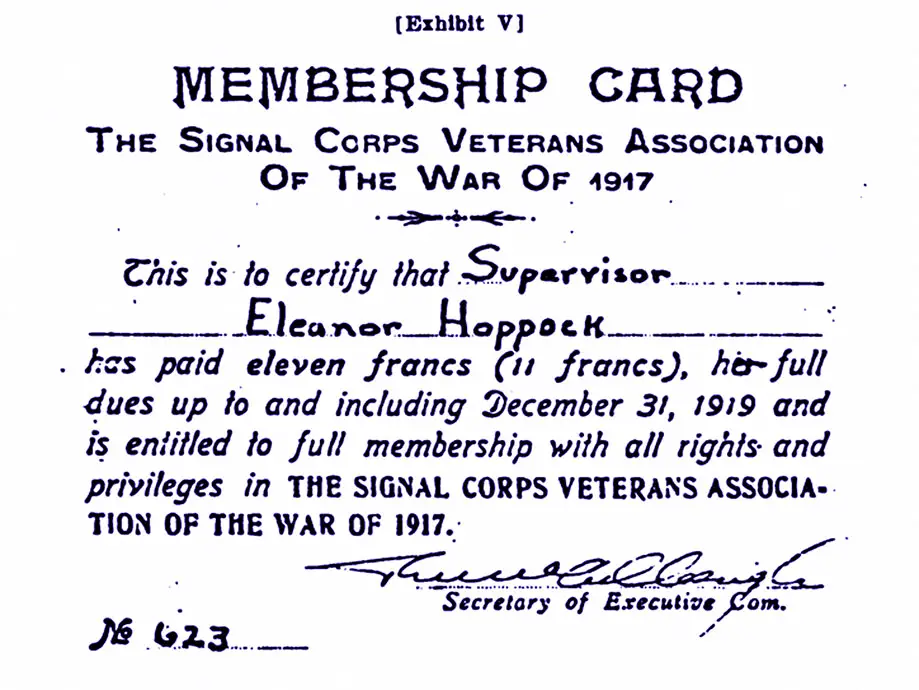
Signal Corps Veterans Association of the War of 1917 Membership Card for Supervisor Eleanor Hoppock, Dues Through 31 Dec. 1919, Card No. 623. [Exhibit V]: Affidavit of Gertrude Hoppock: Signal Corps Veterans Association Membership Card, 1919," in Recognition for Purposes of VA Benefits, Hearing before the Committee on Veterans' Affairs, United States Senate, Ninety-Fifth Congress, First Session on S. 247, S. 1414, S. 129, and Related Bills. Washington, DC: US Government Printing Office, 25 May 1977. | GGA Image ID # 2371e4533e. Click to View a Larger Image.
📖 Foreword
Eleanor Rowena Hoppock, a World War I U.S. Army Signal Corps telephone operator, was admitted into the Signal Corps Veterans Association of the War of 1917 in 1919—an association title that reflects period usage of "War of 1917" to denote the U.S. entry year into WWI Note 3. Membership in this veterans' association signified peer recognition and community among Signal Corps personnel in France, but it was not itself federal veteran status Note 1. The "Hello Girls," as these operators were known, were initially denied official veteran status and only received it after decades of advocacy and legislative action Note 4.
Eleanor Hoppock's service
Recruitment (1918): Eleanor and her sister, Adele, volunteered from Seattle as Signal Corps telephone operators, joining a highly selective unit trained for speed, accuracy, and bilingual operation on military switchboards.
Assignments
France: The sisters served overseas, operating military switchboards in post-armistice France where the Signal Corps maintained extensive communications infrastructure for the AEF and subsequent peace activities Note 2.
Paris Peace Conference (1919): Eleanor was among the operators selected to handle high-level calls during the peace negotiations, supporting secure, rapid connections for military and diplomatic leadership.
Role: The operators' disciplined procedures and round-the-clock staffing provided reliable command-and-control communications across the AEF network, including critical hubs such as GHQ.
Post-war veteran recognition
Despite being sworn into the U.S. Army and serving under military discipline, the Hello Girls were discharged as civilian contract employees and were not initially granted federal veteran status or benefits—an administrative position later revisited by Congress and federal agencies Note 4.
The long campaign for recognition
In 1977, federal legislation acknowledged the operators' service as qualifying for veteran status Note 4. Surviving members subsequently received Honorable Discharges and World War I Victory Medals Note 4. By the time of this recognition, only a small number of the original operators were still living Note 4.
In this context, Eleanor Hoppock's inclusion in the Signal Corps Veterans Association stands as a contemporaneous acknowledgment of service and standing among Signal Corps peers—distinct from the later, formal U.S. government recognition of veteran status and benefits Note 1 Note 4.
📖 Review & Summary
This artifact documents the inclusion of Supervisor Eleanor Rowena Hoppock, a U.S. Army Signal Corps telephone operator, in the Signal Corps Veterans Association of the War of 1917 in 1919. The card (No. 623) states that she had paid eleven francs in dues, securing "full membership with all rights and privileges" through 31 December 1919—a post-armistice sign of peer recognition among Signal Corps personnel in France Note 1 Note 2.
The Association's title—"of the War of 1917"—reflects the U.S. entry year into World War I. The wording on the card mirrors contemporary terminology and orthography, including a period spelling anomaly in "privileges" Note 3.
While this membership recognized service within a veterans' association, it did not itself confer official U.S. federal veteran status or benefits. That recognition arrived decades later through legislative and administrative action acknowledging the Hello Girls as veterans Note 4.
Membership Card Transcript
The Signal Corps Veterans Association of the War of 1917 Note 3
This is to certify that Supervisor Eleanor Hoppock has paid eleven francs (11 francs) her full dues up to and including December 31, 1919 and is entitled to full membership with all rights and privileges in the Signal Corps Veterans Association of the War of 1917.
/s/ [illegible], Secretary of Executive Committee
No. 623
✨ Most Engaging Content
- Card No. 623: Concrete evidence of Eleanor Hoppock's peer-validated status among Signal Corps veterans in France (1919).
- "War of 1917" phrasing: A period label centering the U.S. entry year into WWI, captured verbatim on the artifact.
- Dues in francs: Post-armistice France remains the financial context for association membership.
- Rights & privileges: The Association promised its members internal benefits—distinct from federal veterans' benefits.
📘 Mini Dictionary for Civilians
- Signal Corps
- The U.S. Army branch responsible for military communications (telephones, telegraphs, radio) during WWI.
- Supervisor (Signal Corps)
- A leadership designation within the women's telephone operator units, overseeing operator teams and shift performance.
- Signal Corps Veterans Association of the War of 1917
- A post-armistice veterans' association formed among Signal Corps personnel in France. Membership reflected peer recognition, not federal status Note 1.
- Franc
- French currency at the time;
eleven francs
on the card denotes dues paid in France in 1919 Note 2. - "War of 1917"
- Period term emphasizing the U.S. entry year into World War I, used on some AEF-era materials Note 3.
🎓 Essay Prompts for Students
- What is the difference between membership in a private veterans' association and federal recognition as a veteran, and why did that distinction matter for the Hello Girls?
- Analyze the phrase "War of 1917" on the card. How do names and dates shape public memory of a conflict?
- Using this card as a primary source, what can we infer about the social networks and support systems that formed among Signal Corps personnel after the armistice?
- Discuss how artifacts like membership cards complement official records when reconstructing the service histories of women in WWI.
- How might dues, bylaws, and "rights & privileges" of a veterans' association reflect its mission—and its limits?
🪶 Citation Block
Chicago (Notes & Bibliography)
United States. Congress. Senate. Committee on Veterans' Affairs. Recognition for Purposes of VA Benefits: Hearing on S. 247, S. 1414, S. 129, and Related Bills, 95th Cong., 1st sess., May 25, 1977. Washington, DC: U.S. Government Printing Office, 1977, 375. (Exhibit V: Signal Corps Veterans Association Membership Card, 1919.)
APA (7th ed.)
United States. Congress. Senate. Committee on Veterans' Affairs. (1977). Recognition for purposes of VA benefits: Hearing on S. 247, S. 1414, S. 129, and related bills (95th Cong., 1st sess., p. 375). U.S. Government Printing Office. (Exhibit V)
MLA (9th ed.)
United States, Congress, Senate, Committee on Veterans' Affairs. Recognition for Purposes of VA Benefits: Hearing on S. 247, S. 1414, S. 129, and Related Bills. 95th Cong., 1st sess., 25 May 1977, U.S. Government Printing Office, 1977, p. 375. Exhibit V.
Student (Plain-English)
"Exhibit V: Signal Corps Veterans Association Membership Card, 1919," in Recognition for Purposes of VA Benefits, Hearing before the U.S. Senate Committee on Veterans' Affairs, 95th Congress, 1st Session, May 25, 1977 (Washington, DC: U.S. Government Printing Office, 1977), p. 375.
"[Exhibit V]: Affidavit of Gertrude Hoppock: Signal Corps Veterans Association Membership Card, 1919," in Recognition for Purposes of VA Benefits, Hearing before the Committee on Veterans' Affairs, United States Senate, Ninety-Fifth Congress, First Session on S. 247, S. 1414, S. 129, and Related Bills. Washington, DC: US Government Printing Office, 25 May 1977. p. 375.
End Notes
- Note 1. Association membership (e.g., the Signal Corps Veterans Association) reflected peer recognition within the corps but did not, by itself, confer federal veteran status or benefits. ↩︎ ↩︎
- Note 2. After the Armistice, the AEF and Signal Corps continued extensive communications operations in France, including support to peace-making activities and military administration. ↩︎
- Note 3. "War of 1917" centers on the U.S. entry year into World War I (1917) and appears in period U.S./AEF usage when labeling the conflict and veteran associations. ↩︎ ↩︎
- Note 4. In 1977–1978, federal action recognized WWI U.S. Army Signal Corps telephone operators as eligible for veterans' status; surviving members subsequently received Honorable Discharges and WWI Victory Medals. ↩︎ ↩︎ ↩︎ ↩︎ ↩︎ ↩︎
