
The Signal Corps Girls "Made Good" - 1919
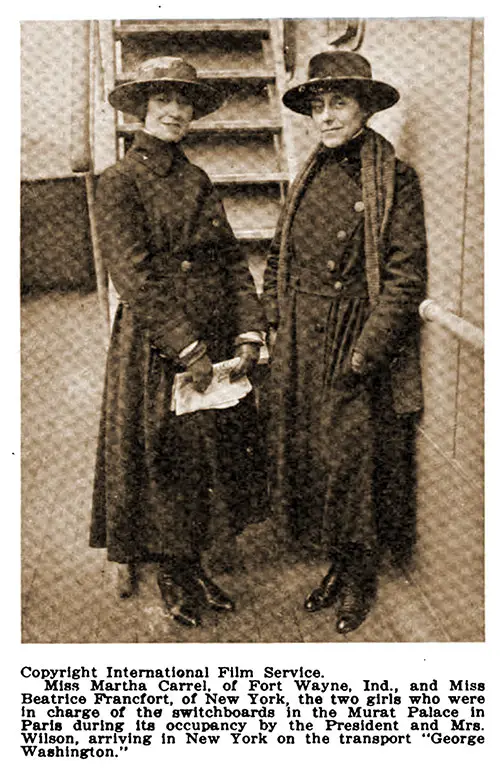
Miss Martha Cairel, of Fort Wayne, Ind., and Miss Beatrice Francfort, of New York, the Two Girls Who Were in Charge of the Switchboards in the Murat Palace in Paris during Its Occupancy by the President and Mrs. Wilson, Arriving in New York on the Transport “George Washington.” Photograph © International Film Service. Bell Telephone News, April 1919. GGA Image ID # 19a6d460b8
📖 Review & Summary
This 1919 feature celebrates the remarkable service of the United States Army Signal Corps telephone operators—the famed “Hello Girls”—who played a crucial role in securing victory during World War I. The article highlights the praise they received from Brigadier General E. Russel, Chief Signal Officer of the A.E.F., who commended their efficiency, composure, and professionalism under extreme conditions.
Written in the aftermath of the Armistice, the piece captures a moment when the Army formally acknowledged women’s indispensable contributions to military communications. These women—many educated, multilingual, and highly trained—operated switchboards at advanced front lines, often within range of artillery fire. They connected generals to troops, coordinated troop movements, and maintained communication links vital to the war effort.
The feature also reflects the shifting perception of women’s wartime roles: what began as an “experiment” quickly became a benchmark of excellence. Their story stands as one of discipline, patriotism, and technical mastery, illustrating how women’s wartime service transformed both military practice and social expectations.
General Russel, Chief Signal Officer of the A. E. F., Compliments Them on the Part They Played in the Great Victory.
To the Signal Corps Girls of the American Army have been awarded many honors, and to them has been given the credit for an unparalleled service that culminated in helping to win the Great War. And for America, these brave girls have scored another triumph—proving the versatility of our women and their bravery and usefulness in times of great need.
At the beginning of the American involvement in World War I, rumors circulated throughout France that American women were not desired or wanted as part of the American army and that they would be more of a nuisance than a help.
This may or may not have been true. It might have been, too, the old prejudice that war is not a feminine gathering, but rather a hard, cold fact that belongs exclusively to men. If so, the present war has instead dissolved this.
Women have served the American army in every possible relation, given every possible assistance, save that of carrying a gun and living in the trenches.
That they have lived just outside of the trenches and been under shell fire hourly is a known fact. The women who have been the nearest to the army, a very part of it, are the ones who have won the highest compliments from the commanding generals and the fighting privates.
Last summer during June and July when Paris was threatened by the big, camouflaged guns of the Huns and thousands of our own American men and boys were massed between this beautiful city and the enemy, it was the three score telephone girls working at the switchboards of this suddenly advanced army zone who are said now to have saved Paris in the second battle of the Marne.
They acquired a reputation second only to General Gallieni’s taxicab army, which saved the capital in the first battle of the Marne.
Now that the armistice is signed, and the world peace negotiations are under way the army has had time to take stock of its human material and in the review has paid a high compliment to the service of these telephone girls—young girls for the most part, slender young things, who look all the more slender and young in the dark blue uniforms and the compact service cap over their oftentimes short cut locks.
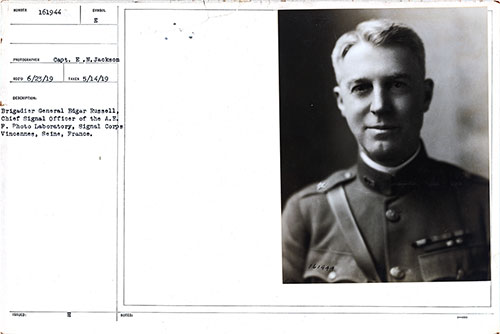
Brigadier General Edgar Russell, Chief Signal Officer of the A.E.F., Photo Laboratory, Signal Corps, Vincennes, Seine, France. Photo by CAPT E. N. Jackson, 15 May 1919. National Archives and Records Administration NAID 313168800/161944. | GGA Image ID # 2375533c11
A letter has been addressed to these girls, signed by the Brigadier General of the Chief Signal Office. This letter reads as follows:
To the Members of the Telephone Operating Unit Signal Corps, A. E. F.:
1. On the occasion of the coming into effect of the armistice with the enemy. I desire to avail myself of the opportunity to express to you the satisfaction with which I and the officers associated with me have observed the quality of your work in these past months and to congratulate you on the large part you have had in our glorious victory.
2. The bringing of women telephone operators to France for service with the American Expeditionary Forces had no precedent. And for this reason, the experiment was watched with unusual interest. It pleases me a great deal to say that by your ability, efficiency, devotions to duty and the irreproachable and businesslike conduct of your affairs, personal and official, you have not only justified the action taken in assembling you but have set a standard of excellence which could hardly be improved upon and which has been responsible in no small measure for the success of our system of local and long distance telephone communication.
3. While this has seemed to be the fitting occasion to express appreciation of your work in the trying period just ended, it will no doubt be some time before the telephone business over our system shows any signs of decreasing. It is not questioned that the brilliant reputation your unit has established for itself will be maintained to the end and that you will continue, both individually and collectively, to uphold the high standard of service you have already set.
E. Russel, Brigadier-General, C. S. O.

"The Completed Telephone and Telegraph System of the American Expeditionary Forces: Telephone Service Women," in United States Army in the World War 1917-1919, Reports of the Commander-in-Chief, Staff Sections and Services, Volume 15. Center of Military History, United States Army, Washington, DC, 1991. (First Printed 1948-CMH Pub 23-21, p. 117. The official report summarized the work of the "Hello Girls" in one paragraph: "Likewise, in the telephone service women highly trained in switchboard operation were brought from the United States to serve at the larger centers. These women, to a large extent, were able to speak French and this made it possible to secure the maximum efficiency in the combined use of the French and the American systems. Their work had been one of the main factors in the success of the telephone service for the American Expeditionary Forces." | GGA Image ID # 2375633dca. Click to View a Larger Image.
Editorial Note: The official Army report’s single-paragraph mention of “telephone service women” gives the impression that operators served only in large rear-area exchanges, bridging linguistic gaps between French and American systems. In reality, the work of the 233 U.S. Army Signal Corps Telephone Operators extended far beyond these “larger centers.” Many were assigned to small forward posts near Toul, Souilly, St. Mihiel, and Meuse-Argonne—areas frequently targeted by German artillery and gas attacks. Operators kept gas masks at their stations, slept within reach of them, and refused evacuation orders to maintain communication links during bombardments. Their discipline and courage allowed headquarters to remain in contact with advancing troops at moments when field wires were being severed by shellfire.
The Reports of the Commander-in-Chief, written for administrative record-keeping, emphasized infrastructure and omitted much of the women’s lived experience. This omission reflected both the gendered reporting practices of 1919 and the Army’s desire for tidy organizational history. Decades later, survivors such as Merle Egan Anderson and others testified before Congress to correct the record, leading to official recognition of the Hello Girls as veterans in 1977. Their story illustrates how the historical record of women’s service often required re-examination by later generations of researchers, archivists, and veterans’ advocates.
Sources: Y.W.C.A. Overseas War Work Report (New York, 1919); Signal Corps History: U.S. Army in the World War, 1917–1919 (Office of the Chief Signal Officer, 1920); United States Army in the World War, 1917–1919: Reports of the Commander-in-Chief, Staff Sections and Services, Vol. 15 (Center of Military History, 1991); and Recognition of the “Hello Girls” for VA Benefits, U.S. Senate Committee on Veterans’ Affairs Hearing on S.247, 95th Congress, 1977.
✨ Most Engaging Content
The heart of the article lies in General Russel’s letter to the members of the Telephone Operating Unit of the Signal Corps. His praise—calling their conduct “irreproachable” and their efficiency “a standard of excellence which could hardly be improved upon”—offers a rare official testament to women’s skill and valor within the Army Expeditionary Forces. It validates the Hello Girls’ claim to full military status, a recognition that would take six decades to be formally granted by Congress.
Equally engaging is the description of these “slender young things” working in dark-blue uniforms under shellfire near the front. The juxtaposition of fragility and courage captures public imagination and embodies a new ideal of womanhood in wartime—professional, composed, and fearless.
🖼️ Noteworthy Image(s)
Hero Image: Miss Martha Cairel (Fort Wayne, IN) and Miss Beatrice Francfort (New York) arriving in New York aboard the transport George Washington. These two Signal Corps operators managed the Murat Palace switchboards during President Wilson’s stay in Paris — a prestigious assignment that placed them at the center of diplomatic communications during the Peace Conference. The photograph underscores the recognition given to women whose technical and linguistic skills made them indispensable to America’s military and diplomatic success abroad.
📘 Mini Dictionary for Civilians
- A.E.F. — American Expeditionary Forces, the U.S. Army deployed to Europe during World War I.
- Signal Corps — The branch of the U.S. Army responsible for communications and information systems, including telephone operations and telegraphy.
- Brigadier General — A one-star general officer rank in the U.S. Army.
- Armistice — The formal agreement signed on November 11, 1918 to end hostilities between the Allies and Germany.
- Marne (First & Second Battles) — Major WWI battles in France where the Allied forces halted and reversed German advances toward Paris (1914 and 1918).
🎓 Essay Prompts for Students
- Examine General Russel’s commendation letter. How did his words validate the importance of the Hello Girls within the Army hierarchy and American society?
- Discuss the ways in which the Hello Girls challenged traditional gender roles during World War I. What barriers did they break?
- Compare the recognition the Hello Girls received after WWI to other women’s service organizations of the era, such as the Navy Yeomen (F) or Red Cross nurses.
- Analyze the phrase “The Signal Corps Girls Made Good.” How does this reflect public attitudes toward women’s competence and patriotism in 1919?
🪶 Citation Block
Chicago Style: “The Signal Corps Made Good: General Russel, Chief Signal Officer of the A.E.F., Compliments Them on the Part They Played in the Great Victory.” Bell Telephone News (Detroit Edition), Vol. 8, No. 9 (April 1919), p. 19.
APA Style: The Signal Corps Made Good. (1919, April). Bell Telephone News, 8(9), 19.
MLA Style: “The Signal Corps Made Good: General Russel, Chief Signal Officer of the A.E.F., Compliments Them on the Part They Played in the Great Victory.” Bell Telephone News, vol. 8, no. 9, Apr. 1919, p. 19.
Student Version: “‘The Signal Corps Made Good’ (1919) recognizes the heroic service of Hello Girls in World War I as told in Bell Telephone News, April 1919 (GG Archives Collection).”
Curator’s Reflection: This article stands as one of the most meaningful rediscoveries within the Hello Girls collection. Its combination of General Russel’s official commendation, the understated Army report, and the later recognition efforts of the 1970s reveals how easily women’s contributions could be acknowledged in the moment yet vanish from institutional memory. Through their technical precision, composure under fire, and linguistic skill, the Signal Corps telephone operators proved themselves to be soldiers in every sense of the word—working without fanfare, often in harm’s way, to keep the Allied armies connected.
The fact that it took nearly sixty years for the United States to formally recognize these women as veterans underscores the importance of archives, testimony, and persistent historical inquiry. Reassembling their stories is more than a matter of commemoration; it restores balance to the record of military service and reminds future generations that recognition, when delayed, is still a form of justice.
- Paul K. Gjenvick, MAS, Archivist for GG Archives.
6 October 2025
“The Signal Corps Made Good: General Russel, Chief Signal Officer of the AEF, Compliments Them on the Part They Played in the Great Victory,” in Bell Telephone News, Detroit Edition, Vol. 8, No. 9, April 1919, p. 19.
