Pershing Requests Women Telephone Operators - 1917


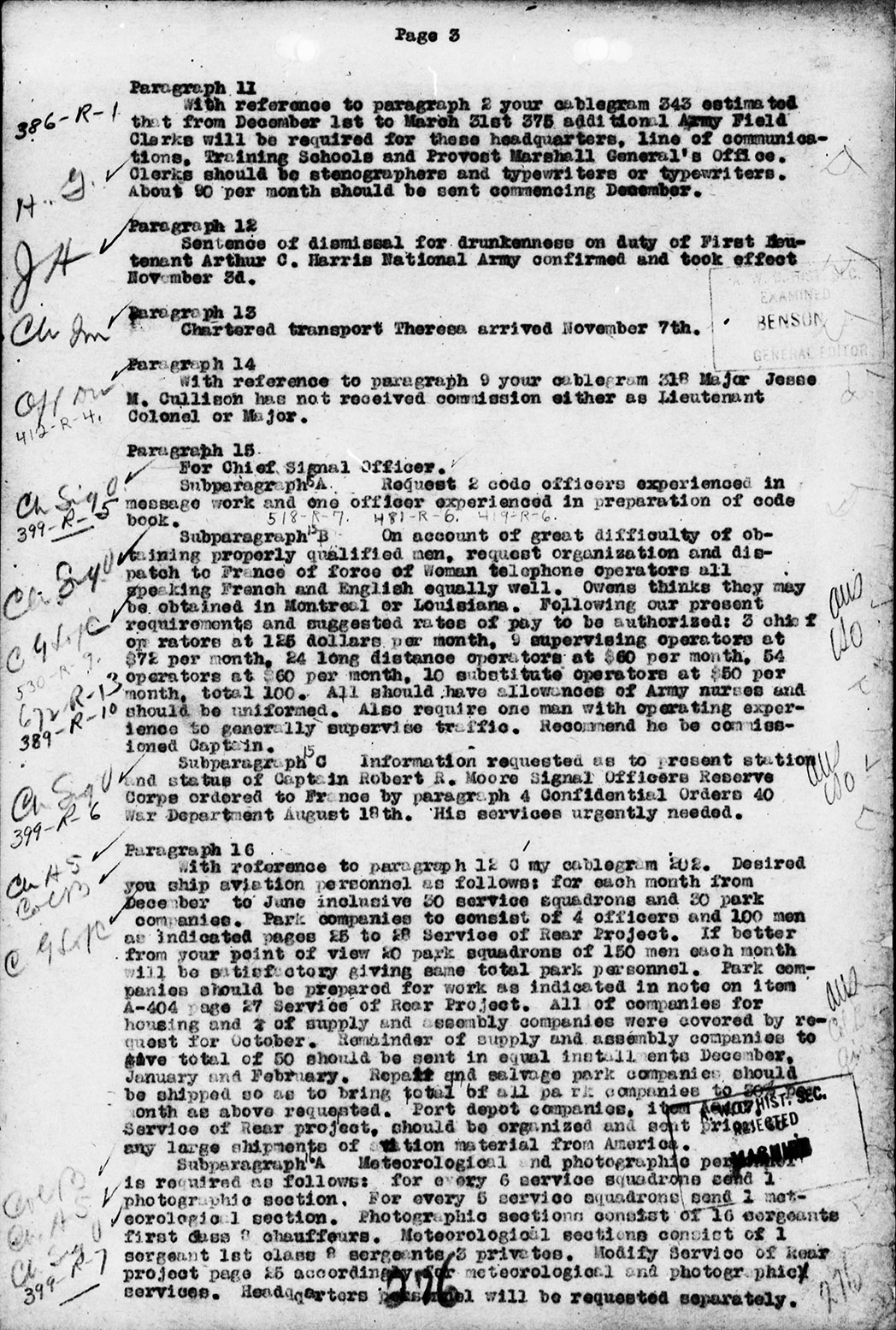
Cable No. 276 (Part 3), Paragraph 15(B), Headquarters A.E.F., 8 Nov 1917—request for bilingual women telephone operators with specified grades and pay (NAID 209249206).

Pershing Requests Women Telephone Operators — 1917

8 November 1917 • Cable No. 276, Paragraph 15(B)

Facing a shortage of qualified male operators, Gen. John J. Pershing asks the War Department to dispatch 100 bilingual women to France, detailing grades, pay, allowances, and uniforms—an early step toward the Signal Corps "Hello Girls."


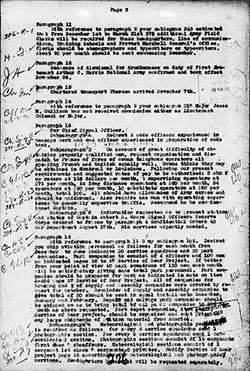
Paragraph 15(B) Request for Women Telephone Operators Speaking French and English Equally Well. Cable Number 276, Part 3 of 4, Headquarters, A.E.F., 08 November 1917.

Paragraph 15(B) Request for Women Telephone Operators Speaking French and English Equally Well. Cable Number 276, Part 3 of 4, Headquarters, A.E.F., 08 November 1917. NAID: 209249206 Textual Records, M930 - Cablegrams Exchanged Between General Headquarters, American Expeditionary Forces, and the War Department, 1917-1919. | GGA Image ID # 237d9fbe20. Click to View a Larger Image.


📖 Review & Summary

What This Document Shows — and Why It Matters

On 8 November 1917, while building out the American Expeditionary Forces' communications network, General John J. Pershing cabled Washington with a practical request: send a bilingual cadre of women telephone operators—"all speaking French and English equally well." He specified a structure, pay scales, uniforms, and even a supervising officer. This is Paragraph 15(B) of Cable No. 276 (Part 3 of 4), the administrative spark that helped ignite the Signal Corps' women's telephone units later nicknamed the "Hello Girls."

  • Headquarters: A.E.F., France
  • Immediate need: 100 women operators, organized by skill and responsibility
  • Bilingual requirement: English & French for seamless Allied coordination
  • Compensation: $50–$125 per month (by role), with allowances of Army nurses and uniforms
  • Oversight: one experienced traffic supervisor, recommended for a captain's commission

Why it's important: The cable demonstrates how operational bottlenecks—"difficulty of obtaining properly qualified men"—opened doors for women with critical skills. It also reveals early thinking about rank, remuneration, and the need for fluency inside a multinational coalition. (For a later policy shift, see Pershing's June 1918 removal of the French-language requirement.)

Primary Source: NAID 209249206, M930, Cablegrams Exchanged Between General Headquarters, A.E.F., and the War Department, 1917–1919.


Transcript of Paragraph 15(B)

On account of great difficulty of obtaining properly qualified men, request orgonization and dispatch to France a force of Women telephone operators all speaking Frenoh and English equally well. Owens thinks they may be obtained in Montreal or Louisiana. Following our prosent requirements and suggested rates of pay to be authorized: 3 Chief Operators at 125 dollar per month, 9 supervision operators at $72 per month, 24 long-distance operators at $60 per month, 54 operators at $60 per month, 10 substitute operators at $50 per month. All should have allowonces of Army nurses and should be miformed. Also require one man with operating experience to generally supervise traffic. Recommend he be commissioned Captain.

Some of the Handwritten Comments on the Left Side of this Paragraph: 530-R-9 | 672-R-13 | 389-R-10


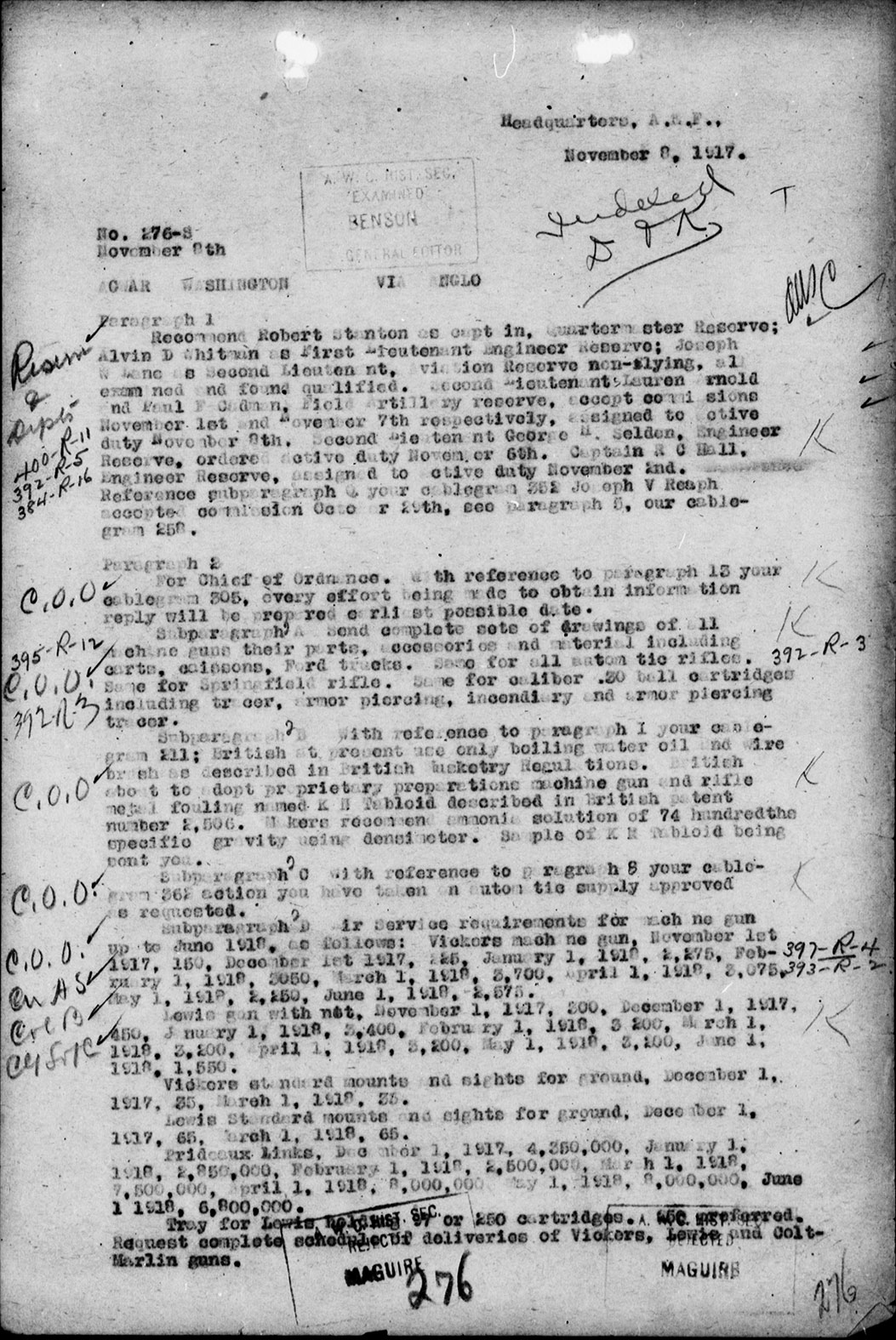
Cable Number 276, Part 1 of 4, Headquarters, A.E.F., 08 November 1917.

Cable Number 276, Part 1 of 4, Headquarters, A.E.F., 08 November 1917. NAID: 209249206 Textual Records, M930 - Cablegrams Exchanged Between General Headquarters, American Expeditionary Forces, and the War Department, 1917-1919. | GGA Image ID # 237dae2811. Click to View a Larter Image.


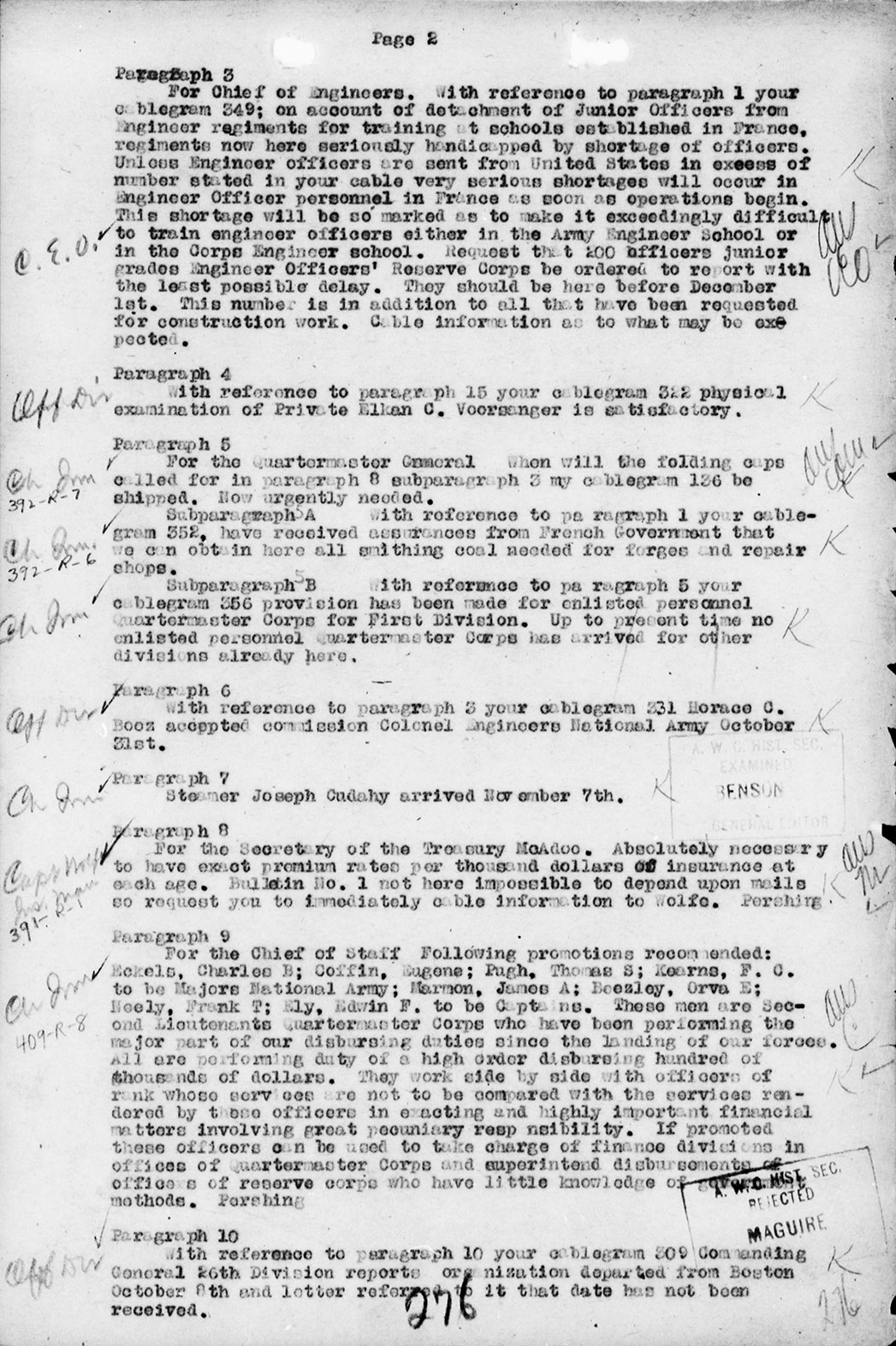
Cable Number 276, Part 2 of 4, Headquarters, A.E.F., 08 November 1917.

Cable Number 276, Part 2 of 4, Headquarters, A.E.F., 08 November 1917. NAID: 209249206 Textual Records, M930 - Cablegrams Exchanged Between General Headquarters, American Expeditionary Forces, and the War Department, 1917-1919. | GGA Image ID # 237e551483. Click to View a Larter Image.


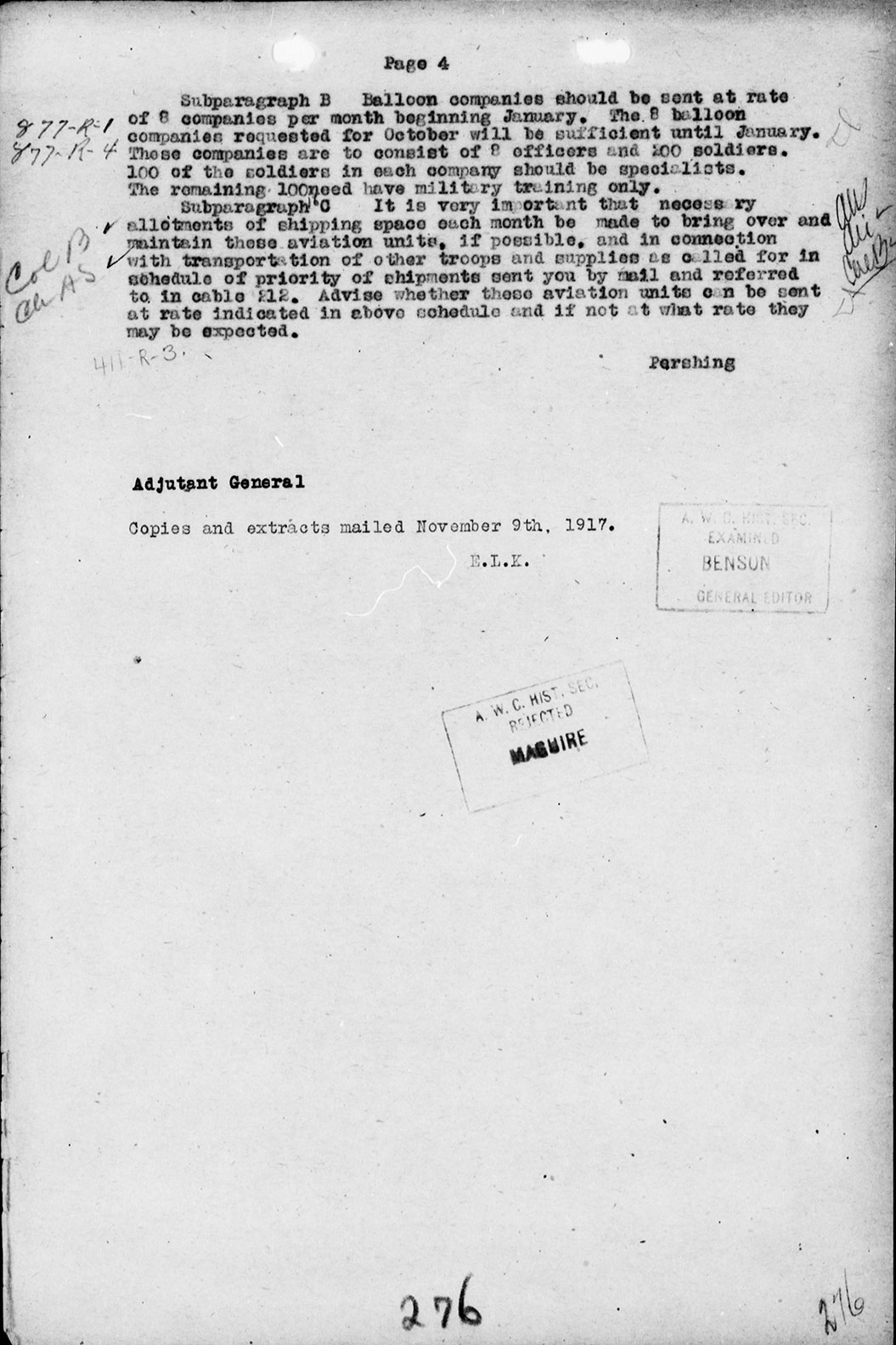
Cable Number 276, Part 4 of 4, Headquarters, A.E.F., 08 November 1917.

Cable Number 276, Part 4 of 4, Headquarters, A.E.F., 08 November 1917. NAID: 209249206 Textual Records, M930 - Cablegrams Exchanged Between General Headquarters, American Expeditionary Forces, and the War Department, 1917-1919. | GGA Image ID # 237ed707e8. Click to View a Larter Image.


This Four-Part Cablegram Provides Complete Information about this Specific Cable Between Pershion and the War Department in Washington DC. Only Part 3 Specifically References the Women Telephone Operators.


✨ Most Engaging Content

"All Speaking French and English Equally Well"

"…request organization and dispatch to France a force of Women telephone operators all speaking French and English equally well… Following our present requirements and suggested rates of pay to be authorized…"

Requested force (Paragraph 15[B]), A.E.F., 8 Nov 1917
Role Count Rate (per month)
Chief Operators 3 $125
Supervisory Operators 9 $72
Long-Distance Operators 24 $60
Operators 54 $60
Substitute Operators 10 $50
Total Women Requested 100 $6,203/mo total payroll*

*Excludes the separate pay of the recommended male traffic supervisor (to be commissioned Captain).


🖼️ Noteworthy Image(s)

Noteworthy Images

  1. Part 3 of 4 (Hero): "Paragraph 15(B): Pershing requests bilingual women telephone operators; A.E.F. Headquarters, 8 Nov 1917 (NAID 209249206)."
  2. Part 1 of 4: "Cable No. 276, Part 1 — Administrative and logistical matters preceding Paragraph 15(B); A.E.F., 8 Nov 1917."
  3. Part 2 of 4: "Cable No. 276, Part 2 — Operational details continuing toward personnel requests; A.E.F., 8 Nov 1917."
  4. Part 4 of 4: "Cable No. 276, Part 4 — Closing sections of the multi-page cablegram; A.E.F., 8 Nov 1917."

Provenance for all four images: NAID 209249206, M930, Cablegrams Exchanged Between General Headquarters, A.E.F., and the War Department, 1917–1919.


📘 Mini Dictionary for Civilians

Mini Dictionary for Civilians

A.E.F.
American Expeditionary Forces—U.S. Army formations deployed to Europe in World War I under Gen. John J. Pershing.
Chief Operator
Most senior switchboard operator on a team; oversees staffing, quality of connections, and rapid routing under pressure.
Supervisory Operator
Middle manager responsible for sections of the switchboard, training, and ensuring procedure compliance.
Long-Distance Operator
Specialist handling intercity/inter-sector circuits—vital for corps-to-army-to-Allied HQ coordination.
Substitute Operator
On-call relief who fills vacancies, covers shifts, and supports during peak traffic or outages.
"Allowances of Army nurses"
Non-pay benefits (quarters, rations, travel, and related entitlements) then associated with Army Nurse Corps service.


🎓 Essay Prompts for Students

Essay Prompts

  1. Logistics & Language: Why was bilingual fluency strategically important for A.E.F. telephone operators in 1917–1918? Use evidence from Paragraph 15(B).
  2. Gender & Opportunity: How did wartime labor shortages create opportunities for women with technical skills? Compare the roles and pay grades requested in the cable.
  3. Policy Shift: Read the related item "Pershing Eliminates French Speaking Operators Requirement" (6 June 1918). What factors might explain the change from 1917 to mid-1918?
  4. Organizational Design: What does the proposed team structure (chief, supervisory, long-distance, substitute) reveal about early 20th-century communications management?
  5. Ethics & Recognition: Should these operators have been considered soldiers at the time? Argue your position using primary and secondary sources from the Hello Girls collection.


🪶 Citation Block (Chicago, APA, MLA + student version)

How to Cite This Page / Document

Chicago Notes & Bibliography

Note: John J. Pershing to War Department, Cable No. 276, para. 15(B), November 8, 1917, Headquarters A.E.F., in Cablegrams Exchanged Between General Headquarters, American Expeditionary Forces, and the War Department, 1917–1919, M930, RG 120, National Archives and Records Administration (NAID 209249206), digitized at Gjenvick-Gjønvik Archives, https://www.ggarchives.com/…, accessed October 11, 2025.

Bibliography: Pershing, John J. Cable No. 276, Paragraph 15(B), November 8, 1917. Headquarters A.E.F. In Cablegrams Exchanged Between General Headquarters, American Expeditionary Forces, and the War Department, 1917–1919. M930, RG 120. National Archives and Records Administration (NAID 209249206). Digitized at Gjenvick-Gjønvik Archives. Accessed October 11, 2025.

APA (7th ed.)

Pershing, J. J. (1917, November 8). Cable No. 276, Paragraph 15(B) [Cablegram, Headquarters A.E.F.]. National Archives and Records Administration (NAID 209249206). Gjenvick-Gjønvik Archives. https://www.ggarchives.com/MIL/HelloGirls/Docs/PershingRequestWomenTelephoneOperators-EnglishAndFrenchSpeaking-1917-11-08.html

MLA (9th ed.)

Pershing, John J. "Cable No. 276, Paragraph 15(B)." 8 Nov. 1917. Cablegrams Exchanged Between General Headquarters, American Expeditionary Forces, and the War Department, 1917–1919. National Archives and Records Administration, NAID 209249206. Gjenvick-Gjønvik Archives. Accessed 11 Oct. 2025.

Student (Copy-and-Paste) Footnote

John J. Pershing, "Cable No. 276, Paragraph 15(B)," November 8, 1917, Headquarters A.E.F., NAID 209249206, M930 (RG 120), NARA; digitized at Gjenvick-Gjønvik Archives, page link; full-size image, accessed October 11, 2025.



Return to Top of Page

The "Hello Girls" in the Great War
WW1 US Army Signal Corps
GG Archives

Telephone Operators in World War I


Documents & Reference Materials


Commanding Officers & Allies in Service

  • General John J. Pershing – Commander, American Expeditionary Forces (AEF)
  • Major General George Owen Squier – Chief Signal Officer, 1917–1923
  • Captain Ernest J. Wesson – Signal Corps Recruiter and Organizer of the “Hello Girls”


🪖 RISKS & RECOGNITION


🕯️ IN MEMORIAM

  • Chief Operator Inez Ann Murphy Crittenden (1887–1918)
  • Operator Cora Bartlett (1886-1919)
  • Miss Jeanne Bourquin (