
Exhibit C - Gertrude Hoppock - Memo from Capt. E. J. Wesson, US Army - 1918
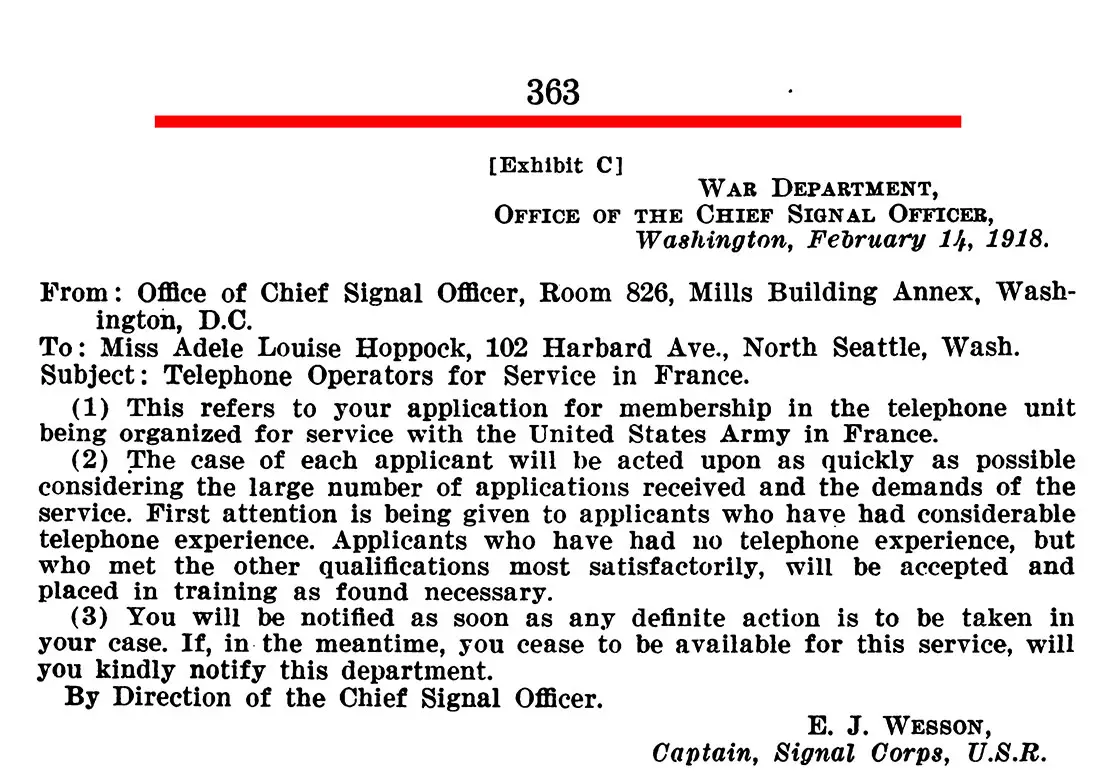
Exhibit C: Affidavit of Gertrude Hoppock: Memo from Capt. E. J. Wesson, US Army, 14 February 1918, in Recognition for Purposes of VA Benefits, Hearing before the Committee on Veterans' Affairs, United States Senate, Ninety-Fifth Congress, First Session on S. 247, S. 1414, S. 129, and Related Bills. Washington, DC: US Government Printing Office, 25 May 1977. GGA Image ID # 23764c27fd. Click to View a Larger Image.
📖 Review & Summary
This brief memorandum from Captain E. J. Wesson of the U.S. Army Signal Corps, dated February 14, 1918, is one of the earliest known official communications regarding the formation of the Army’s Telephone Operator Units — the group that would soon be known as the Hello Girls.
Addressed to applicant Miss Adele Louise Hoppock of Seattle, the memo acknowledges receipt of her application and outlines selection criteria, training plans, and the priority given to experienced telephone operators. Signed “By Direction of the Chief Signal Officer,” it represents the bureaucratic birth certificate of America’s first women soldiers in communications.
For educators and students, this document illustrates how wartime innovation and administrative necessity opened doors for women in technical service. For genealogists, it serves as a tangible link between individual applicants like Hoppock and the larger mobilization that connected the U.S. Army to its front-line units in France.
War Department,
Office of the Chief Signal Officer,
Washington, February 14, 1918.
From : Office of Chief Signal Officer, Room 826, Mills Building Annex, Washington, D.C.
To: Miss Adele Louise Hoppock, 102 Harbard Ave., North Seattle, Wash. Subject: Telephone Operators for Service in France.
1. This refers to your application for membership in the telephone unit being organized for service with the United States Army in France.
2. The case of each applicant will be acted upon as quickly as possible considering the large number of applications received and the demands of the service. First attention is being given to applicants who have had considerable telephone experience. Applicants who have had no telephone experience, but who met the other qualifications most satisfactorily, will be accepted and placed in training as found necessary.
3. You will be notified as soon as any definite action is to be taken in your case. If, in the meantime, you cease to be available for this service, will you kindly notify this department.
By Direction of the Chief Signal Officer.
E. J. Wesson,
Captain, Signal Corps, U.S.R.
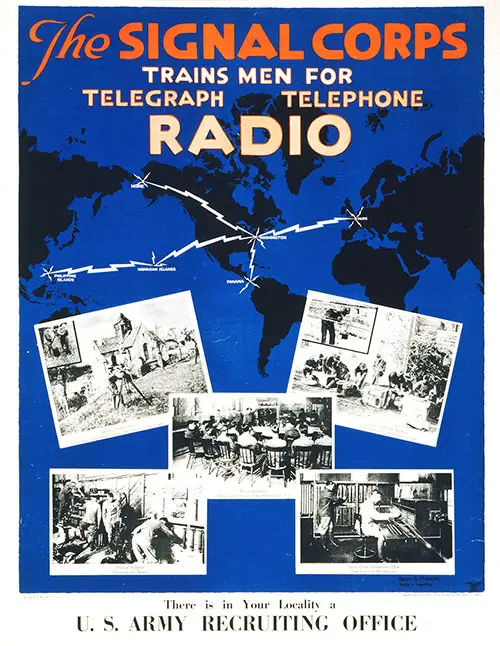
Poster: The Signal Corps Trains Men for Telegraph, Telephone, and Radio. There Is a U.S. Army Recruiting Office in Your Locality. Created by Harry S. Mueller, Major Infantry, 1919. Library of Congress, LCCN 00651832 | GGA Image ID # 236a1c61c7
Did You Know?
On the day Congress declared war, the Signal Corps had 55 officers and 1,570 enlisted men, an inadequate force to support the Army expansion contemplated.
Chief Signal Officer Squier met with Theodore Vail, President of AT&T, and Newcomb Carlton, President of Western Union, and secured their support to mobilize their employees to produce battalions of signal troops that could be sent to the American Expeditionary Force in France.
New schools were opened, and national guard and reserve units were mobilized. In total, the Signal Corps expanded to 2,712 officers, 53,277 enlisted men, and thousands of civilians during the war.
✨ Most Engaging Content
The memo’s closing line — “The case of each applicant will be acted upon as quickly as possible considering the large number of applications received and the demands of the service” — conveys both urgency and vision. It reminds readers that hundreds of women were vying to serve long before official recognition was possible.
That single paragraph captures the scale of interest and the Army’s rapid adaptation — a moment when bureaucracy struggled to keep pace with social change.
🖼️ Noteworthy Image(s)
- Typed Memo from Capt. E. J. Wesson (1918) – The original document verifies the Army’s acknowledgment of female applicants for Signal Corps service and is preserved as Exhibit C in the 1977 Senate hearings.
- Signal Corps Recruiting Poster (1919) – Shows how communications work had become central to military identity only a year after Wesson’s memo.
These visuals connect the paper trail of administration to the public campaign that encouraged both men and women to join the Signal Corps effort.
📘 Mini Dictionary for Civilians
- Signal Corps U.S.R.: United States Army Signal Reserve, responsible for telegraph, telephone, and radio communications.
- Chief Signal Officer: Head of the Signal Corps; in 1918, Major General George O. Squier.
- Application for Membership: The formal process for women seeking to serve as telephone operators overseas with the A.E.F.
- Telephone Unit: Detachment of trained operators attached to the U.S. Army’s communications network in France.
- War Department: The pre-1947 U.S. government agency overseeing Army operations before the Department of Defense was created.
🎓 Essay Prompts for Students
- Early Organization: What does Captain Wesson’s memo reveal about the Army’s initial approach to recruiting women for technical service roles in 1918?
- Administrative Language: How does the tone of this memo reflect both military formality and gendered bureaucracy of its era?
- Primary Source Analysis: Why is a document like this valuable for understanding the Hello Girls beyond popular retellings?
- Comparative Research: Compare this memo to later letters by Wesson (1950). How did his view of the Hello Girls’ service evolve over time?
- Women and Technology: How did the need for efficient communication influence gender roles within the military during WWI?
🪶 Citation Block
Chicago: “Exhibit C: Affidavit of Gertrude Hoppock: Memo from Capt. E. J. Wesson, U.S. Army, 14 February 1918.” In Recognition for Purposes of VA Benefits, Hearings before the Committee on Veterans’ Affairs, United States Senate, 95th Cong., 1st sess., 25 May 1977, p. 363. Washington, DC: Government Printing Office. Reprinted by Gjenvick-Gjønvik Archives.
APA: U.S. Senate Committee on Veterans’ Affairs. (1977, May 25). Exhibit C: Affidavit of Gertrude Hoppock: Memo from Capt. E. J. Wesson, U.S. Army (1918, Feb 14). In Hearings on S. 247, S. 1414, S. 129, and Related Bills (p. 363). Washington, DC: Government Printing Office. Reprinted by Gjenvick-Gjønvik Archives (2025).
MLA: “Exhibit C: Affidavit of Gertrude Hoppock: Memo from Capt. E. J. Wesson, U.S. Army.” 14 Feb. 1918. Hearings before the Committee on Veterans’ Affairs, 95th Cong., 1st sess., Washington, GPO, 1977, p. 363. Reprinted in Gjenvick-Gjønvik Archives, 2025.
Student Citation (Short Form): “Exhibit C: Memo from Capt. E. J. Wesson (1918).” U.S. Senate Veterans’ Affairs Hearings, p. 363. Reprinted by GG Archives (https://www.ggarchives.com/MIL/HelloGirls/Stories/ExhibitC-Hoppock-MemoFromCaptEJWesson-1918.html).
"Exhibit C: Affidavit of Gertrude Hoppock: Memo from Capt. E. J. Wesson, US Army, 14 February 1918," in Recognition for Purposes of VA Benefits, Hearing before the Committee on Veterans' Affairs, United States Senate, Ninety-Fifth Congress, First Session on S. 247, S. 1414, S. 129, and Related Bills. Washington, DC: US Government Printing Office, 25 May 1977. p. 363.
