
"Hello" Heroines - Telephone Operators of the Great War Era - 1920
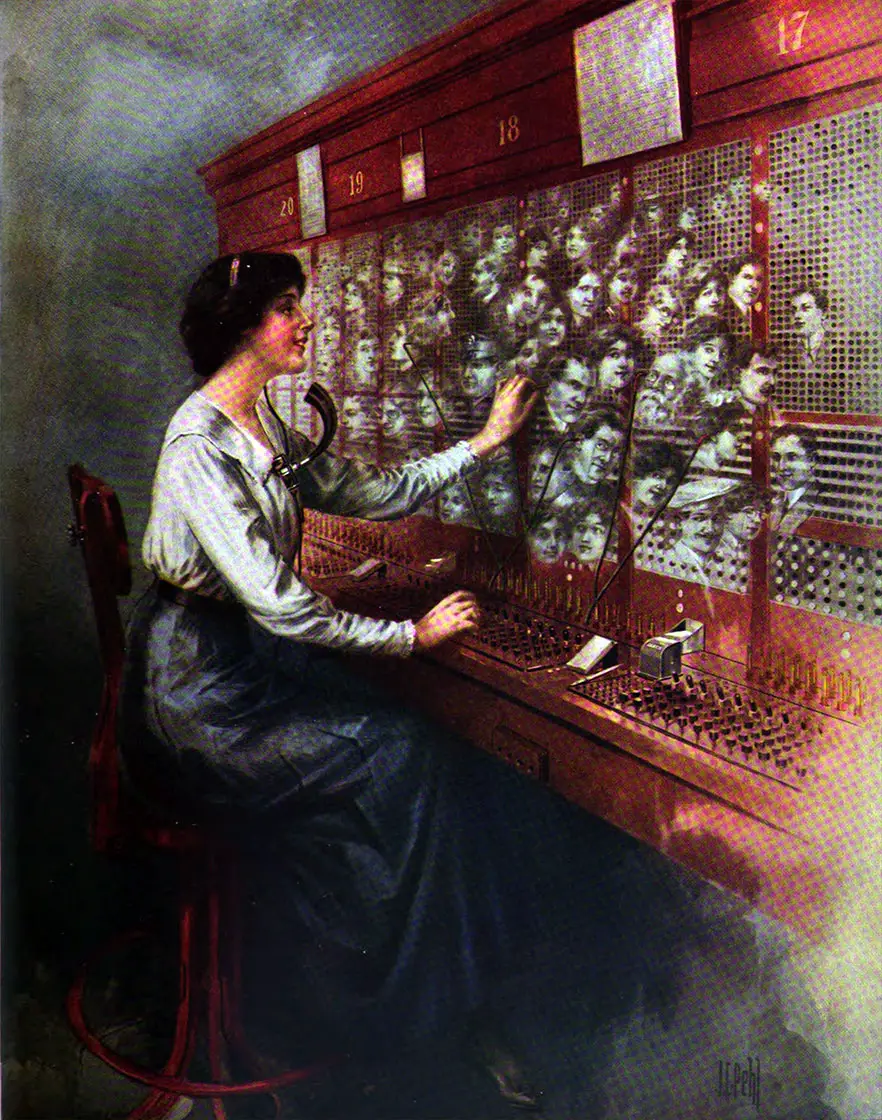
Front Cover Image of a Telephone Operator and the Faces of Telephone Extensions. The Telephone Review, April 1918. | GGA Image ID # 19865a905f. Click to View a Larger Image.
While this story focuses in on the Heroines among the telephone operators during the time of World War 1, the story covers events both at home and in France where the "Hello Girls" were often stationed close to the fighting line. -- GG Archives
📖 Review & Summary
Lucy Calhoun’s 1920 feature “Hello Heroines” celebrated the courage, skill, and endurance of America’s telephone operators during and after the Great War. Blending humor, realism, and reverence, the article moves from everyday civilian vignettes to extraordinary wartime heroism—from the sleepless night operator connecting anxious subscribers to Signal Corps girls keeping communication lines alive near Verdun.
Through vivid storytelling, Calhoun elevated these women from anonymous “voices on the wire” to vital participants in the machinery of modern war. Whether battling floods in Texas, explosions in Chicago, or artillery fire in France, they embodied reliability, discipline, and compassion under pressure—qualities that redefined professional womanhood in the early 20th century.
For educators and historians, this article captures a transitional moment when technology, gender, and patriotism intersected. It remains a powerful primary source illustrating women’s indispensable contributions to national infrastructure and military success.
The splendid things that the American telephone girls have accomplished.
John Smith lay comfortably snoozing in his comfortable bed one cold winter night when suddenly came the jarring jangle of the telephone bell. John hated to get up and answer that call. The telephone was in the hall. It was cold. John was only half awake. Who the deuce wanted him at that hour? John turned over and buried his head in the bedclothes, hoping that the echoes of slumberland would still the insistent clangor.
"Brrrrrr—brrrrrrrr"— The faithful night operator, whose duty it was to get John to that telephone if it were humanly possible, rang again and again, and at last John had to rise and stumble to the hall, knocking his shins against all the furniture and saying very impolite things about the man who invented the telephone.
Mrs. John Smith had just started baking on a Saturday morning, and the eggs for John's favorite cake had reached the point in the beating process where they must not be left for an instant. Again, the hateful telephone bell, the persistent, pestiferous, perturbing tintinnabulation which would not wait a second, eggs or no eggs. Mrs. Smith had to sacrifice the work on the eggs and answer that stubborn summons only to find perhaps that it was nothing important at all for which the central operator had been asked to plug in.
It is a common experience. Who has not, when reclining blissfully in a warm bath, been rudely disturbed by the telephone bell and the hateful consciousness that there is no one to answer it but oneself? If you let it go unanswered, you may miss the early announcement that your Uncle Bim has just died and left you a fortune. No one can guess what delightful tidings wait for you at the end of the wire. No mere subscriber can tell on what great tragedy or shrieking comedy life's curtain may rise to this modern prompter's bell.
And herein lies the romance of the telephone girl's job—the most romantic job in the world. Someone may try to tell you that the speed of the present-day telephone business has destroyed that romance, but ask some of the girls who work at the big-city exchanges. They have the most exciting things to relate.
The telephone girls have their fingers on the pulse of the world. They have the biggest opportunities for individual service of any group of young women in existence. They can be of use in the grand affairs of the largest businesses, and they can connect to the most delicate and intricate aspects of the heart.
International loans and the fate of nations have depended upon the quick and efficient service of a little girl sitting before a switchboard, attending to her job. Dear Mabel's happiness may be eternally wrecked if the girl at the switchboard does not help Jack to communicate to Mabel at precisely the right moment the information that he "really does."
The telephone girls have taken part in some of the most romantic, daring, and dashing enterprises in modern history, and one could fill a book with tales of their heroism. There are no mere "until" jobs entered into with the idea that they will last until Billie, Jim, or Tom comes along with the offer of another kind of job.
Even if Billie, Jim, and Tom do come, the telephone girls are hard to win away from their positions. They frequently return after marriage to the switchboards and the fascinating lines with which they drive ahead the business and pleasure of the world.
In Japan, when the subscriber rings up the exchange, it goes something like this:
"What number does the honorable son of the moon and stars desire?"
"Hohi, two, three."
There is silence for a long minute, and then the operator resumes:
"Will the honorable person graciously forgive the inadequacy of the insignificant service and permit the humble slave of the wire to inform him that the never-to-be-sufficiently-censured line is busy."
This is somewhat different from our curt American busy signal given by the girl at the "B" board who never talks to the subscribers at all, but who connects you with the trunk line you want to reach through the medium of the "A" girl and her "numbah pleeuz."
They have to be brief, these American telephone girls with their hundreds of calls every day and their blinking switchboards whose red eyes are constantly on them.
There are only a certain number of lines that one girl can handle. Yet, on a busy exchange that has not been able to get any new equipment since the war, the red lights will burn and keep on burning when all the plugs are in the jacks —and it is then that diplomacy and tact must come into play to handle the irate and often ignorant subscriber who has had to wait for his number.
Why Telephone Operators are Girls
"That's why they're girls—these telephone operators," says Mrs. Frederick Dewhurst, who has charge of the welfare work for the Chicago telephone girls. "The company tried boys once, and once only. It was discovered that the boys were making engagements with some of the men subscribers to meet them in the alley after business hours and settle their scores with their fists.
The girls are polite and patient, quick-witted and sympathetic, and loyal as the day is long. That's why they're girls." Faithful as the day is long! Yes, and sometimes their day is very long indeed, far beyond the regulation eight or ten hours, when a significant public catastrophe causes the switchboards to blaze with lights after the regular traffic is over.
Telephone Operators Handle Floods
Sometimes these girls, whom we so impatiently abuse, lay down their lives for us and the honor of the job. Such a one was Mrs. Sarah Rooke, chief operator at Folsom, New Mexico, who was carried away by the flood a year ago. "Ah, yes," we say. "A heroine! Splendid thing to do. Stuck to her post till the last. Went down with the ship. Three cheers for Mrs. Rooke!"
And then we go on our busy way. When the next telephone operator is a little slow in getting our number, we impatiently jerk her up with "What's the matter there? Gone to sleep?" or some such pleasantry.
There has been talk at various times of a new kind of telephone by which the subscriber cannot only hear the voice of the person with whom he wishes to communicate, but can also look upon his face. Suppose such a thing were possible. Suppose, too, that we could, by some small electrical device, see what the operator is doing at the switchboard.
Suppose we had looked into that little exchange at Folsom, New Mexico, presided over by Sarah Rooke. It is dark there. The wind howls around the building, and the rain beats upon the windows.
Outside, the river, swollen with days of heavy downpour, rushes on its devastating way, spreading over the country and sweeping along with it trees, houses, barns, and livestock, undermining telephone poles, and coming ever nearer to the little room where the chief operator sits alone at the switchboard, plugging in.
Her hair is disheveled, her face is pale, but the slender hands that pick up the plugs are steady, and her voice is clear. She is the captain of the sinking ship. The flood has come faster than anyone dreamed it would. The other operators, the crew, have been cared for—the captain saw to that—and when they wanted to stay with her, she told them sternly to do as they were bidden.
She would come too, she assured them, as soon as she had warned a few more of their danger. It would be all right. And so she stays there at the switchboard, this little woman, remains until the water begins to come in at the door of the exchange, till it forces the door and sweeps everything before it.
They found her a few days later, lying near some reeds by the edge of the river.
The Bombing in Chicago, 1918
Here is another picture that you might have seen had you been able to look through the mouthpiece of your telephone when you called a specific number in Chicago's Loop district in the early fall of 1918. This switchboard was in the office of the British Recruiting Mission just across the street from the Chicago Post Office.
I, myself, was in that vicinity, so I didn't need any patent device to help me picture the bravery of the telephone operator. You may remember that it was just about this time when an inspired madman decided that some of us had lived long enough in the vicinity of the Federal building and tried to blow a few hundred of us to bits.
As a newspaper representative, I was, of course, on the spot when the bomb went off, and I rushed into the Mission to telephone my city editor. The infernal machine had shaken every building near it, and the whole front window of the Mission was blown out. Glass was falling everywhere, and no one knew when another bomb might explode.
A recruiting officer had a squad of rookies in hand, and the poor things, though standing as straight as they could, looked scared to death. We were all scared. Several people had been killed. The Adams street side of the post office was crumbling. Ambulances were dashing up to the scene. Police officers and soldiers began to arrive. The only cool person I saw was the girl at the switchboard.
"Just a moment, please," she would say, and go on with her work, trying to handle the calls which came in so fast that her hands fairly flew over the board. She would give an involuntary shudder when another pane of glass would go crashing down, and her voice was pitched higher to carry above the noise—that was all. She was polite, calm, and efficient.
"Dam it all, how do they get that way?" questioned a young officer off duty as he looked at her. "Do you know that girl only gave a little bit of a scream when the bomb went off, then she settled right back at the board, and she sticks to it. There's nerve for you!"
They are loyal, these girls. We have had proof of it time and again. A big fire breaks out in a theater just at the close of the performance. You think your daughter is in that audience. You hope that she may have gone somewhere else, but you are not sure. You must find out at once if she is safe. The streetcars are too slow. You and hundreds of others like you rush to the telephones, and the girls of the first night shift, just removing their sets for the rest period, put them on again, turn back and work uncomplainingly with the second-group boards to relieve the suspense of anxious relatives and friends.
Late in the afternoon of a dull day, a dirigible carrying passengers catches fire in mid-air and, plunging downward a thousand feet, crashes through the roof of a well-known bank in the heart of the city, causing a big explosion and the loss of many lives. There is no time to think of being tired. The switchboards are alive with questions which must be answered for humanity's sake, and the telephone girls remain at their posts.
"I have seen our girls working with all their might while the tears streamed down their cheeks," one of the old operators told me. "It was at the time of the Eastland disaster, and maybe we weren't busy that day! Lots of the girls had relatives on the boat, and they were just wild with anxiety, of course.
But did they desert their posts? Not a bit of it. They stuck, and it was a good thing they did, for everyone in the world wanted us that day; the newspapers were calling up the forty-fifth cousins of everyone who had been on the boat and trying to get pictures, relatives were all phoning each other, and the public in general was keeping us jumping.
It was the same thing on Armistice Day—only then the girls cried tears of joy, and we thought we'd never be able to get them to take any rest. They were so excited that they wanted to catch every single call that came in. You'd have thought that General Pershing himself was at the end of every wire."
The "Hello Girls" of France
The telephone girls had the right to take pride in the victory they had won. Did they not have a glorious share in the winning? It was said early in the war that American women were not wanted overseas with the American army. Then somebody persuaded somebody else that the war could not be won without the telephone girls, and so on.
Well, in June and July of 1918, when Paris was threatened by the enemy and our own American boys were massed in thousands between the French capital and the German guns, it was a corps of American telephone girls, sixty of them working at the switchboards, who helped to save the city and to win the second battle of the Marne.
General Gallieni's army of taxicabs, which saved Paris in the first Marne fight, can have no greater credit than these slim young members of the United States Signal Corps. They knew things, those Signal Corps girls, that all the world wanted to know and couldn't.
Those girls with the American army, northwest of Verdun, knew what they were doing when, in October, before the armistice, they won the admiration of the whole world by remaining at their posts in burning wooden barracks in the Moselle region until ordered to quit.
Their names will go down in history to the everlasting glory of the American girl: Miss Grace D. Banker, of Passaic, New Jersey, chief operator, and the first girl to join the A. E. F.; Maria Flood, of Chicago; Louise Beraud, of San Antonio; Adele Pappock, of Seattle; Helen Hill, also of Seattle; Marie Cooper, Marion Lange, Miss Hunt, and Julie Russell of the YMCA, attached to the telephone girls' dormitory.
Then there were the two girls who had charge of the Murat Palace switchboard during President Wilson's visit to Paris. They must have had some enjoyable experiences upon which they will, of course, be forever discreetly silent. Then there was the girl who "never listened in," Maria Flood, of Chicago, who had charge of the Peace Conference switchboard for the President.
A reporter asked Miss Flood when she returned and was being interviewed in New York, "I suppose you knew everything that went on over the wire regarding the Peace Conference."
Miss Flood replied, "No. I never listened in once." "And wasn't I glad to be able to cross my heart on it," she wrote afterwards to friends.
"You see, we were on our honor." It didn't need a war, however, to bring out the courage and devotion of the telephone operators. In strikes, riots, and disasters of all kinds, they have proved what girls can do who are interested in their jobs and who work conscientiously and fearlessly.
The Floods of Corpus Christi
Perhaps the most striking instance is that of the Texas operators in the November floods at Corpus Christi, Galveston, Port Aransas, and other seaports, where the enraged waters piled up scores of dead and would have added many more had it not been for the dauntless courage of these girls.
Their own homes were flooded, many of them, and yet instead of seeking safety for themselves, they stood by to relieve at the call of human suffering. "Service" was their slogan, and they served. They left their flooded homes and went to work in bathing suits at flooded exchanges.
Mrs. Blanche Prather, like Mrs. Sarah Rooke, stuck to her post until the central office at Port Aransas began to go down. She fared better than Mrs. Rooke; she was rescued just in time, but her heroism was equally extraordinary. The Corpus Christi operators defied the flood and storm, which, near the city park, tossed the telephone poles about as if they had been straws and carried ships up into the back yards of private residences.
Galveston operators, who had seen many floods, all stayed at their posts and maintained service in the face of the greatest danger. "I shall never again permit myself to get out of patience with the telephone girls," said the mayor of Galveston after the catastrophe, "nor would anyone else who considers for a moment the service these girls have rendered."
The Role of Chief Operator
Why should we be patient with them? Do we know anything about their work? Here are a few side-lights given by Miss Lucile Roberts, of Norman, Oklahoma, who is chief operator in one of the exchanges of that town and who writes in the "Southwestern Telephone News" on "The Exquisite Pleasure of Being a C. O." "I do not believe folks realize," she says, "the thousand and one things a chief operator has to do anyway; especially a chief operator in the medium-sized towns which are large enough to require a lot of attention, but not large enough to have all the work specialized.
"First, she has to see that the force is kept up and well trained, usually doing the training herself. On days when they are short she has to rearrange the schedule of work, change somebody here and another person there and spread them all out to cover as much space as possible, in the meantime smoothing Madge's ruffled feathers because she didn't get as good hours as Susie did, and appeasing Matilda who didn't want to sit on that position at all (she wanted the one Alice has) at the same time trying to get a different head-set for Sarah who complains that hers hurts.
The chief operator, too, has a considerable amount of clerical work to do on a small exchange, and there are always several special reports that need to be completed. Part of the supervising falls to her lot, including answering information, the trouble department, and public toll. And so it goes.
Finally, the last job is finished; fourteen hours of work have been crammed into eight or nine, and she has the happy feeling of a job well done. But that night, just as she is drifting into dreamland, an awful thought brings her wide awake. "Horrors! Here is the day gone, and I didn't get a single toll-timing test the district chief asked for!"
So, you see, we play a varied role, but ultimately, we love our work and wouldn't trade places with the best of you. Our trials are forgotten, and the world wears a rosy hue when some subscriber calls in and says, "I want to thank you, Miss C. O., for the excellent service I got on such and such a call. That was the best service I ever got. Oh my! That is bliss.
" Unlike Miss Flood, who 'never listened in,' I did listen in once at a luncheon where a tableful of old telephone operators were reminiscing. Dear old girls, most of them with white hair. "Yes," said one, a pleasant-looking woman past fifty, "I have been with the telephone service for nearly thirty years.
When I arrived in Chicago, there were only seven exchanges. Now they have thirty, not including the suburban ones. Times have changed, but the old spirit still exists— the spirit of service and the thrill of the work. Things happen all the time on a big city exchange. When you see that little red light burning and you answer its call, and there's no one talking on the other end — well, it may only be some careless person who has left the receiver off the hook. Still, it might be, and has been known to be, a mute call for help from a helpless woman who is overpowered before she can make any other effort to call for assistance. "
The signal indicates that something is wrong, and a quick-witted operator has been known to save a life through swift action. Yes, there's still romance in it and adventure and a lot of fun too." They told, then, of Maggie Mackin, "the best telephone operator in the world," retired now on a pension and married to one of the officials of the Bell Telephone Company. She was an operator for thirty-three years.
"We had always the habit of putting up the hardest jobs to Maggie Mackin," one of the Chicago telephone heads has said. "If our machine began to creak at any part, she knew intuitively just where to inject the lubrication." It was Miss Mackin who helped to make a success of the new kind of switchboard adopted by the company during the Chicago World's Fair in 1893.
And so, when the officials decided to provide a good rest home and vacation camp for the telephone girls, they thought of the best one they had ever had, and they named the place Margaret Mackin Hall. Miss Mackin, or Mrs. Hyatt as she is now, went out to the dedication and laid the cornerstone for the home which is situated in beautiful grounds at Warrenville, Illinois, a short ride from Chicago. There is a large portrait of the best telephone operator over the mantel in the living room.
Isn't it worthwhile doing your job so well that you're known as the best? Subscribers may be crusty, but the honors do come in the end.
✨ Most Engaging Content
- Heroism Under Fire — Moselle Region (1918): Operators remained at their switchboards inside burning barracks until ordered to withdraw.
- Everyday Valor: The contrast between domestic interruptions and battlefield duty highlights the universal reliability of these women.
- Portraits of Leadership: Grace D. Banker, Maria Flood, Louise Beraud, and others emerge as early exemplars of women’s professional command.
- Acts of Devotion: Chief operators such as Mrs. Sarah Rooke and Mrs. Blanche Prather gave their lives—or nearly so—while keeping communication alive during disasters.
- Legacy of Service: The creation of “Margaret Mackin Hall,” a rest home honoring a lifelong operator, symbolizes how technical excellence earned social respect.
🖼️ Noteworthy Image(s)
Front Cover, The Telephone Review (April 1918): Stylized illustration of a young operator surrounded by the faces of callers—a metaphor for connection, vigilance, and invisible service. The artwork captures the humanity behind industrial communication.
Ideal for classroom discussion on how media visualized women’s roles in technology and wartime service.
📘 Mini Dictionary for Civilians
- Signal Corps
- U.S. Army branch responsible for communications—telegraph, telephone, and radio—during WWI.
- Switchboard
- A manual panel where operators connected telephone circuits using cords and plugs.
- Chief Operator (C.O.)
- The supervisor in charge of an exchange, responsible for training, scheduling, and service quality.
- Armistice Day
- November 11, 1918 — the official end of World War I hostilities.
- Taxicab Army of the Marne
- Nickname for the fleet of Paris taxis used to transport French troops in the 1914 Battle of the Marne.
- Exchange
- A local telephone office connecting subscribers within a geographic area.
🎓 Essay Prompts for Students
- How did Lucy Calhoun’s article redefine public perceptions of women’s labor during WWI?
- Compare the risks faced by domestic operators in the United States with those of Signal Corps “Hello Girls” in France.
- Analyze how telephone technology transformed communication and gender expectations in early 20th-century America.
- Discuss the symbolic meaning of the phrase “Faithful as the day is long” in relation to women’s wartime service.
- What parallels exist between the “Hello Girls” of WWI and modern women in tech or military communications roles?
🪶 Cite This Page
Chicago Style: Lucy Calhoun. “‘Hello’ Heroines – Telephone Operators of the Great War Era.” The Green Book Magazine, Vol. XXIV, No. 5 (November 1920): 72-74. Reprinted at Gjenvick-Gjønvik Archives. https://www.ggarchives.com/MIL/HelloGirls/Press/HelloHeroines-TelephoneOperatorsOfWW1-1920.html
APA Style: Calhoun, L. (1920, November). “Hello” heroines – Telephone operators of the Great War era. The Green Book Magazine, 24(5), 72-74. Retrieved from https://www.ggarchives.com/MIL/HelloGirls/Press/HelloHeroines-TelephoneOperatorsOfWW1-1920.html
MLA Style: Calhoun, Lucy. “‘Hello’ Heroines – Telephone Operators of the Great War Era.” The Green Book Magazine, vol. 24, no. 5, Nov. 1920, pp. 72-74. Gjenvick-Gjønvik Archives, https://www.ggarchives.com/MIL/HelloGirls/Press/HelloHeroines-TelephoneOperatorsOfWW1-1920.html.
Student Version: Lucy Calhoun (1920). “Hello Heroines – Telephone Operators of the Great War Era.” GG Archives – Military Hello Girls Collection.
Lucy Calhoun, "'Hello' Heroines: The Splendid Things that Have been Accomplished by the American Telephone Girls," in The Green Book Magazine, Chicago: The Story-Press Corporation, Vol. XXIV, No. 5, November 1920, pp. 72-74.
