
Good Bye U of W, Hello France - 1918
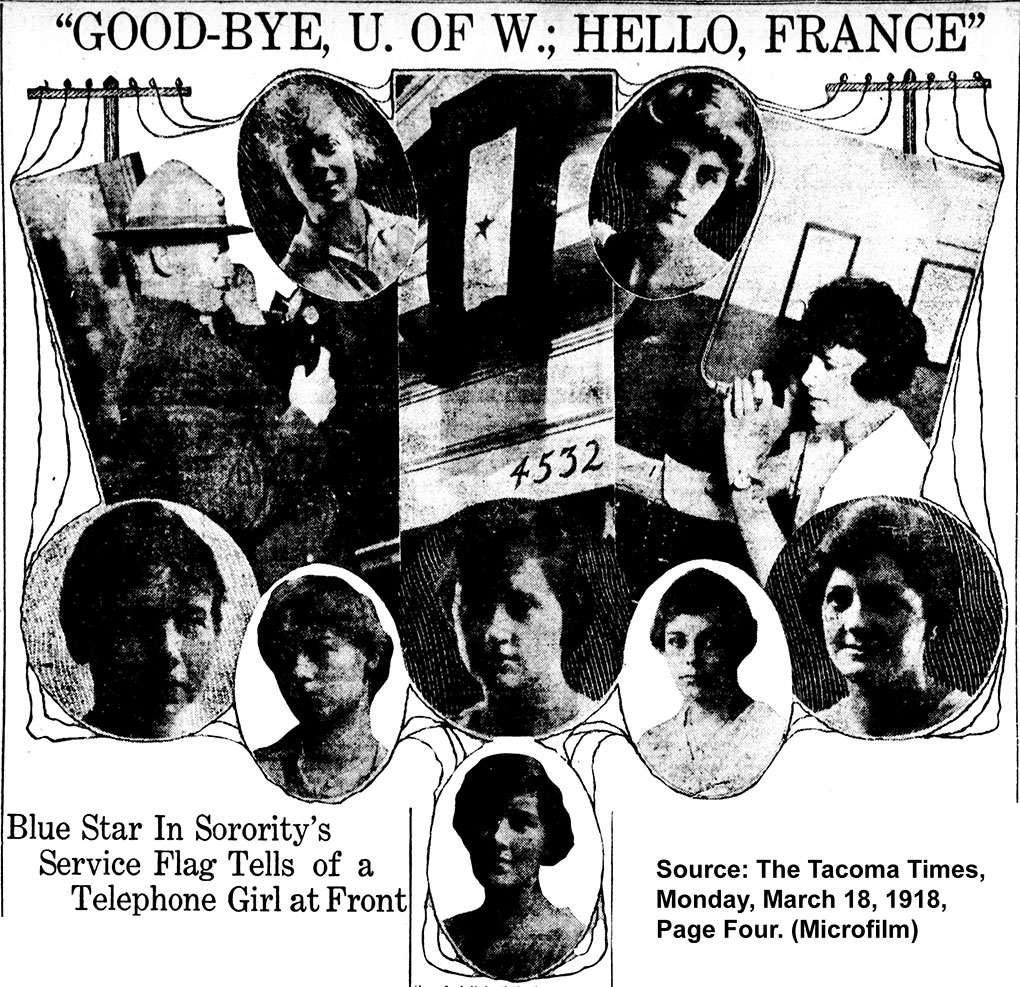
Photo from Microfilm Archive of The Tacoma Times, Monday, 18 March 1918, Page 4. Top (L to R) Frances Laney, Doris Summers. Middle Row: Jennie Young, Adele Hoppock, Marjorie McKillip, Helen Naismith, and Helen Hill. Bottom: Ellen Turner. Center Inset: Service Flag of Alpha Phy Sority of Which Ellen Turner is a Member, Showing a Blue Star for Uncle Sam's Telephone Operator. | GGA Image ID # 236c4c6eb4. Click to View a Larger Image.
📖 Review & Summary
The article “Good Bye U of W, Hello France” from the March 18, 1918 issue of The Tacoma Times captures the excitement and patriotic spirit of University of Washington co-eds preparing to serve overseas as U.S. Army Signal Corps telephone operators — the “Hello Girls.” Fluent in French and skilled in communications, these women volunteered to leave academia and home life to support Allied command networks during World War I.
The story blends college enthusiasm with wartime realism, showing professors torn between pride and concern as students traded textbooks for switchboards. With humor and admiration, the article documents how fraternities and sororities competed to add blue stars to their service flags, symbolizing women’s wartime service. This early coverage helped shape public perception of the Hello Girls as brave, educated, and determined pioneers who carried America’s voice across the Atlantic.
Monday, March 18, 1918,-THE TACOMA Times-Page Four
"GOOD-BYE, U. OF W.; HELLO, FRANCE"
Blue Star In Sorority's Service Flag Tells of a Telephone Girl at Front
"Good-bye, 'Varsity! Hello, France!"
A dozen pretty U. of W. co-eds are ainginig their own version of the popular song. They're bubbling over with joy; for they're going to France for Uncle Sam as "hello" girls.
Each is anxiously awaiting the day when she will lean against the rail of a transport, neat and trim in her navy blue operator's uniform, and wave good-bye, temporarily, to Etat Unis, as the Statue of Liberty disappears on tlie horizon.
Serve Behind Lines
The government is sending scores of young women who can speak French fluently and can operate a switchboard, to France for service behind the lines.
The first division of 100 operators Is already looking for periscopes on the surface of the Atlantic. They'll soon bo doing their bit "over there."
In this division is Miss Helen A. Naismith, the first Seattle girl to be admitted into the service. She was a Junior in the university, Outbursts of Everett True and gave up her studies to answer the call. She has been trained as an Inspector of operators.
Singing, laughing and guessing what they'll find ln France!
That's how the girls are enjoying their game of tag with Kaiser Bill's submarines, near the op posite .shore.
Sighs, frowns and mutterings.
Prof. Is Restless
This 's how a certain gentleman on the campus is taking It. He paces up and down in his office on the second floor of Denny hall. And why should he be so restless?
He 1s Prof. P. J. Frein, head of tlie French department, and they're taking all his "majors." "
If they don't stop going we won't have any seniors left in the department," he complains. "And then how can we graduate any?"
Prof. Frein misses his star students, but, after all, he's glad they have the chance to go.
"They're a very fine lot of girls —all anxious to help win the war. With so many young men gone, they feel it is their duty to serve ln whatever capacity they are fitted," said he today to a Times correspondent.
Can't Stop Them
"One girl 1 understand has a brother who has tried to get into every branch of the service, and had been turned down. She was determined that her family should have a service flag, so she volunteered for this work.
"I explain to them the danger aad hardships, but that doesn't stop them."
Blue stars on service flags represent the number of girls who have gone.
Since last spring there haa been keen rivalry among fraternities to add stars to their flag.
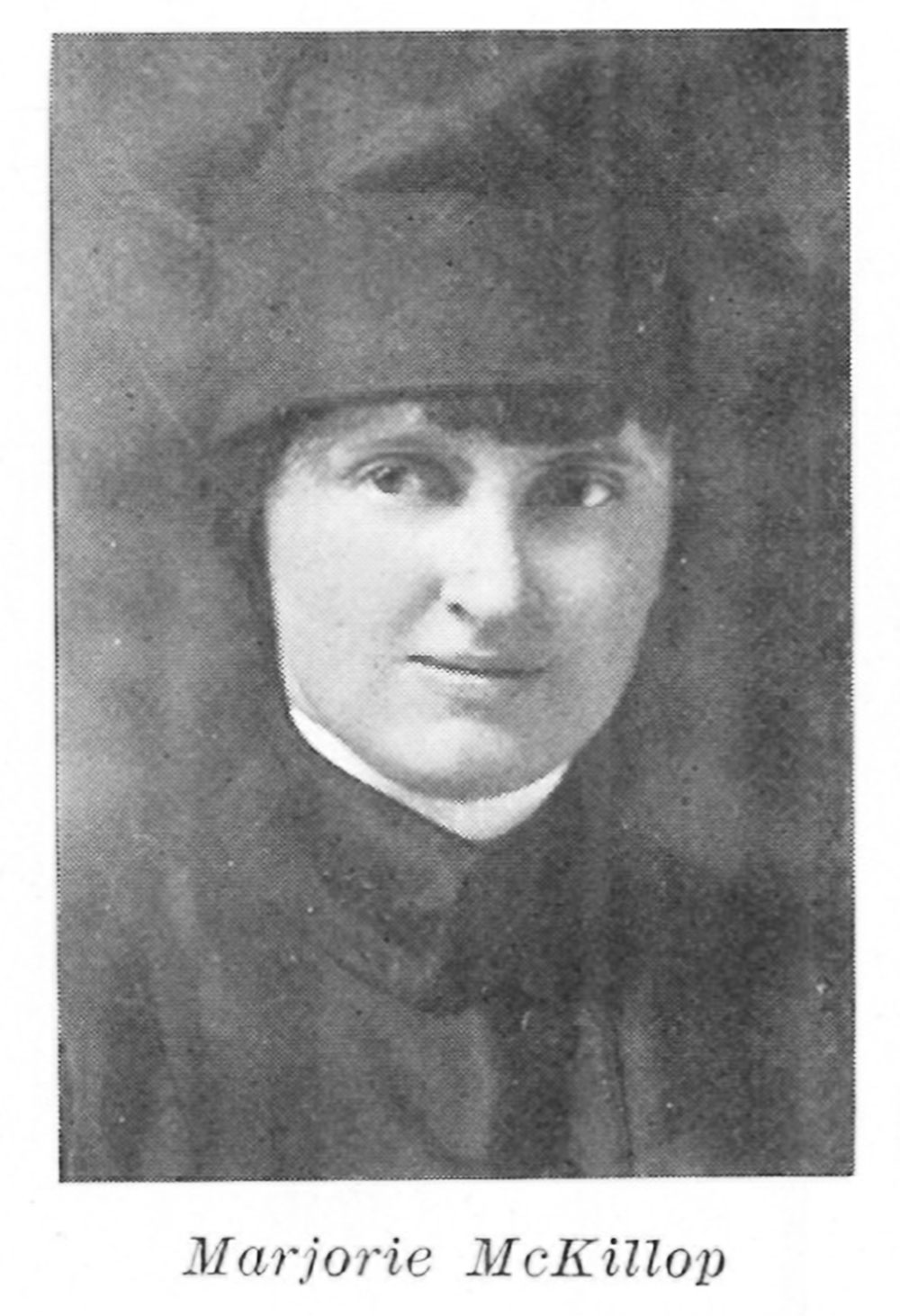
Photo of Marjorie McKillop in Uniform of the US Army Signal Corps. University of Washington Yearbook, Tyee, Vol. XX, 1919. | GGA Image ID # 236c53212d. Click to View a Larger Image.
Sororitiies in Race
Now the sororities are ln the race. Two already have a flag. Alpha Phi and Alpha Gamma Delta. Proud? Why, they'd give up the honor of having secretary of the student body, half a dozen class numerals before they would past with a star.
Some university girls already have gone, and two will leave next week. Other girls who have not attended the university, but who are qualified, also are accepted. Many have made application.
The girls are given two preliminary examinations in French and a physical examination here. After Obtaining recommendation from Prof Frein, they are quizied on their French by J. W. Newell, district chief of the Pacific Telegraph & Telephone company, and the French consul. They [then] go to San Francisco for a month's training, after which they are examined again In French and physically. They are then sent to New York to embark.
Adele Hoppock is on her way to New York now. Five others, Doris Summers, Helen E. Hill, Ellen Turner, Marjorle McKillop and Jennie Young have just arrived in San Francisco.
Frances Laney and Mary C. Story expect to leave next week. Thelma Miller, a former university student at Seattle, also will leave then. Miss Story Is a daughter of Vice Admiral Story, of the British navy.
Florence Keyser and Ethel Keyser, sisters, employed by Frederick & Nelson and in the office of Dr. S. V. R. Hooker, respectively, also have gone.
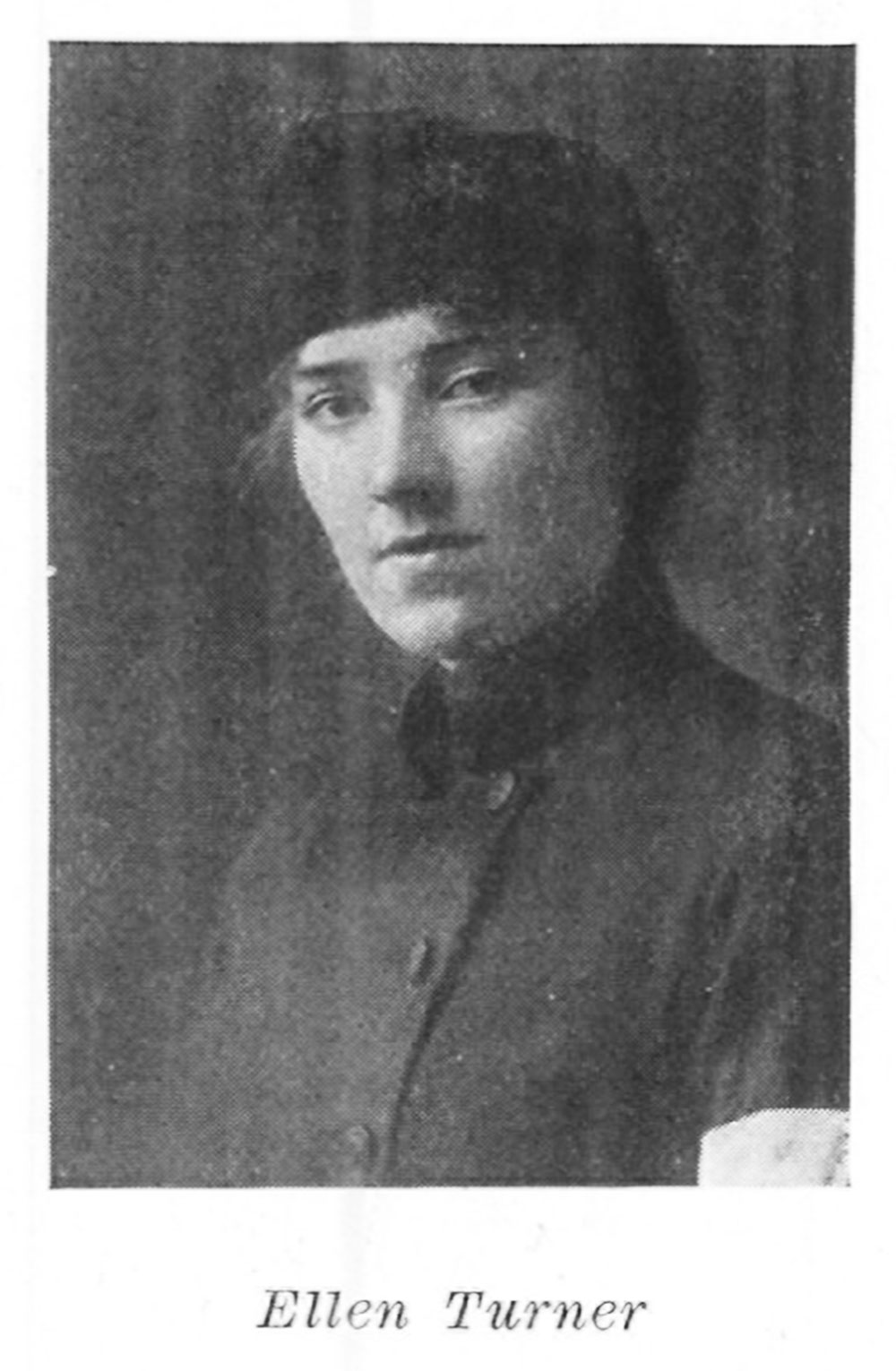
Photo of Ellen Turner in Uniform of the US Army Signal Corps. University of Washington Yearbook, Tyee, Vol. XX, 1919. | GGA Image ID # 236c66554e. Click to View a Larger Image.
✨ Most Engaging Content
The most memorable passage describes the women’s joyful anticipation as they prepare to depart: “They’re bubbling over with joy; for they’re going to France for Uncle Sam as ‘hello girls.’ Each is anxiously awaiting the day when she will lean against the rail of a transport, neat and trim in her navy blue operator’s uniform, and wave good-bye as the Statue of Liberty disappears on the horizon.”
This vivid imagery transforms these college students into symbols of national service and courage. Equally striking is Professor P. J. Frein’s pride and melancholy as he watches his French-language majors depart — an emotional snapshot of academia contributing directly to the war effort.
🖼️ Noteworthy Image(s)
Primary Image: “Good Bye U of W, Hello France.” Top row: Frances Laney, Doris Summers. Middle row: Jennie Young, Adele Hoppock, Marjorie McKillop, Helen Naismith, Helen Hill. Bottom: Ellen Turner. The Tacoma Times, 18 March 1918. | GGA Image ID # 236c4c6eb4.
Supporting Images: Portraits of Marjorie McKillop and Ellen Turner from the University of Washington Yearbook Tyee (1919) document how these students traded sorority life for military discipline, bridging campus culture and wartime service.
📘 Mini Dictionary for Civilians
- U. of W.
- Abbreviation for the University of Washington, whose students featured prominently among early Signal Corps recruits.
- Blue Star Service Flag
- A banner displayed by families or organizations to signify members serving in the armed forces during wartime.
- Co-ed
- Early-20th-century term for a female college student; here used affectionately for university volunteers.
- Signal Corps
- The U.S. Army branch responsible for communications, including the recruitment of female telephone operators known as “Hello Girls.”
- Sorority
- A social organization for female students; many kept service flags and organized wartime relief efforts.
- Periscope
- Referenced humorously as the girls “looking for periscopes” on the Atlantic — meaning vigilance against German submarines.
🎓 Essay Prompts for Students
- How did the University of Washington Hello Girls exemplify the intersection of education, language, and patriotism during WWI?
- What role did college sororities and women’s organizations play in promoting wartime service opportunities?
- Analyze the tone of the Tacoma Times article — how does it reflect early-20th-century attitudes toward women’s military participation?
- Compare the motivations of these student operators to those of modern women entering military or communication careers.
- What does Professor Frein’s reaction reveal about the shifting gender balance in academia during World War I?
🪶 Citation Block
Chicago: “Good Bye U of W, Hello France.” The Tacoma Times, March 18 1918, p. 4.
APA: The Tacoma Times. (1918, March 18). Good Bye U of W, Hello France. The Tacoma Times, 4.
MLA: “Good Bye U of W, Hello France.” The Tacoma Times, 18 Mar. 1918, p. 4.
Student-Friendly: “Good Bye U of W, Hello France.” The Tacoma Times, March 18 1918, p. 4. GG Archives, www.ggarchives.com.
"Good Bye U of W, Hello France," The Tacoma Times, Monday, 18 March 1918, Page 4.
