
Four of The Michigan Telephone Company’s “Returned Soldiers” - 1919
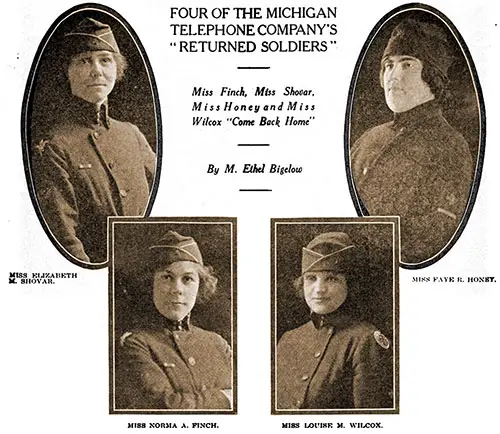
Four of Michigan Telephone Company’s Returned Soldiers. Left to Right: Miss Elizabeth M. Shovar, Miss Norma A. Finch, Miss Louise M. Wilcox, Miss Faye R. Honey. Bell Telephone News, November 1919. | GGA Image ID # 19ac5da927
📖 Review & Summary
This 1919 article, “Four of The Michigan Telephone Company’s ‘Returned Soldiers,’” by M. Ethel Bigelow, honors four Michigan women — Norma B. Finch, Elizabeth Shovar, Faye K. Honey, and Louise M. Wilcox — who returned home after serving as Signal Corps telephone operators in France. Working under military discipline and wartime danger, these women proved essential to communications across the American Expeditionary Forces.
From air raids in Paris to long hours connecting critical calls at the front, their experiences reflected courage, professionalism, and adaptability. Their return to Michigan’s civilian workforce marked not only the close of their overseas service but also the dawn of recognition for women’s critical role in modern military operations. Through this feature, Bell Telephone News celebrated these operators as heroes — disciplined, patriotic, and skilled “soldiers of communication.”
Foreword
In the aftermath of World War I, the brave contributions of women in the Signal Corps came to light, showcasing their resilience and adaptability in critical roles. Four remarkable women—Miss Norma B. Finch, Miss Elizabeth Shovar, Miss Faye K. Honey, and Miss Louise M. Wilcox—represent the dedication and courage displayed by Michigan State Telephone Company employees who served as telephone operators in France. Their journey from Detroit to the war-torn landscapes of Europe exemplifies commitment to duty and a willingness to face challenges head-on. Their story highlights their bravery and reflects the evolving role of women in both the workforce and military operations during a time of global upheaval.
Miss Norma B. Finch, Miss Elizabeth Shovar, Miss Faye K. Honey, and Miss Louise M Wilcox, the Michigan State Telephone Company employees, have just returned from serving as telephone operators in France.
They left Detroit in July 1918 and sailed from New York on 5 August, arriving in Liverpool on 13 August after a pleasant but unexciting trip. From Liverpool, they went to Tours by way of Southampton, Havre, and Paris, stopping only long enough for the necessary transfers in those places. They arrived in Tours on 15 August 1918.
At Tours, they were assigned to their offices, and the thirty operators, who had been together since leaving the United States, formed a close-knit group. They were sent to all parts of France, each contributing to the war effort in their own way. Of the four from Michigan, Miss Honey was sent to Bordeaux, and Miss Wilcox, Miss Finch, and Miss Shovar to Paris.
In Paris, fifty Signal Corps operators lived at the Hotel Ferres, which was called the Signal Corps House. Mrs. Lulu Taylor of Ann Arbor, Michigan, was the YWCA hostess at this hotel. Mrs. Taylor had a great deal of experience working with girls, having been in charge of the Martha Cook dormitory at the University of Michigan for several years. She planned many pleasant hours for the operators who lived at the Signal Corps House.
Miss Wilcox, Miss Finch, and Miss Shovar were in Paris during the biggest air raid on 16 September. Despite the danger, they continued their duties, a testament to their resilience and dedication. By working the day that they were scheduled to be off duty one week, they could arrange to have two days the following week, and this gave them ample time to visit such points of interest as Soissons, Chateau Thierry, Rheims, and Chemin des Dames. In Paris, they had many opportunities to see most of the leading men of the allied countries.
After spending five months in Paris, Miss Finch was sent to Bordeaux for five months. She was there for the Peace Day celebration on 28 June. She then returned to Paris and spent the rest of the year. Miss Finch and Miss Wilcox were in Paris for the 4th of July when, as Miss Shovar said, “everyone tried to see how much they could do for the Americans.”
Miss Shovar was recommended for advancement to a supervisory position and received her appointment on 9 February 1919. Miss Finch was also recommended, but no more promotions were being approved then.
Miss Honey spent the year in Bordeaux except for the last month when she was sent to Tours. Her fourteen-day leave was spent in and around Nice. Miss Honey and Miss Wilcox left Bordeaux on the “Niagara” on 9 August and arrived in New York on 21 August. Before going overseas, they were toll operators in Detroit, and now, they have returned to their work in that office, bringing with them the experiences and lessons learned during their service in France.
In August, Miss Shovar and Miss Finch returned on the “La Savoie.” Miss Finch has returned to her home in Hillsdale and her position with the Michigan State Telephone Company there. Miss Shovar is on a leave of absence visiting relatives. She is an instructor in the Toll Training Department in Detroit.
Summary of Activities:
Miss Norma B. Finch
- Assigned to Paris initially and worked during the largest air raid on 16 September 1918.
- Later transferred to Bordeaux for five months, attending the Peace Day celebration on 28 June 1919.
- Returned to Paris for the rest of the year.
- Recommended for a supervisory position but did not receive a promotion due to restrictions on approvals.
- Returned home on the La Savoie and resumed her role with the Michigan State Telephone Company in Hillsdale.
Miss Elizabeth Shovar
- Worked in Paris, including during the 16 September air raid.
Recommended for and appointed to a supervisory position on 9 February 1919. - Returned home on the La Savoie and is currently on leave visiting relatives.
- Works as an instructor in the Toll Training Department in Detroit.
Miss Faye K. Honey
- Assigned to Bordeaux for most of her service, spending her final month in Tours.
- Took a fourteen-day leave in and around Nice.
- Returned home on the Niagara on 21 August 1919.
- Resumed her position as a toll operator in Detroit.
Miss Louise M. Wilcox
- Stationed in Paris initially, working during the 16 September air raid.
- Spent time in Bordeaux later in her service.
- Returned home on the Niagara on 21 August 1919.
- Resumed her role as a toll operator in Detroit.
These women demonstrated resilience, dedication, and adaptability in their service as telephone operators during World War I, and they returned to their civilian roles enriched by their experiences.
Conclusion
The return of Miss Finch, Miss Shovar, Miss Honey, and Miss Wilcox to Michigan marked the end of their extraordinary wartime service but the continuation of their invaluable contributions to the Michigan State Telephone Company. Their experiences in France—from enduring air raids in Paris to celebrating the Peace Day festivities in Bordeaux—demonstrate their resilience, adaptability, and patriotism. These women exemplify the critical role of communication in modern warfare and serve as enduring symbols of women's contributions to the war effort. Their legacy continues to inspire, reminding us of the power of courage and service in the face of adversity.
✨ Most Engaging Content
The most compelling moment occurs when the women describe their experience during the Paris air raid of 16 September 1918. Despite bombs falling nearby, they continued to operate their switchboards to ensure constant communication between field units. Their composure under fire illustrated not only professional discipline but genuine heroism — an early example of women serving in harm’s way for the United States military.
Another moving aspect is the camaraderie these women shared at the Signal Corps House in Paris, where Mrs. Lulu Taylor of Ann Arbor (a YWCA hostess) ensured their well-being. The story captures the humanity behind their service — the laughter, shared meals, and emotional resilience that sustained them through war and separation.
🖼️ Noteworthy Image(s)
Image: “Four of Michigan Telephone Company’s Returned Soldiers.” Left to Right: Miss Elizabeth M. Shovar, Miss Norma A. Finch, Miss Louise M. Wilcox, Miss Faye R. Honey. Bell Telephone News, November 1919. | GGA Image ID #19ac5da927
Interpretation: This portrait captures the professionalism and pride of Michigan’s Signal Corps women, uniformed and resolute after returning home. Their faces tell the story of a generation who proved that discipline, technical skill, and patriotism transcend gender barriers.
📘 Mini Dictionary for Civilians
- Signal Corps
- The U.S. Army branch responsible for communications — telegraph, telephone, and later radio systems — vital for command coordination.
- AEF
- American Expeditionary Forces, the U.S. military contingent sent to Europe during World War I under General John J. Pershing.
- Peace Day
- Celebrations held on June 28, 1919, marking the signing of the Treaty of Versailles and the official end of World War I.
- YWCA Hostess
- Members of the Young Women’s Christian Association who provided housing, meals, and emotional support for women serving overseas.
- Switchboard
- A manual telephone connection panel operated by human “switchboard soldiers” — in this case, the Hello Girls — linking officers and commands across battlefronts.
🎓 Essay Prompts for Students
- How did the Michigan Signal Corps operators’ service redefine women’s roles in both the workplace and the military?
- Compare the experiences of these operators in France with those of nurses or Red Cross workers during World War I.
- What does the article reveal about camaraderie, morale, and resilience among women serving overseas?
- Discuss how organizations like the YWCA supported America’s “Hello Girls” abroad. Why was this crucial to their success?
- How did postwar recognition — or lack thereof — affect the public’s understanding of women’s contributions to the war?
🪶 Citation Block
Chicago: Bigelow, M. Ethel. “Four of The Michigan Telephone Company’s ‘Returned Soldiers.’” Bell Telephone News, Detroit Edition, Vol. 9, No. 4, November 1919, p. 8.
APA: Bigelow, M. E. (1919, November). Four of The Michigan Telephone Company’s “Returned Soldiers.” Bell Telephone News, 9(4), 8.
MLA: Bigelow, M. Ethel. “Four of The Michigan Telephone Company’s ‘Returned Soldiers.’” Bell Telephone News, vol. 9, no. 4, Nov. 1919, p. 8.
Student-Friendly: Bigelow, M. Ethel. “Four of The Michigan Telephone Company’s ‘Returned Soldiers.’” Bell Telephone News, Nov. 1919, p. 8. GG Archives, www.ggarchives.com.
M. Ethel Bigelow, “Four of The Michigan Telephone Company’s ‘Returned Soldiers’,” in Bell Telephone News, Detroit Edition, Vol. 9, No. 4, November 1919. p. 8.
