
How the Signal Corps Organized 100 Girls - 1918
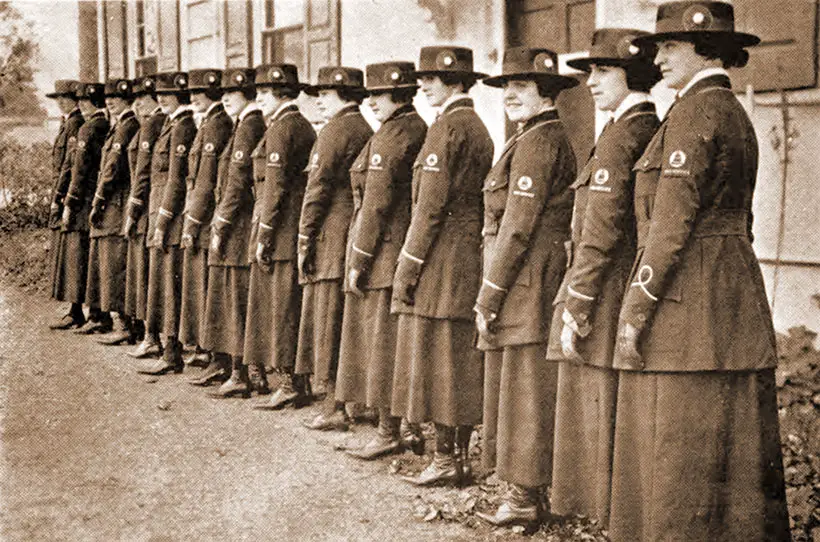
Telephone Operators of the Bell Telephone Company of Pennsylvania, at Camp Dix, New Jersey. Circuits of Victory, 1921. | GGA Image ID # 199f93401a. Click to View a Larger Image.
📖 Review & Summary
In late 1917, General John J. Pershing cabled the War Department requesting a force of bilingual women telephone operators to overcome delays and language gaps between American and French commands. The Signal Corps responded by recruiting, vetting, and training a unit of 100 women fluent in English and French. Candidates underwent operator proficiency checks, psychological testing, and Secret Service background investigations due to the sensitive nature of their work.
Training began 12 January 1918 with advanced telephony, large private-branch exchange practice, and familiarization at cantonment exchanges, plus daily military drill and briefings on Signal Corps duties. Three contingents sailed in March–April 1918 and were posted at AEF bases of supply and embarkation points. Uniformed and oath-bound, they connected high-priority operational traffic and translated live over the wire, dramatically improving call speed and accuracy compared with earlier male and French civilian operators.
- Manpower need: Pershing's request cited the "great difficulty" of obtaining suitably qualified men.
- Scale of interest: Thousands applied; only a small fraction met the bilingual + operator standard.
- Structure: Chief operators, supervisors, long-distance specialists, and operators—organized for 24/7 coverage.
- Deployment: Three groups embarked (2 March, 16 March, late April) and immediately raised exchange performance.
- Uniform & pay: War-College-prescribed uniform; pay scales set by role, with allowances like Army nurses.
The Division on Women's War Work, Committee on Public Information, issues the following:
Owing to the problems which the use of two languages presented to the American troops in France, and the necessity of accurate intercommunication between the American and the French Armies, the Signal Corps has sent abroad 100 trained women telephone operators, who speak both French and English fluently, to work in military telephone exchanges in bases of supplies and points of embarkation. During 1917, the Army used male operators and French women for this work. Neither group proved satisfactory.
Gen. Pershing Cables Request
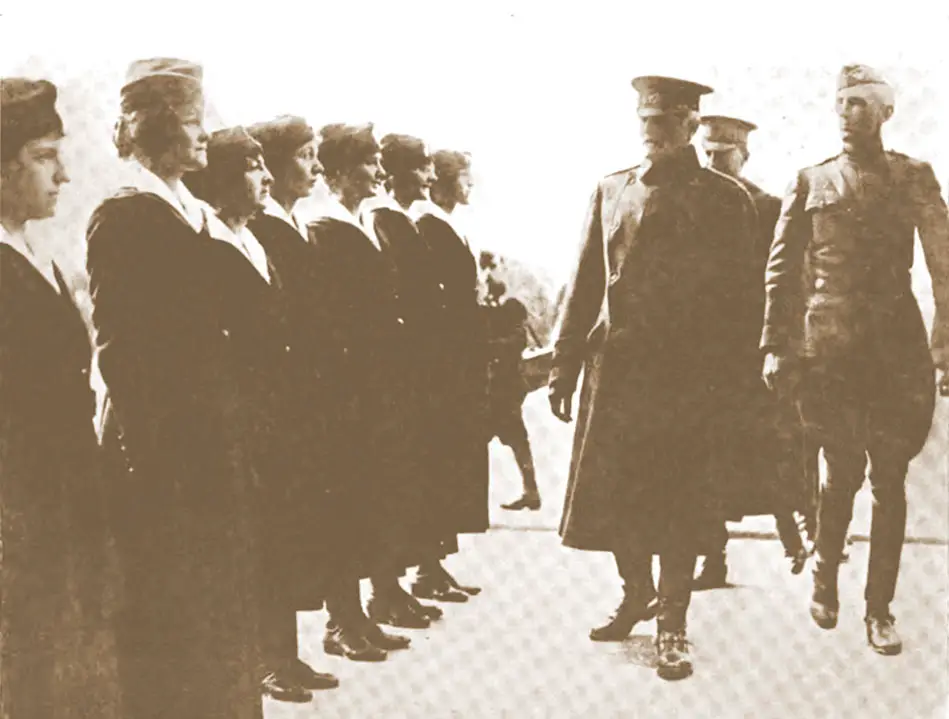
General Pershing Reviewing Signal Corps Telephone Operators of the American Expeditionary Force on the Rhine. Photographed at Divisional Headquarters near Coblenz. The Telephone Review, August 1919. | GGA Image ID # 191f61b3f0. Click to View a Larger Image.
Therefore, in the early part of November, a cablegram was sent to the Signal Corps of the United States Army by Gen. Pershing, commander of the American Expeditionary Forces, recommending that, on account of the great difficulty in obtaining suitably qualified men, a force of women telephone operators speaking French and English equally well should be organized and sent to France.
He required three chief operators at $125 a month, nine supervising operators at $72 a month, 24 long-distance operators at $60 a month, 54 operators at $60 a month, ten substitute operators at $50 per month, a total of 100. All should have the allowances of Army nurses and should be uniformed.
Capt. E. J. Wesson, civilian personnel section of the Signal Corps, experienced in recruiting emergency groups of trained workers, was given charge of the proposed unit. Capt. W. S. Vivian was made responsible for the housing and general welfare of the operators in France.
Small Percentage Qualified
Considering the possibility of recruiting telephone operators fluent in both languages in areas with significant French populations, an initial effort was made to recruit from Montreal, Canada, and Louisiana.
The announcement was placed in French-Canadian papers, with the result that from 300 to 400 women applied. Out of these, only six could be considered. The announcement was then made to the press of the country and the telephone companies.
A list of 2,400 applications was received, yielding two experienced operators who could speak both languages and 25 other candidates who may be eligible. To this date, 7,600 applications have been received.
In addition to the 100 already sent over, 150 fully equipped units are now in training schools to meet potential demand, and a list of 400 as a reserve force is on file.
Classified in Groups
The group of 100 is composed mainly of French girls who have come to America or American girls who have lived in France. The unit was sent in 3 groups of about 30 each.
Groups No. 1 and 2 are made up of experienced telephone operators. Group No. 3 consists of girls who have been given intensive emergency training in telephony.
These girls come from New York State, California, and Massachusetts, with the following being the largest numbers for the most part. Seventy-two percent are Americans, while 28 percent are foreign-born, including French and Belgian, Canadian, English, Swiss, and Dutch East Indian.
Under existing laws, wives of Army officers and enlisted men who are liable for duty abroad are not eligible for membership in this unit.
An unauthorized statement, which appeared in many papers, saying that a unit of telephone girls was to be organized and that many women whose husbands were officers had thus found a way to go abroad, occasioned an enormous number of applications and met with an emphatic denial from the Signal Corps.
Rigid Tests Required
Upon filling out the application blanks, which asked for facts about age, nationality, knowledge of French and English, previous telephone experience, and health, and which demanded a promise to serve for the duration of the war.
The candidate whose answers indicated satisfactory qualifications was given an examination by the manager of the local telephone company, who had been authorized by the Signal Corps.
A full report on the ability and character of the applicant was submitted to a board of experts in New York. A psychologist gave tests to the prospective operators similar to the methods used by the Army in examining officers.
Also, since the work that the unit would perform was of a confidential military nature and would give the members essential knowledge of the movements of troops, Secret Service agents investigated their loyalty and motives for applying for service.
Began Training 12 January 1918
On 12 January, the first group entered the training schools to be trained in advanced telephony. Practice was then given in the largest private branch exchange in New York, followed by three days' work in cantonment telephone exchanges, to acquire familiarity with military terms.
During the training period, military drill was given to the women every day. Lectures were delivered to them by officers of the Signal Corps on the duties of that branch of the Army and its traditions.
The importance of lines of communication in modern warfare was explained, and the various responsibilities of the Signal Corps divisions were outlined. Women surgeons gave talks on personal hygiene.
Sailing to Europe
On 2 March, the first contingent sailed, and later in the month, American officers in France were agreeably surprised by hearing over the military telephones operators who used American terms, gave splendid service, and who could translate the message of a French officer to an American officer, or vice versa.
A second group sailed on 16 March, and a third during the latter part of April. They were stationed in groups of 10 in American bases of supplies and points of embarkation.
The women's Telephone Unit members were required to pass strict health examinations. They were inoculated and vaccinated in the same manner as American soldiers.
Out of 60 girls who were immunized, not one fainted. An officer who has seen many soldiers meet the same experience said this was most unusual.
Signal Corps Telephone Operators Uniform
The uniform was designed and prescribed by the War College. It consisted of a blue coat and skirt made of navy blue serge, strictly tailor-made; a tailored shirtwaist of navy blue palm beach cloth or similar material; and a straight-brimmed hat of blue felt, with the official orange and white hat cord of the Signal Corps.
The brassard on the coat's left sleeve is of white whipcord or doeskin, bearing small devices indicating the status of chief operator, supervisor, and operator.
Women Better as Telephone Operators
It would be impossible to brigade an American troop without these girls, Capt. Wesson, who has recruited the unit, states. They are going to astound the people over there with the efficiency of their work.
In Paris, it takes from 40 to 60 seconds to complete one telephone call. Our girls are equipped to handle 300 calls an hour. The English Women's Army Auxiliary Corps, the "WAAAC," is doing similar work.
Still, they lack fluent knowledge of French, and the American system of telephony has always been better than the European one.
Personnel of the Units
The personnel of the Woman's Telephone Unit follows:
- Melina J. Adam
- Margaret Anderson
- Eulalie I. Audet
- Grace Banker
- Julie Barrere
- Emma Marie Brousseau
- Almería Capistran
- Bertha A. Carrel
- Mrs. Inez Crittenden
- Josephine Davis
- Cordelia Dupuis
- Sara Fecteau
- Marie Louise Ford
- Anna C. Fox
- Esther Fresnel
- Marie A. Gagnon
- Lydia C. Gelinas
- Charlotte Gyss
- Darnaby Henton
- Matina Heymen [Heynen]
- Derise Ingram
- Ethel Keyser
- Florence F. Keyser
- Marie S. La Blanc [Le Blanc]
- Leontine Lamoureux
- Nellie Martin
- Mrs. Pauline McDermott
- Kathleen Mitchell
- Minerva G. Nadeau
- Helen A. Naismith
- Frances Paine Bigelow [Frances Bigelow Paine]
- Drucilla Palmer
- Lawrence Helene Pechin
- Helen F. Perreton
- Bertha Plamondon
- Suzanne Prevot
- Minnie R. Richards
- Katharine Hay Robinson
- Olive M. Shaw
- Marion A. Taylor
- Evelyn Thomas
- Isabelle Villiers
- Ethelyn White
- Mrs. Clara Whitney
- Margaret S. Bleyers [Marguerite S. Bleyeres]
- Jeanne Bouchet
- Martha L. Carrel
- Louise Essirard
- Anns LeBorde [Anna LaBorde
- Louise Le Breton
- Raymond Le Breton
- Marie Antonette Neyrat McEntyre
- Renne Messelin [Renee Y. Messelin]
- Marie Ponsolle
- Georgette Schaerr
- Albertine Asrents [Albertine M. Aarents]
- Edith Dodson
- Martha Libert
- Estelle L. Caron
- Jean Cunningham
- Amallem Jackson
- Agnes M. Therinult [Agnes Mary Theriault]
- Winifred Hardy
- Elizabeth Hunter
- Alice V. Ward
- Helen F. Perreton [F. Helene Perreten]
- Dee Van Balkom [Fernande Jacquelane Van Balkon]
- Suzanne M. Beraud
- Louisette H. Gravard [Louisette H. Gavard]
- Margaret Hutchins
- Lucille De Jersey
- Bertha M. Hunt
- Margaret H. Milner [Marguerite H. Milner]
- Martha Steinbruner [Martha Steinbrunner]
- Marie Floyd [Maria Flood?]
- Dorothy L. Sage
- Bertha H. Verkler
- Lillian V. Verkler
- Yvonne M. Gauther [Yvonne M. Gauthier]
- Eugenie Racicot
- Maude McLowell
- Michele F. Blanc
- Marie B. Belanger
- Marie L. Bousquet
- Suzanne Coheleach
- Frances Des Jardins
- Blanche Grand Maitre
- Adele L. Hoppock
- Janet R. Jones
- Hopo Kervin [Margaret Hope Kervin]
- Miriam De Jersey
NOTE: Nellie Martin, Marie Floyd, and Maude McLowell were not part of the official roster of the US Army Signal Corps Telephone Operators. Names that were likely typos had the official roster names in brackets "[]" to aid researchers.

Orignal Article, "How the Signal Corps Organized 100 Girls Who Speak Who Speak Both English and French as Army Telephone Operators in France," in The Official Bulletin, Tuesday, 21 May 1918. | GGA Image ID # 237fead9cc. Click to View a Larger Image.
✨ Most Engaging Content
- "100 or bust." Pershing's cable specified exact billets—3 chiefs, 9 supervisors, 24 long-distance specialists, 54 operators, and 10 substitutes—plus uniforms and nurse-equivalent allowances.
- 7,600 applicants, handful qualified. Bilingual + expert operator skill was rare; rigorous testing and investigations narrowed the field.
- Training to the mission. Advanced switchboard drills, military terminology, hygiene talks, and daily drill prepared the unit for war conditions.
- On station by spring 1918. Three embarkations in March–April put operators in place as AEF tempo surged.
- Speed as a weapon. Operators handled hundreds of calls per hour and translated in real time, turning communication into combat power.
🖼️ Noteworthy Image(s)
- Camp Dix telephone operators (GGA Image ID # 199f93401a). Shows stateside training context and civilian operator pipeline.
- Pershing reviewing Signal Corps operators on the Rhine (GGA Image ID # 191f61b3f0). Useful for discussing deployment, discipline, and uniform standards.
- Scan of the 21 May 1918 Official Bulletin article (GGA Image ID # 237fead9cc). Anchor for sourcing, quotation verification, and page citation (p. 13).
📘 Mini Dictionary for Civilians
- Committee on Public Information (CPI)
- WWI U.S. government agency that oversaw public information; published The Official Bulletin.
- The Official Bulletin
- Daily government periodical (Washington, D.C.) carrying official notices and war-related releases.
- Private Branch Exchange (PBX)
- A switchboard that connects internal lines and external trunks; training included large PBX practice.
- Base of Supply / Point of Embarkation
- Logistics hubs supporting movement of personnel and materiel; common duty stations for operators.
- Brassard
- Armband displaying branch or role (e.g., operator, supervisor, chief operator) on the uniform sleeve.
- WAAC (British)
- Women's Army Auxiliary Corps (UK), a contemporary comparator force; later renamed QMAAC.
- Psychological testing
- Early aptitude/selection exams similar to those used for Army officer candidates during WWI.
🎓 Essay Prompts for Students
- From cable to capability: Analyze how Pershing's November 1917 request translated into selection criteria, training, and deployment by spring 1918.
- Language as logistics: Evaluate why bilingual proficiency mattered operationally and how it changed call throughput and accuracy.
- Selection ethics: Consider the balance between wartime urgency and stringent vetting (psychological tests, security checks). Was it proportionate?
- Comparative forces: Contrast the U.S. Signal Corps operators with Britain's WAAC/QMAAC communications roles in 1918.
- Uniforms and status: How did prescribed uniforms, drill, and pay scales shape public perceptions of the women's military standing?
- DBQ mini-task: Using the Official Bulletin article scan (p.13) and one roster entry, reconstruct a likely training-to-deployment path for a named operator.
📎 Cite This Page
Use n.d. if no "last updated" date appears on the page; always include your access date.
Chicago (Notes & Bibliography)
Gjenvick-Gjønvik Archives (GG Archives). "How the Signal Corps Organized 100 Girls – 1918." GG Archives. Accessed [Month Day, Year]. https://www.ggarchives.com/MIL/HelloGirls/Intro/HowTheSignalCorpsOrganized100Girls-1918.html.
Chicago (Author–Date)
Gjenvick-Gjønvik Archives (GG Archives). n.d. "How the Signal Corps Organized 100 Girls – 1918." GG Archives. Accessed [Month Day, Year]. https://www.ggarchives.com/MIL/HelloGirls/Intro/HowTheSignalCorpsOrganized100Girls-1918.html.
APA (7th ed.)
Gjenvick-Gjønvik Archives. (n.d.). How the Signal Corps Organized 100 Girls – 1918. GG Archives. Retrieved [Month Day, Year], from https://www.ggarchives.com/MIL/HelloGirls/Intro/HowTheSignalCorpsOrganized100Girls-1918.html
MLA (9th ed.)
"How the Signal Corps Organized 100 Girls – 1918." GG Archives, Gjenvick-Gjønvik Archives, n.d., https://www.ggarchives.com/MIL/HelloGirls/Intro/HowTheSignalCorpsOrganized100Girls-1918.html. Accessed [Month Day, Year].
Chicago short note (repeat citations)
GG Archives, "How the Signal Corps Organized 100 Girls – 1918."
"How the Signal Corps Organized 100 Girls Who Speak Who Speak Both English and French as Army Telephone Operators in France," in the Official Bulletin, Published Daily Under Order of The President of The United States by Committee on Public Information, Washington, DC: US Government Printing Office, Vol. 2, No. 315, 21 May 1918, p. 13.
