
General Squier in Charge of Aviation and Signal Corps - 1918
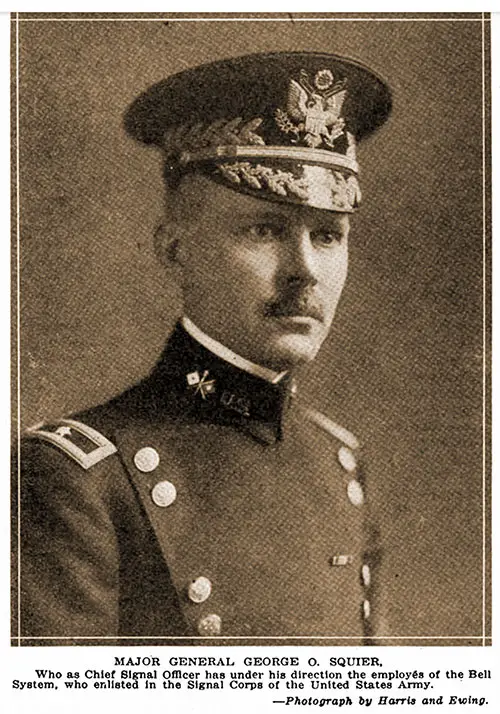
Major General George O. Squier, Who as Chief Signal Officer Has under His Direction the Employees of the Bell System, Who Enlisted in the Signal Corps of the United States Army. Photograph by Harris and Ewing. Bell Telephone News, January 1918. GGA Image ID # 19a77c4d77
📖 Review & Summary
Why this matters: In early 1917, the U.S. Army placed both aviation and the Signal Corps under a single leader—Brig. Gen. (later Maj. Gen.) George O. Squier. A scientist-officer with deep experience in telegraphy, cabling, and radio, Squier's remit spanned airplanes in the air and telephones on the ground. That consolidation accelerated the AEF's modernization—and created the administrative space for a bold solution to bilingual, high-speed switching needs at headquarters and near the front: the women telephone operators later known as the "Hello Girls."
- Scientific pedigree: Squier helped draft the first U.S. Army airplane specifications (1907–08), laid inter-island cables in the Philippines, and advanced cable transmission techniques—skills that informed his approach to wartime communications.
- Rapid scale-up: Under his direction, aviation and Signal Corps programs expanded dramatically in manpower, appropriations, and equipment throughout 1917–1918.
- Direct relevance to the Hello Girls: Centralized control over telephony and linguist requirements at AEF headquarters made it feasible to recruit and deploy a specialized women's operating force to keep command lines open under pressure.
Source: "General Squier in Charge of Aviation and Signal Corps," Bell Telephone News, Detroit Edition, vol. 7, no. 6 (January 1918), 13.
Chief Signal Officer's Scientific and Military Training Well Fits Him for Responsibilities of Difficult Position.
The great two-sided task of upbuilding America’s air fleet and of providing for all the field telephone and wireless communications for our new armies has been entrusted to Major General George O. Squier, who, as it happens, drew up the first airplane specifications ever issued by a war office, who was the first passenger to go up in an airplane, and who has invented many electrical communicating appliances along the lines of his present work.
General Squier thus brings to the great responsibility resting upon him, a life’s effort in science and a military training running back through four years at the embassy in London, during the present war, through the Philippine insurrection and the Spanish war to West Point.
The importance of his duties cannot be exaggerated. The air service, which this year needs a billion dollars above the $700,000,000 allotted last year, is counted on to clear the road to victory for the American ground troops.
Soon, from the skies of France, the men now under General Squier’s care will be guiding American batteries, saving American lives from surprise attack, bombing German trenches, seeking out German guns, while the Signal Corps itself will be serving as the nerves of the army, flashing back and forth, by radio and telephone the priceless intelligence upon which every military move must depend. The life of the man responsible for this organization is, therefore, doubly interesting.
General Squier was born in Dryden, Mich., on March 21, 1865, in the old homestead which he still owns, and which was settled by his grandfather in 1835. In 1883 he was chosen for West Point, and in 1887 graduated seventh in a class of sixty-five.
Appointed a Second Lieutenant in the Third Artillery at Fort McHenry, Baltimore, on June 12, 1887, he used all his spare time studying physics at Johns Hopkins University under such leaders as Rowland, Remsen and Newcomb.
There he laid the basis of his scientific knowledge, being made a fellow of the university in 1902-3-4 and receiving his Ph. D. in 1903.
In 1897 he announced before the American Institute of Electrical Engineers a new method of rapid telegraphy, based on the use of the alternating current with the polarizing photochronograph. Three years later he announced to the same society the adaptation of these principles to cable telegraphy, using the sine wave e. m. f.’s as worked out in experiments begun the year before with Dr. A. C. Crehore.
Meanwhile his military career claimed him, especially during the rush of the Spanish war. In 1900 he took the cable steamer Burnside from New York through Suez to the Philippines, where he laid the inter-island cable still in use. During this time he rose through various ranks till he was made Major on March 2, 1903.
In 1907, as Chief of Staff to General Allen of the Signal Corps, he was entrusted with drawing up the first specifications for a military airplane ever issued by any government. On September 12th of the next year, when in charge of the first tests at Fort Myer, he made the first ascent as a passenger in an airplane. That December he showed his faith in aviation by a public address stating that airplanes are fast “obliterating present national frontiers in conducting military operations.”
After several years more of intense scientific investigation he was sent, in 1912, to England as military attaché to the American embassy, where he built up many of the friendships and secured much of the information, especially in the first two years of the war, which have since proved so useful.
He also represented the United States at the International Radio Conference in London that year. It was there, too, in June. 1915, before the Physical Society that he made the announcement of his cable transmission invention, which later led to its adoption.
It is estimated that this doubled the capacity of the cables by substituting for the cable “curve” made by opening and closing the circuit, a single-phase alternating current of the sine wave type, operating with the Morse code.
In May 1916, with the war two years old and the vital importance of aviation fully demonstrated, he was recalled to this country by President Wilson to reorganize the air service.
On February 14, 1917, he was appointed Chief Signal Officer in charge of both aviation and the Signal Corps, with the rank of Brigadier General. He was promoted to the rank. of Major General on October 6, 1917.
During that brief eight months since he has been in charge the air service has jumped from a strength of 2,000 to an authorized strength of 153,000; its appropriations have increased from about a million dollars in five years to $700,000,000 granted in one and a billion asked in the next; its planes and aviators have increased from a handful to thousands. The Signal Corps itself has had to meet the needs of an army six times that of a few months ago.
✨ Most Engaging Content
- "Firsts" with flight: Squier oversaw the Army's earliest airplane tests and was the first passenger to go aloft during trials at Fort Myer (1908).
- From lab to field: His alternating-current cable work and inter-island cable-laying in the Philippines illustrate how laboratory innovations translated to battlefield communications.
- Dual hat, single aim: Uniting aviation and the Signal Corps under one chief aligned reconnaissance, artillery spotting, and message traffic with the telephone network that carried orders.
🖼️ Noteworthy Image(s)
- Hero image: "Major General George O. Squier" (Harris & Ewing studio portrait). Published in Bell Telephone News, January 1918 (Detroit Edition). Recommended alt text: "Maj. Gen. George O. Squier, U.S. Army Chief Signal Officer, 1917–1918 (Harris & Ewing)."
- Caption highlights: Notes Squier's direction over Bell System employees who enlisted in the Signal Corps—useful context for trade/house-organ coverage of the Hello Girls.
📘 Mini Dictionary for Civilians
- Chief Signal Officer (CSO)
- The Army general in charge of all Signal Corps functions—wireless, telegraph, and telephone—during WWI.
- Signal Corps
- U.S. Army branch responsible for military communications. In WWI, it deployed massive wireline and radio networks across the AEF.
- AEF (American Expeditionary Forces)
- U.S. forces sent to Europe in WWI under Gen. John J. Pershing.
- House organ
- A company's internal magazine (e.g., Bell Telephone News) aimed at employees; often a key source on communications history.
🎓 Essay Prompts for Students
- Leadership & Technology: How did placing both aviation and the Signal Corps under George O. Squier shape the AEF's approach to communications and air-ground coordination?
- Science to Service: Trace a line from Squier's prewar cable/radio work to WWI innovations at GHQ. Where do the Hello Girls fit into that chain?
- Policy & Personnel: Evaluate how organizational decisions (centralizing Signal, linguistic requirements) enabled the recruitment of bilingual women operators.
- Sources & Bias: Compare house-organ coverage (e.g., Bell Telephone News) with official Army histories. What emphases or omissions do you notice?
📎 Cite This Page
Cite this GG Archives web page
Replace n.d. with a "last updated" date if shown on the page; always include your access date.
Chicago (Notes & Bibliography)
Gjenvick-Gjønvik Archives (GG Archives). "General Squier in Charge of Aviation and Signal Corps - 1918." GG Archives. Accessed [Month Day, Year]. https://www.ggarchives.com/MIL/HelloGirls/Intro/GeneralSquierInChargeOfAviationAndSignalCorps-1918.html.
Chicago (Author–Date)
Gjenvick-Gjønvik Archives (GG Archives). n.d. "General Squier in Charge of Aviation and Signal Corps - 1918." GG Archives. Accessed [Month Day, Year]. https://www.ggarchives.com/MIL/HelloGirls/Intro/GeneralSquierInChargeOfAviationAndSignalCorps-1918.html.
APA (7th ed.)
Gjenvick-Gjønvik Archives. (n.d.). General Squier in Charge of Aviation and Signal Corps - 1918. GG Archives. Retrieved [Month Day, Year], from https://www.ggarchives.com/MIL/HelloGirls/Intro/GeneralSquierInChargeOfAviationAndSignalCorps-1918.html
MLA (9th ed.)
"General Squier in Charge of Aviation and Signal Corps - 1918." GG Archives, Gjenvick-Gjønvik Archives, n.d., https://www.ggarchives.com/MIL/HelloGirls/Intro/GeneralSquierInChargeOfAviationAndSignalCorps-1918.html. Accessed [Day Month Year].
Chicago short note (repeat citations)
GG Archives, "General Squier in Charge of Aviation and Signal Corps - 1918."
"General Squier in Charge of Aviation and Signal Corps," in Bell Telephone News, Detroit Edition, Vol. 7, No. 6, January 1918, p. 13.
Primary source for this page: "General Squier in Charge of Aviation and Signal Corps," Bell Telephone News, Detroit Edition, vol. 7, no. 6 (Jan. 1918), p. 13.
