
Exhibit U - American Legion Membership Card for Adele Louise (Hoppock) Mills - 1920
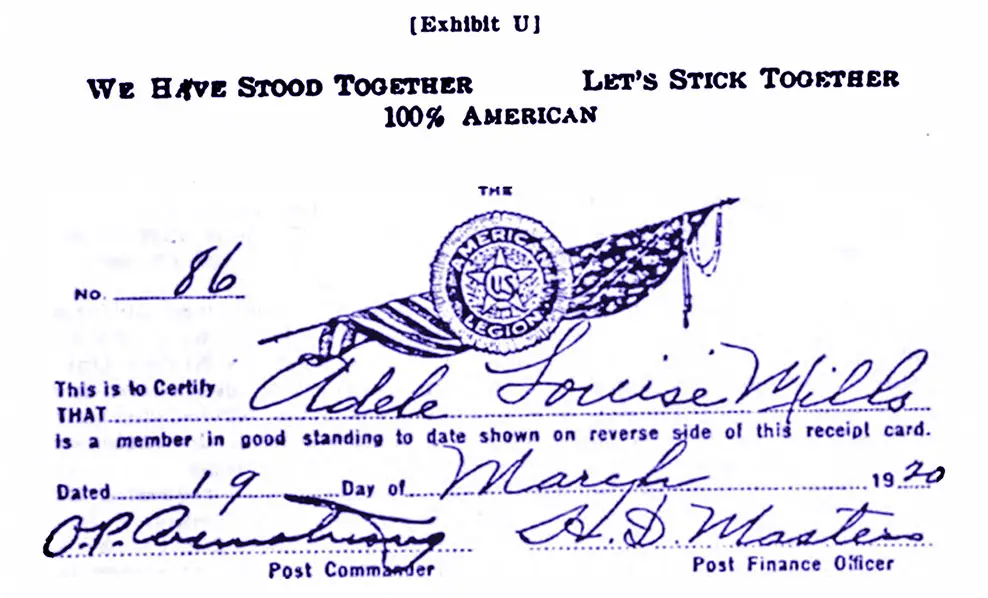
Exhibit U: Affidavit of Gertrude Hoppock: American Legion Membership Card for Adele Louise (Hoppock) Mills, 19 March 1920," in Recognition for Purposes of VA Benefits, Hearing before the Committee on Veterans' Affairs, United States Senate, Ninety-Fifth Congress, First Session on S. 247, S. 1414, S. 129, and Related Bills. Washington, DC: US Government Printing Office, 25 May 1977. | GGA Image ID # 2370d37caf. Click to View a Larger Image.
📖 Foreword
The American Legion actively supported the recognition of the Hello Girls (WWI Signal Corps Female Telephone Operators Unit) by endorsing their bid for veteran status and later the Congressional Gold Medal.
After decades of campaigning by the women and their supporters, including the Legion, Congress passed legislation in 1977 granting them veteran status and then in 2024, the Congressional Gold Medal was awarded, though posthumously.
The Legion's involvement included passing resolutions, leading email campaigns, and working with lawmakers to ensure the Hello Girls' service was formally honored.
Background on the Hello Girls
- Service during WWI: The Hello Girls served as telephone operators for the U.S. Army Signal Corps in France during World War I, providing critical communication services near the front lines.
- Denied veteran status: Despite wearing uniforms and following Army regulations, they were denied honorable discharge and veteran status after the war, being classified as civilian employees by the Army.
- Decades of advocacy: For nearly 60 years, the surviving Hello Girls petitioned Congress to grant them the veteran status they deserved.
American Legion's Role
- Early inclusion: Women were eligible for American Legion membership from the organization's beginning in 1919. Women veterans from World War I were among the first members.
- The Auxiliary: For many decades, most women associated with the Legion belonged to the American Legion Auxiliary, which was established in 1920 for female relatives of veterans. Membership rules have since been updated to be more inclusive.
- Initial advocacy: The American Legion supported the Hello Girls' efforts starting in the 1970s alongside the Veteran Affairs Administration and other groups, helping to pass the bill that conferred veteran status in 1977.
- Continued support: In 2018, the National Executive Committee passed Resolution 110, formally supporting the designation of the Hello Girls and their service.
- Congressional Gold Medal campaign: The Legion continued its work in the 2020s, conducting an email campaign that generated over 21,000 messages to Congress in support of the bill to award the Hello Girls the Congressional Gold Medal.
The Recognition
- Veteran status (1977): The advocacy efforts led by Merle Egan Anderson and supported by the American Legion culminated in President Jimmy Carter signing a bill into law, granting the Hello Girls full veteran status in 1978.
- Congressional Gold Medal (2024): In December 2024, almost 50 years after the initial recognition, the President signed legislation awarding the Hello Girls the Congressional Gold Medal, the highest civilian honor in the U.S.
📖 Review & Summary
The American Legion actively supported recognition of the Hello Girls (U.S. Army Signal Corps Female Telephone Operators) for both veteran status and, later, the Congressional Gold Medal Note 1 Note 2.
After decades of advocacy, Congress created the legal pathway in 1977 for certain groups to be granted veteran status; subsequent administrative actions conferred veterans' status and discharges to the Hello Girls in the late 1970s Note 3.
In December 2024, Section 5703 of Public Law 118-159 made the Hello Girls Congressional Gold Medal the law of the land Note 4.
Background on the Hello Girls
- Service during WWI. The Hello Girls operated critical military switchboards in France, often near the front, enabling rapid, secure communications for the AEF Note 5.
- Postwar classification. Despite uniforms and Army regulations, they were long treated as civilian employees and initially denied veterans' benefits Note 5.
- American Legion connection. From the Legion's founding, eligibility has followed military service rather than gender; many women veterans were eligible for membership, while most other women historically joined the American Legion Auxiliary (established 1920) Note 6.
[Exhibit U]
We Have Stood Together -- Let’s Stick Together -- 100% American
No. 86
The American Legion
This is to Certify That Adele Louise [Hoppock] Mills is a member in good standing to date shown on reverse side of the receipt card.
Dated 19 Day of March 1920.
/s/ O. P. Armstrong, Post Commander
/s/ H. D. Masters, Post Finance Oficer
✨ Most Engaging Content
"We Have Stood Together — Let's Stick Together — 100% American."
— Slogan printed on Adele Hoppock Mills's 1920 Legion card (Exhibit U)
- Then & now: In 1920 a local Legion post welcomed a Hello Girl; in 1977 the United States formally recognized their service; and in 2024 Congress awarded them a Congressional Gold Medal.
- Why it matters: The card is quiet evidence of how communities perceived the Hello Girls—as soldiers—long before Washington did.
- Advocacy timeline: Legion backing (including 2018 NEC Resolution 110) and a nationwide email campaign (21,000+ messages) helped secure the final honor.
🖼️ Noteworthy Image
- Exhibit U — American Legion Membership Card (19 March 1920). "This is to certify that Adele Louise [Hoppock] Mills is a member in good standing …" Used as evidence in the 1977 Senate hearing on veterans' recognition. File:
375a-ExhibitU-AmericanLegionMembershipCard-500.jpg.
📘 Mini Dictionary for Civilians
- American Legion
- Nationwide veterans' organization founded in 1919. Women who served in the armed forces were always eligible to join; many other women participated through the Auxiliary (est. 1920).
- American Legion Auxiliary
- A companion organization formed in 1920 for female relatives of veterans; today its membership rules are broader. (Background context from Legion sources.)
- Exhibit (Congressional hearing)
- A document/artifact submitted to a committee and printed in the official hearing record to support testimony or written statements.
- Public Law 95-202 (1977)
- G.I. Bill Improvement Act. Authorized the federal government to determine certain wartime civilian groups performed "active military service," enabling discharges and VA benefits; used to recognize the Hello Girls.
- Congressional Gold Medal
- One of the highest civilian honors bestowed by Congress; awarded to the Hello Girls in law in December 2024 (P.L. 118-159, §5703).
🎓 Essay Prompts for Students
- Local Acceptance vs. Federal Recognition: Using Exhibit U and Public Law 95-202, analyze why a community could accept a Hello Girl as a veteran in 1920 while the federal government withheld recognition until 1977–1978.
- Advocacy that Moves History: Evaluate the American Legion's role—from early eligibility for women to 2018 Resolution 110 and the 21,000-message campaign—in achieving the 2024 Congressional Gold Medal. What strategies were decisive?
- Memory, Law, and Honor: How do artifacts (like a 1920 card) and laws (1977 statute; 2024 medal) together shape historical memory of women's military service? Cite specific passages from the 1977 Senate hearing record.
[Citation Block (Chicago, APA, MLA + student version)]
"[Exhibit U]: Affidavit of Gertrude Hoppock: American Legion Membership Card for Adele Louise (Hoppock) Mills, 19 March 1920," in Recognition for Purposes of VA Benefits, Hearing before the Committee on Veterans' Affairs, United States Senate, Ninety-Fifth Congress, First Session on S. 247, S. 1414, S. 129, and Related Bills. Washington, DC: US Government Printing Office, 25 May 1977. p. 375.
End Notes
- The American Legion has publicly supported the Hello Girls' recognition, including the 2018 National Executive Committee's Resolution 110 and subsequent national advocacy. See: "A century later, the Hello Girls receive recognition," The American Legion, Oct. 3, 2024 (notes the 2018 Resolution and Legion support). legion.org. ↩︎
- The same American Legion article reports an email campaign that generated more than 21,000 messages to Congress in support of the Congressional Gold Medal legislation. "A century later, the Hello Girls receive recognition," The American Legion, Oct. 3, 2024. legion.org. ↩︎
- Congress enacted the G.I. Bill Improvement Act of 1977 (Public Law 95-202), authorizing recognition of certain groups for veterans' status; the Hello Girls subsequently received veterans' status and discharges in the late 1970s. Useful overviews: National Archives, "Unwritten Record" blog (Mar. 30, 2021) and VFW news release (Mar. 3, 2021). archives.gov; vfw.org. ↩︎
- Hello Girls Congressional Gold Medal enacted as §5703 of Public Law 118-159 (National Defense Authorization Act for Fiscal Year 2025), approved Dec. 23, 2024; codified as a note under 31 U.S.C. § 5111. Official text: P.L. 118-159, §5703. govinfo.gov (header shows "Approved December 23, 2024"); section excerpt: govinfo.gov §5703. ↩︎
- Concise official background on the Hello Girls' WWI service and postwar status: U.S. Department of Veterans Affairs, "Hello Girls' quest for veteran recognition" (Mar. 6, 2024); U.S. Army, "Hello Girls of World War I" (Mar. 27, 2020). va.gov; army.mil. ↩︎
- Membership in The American Legion is tied to qualifying military service (not gender); the American Legion Auxiliary was organized in 1920 for eligible family members. See: "The American Legion Membership Eligibility" page; and ALA Unit Guide Book (historical overview). legion.org/membership; legion-aux.org (Unit Guide Book). ↩︎
