
Adele Hoppock En Route to France - 1918
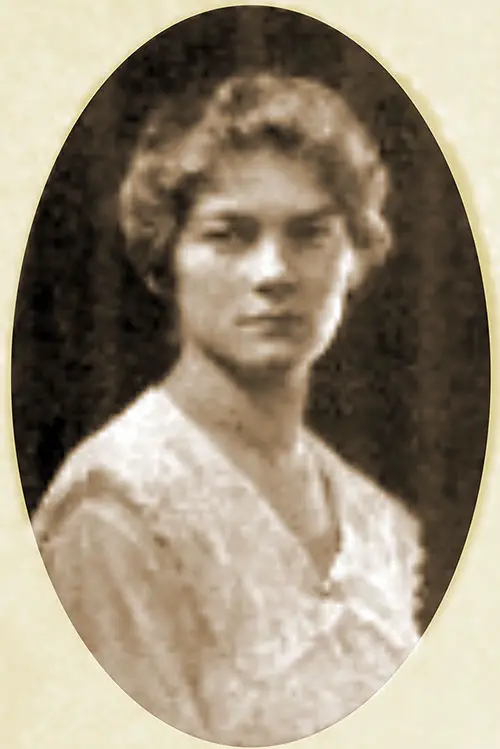
Adele Louis Hoppock, Tyee 1918 Yearbook, War Edition, Univeristy of Wisconisin. | GGA Image ID # 19a87704c7
📖 Review & Summary
This 1918 feature traces the remarkable path of Adele Louise Hoppock, a University of Washington honor student fluent in six languages, who volunteered for the U.S. Army Signal Corps’ “Hello Girls.” The article follows her from the Seattle and San Francisco training schools to her voyage aboard the massive troop transport Vaterland, renamed for American service.
Hoppock’s linguistic skill and academic discipline exemplify the new professional identity of women in wartime communications. Her story reflects how education, language, and patriotism combined to open unprecedented opportunities for women during World War I. As both scholar and soldier, she personified America’s confident, capable young women answering the call to serve overseas.
Adele Hoppock, a graduate of the Wenatchee High School, and daughter of Mr. and Mrs. Arthur W. Hoppock, now living in Seattle, who left early in the year for the training school in San Francisco for telephone operators in the signal corps, left New York last week for France, according to information received in Seattle.
She was the only Western girl who started at this time, due to crowded transportation facilities. It is believed that she departed on the largest transport afloat, formerly the Vaterland, which was designed to carry 4,000 soldiers.
The telephone girls travel as officers, so only small units can be accommodated at one time. While in New York, the operators, in their new navy blue uniforms, attracted a great deal of attention. Before sailing, each girl was presented with a ten-pound box of candy by the telephone company.
Versatile Linguists on Campus—Two Coeds Speak Many Tongues
Few can speak six or eight languages, but two of the accomplished minority are Washington co-eds. They are Adele Hoppock and Helen Bushnell, juniors in the College of Liberal Arts.
Miss Hoppock, who played the leading role in “Zaragueta” a short time ago, converses fluently in French, German, Italian, and Spanish, in addition to her native tongue.
Her study of Italian was primarily conducted in Italy, where she spent time traveling with her mother and sister before entering college. Although she began studying Russian only recently, she can understand the language and carry on a conversation in the Slavic tongue.
Miss Bushnell, who holds offices in the French and Spanish clubs, is conversant with both these languages. She has a good knowledge of German and has made progress in the study of Italian.
She is taking the course in Russian and is a frequent participant in conversation at the Russian table. Miss Bushnell has a slight knowledge of Dutch and spends her spare moments studying Norwegian and Hungarian.
Prominent Senior To Be Phone Girl
Adele Hoppock. Honor Student, To Give Services to U.S. in France, Will Be Given Her Degree.
The University Will Graduate Her before She Leaves for San Francisco to Study—Speaks French and Italian Fluently.
February 15, 1918.—When one thinks of “women in war” one is apt to visualize the strong, robust, heavyset woman of the Amazon type; at least one never pictures the very small and dainty golden haired girl with big blue eyes and a sweet smile that fairly spells happiness.
Yet that very miss is here on the campus in the person of Adele Hoppock, who leaves next week for California, where she will take a month’s instruction before leaving for France to act as a telephone operator in the United States service.
She who has carried the role of the charming señorita in the Spanish play and flourished a fan in the coy fashion of the southern beauties, is soon to be gowned in the somber olive drab uniform of Uncle Sam.
Miss Hoppock’s unusual qualifications for the work have moved the war department to make an exception to the age qualification in her case, for she is three years younger than the requirement
She has traveled considerably in Europe and was in Italy when the war broke out, having been in France a month previous.
Miss Hoppock has been an active member of both the French and Spanish clubs, speaking both languages fluently. She is also a member of Tolo, Red Domino, senior council, Women’s league cabinet, a student advisor and a member of the Y. W. social service committee.
The same provision will be made for Miss Hoppock as was made for the men in service, and she will receive her degree at once. She was to have graduated in June, having completed her college work in three years.
![[Exhibit P], Part 1: Affidavit of Gertrude Hoppock: Termination of Services - Adele Hoppock and En Route to France, [From the University of Washington Daily, 15 February 1918].](../../../CVimages/MIL/HelloGirls/CongressionalHearings/95th-S247-S1414-S129/1977-05-25/371-AffidavitOfGertrudeHoppock.jpg "GGA Image ID # 237463a90d. Click to View a Larger Image.")
[Exhibit P], Part 1: Affidavit of Gertrude Hoppock: Termination of Services - Adele Hoppock and En Route to France, [From the University of Washington Daily, 15 February 1918]," in Recognition for Purposes of VA Benefits, Hearing before the Committee on Veterans' Affairs, United States Senate, Ninety-Fifth Congress, First Session on S. 247, S. 1414, S. 129, and Related Bills. Washington, DC: US Government Printing Office, 25 May 1977. | GGA Image ID # 237463a90d. Click to View a Larger Image.
![[Exhibit P], Part 2: Affidavit of Gertrude Hoppock: Termination of Services - Adele Hoppock and En Route to France, [From the University of Washington Daily, 15 February 1918].](../../../CVimages/MIL/HelloGirls/CongressionalHearings/95th-S247-S1414-S129/1977-05-25/372-AffidavitOfGertrudeHoppock.jpg "GGA Image ID # 23748ae14b. Click to View a Larger Image.")
[Exhibit P], Part 2: Affidavit of Gertrude Hoppock: Termination of Services - Adele Hoppock and En Route to France, [From the University of Washington Daily, 15 February 1918]," in Recognition for Purposes of VA Benefits, Hearing before the Committee on Veterans' Affairs, United States Senate, Ninety-Fifth Congress, First Session on S. 247, S. 1414, S. 129, and Related Bills. Washington, DC: US Government Printing Office, 25 May 1977. | GGA Image ID # 23748ae14b. Click to View a Larger Image.
✨ Most Engaging Content
- Multilingual Talent: Hoppock’s mastery of six languages illustrates the intellectual caliber sought by the Signal Corps for high-priority communications.
- Breaking Barriers: Her early graduation and age-waiver reveal how women’s academic merit could override traditional limits during wartime.
- Symbol of Modern Womanhood: The transformation from campus actress and honor student to uniformed operator embodies the changing social role of women in 1918 America.
🖼️ Noteworthy Image(s)
Adele Louise Hoppock (1918)
Her portrait from the Tyee 1918 Yearbook captures a poised, self-assured student who soon traded her university regalia for the olive-drab uniform of the U.S. Army Signal Corps. The image symbolizes a generation of educated women stepping into military service for the first time.
📘 Mini Dictionary for Civilians
- Signal Corps: The U.S. Army branch responsible for military communications, including telephone, telegraph, and radio systems.
- Vaterland: A German luxury liner seized during World War I and converted into one of the largest American troop transports.
- Co-ed: Early-20th-century term for a female college student (“co-educational student”).
- Y.W.C.A. Social Service Committee: A women’s organization promoting volunteer and morale-building work during the war.
🎓 Essay Prompts for Students
- How did Adele Hoppock’s university education and multilingualism prepare her for military communication work during World War I?
- Discuss how Hoppock’s story challenges early-20th-century assumptions about women’s roles in war and academia.
- Compare the recruitment of women telephone operators in 1918 with today’s integration of women in military technology fields.
- What does Hoppock’s age-waiver tell us about the government’s evolving view of women’s capabilities during the war?
📚 Cite This Page
Chicago Style:
“Adele Hoppock En Route to France.” University of Washington Daily and The Butte Miner, 1918. Reproduced at the Gjenvick-Gjønvik Archives. https://www.ggarchives.com/MIL/HelloGirls/Stories/AdeleHoppockEnRouteToFrance-1918.html
APA Style:
Hoppock, A. L. (1918). Adele Hoppock En Route to France. University of Washington Daily & The Butte Miner. Retrieved from Gjenvick-Gjønvik Archives: https://www.ggarchives.com/MIL/HelloGirls/Stories/AdeleHoppockEnRouteToFrance-1918.html
MLA Style:
“Adele Hoppock En Route to France.” University of Washington Daily and The Butte Miner, 1918. Gjenvick-Gjønvik Archives, https://www.ggarchives.com/MIL/HelloGirls/Stories/AdeleHoppockEnRouteToFrance-1918.html.
Student Version:
“Adele Hoppock En Route to France” (1918). University of Washington Daily & The Butte Miner. Reprinted by the GG Archives. GG Archives Link
"[Exhibit P]: Affidavit of Gertrude Hoppock: Termination of Services - Adele Hoppock and En Route to France, [From the University of Washington Daily, 15 February 1918]," in Recognition for Purposes of VA Benefits, Hearing before the Committee on Veterans' Affairs, United States Senate, Ninety-Fifth Congress, First Session on S. 247, S. 1414, S. 129, and Related Bills. Washington, DC: US Government Printing Office, 25 May 1977. p. 371-372.
