
85 German-Speaking Telephone Operators Required For Completing Work by A.E.F.
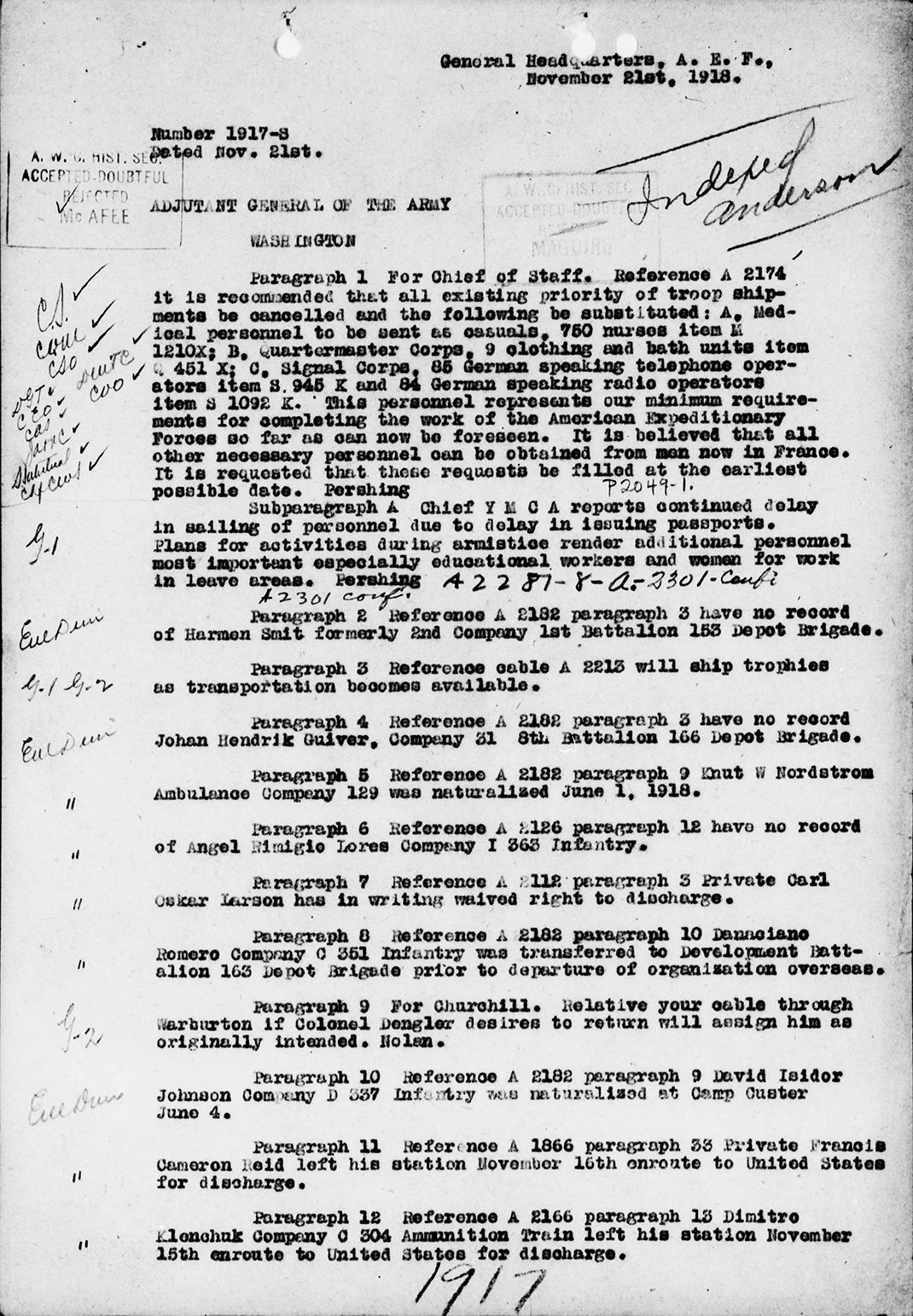
Pershing Requests a Miminim of 85 German-Speaking Telephone Operators, Cable Number 1917, Part 1 of 3, General Headquarters, A.E.F., 21 November 1918. NAID: 209254168 Textual Records. Part of M930 - Cablegrams Exchanged Between General Headquarters, American Expeditionary Forces, and the War Department, 1917-1919. National Archives and Records Administration. | GGA Image ID # 237ee94d8c. Click to View a Larger Image.
📖 Review & Summary
Post-Armistice Priorities: Why German-Speaking Operators?
Ten days after the Armistice, on 21 November 1918, General John J. Pershing issued Cable No. 1917-S (Part 1 of 3) from GHQ A.E.F., asking Washington to cancel all existing troop-shipment priorities and adopt a new list. The new priorities included medical staff and Quartermaster clothing and bath units, but the centerpiece for communications was a request for 85 German-speaking telephone operators and 84 German-speaking radio operators.
- Purpose: "Minimum requirements for completing the work of the American Expeditionary Forces so far as can now be foreseen."
- Communications workforce: 169 specialists with German proficiency (85 telephone, 84 radio).
- Other priority elements: 750 nurses (as casuals) and 9 Quartermaster clothing & bath units.
- Welfare note: YMCA reports passport delays; additional personnel—especially educational workers and women for leave areas—urgently needed.
Why it matters: The cable shows how language skills became critical to the A.E.F.'s post-combat phase—demobilization, liaison, and administration—requiring operators fluent in German to interface with networks, officials, and civilians in the Armistice environment.
Primary Source: NAID 209254168, M930, Cablegrams Exchanged Between General Headquarters, A.E.F., and the War Department, 1917–1919.
Transcript of Paragraph 1 of Cable No. 1917-S
General Headquarters, A.E.F. — November 21, 1918. Number 1917-S.
Paragraph 1 (For Chief of Staff). Reference A 2174: It is recommended that all existing priority of troop shipments be cancelled and the following be substituted:
- A. Medical personnel to be sent as casuals, 750 nurses (item M 1210X);
- B. Quartermaster Corps, 9 clothing and bath units (item 451X);
- C. Signal Corps, 85 German speaking telephone operators (item S 945K) and 84 German speaking radio operators (item S 1092K). This personnel represents our minimum requirements for completing the work of the American Expeditionary Forces so far as can now be foreseen. It is believed that all other necessary personnel can be obtained from men now in France. It is requested that these requests be filled at the earliest possible date. Pershing P2049-1.
Subparagraph A. Chief YMCA reports continued delay in sailing of personnel due to delay in issuing passports. Plans for activities during armistice render additional personnel most important, especially educational workers and women for work in leave areas. Pershing A2287-8-A2301 comf.
Spelling and punctuation lightly standardized; bracketed emphasis added. Source: NAID 209254168, M930, NARA.
Remaining Parts 2 and 3 of Cable 1917-S
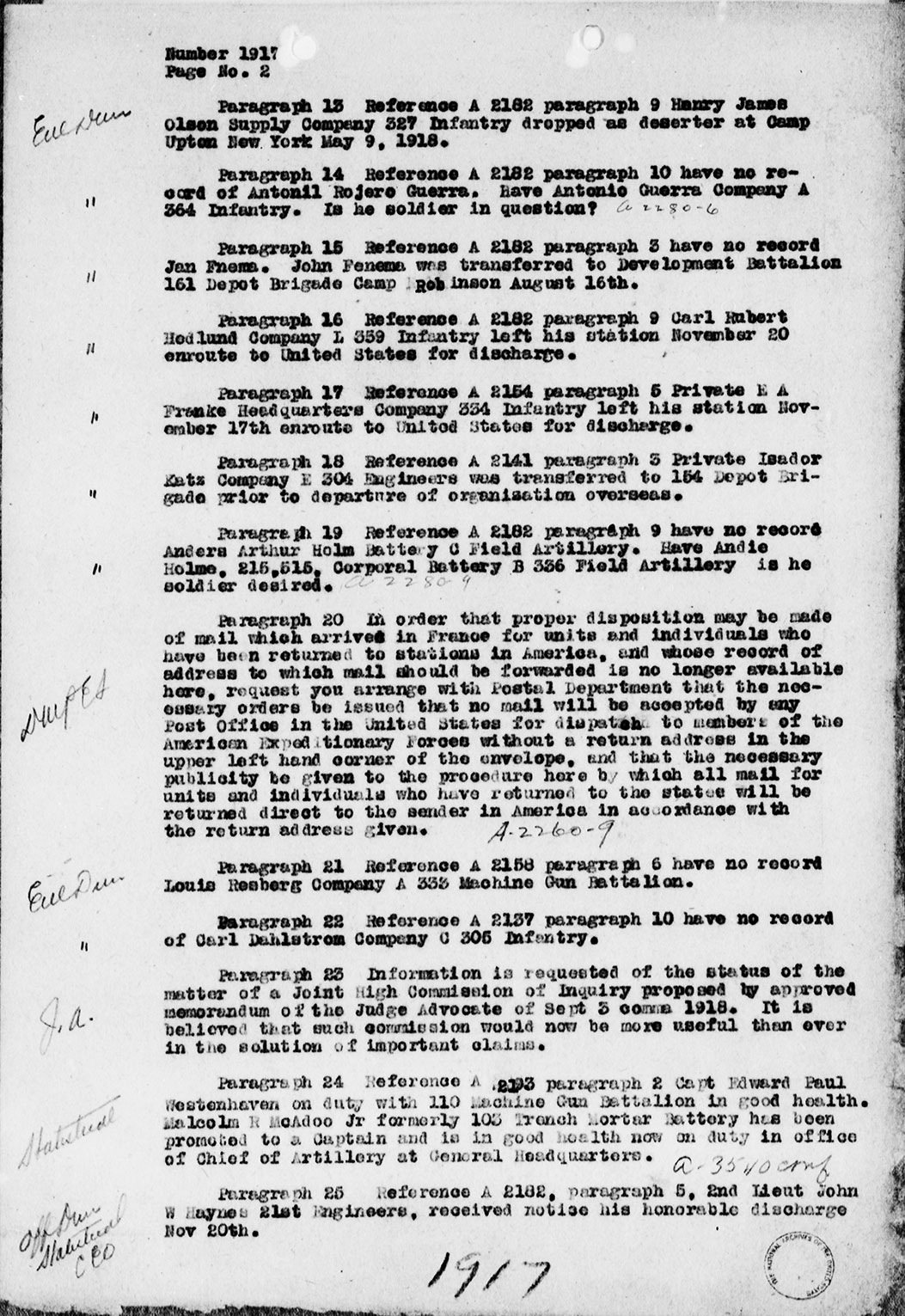
Cable Number 1917, Part 2 of 3, General Headquarters, A.E.F., 21 November 1918. NAID: 209254168 Textual Records. Part of M930 - Cablegrams Exchanged Between General Headquarters, American Expeditionary Forces, and the War Department, 1917-1919. National Archives and Records Administration. | GGA Image ID # 237f29d662. Click to View a Larger Image.
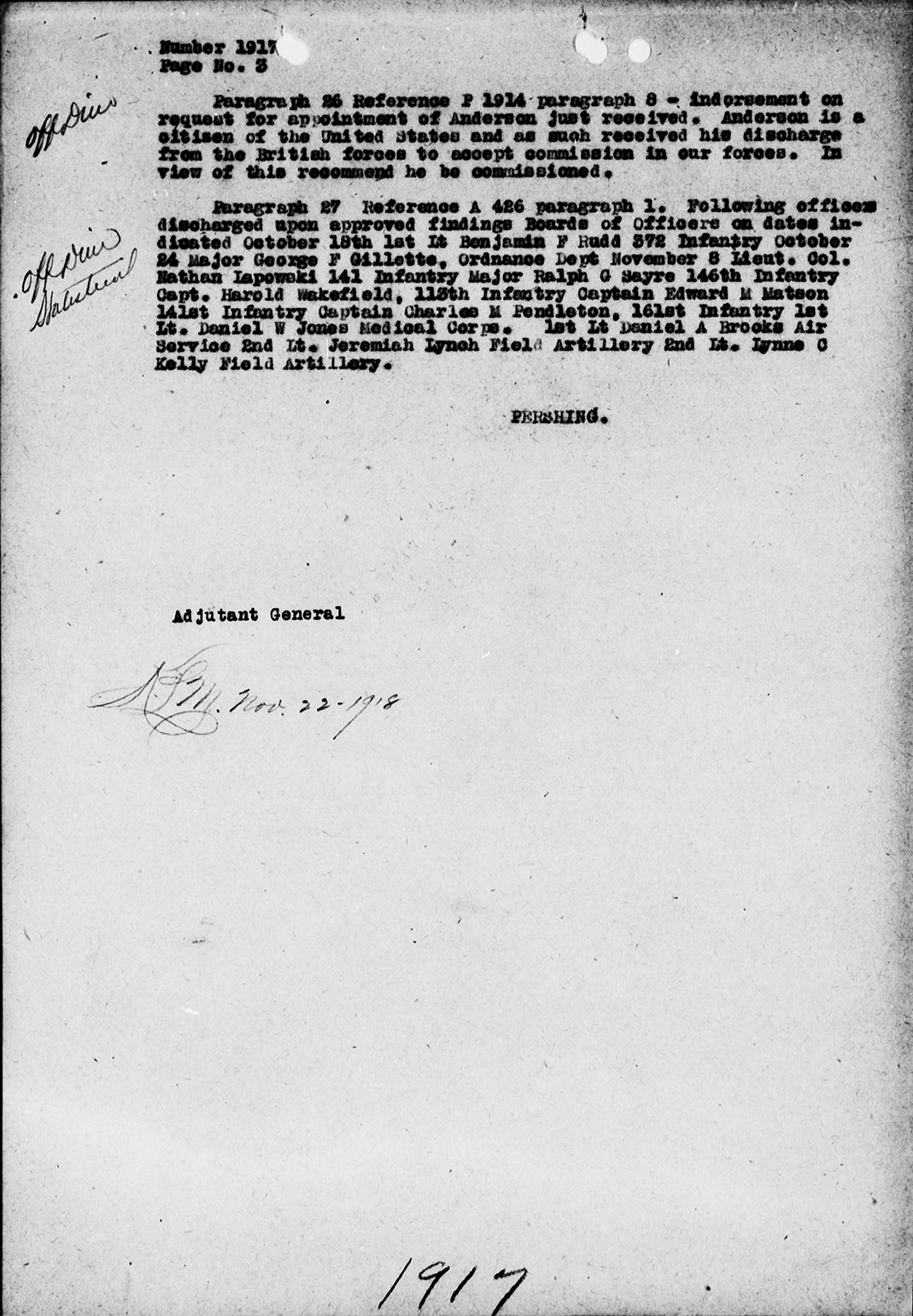
Cable Number 1917, Part 3 of 3, General Headquarters, A.E.F., 21 November 1918. NAID: 209254168 Textual Records. Part of M930 - Cablegrams Exchanged Between General Headquarters, American Expeditionary Forces, and the War Department, 1917-1919. National Archives and Records Administration. | GGA Image ID # 237f37d195. Click to View a Larger Image.
✨ Most Engaging Content
"This personnel represents our minimum requirements…"
"…all existing priority of troop shipments be cancelled and the following be substituted… Signal Corps, 85 German speaking telephone operators… and 84 German speaking radio operators… This personnel represents our minimum requirements for completing the work of the American Expeditionary Forces…"
| Category | Item | Quantity | Notes |
|---|---|---|---|
| Medical | Nurses (as casuals) | 750 | Item M 1210X |
| Quartermaster | Clothing & Bath Units | 9 | Item 451X |
| Signal Corps | German-speaking telephone operators | 85 | Item S 945K |
| Signal Corps | German-speaking radio operators | 84 | Item S 1092K |
| Total German-language communications specialists | 169 | Telephone + Radio | |
Quotation and figures from Cable No. 1917-S, GHQ A.E.F., 21 Nov 1918 (NAID 209254168).
🖼️ Noteworthy Image(s)
Noteworthy Images (with Suggested Alt Text)
- Part 1 of 3 (Hero): "Cable No. 1917-S, Part 1 — Shipment priorities and request for 85 German-speaking telephone operators; GHQ A.E.F., 21 Nov 1918 (NAID 209254168)."
- Part 2 of 3: "Cable No. 1917-S, Part 2 — Continuation of GHQ requests; GHQ A.E.F., 21 Nov 1918."
- Part 3 of 3: "Cable No. 1917-S, Part 3 — Closing sections; GHQ A.E.F., 21 Nov 1918."
Provenance for all three images: NAID 209254168, M930, Cablegrams Exchanged Between General Headquarters, A.E.F., and the War Department, 1917–1919.
📘 Mini Dictionary for Civilians
Mini Dictionary for Civilians
- Casuals
- Personnel traveling individually (not with a unit), assigned to fill needs at destination.
- Clothing & Bath Unit
- Quartermaster service outfit that provided bathing, disinfection, and clean uniforms—key for hygiene during demobilization and movement.
- German-speaking Operators
- Telephone or radio specialists fluent in German to support liaison, negotiations, and technical work with local networks and authorities after the Armistice.
- Item Codes (e.g., "S 945K")
- Catalog or requisition identifiers used by the War Department/AEF to track requested personnel or materiel.
- YMCA
- The Young Men's Christian Association provided welfare, education, recreation, and support services to troops; passport delays impeded their deployments.
🎓 Essay Prompts for Students
- Language as Logistics: Assess why German fluency became a minimum requirement for A.E.F. communications staff after 11 November 1918.
- From Combat to Administration: What does the priority shift (nurses, bath units, German-speaking operators) reveal about A.E.F. missions in late 1918?
- Comparative Policy: Contrast this cable with earlier 1917–1918 requests for French speakers among telephone operators. What changed, and why?
- Organizational Ethics: Evaluate whether language-specialist operators should have received distinct recognition or status during demobilization.
- Welfare & Readiness: Analyze the YMCA passport-delay note. How did welfare organizations shape troop readiness in the Armistice period?
🪶 Citation Block (Chicago, APA, MLA + student version)
Chicago Notes & Bibliography
Note: John J. Pershing to War Department, Cable No. 1917-S, Part 1, November 21, 1918, General Headquarters, A.E.F., in Cablegrams Exchanged Between General Headquarters, American Expeditionary Forces, and the War Department, 1917–1919, M930, RG 120, National Archives and Records Administration (NAID 209254168), digitized at Gjenvick-Gjønvik Archives, https://www.ggarchives.com/…, accessed October 11, 2025.
Bibliography: Pershing, John J. Cable No. 1917-S, Part 1, November 21, 1918. GHQ A.E.F. In Cablegrams Exchanged Between General Headquarters, American Expeditionary Forces, and the War Department, 1917–1919. M930, RG 120. National Archives and Records Administration (NAID 209254168). Digitized at Gjenvick-Gjønvik Archives. Accessed October 11, 2025.
APA (7th ed.)
Pershing, J. J. (1918, November 21). Cable No. 1917-S (Part 1) [Cablegram, GHQ A.E.F.]. National Archives and Records Administration (NAID 209254168). Gjenvick-Gjønvik Archives. https://www.ggarchives.com/MIL/HelloGirls/Docs/PershingRequests85GermanSpeakingTelephoneOperators-1918-11-21.html
MLA (9th ed.)
Pershing, John J. "Cable No. 1917-S, Part 1." 21 Nov. 1918. Cablegrams Exchanged Between General Headquarters, American Expeditionary Forces, and the War Department, 1917–1919. National Archives and Records Administration, NAID 209254168. Gjenvick-Gjønvik Archives. Accessed 11 Oct. 2025.
Student (Copy-and-Paste) Footnote
John J. Pershing, "Cable No. 1917-S, Part 1," November 21, 1918, GHQ A.E.F., NAID 209254168, M930 (RG 120), NARA; digitized at Gjenvick-Gjønvik Archives, page link; full-size image, accessed October 11, 2025.

