
Hello Girls Personal Stories & Voices

Experience the personal stories, letters, and memoirs of the Hello Girls — the U.S. Army Signal Corps telephone operators who connected the front lines of World War I. Each story preserves a firsthand voice in America’s history of women in uniform.
Citation Block
All materials are part of the Hello Girls Collection, Gjenvick-Gjønvik Archives (GG Archives), Milwaukee, Wisconsin, USA. For academic citation formats (Chicago, APA, MLA), refer to individual story pages.
📖 Introduction: Personal Stories & Voices of the Hello Girls
When the U.S. Army Signal Corps began recruiting women telephone operators for service in France during World War I, it found an extraordinary pool of talent. The “Hello Girls” were not ordinary recruits. Many were college graduates at a time when fewer than four percent of American women held a degree. They were linguists, teachers, business professionals, and students fluent in French, German, and other European languages—precisely the skills the Army needed to connect Allied headquarters across continents and cultures.
Like the multilingual Dutch, these American women could shift gracefully between languages and environments. Their education and professionalism allowed them to step into high-pressure communication centers where clarity and precision could determine victory or loss. Working under military discipline but without official military recognition, they performed their duties with quiet excellence, proving that competence, intellect, and cooperation knew no gender boundaries.
The stories in this section—letters, newspaper features, and memoirs—capture their courage, humor, and humanity. Each voice reveals a woman who was at once a citizen, a professional, and a pioneer in an era of rapid social change. Collectively, the Hello Girls demonstrate that America’s wartime strength came not only from its armies, but also from the remarkable women who kept the world talking.
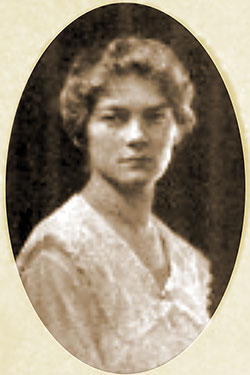 Adele Hoppock En Route to France (1918)
Fluent in six languages and a University of Washington honor student, Adele Hoppock left New York in 1918 aboard the world’s largest troop transport—formerly the German Vaterland—to serve as a U.S. Army Signal Corps “Hello Girl.”
The article highlights her academic excellence, cosmopolitan background, and early recognition as one of America’s first women soldiers in communications. Published 1918 | University of Washington Daily | GG Archives Hello Girls Collection.
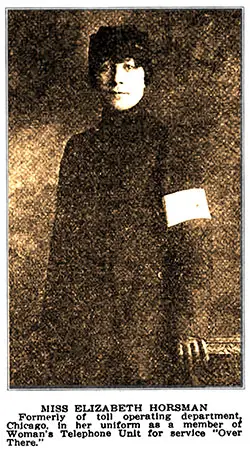
The Adventures of Miss Elizabeth Horsman and Miss Helen Carey – 1918
Two Chicago telephone operators recount their wartime service in France and England with humor, grace, and professionalism — a lively glimpse into the daily life of America’s Hello Girls during World War I.
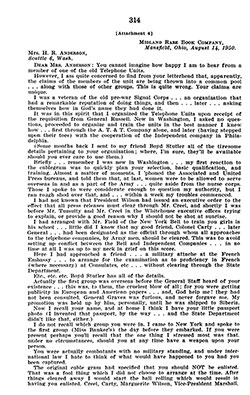
[Attachment 4]: Letter from CAPT Ernest J. Wessen (USA, Ret.) to Mrs. H. R. Anderson – 1950
Discover how a retired U.S. Army Signal Corps officer—later a rare book dealer—championed recognition for the Hello Girls decades after World War I. His words reveal the pride and persistence behind their long-overdue fight for veteran status.
This 1950 letter from the Signal Corps officer who organized the Hello Girls, urged Congress to grant them long-overdue veteran recognition. A key primary source in the Hello Girls’ postwar story.
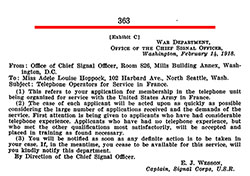
Exhibit C – Memo from Capt. E. J. Wesson, U.S. Army – 1918
Learn how a Signal Corps officer’s 1918 memo laid the foundation for the Hello Girls program and opened the door for women in military communications service during World War I.
This early document acknowledges the application of Adele Louise Hoppock and marks one of the first official records linking the U.S. Army to female telephone operators serving overseas.
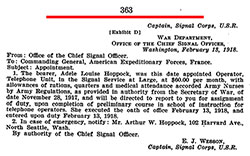
Exhibit D – Memo from Capt. E. J. Wesson, U.S. Army – 1918
Learn how Captain E. J. Wesson’s appointment of Adele Hoppock to the Signal Service at Large formalized the Hello Girls’ wartime role and granted them Army-nurse-level privileges long before official recognition.
This early 1918 memo serves as proof of military appointment and illustrates how women’s technical expertise reshaped communications on the eve of America’s entry into World War I.
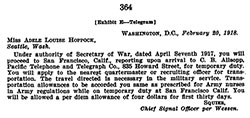
Exhibit E — Telegram from Maj. Gen. Squier to Adele Louise Hoppock – 1918
Learn how a single telegram launched Adele Hoppock’s journey into the U.S. Army Signal Corps. This order from Maj. Gen. George Owen Squier formalized the Hello Girls’ military service in World War I.
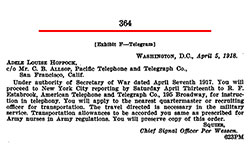
Exhibit F — Telegram to Adele Louise Hoppock from Maj. Gen. Squier – 1918
Discover the telegram that sent Adele Hoppock across the country for training with AT&T. This directive from Maj. Gen. George Owen Squier cemented her path to becoming a Hello Girl in WWI.
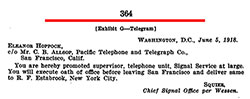
Exhibit G — Telegram to Eleanor Hoppock from Maj. Gen. Squier – 1918
Learn how Eleanor Hoppock’s promotion to Supervisor marked a turning point for the Hello Girls. This telegram from Maj. Gen. Squier formally recognized female leadership in the Signal Corps during World War I.
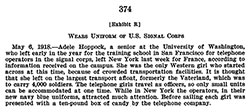
Exhibit R – The Uniform That Defined the Hello Girls as U.S. Army Veterans – 1918
Discover how Adele Hoppock’s U.S. Signal Corps uniform became the defining proof that the “Hello Girls” were bona-fide U.S. Army soldiers.
Her navy-blue overcoat, regulation boots, and voyage aboard the RMS Baltic stand as enduring symbols of women’s service and recognition in World War I.
This 1918 news item—and the preserved uniform itself—helped Congress finally acknowledge the Hello Girls as American veterans nearly sixty years later.
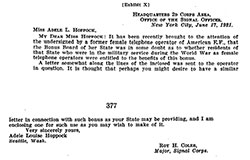
Exhibits X & Y – Major Roy H. Coles’ Letters Confirming Hello Girls’ Military Service (1921)
Learn how Major Roy H. Coles’ letters to Adele Hoppock and Washington State officials helped prove that the Hello Girls served as U.S. Army soldiers under military discipline — a crucial step toward their official recognition as veterans in 1977.
These 1921 letters offer rare first-hand acknowledgment of women serving in uniform long before policy caught up with reality.
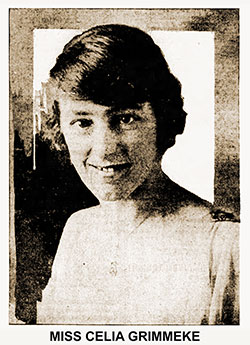 Grimmeke to Help Transform Phone Bells into Liberty Bells (1918)
A patriotic feature from The Butte Miner introduces Miss Celia Grimmeke of Butte, Montana, who joined the U.S. Army Signal Corps to help “transform phone bells into Liberty Bells.”
The story captures her farewell from fellow operators, her leadership at the Butte telephone exchange, and her anticipation as one of America’s first “Hello Girls” preparing for duty in France. Published 24 August 1918 | The Butte Miner | GG Archives Hello Girls Collection.
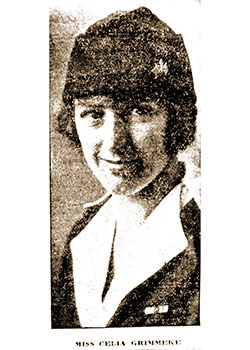 Grimmeke Tells of Work as “Phone Girl” with the A.E.F. (1919)
A 1919 article from The Butte Miner recounts the experiences of Miss Celia Grimmeke of Butte, Montana — one of the U.S. Army Signal Corps “Hello Girls.”
She describes General Pershing’s leadership, life in Paris, the Army of Occupation in Germany, and the humor and discipline that defined America’s first women soldiers. Published 19 October 1919 | The Butte Miner | GG Archives Hello Girls Collection.
Repository Information
The Gjenvick-Gjønvik Archives (GG Archives) is cataloged with the Library of Congress under MARC Org Code: WiMfGGA and ISIL: US-wimfgga.
Current location:
N91W16562 Pershing Ave, #1
Menomonee Falls, Wisconsin 53051-2170, USA
Note: Historic addresses listed in earlier MARC records include Marietta, GA and Woodstock, GA. These appear in authority files but are no longer active.
