
Grimmeke Tells of Work As Phone Girl With AEF - 1919
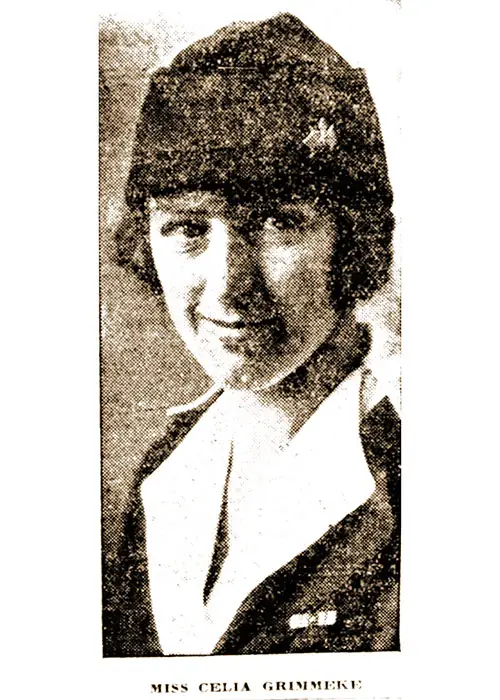
Miss Celia Grimmeke, A Native of Butte, Montana, Shown Here In Her "Hello Girls" Uniform of the US Army Signal Corps. The Butte Miner, Sunday, 19 October 1919. | GGA Image ID # 2372568ae1
📖 Review & Summary
This 1919 feature from The Butte Miner offers an engaging look at Miss Celia Grimmeke, a Montana native who served as a US Army Signal Corps telephone operator—one of the famed “Hello Girls” of World War I. Her recollections reveal the professionalism, humor, and adaptability required of women who bridged the communications gap between commanding officers and front-line operations.
Grimmeke’s story sheds light on the early integration of women into vital military communications. From her service at Pershing’s headquarters in Paris to her later assignment in occupied Germany, she provides firsthand testimony on the discipline, camaraderie, and gender paradoxes of military service—where operators were told they were “not in the army” when asking for privileges, but “definitely in the army” when facing discipline. The article also captures her wit and resilience, as well as her pride in representing the American spirit abroad.
For teachers and students, this piece humanizes the “Hello Girls” legacy—demonstrating how communication, morale, and professionalism were as critical to victory as weapons or strategy.
Was on Duty With the Army of Occupation at Coblenz; States Americans Were Well Treated.
Danced With General Pershing and Declares That He Is Dear but Demands “Pep” Over the Phone.
General Pershing is a dear: he's a good dancer and a good mixer: a stern disciplinarian, snappy over the phone, polite to the operators, but wants fast service and gets it.
Paris is a wonderful place, Belgium is a second America for “pep” and the Germans treated the Americans exceptionally well. Dances and good times were plentiful for the men of the army of occupation üfter the armistice was signed.
The two above excerpts from the remarks of a Butte girl, who was one of the busiest little workers in Franc, throw a new light on General Pershing and Belgium. They were voiced by Miss Pella Grímmeke, one of the three Montana girls who served with the United States army signal corps in France during the latter part of the world conflict.
The demand of the American army for American telephone girls is more easily understood after one sees and talks with Miss Gremmeke, who possibly is as representative a type as could be found. Neatly dressed in the regulation overseas uniform, with two gold service stripes on her left sleeve, the victory badge with one star on her breast, and the jaunty little overseas car bearing the regulation crossed flags of the signal corps, talking directly and to the point, she gives an excellent idea of the efficient American girls gathered together to serve where calmness and efficiency were essential.
Was Eager to Go.
Mise Grimmeke was chief operator at the local Bell Telephone company when the call came for volunteers. Despite the fact that her father is dead and her mother past 74 Miss Grimmeke lost no time in filing her application and finally received her sailing orders.
"That was one of the happiest moments of my life,” she stated In telling of the event, "but one of the most unhappy when I sailed from New York on a transport The demon ally of the Boche. the flu,' made a direct attack on her ship and I was one of those stricken. When we docked in England I was removed to Southampton to a hospital, from which I was finally re- leased after three weeks. It rained all the time I lay in that institution and England holds no place in my affections, nor do I carry fond memories of that land.
First Sent to Tours.
"When I crossed the channel I reported at headquarters in Paris and had one glorious day in that great city. I tried to see it all in 24 hours, as I never expected to have another chance. I was sent to the training school in Tours, where all the girls are given a week's intensive course in switchboard work I and in French phrases necessary to the efficient performance of their duties. The switchboard work was not new to the toll operators from America and they were allowed to devote the great« r part of their time to the study of French.
"When we had completed the course, I looked for an assignment to some out-of-the-way place, but imagine my surprise when I learned that I was to report to the head exchange in the Elysée Palace hotel in Paris. I was transferred to aviation headquarters after two months and served there for five months. This was General Pershing’s headquarters when he came to Paris from G. 1. Q at Chaumont.
"Black-Jack" Snappy
"General Pershing was snappy when talking over the phone, gave his orders clearly, was polite to the operators, but wanted fast service and got it. The telephone girls were under strict discipline, but lived and worked under excellent conditions, all things considered. We were comfortably billeted and In the Paris exchanges the equipment was modern and American. There were six exchanges in the French metropolis with 88 operators. of course I mean army exchanges only.
"Fifty percent of the army telephone operators were American girls and a large percentage of the remainder were Canadians, those from Montreal from old French-Canadian families predominating. An amusing thing was the attitude of many French girls who had been in America for some years before the war. They had crossed to do phone work with the American girls, and, while their patriotism was beyond question, they were prone to try and lord it over the other French people with whom they came in contact. They declared they were Americans and became highly indignant if anyone questioned their right to the name."
Few Girls Under Fire
Like every other real American girl Miss Grimmeke was anxious to get assigned to duty in an active sector, but only girls that could speak French and German fluently were allowed these assignments in the danger zone and wherever possible they were relieved by men from the signal corps.
Miss Grimmeke went to Coblenz on duty with the Army of Occupation May 5. 1919, and served there until she was permanently relieved in July. She was billeted with one of the wealthiest families in the old German city and declares her treatment left nothing to be desired. Pespito strict rules against fraternizing the American soldiers could often be seen wandering around with a German fraulein on their arm. At Weissbaden, ono of the popular resorts, allied officers danced with the German girls to the strains of a rag-time American band.
Life Not All Hardships
The life of the girls was not all hardships, but they had a decided advantage over the Red Cross nurses. The latter were allowed to dance only at the hospitals. There were no such restrictions on the phone operators. However, according to Miss Grimmeke, when they wanted anything special that army ratings would entitle them to they would be informed they were not in the army proper, on the other hand; when it was a question of discipline they would be informed they could be court- martialed.
"But we are not in the army." the girls would exclaim. "Oh. yes, you are.” would respond some colonel or “jiggadier brindle." The result was that most of the girls have not yet decided whether they were or were not in the army.
"Did the American boys find many brides in France?” Miss Grimmeke was asked. "About 8,000, according to official figures,” she responded. She told of one amusing instance where a young girl from one of the better families had married an American and was returning home on the same ship as the Butte girl.
All the girls aboard had to take turns acting as interpreter for the newlyweds. However, there was one language they understood and that was the language of love. In accordance with the general practice in the better-class homes the soldier had never been alone with his bide until they were actually wed.
Her father and mother accompanied her until the knot was actually tied. While Miss Grimmeke did not say so, this constant supervision must have been especially trying to the American lad who had been used to strolling along moonlit paths with his sweethearts at home.
Miss Grimmeke was permitted to spend one of her furloughs in Belgium and stated that the Belgians are very like the Americans in their pep. They have lost no time starting to work re- building their ruined cities and Liege is rapidly losing its scenes of devastation. However, some will be preserved as a matter of historic interest.
Following her discharge Miss Grimmeke spent several weeks in Paris. New York and Chicago. She returned to Butte last week and will resume her place in the local exchange Monday. One of the amusing incidents she told of was in connection with the orders to operators to disconnect anyone talking but official business.
One of the "Jiggadier brindles" called up a French mademoiselle and stated that he had just called to have a little chat. "Sorry, general," cut in the operator, "but you can’t chat over this wire."
Another was when Miss Grimmeke arrived home. She was walking up the street when a boy in uniform stopped her and said, "Say, didn’t I dance with you at Coblenz, for the love of Mike why didn’t you say you were from Butte.”
Miss Merle Egan and Mary Vannier of Helena, and Deer Lodge, respectively, were the other two Montana girls who served with Miss Grimmeke.
Hello Girls mentioned in this story include: Celia Ann Grimmeke, Merle Egan, and Mary Jane Elizabeth Vannier.
✨ Most Engaging Content
- General Pershing’s Character: Grimmeke’s lively account portrays Pershing as “snappy” yet respectful—demanding “pep” and fast service over the line.
- Life of a Hello Girl: The contrast between strict military rules and lighthearted social dances paints a vivid picture of morale behind the front.
- Post-Armistice Germany: Her observations in Coblenz highlight unexpected goodwill between soldiers and civilians, showing post-war humanity amid tension.
- Gender Ambiguity: The recurring joke—whether the operators were truly “in the Army”—adds humor while underscoring women’s uncertain military status prior to 1977 recognition.
🖼️ Noteworthy Image
Miss Celia Grimmeke in Uniform (1919)
Her crisp US Army Signal Corps uniform—complete with service stripes and victory badge—symbolizes the professionalization of women’s wartime roles. This portrait, printed in The Butte Miner, conveys the pride and precision expected of the “Hello Girls” who kept the Allied lines of communication open.
📘 Mini Dictionary for Civilians
- AEF (American Expeditionary Forces): The US military force sent to Europe during World War I under General John J. Pershing.
- Army of Occupation: US troops stationed in Germany after the Armistice to enforce peace terms.
- Fraulein: German for “young woman” or “miss.”
- Court-martialed: Tried under military law for disciplinary infractions.
- Signal Corps: The branch of the US Army responsible for communications—telephones, telegraphs, and radios.
🎓 Essay Prompts for Students
- Discuss how Celia Grimmeke’s experiences reflect broader challenges faced by women serving in World War I.
- Analyze how communication roles like the “Hello Girls” contributed to military success and morale.
- Compare the gender dynamics described by Grimmeke to those of women in the military today.
- How did humor and resilience help soldiers and operators endure the stress of war and occupation?
📚 Cite This Page
Chicago Style:
"Grimmeke Tells of Work as Phone Girl with A.E.F." The Butte Miner (Butte, Montana), October 19, 1919. Reproduced at the Gjenvick-Gjønvik Archives. https://www.ggarchives.com/MIL/HelloGirls/Stories/GrimmekeTellsOfWorkAsPhoneGirlWithAEF-1919.html.
APA Style:
Grimmeke, C. A. (1919, October 19). Tells of Work as Phone Girl with A.E.F. The Butte Miner. Retrieved from Gjenvick-Gjønvik Archives: https://www.ggarchives.com/MIL/HelloGirls/Stories/GrimmekeTellsOfWorkAsPhoneGirlWithAEF-1919.html
MLA Style:
“Grimmeke Tells of Work as Phone Girl with A.E.F.” The Butte Miner, 19 Oct. 1919. Gjenvick-Gjønvik Archives, https://www.ggarchives.com/MIL/HelloGirls/Stories/GrimmekeTellsOfWorkAsPhoneGirlWithAEF-1919.html.
Student Version:
“Grimmeke Tells of Work as Phone Girl with A.E.F.” (1919). The Butte Miner. Reprinted by the GG Archives. GG Archives Link
"Tells of Work as Phone Girl With A.E.F.," in The Butte Miner, Butte, Montana, Sunday, 19 October 1919, Page. 44.
