
Eugenie Jeannette Couture, Operator
Quick Facts
- Unit: Four
- Deployed: The fourth group of "Hello Girls" sailed on June 28, 1918 on the transport ship SS Czaritza (originally built in 1915 for the Russian American Line). Led by Chief Operator Geneva Mildred Marsh, the unit departed from New York harbor, crossing the Atlantic to Europe. While their ultimate destination was France, the voyage's initial stop was in England.
- Repatriated:
- Hometown at Time of Enlistment: Lynn, Massachusetts
- Original Hometown (if Known):
- Education:
- Occupation at Enlistment:
- Lifespan:
Articles and Documents on GG Archives
"Hello Girls" Documents & Reference Materials
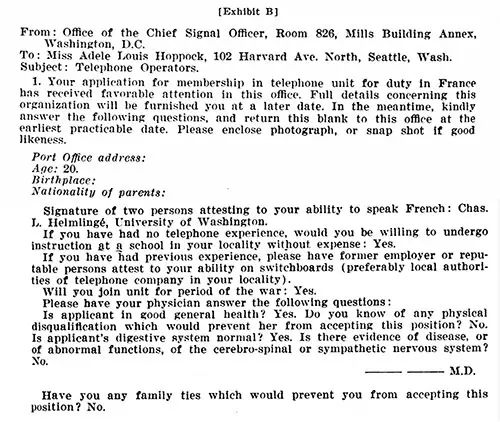
Application for Membership in the Signal Corps Telephone Unit (1918)
How the Army recruited and screened bilingual operators for service in France. Features Exhibit B with Adele L. Hoppock’s questionnaire—language attestations, medical fitness, instruction pledge, and wartime commitment.
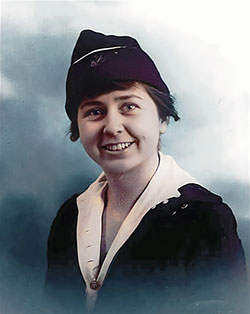
223 Women of the U.S. Army Signal Corps Telephone Operators Overseas (1918–1919)
Explore the earliest compiled roster of 223 “Hello Girls,” the U.S. Army Signal Corps telephone operators who served overseas during World War I.
Based on 1918–1919 press and Signal Corps reports, this list reflects the original wartime recognition of these women’s service and leadership.
Includes names, operating units, and select period photographs—an invaluable snapshot of how the women of the Signal Corps were viewed during the war itself.
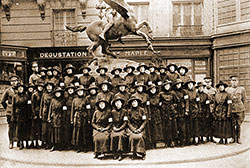
Roster and Hometowns of the WWI “Hello Girls” – U.S. Army Signal Corps Telephone Operators (1918–1920)
Explore the complete roster of 223 women and two men who served as U.S. Army Signal Corps telephone operators during World War I.
Organized by unit and hometown, this list reveals the national and international scope of the bilingual operators who kept the American Expeditionary Forces connected across France.
This roster serves as a cornerstone for genealogists, educators, and historians researching the pioneering women who made military communications possible.
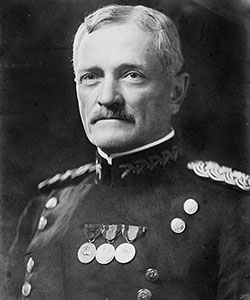
Exhibit H — Pershing’s Commendation of Signal Corps Operators (1918)
Dated 20 November 1918, this concise commendation credits “the officers and men and the young women of the Signal Corps” for wartime communications—an A.E.F.-level nod that explicitly includes the Hello Girls.
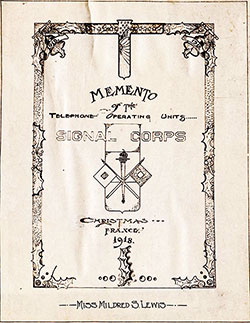
Memento of the Telephone Operating Units – Signal Corps (1918)
Explore the rare commemorative booklet presented to the U.S. Army’s “Hello Girls” at Christmas 1918 in France—filled with officer commendations, photographs, and personal keepsakes.
This artifact offers a tangible link between the women’s frontline service and their later fight for veteran recognition.
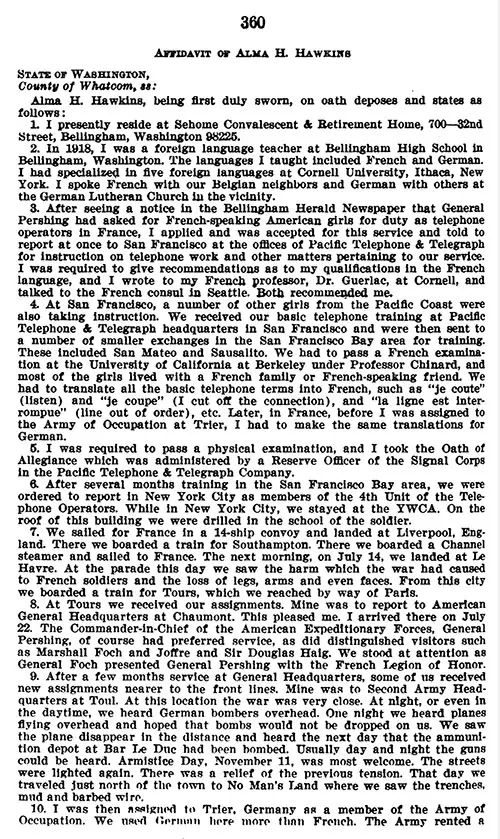
Affidavit of Alma H. Hawkins (1977)
Unit 4 operator Alma Hawkins recounts oath, uniformed status, bilingual training, and service from GHQ Chaumont to Second Army at Toul—key evidence for the Hello Girls’ recognition case.
Source: U.S. Senate Hearing (1977), Appendix B, pp. 360–361.
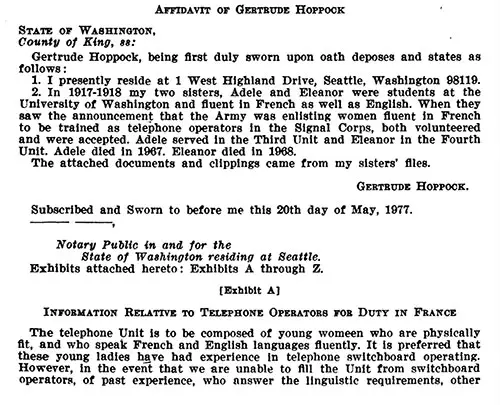
Affidavit of Gertrude Hoppock (1977)
A sister’s sworn statement lodging exhibits from Adele (Unit 3) and Eleanor (Unit 4) Hoppock—evidence used in the 1977 hearings to recognize the Hello Girls as U.S. Army veterans.
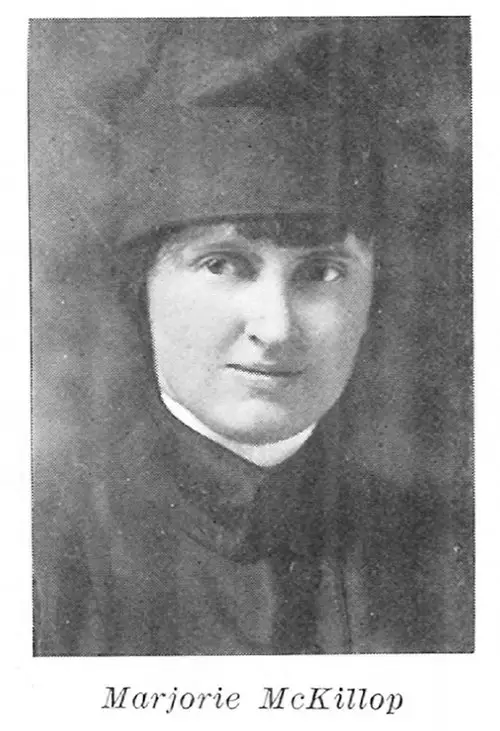
Affidavit of Marjorie L. McKillop (1977)
Unit 4 operator details oath and training, embarkation via Southampton, sustained duty at Le Havre to the Armistice, and later service in Paris and Brest—essential testimony from the 1977 recognition hearings.
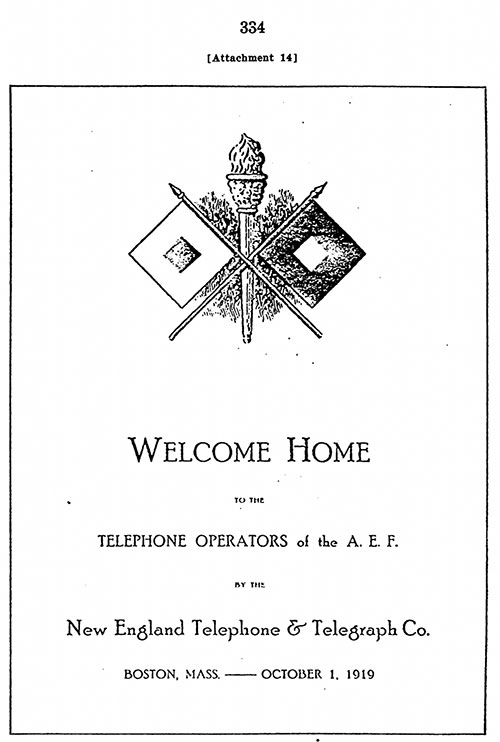
Telephone Operators of the AEF — Roll of Honor (1919)
Step into a 1919 homecoming: New England Telephone & Telegraph’s program honoring the
U.S. Army Signal Corps operators who kept the AEF connected. Explore the period Roll of Honor,
appreciation notes, the celebration schedule, and a contemporary tribute poem.
Source: Reprinted in the 1977 U.S. Senate hearing on recognition for VA benefits.
Photographs
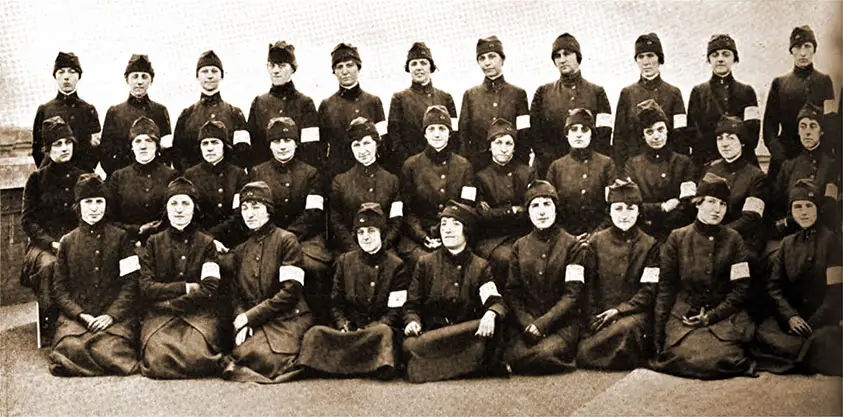
Left Section of the Fourth Unit of Telephone Operators for General Pershing's Army, Trained by the Bell System and Ready for Overseas Service. Photographed on Roof of 195 Broadway, New York, June 13, 1918. They are (left to right): Top Row — Miss Kathleen M. Hyatt, Miss Albertine M. Belhumeur, Miss Evelyn C. La Riviere, Miss Alma H. Hawkins, Miss Mary Marshall, Miss Eugene J. Couture, Miss Emma Riendeau, Miss Lillie H. Noble, Miss Louise Maclin, Miss Vivienne Hamel, Miss Louise L. Armand, Middle Row — Miss Edmee LeRoux, Miss Melanie Van Gastel, Miss Aurelie C. Lucier, Miss Stella M. Viau, Miss Berthe Arlaud, Miss Helen E. Hill, Miss E. Tilleard, Miss Juliette Courtail, Miss Eleanor Hoppock, Mrs. Eileen Munro, Miss Beatrice Francfort, Front Row —Miss Lucienne Bigou, Miss Camille Rieder, Miss Agnes G. Burge, Miss Ruth Couturier, Miss Louise Chaix, Miss Mathilde Ferrie, Miss Leonie Peyron, Miss Georgette Boehrer, Miss Mary Story. The Telephone Review, July 1918. | GGA Image ID # 19283d8c2d. Click to View a Larger Image.
 .
.
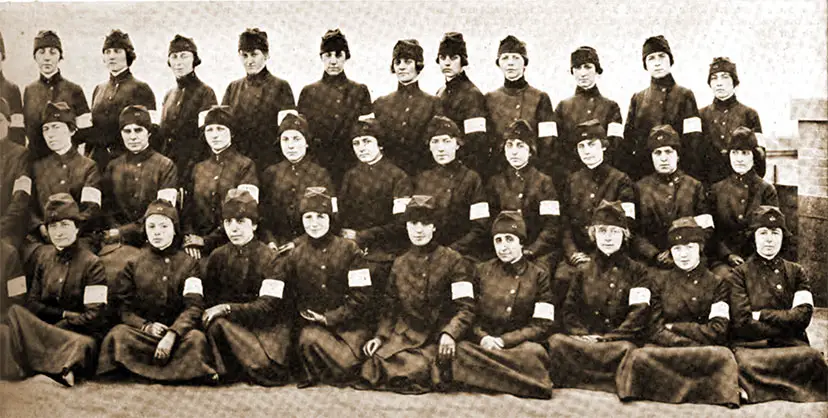
Right Section of the Fourth Unit of Telephone Operators for General Pershing's Army, Trained by the Bell System and Ready for Overseas Service. Photographed on Roof of 195 Broadway, New York, June 13, 1918. They are (left to right): Top Row -- Miss Marguerite Martin, Miss Madeline Batta, Miss Mary C. O'Rourke, Miss Eglantine Moussu, Miss Marjorie L. McKillop, Miss Doris Summers, Miss Charlotte Anderson, Miss Germaine Lamontagne, Mrs, Eleanor A. Brown, Miss Marthe Carroul, Miss Lalla Munoz, Miss Marie Lange. Middle Row -- Miss Geneva M. Marsh, Miss Beatrice P. Bourneuf, Miss Mary E. Vannier, Miss Jane Lang, Mrs. Pauline McDonnell, Miss Jeanne Legallet, Miss Ellen M. Turner, Miss Louise Beraud, Miss Irma Armanet, Miss Alice Raymond, Miss Ruth Clarke. Front Row -- Miss Jennie R. Young, Miss Ida B. Lanz, Miss Alice J. Borreson, Miss Marie A. Lassalle, Miss Louise Ruffe, Miss Emelia Lumpert, Miss Ida Trahan, Miss Frances W. Laney, Miss Marguerite Chenot, Miss Celestine Leguia. The Telephone Review, July 1918. | GGA Image ID # 19285f95ad. Click to View a Larger Image.
External Resources
Repository Information
The Gjenvick-Gjønvik Archives (GG Archives) is cataloged with the Library of Congress under MARC Org Code: WiMfGGA and ISIL: US-wimfgga.
Current location:
N91W16562 Pershing Ave, #1
Menomonee Falls, Wisconsin 53051-2170, USA
Note: Historic addresses listed in earlier MARC records include Marietta, GA and Woodstock, GA. These appear in authority files but are no longer active.
