
Telephone Operators Welcomed to Paris - 1918
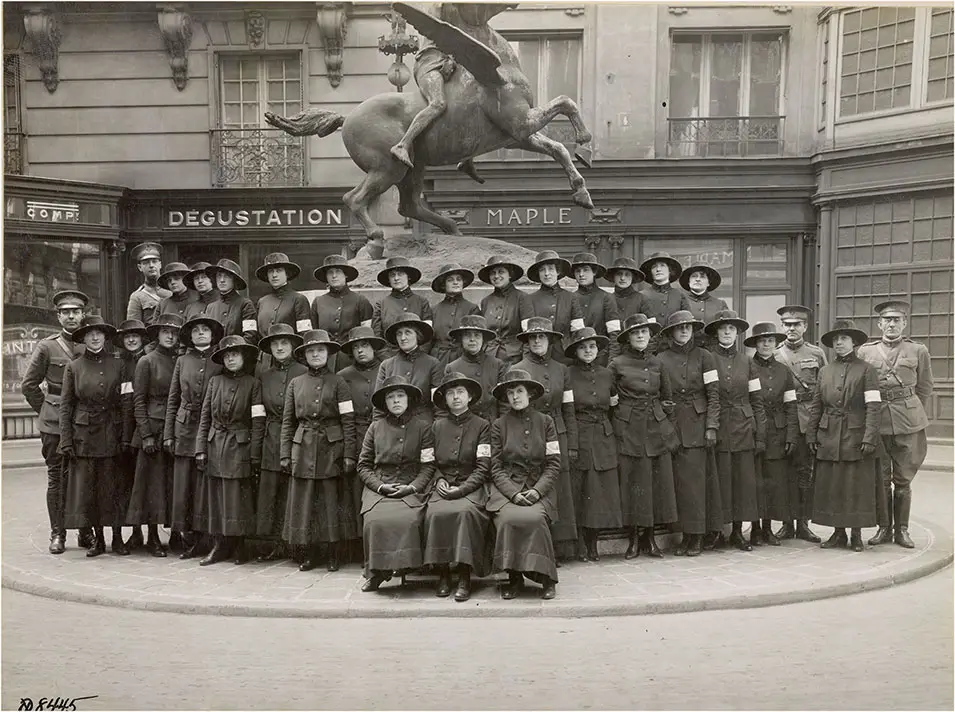
American Telephone Girls Photographed on Arrival for "hello" Duty in France, March 1918. They All Can Speak Both English and French. Photograph by Q.M. Sgt. Leon H. Caverly, U.S.R. Censored and Released 28 April 1918 by War College Division. National Archives and Records Administration, 111-SC-8445. NARA ID # 55177410. | GGA Image ID # 199d9d7646. Click to View a Larger Image.
📖 Review & Summary
Published in June 1918, “Telephone Operators Welcomed to Paris” chronicles the arrival of America’s first contingent of U.S. Army Signal Corps telephone operators—the “Hello Girls”—in the French capital. The Y.W.C.A., led by Miss Mary George White, coordinated housing, furnishings, and daily support for these pioneering women, ensuring dignified accommodations that mirrored their new military roles.
The article highlights how the Y.W.C.A. transformed an officers’ club near General Headquarters into a welcoming home for the operators. By providing structure, supervision, and community, it set a model for future women’s units in wartime service. The story captures the beginning of an international sisterhood—where American skill met French hospitality—under the shared mission of communication and victory.
This piece illustrates both the logistical challenges and the cultural triumph of integrating women into military life abroad—balancing professionalism, comfort, and camaraderie during one of history’s most transformative conflicts.
Unseen in the text but visible in the surviving photograph is another layer of the story: the women’s first night in Paris was marked by a severe German bombardment that struck nearby buildings. The next morning, they posed for the now-famous group photo—some glancing upward, still alert for danger. Their composure amid chaos symbolized the bravery and professionalism that would soon define their service at the front.
Paris, June 10, 1918.—When the first group of American women telephone operators arrived in this city in March, they found comfortable living quarters awaiting them that had been prepared for them.
"The YWCA accepted gladly the responsibility offered it by the army," says Miss Mary George White. "Before the girls arrived, the Signal Corps officer in charge of the first group came with a request for help.
The YWCA, recognizing that these arrivals might be the forerunners of an American organization similar to the British W.A.A.C., gladly undertook the task.
"It was easy for the telephone operators assigned to Paris to live at the Hotel Petrograd, our Hostess House there. Secretaries in certain other places could look out for those assigned to the interior.
"Workers were fortunately already at the first town chosen south of Paris. For the relatively large group, however, who were assigned to general headquarters, some provision had to be made. As I was the only secretary with a permit enabling me to travel freely in the army zone, I was assigned to that task.
"The town where the general headquarters is situated is, of course, very much crowded, but we were fortunate enough to obtain a house which had been rented and fitted out as a clubhouse by a group of officers just before they were transferred to another post.
"The house had been furnished very modestly for the most part, considering the wealth and rank of the reserve officers who had planned to use it, and we could take over the furniture almost without exception.
"The men had added such things as extra bathrooms and a central heating plant to mitigate the horrors of army life in France. We were delighted to inherit these luxuries.
"Sufficient equipment was added to make it possible for three or four persons instead of one to occupy each of the large rooms. Behold! We had a house ready to accommodate thirty persons.
"Miss Julia Russel was assigned as 'hostess' to the house, rather than 'matron,' the term at first suggested by the army men, but quickly abandoned when we told the other. Miss Russel was installed in the house, with an excellent French woman in charge of the housekeeping. On my last visit, the telephone girls were already feeling like they were part of a very real and happy family. As I write this report, I am preparing to go to the general headquarters to attend their first reception for the officers of the post.
✨ Most Engaging Content
The most engaging element of this article lies in the firsthand description by Miss Mary George White, who recounts how Y.W.C.A. staff converted a rented Parisian residence into a fully functional officers’ home for thirty women. The practical yet warm tone underscores the professionalism of the Y.W.C.A. and the respect the Army afforded these women. Her account transforms a simple logistical task into a symbol of international cooperation and women’s empowerment during wartime.
🖼️ Noteworthy Image(s)
American Telephone Girls Photographed on Arrival for “Hello” Duty in France, March 1918. The photograph was taken the morning after a night of heavy German artillery fire that destroyed part of an adjacent building. The women had spent much of the night in a bomb shelter and were reportedly looking skyward for any sign of renewed shelling as the picture was taken. Their calm bearing and poise under such conditions became an early symbol of the courage and professionalism that would define the Signal Corps’ “Hello Girls.” Photograph by Q.M. Sgt. Leon H. Caverly, U.S.R. National Archives and Records Administration, 111-SC-8445. NARA ID #55177410. | GGA Image ID #199d9d7646.
📘 Mini Dictionary for Civilians
- Hostess House: A Y.W.C.A.-operated residence for women workers and soldiers’ families near military zones during WWI, offering comfort, meals, and supervision.
- Signal Corps: A branch of the U.S. Army responsible for communications, including telegraph, telephone, and radio operations.
- General Headquarters (G.H.Q.): The central command post for American Expeditionary Forces in Europe, overseeing military operations.
- Permit (Army Zone): Special travel authorization required within restricted combat or command areas during the war.
🎓 Essay Prompts for Students
- Discuss how the Y.W.C.A. supported the U.S. Army Signal Corps’ female operators in France and what this reveals about women’s roles in wartime logistics.
- Analyze how “Telephone Operators Welcomed to Paris” reflects the evolving perception of women’s work and patriotism during WWI.
- Compare this article to modern military support systems—what lessons from 1918 remain relevant for today’s servicewomen?
🪶 Citation Block (Chicago, APA, MLA + Student Version)
Chicago Style:
“Telephone Operators Welcomed to Paris.” Philadelphia Public Ledger, June 7, 1918; The Pacific Telephone Magazine, June 10, 1918. Reprinted in Recognition for Purposes of VA Benefits, U.S. Senate Hearings, 25 May 1977, p. 379. Gjenvick-Gjønvik Archives. https://www.ggarchives.com/MIL/HelloGirls/Press/TelephoneOperatorsWelcomedToParis-1918.html.
APA Style:
Telephone Operators Welcomed to Paris. (1918, June 10). Philadelphia Public Ledger & The Pacific Telephone Magazine. In Recognition for Purposes of VA Benefits (U.S. Senate, 1977, p. 379). Gjenvick-Gjønvik Archives. Retrieved from https://www.ggarchives.com/MIL/HelloGirls/Press/TelephoneOperatorsWelcomedToParis-1918.html.
MLA Style:
“Telephone Operators Welcomed to Paris.” Philadelphia Public Ledger, 7 June 1918, and The Pacific Telephone Magazine, 10 June 1918. Recognition for Purposes of VA Benefits, U.S. Senate, 1977, p. 379. Gjenvick-Gjønvik Archives, https://www.ggarchives.com/MIL/HelloGirls/Press/TelephoneOperatorsWelcomedToParis-1918.html.
Student Citation (Simplified):
“Telephone Operators Welcomed to Paris,” Philadelphia Public Ledger, June 7, 1918. Reprinted in Recognition for Purposes of VA Benefits (1977). GG Archives. https://www.ggarchives.com/MIL/HelloGirls/Press/TelephoneOperatorsWelcomedToParis-1918.html.
"[Exhibit AA (Part 2)]: Affidavit of Gertrude Hoppock: "Telephone Operators Welcomed to Paris," in Philadelphia Public Ledger, 7 June 1918, and The Pacific Telephone Magazine, June 10, 1918" in Recognition for Purposes of VA Benefits, Hearing before the Committee on Veterans' Affairs, United States Senate, Ninety-Fifth Congress, First Session on S. 247, S. 1414, S. 129, and Related Bills. Washington, DC: US Government Printing Office, 25 May 1977. pp. 379-.
