
Exhibit R - Wears Uniform of U.S. Signal Corps - 1918
![[Exhibit R]: Affidavit of Gertrude Hoppock: Termination of Services - Wears Uniform of U.S. Signal Corps, 6 May 1918.](../../../CVimages/MIL/HelloGirls/CongressionalHearings/95th-S247-S1414-S129/1977-05-25/374r-WearsUniformOfUSSignalCorps-1918-05-06.jpg "GGA Image ID # 2377c66268. Click to View a Larger Image.")
[Exhibit R]: Affidavit of Gertrude Hoppock: Termination of Services - Wears Uniform of U.S. Signal Corps, 6 May 1918, in Recognition for Purposes of VA Benefits, Hearing before the Committee on Veterans' Affairs, United States Senate, Ninety-Fifth Congress, First Session on S. 247, S. 1414, S. 129, and Related Bills. Washington, DC: US Government Printing Office, 25 May 1977. | GGA Image ID # 2377c66268. Click to View a Larger Image.
📖 Review & Summary
This 1918 report captures a pivotal moment in the recognition of the U.S. Army Signal Corps female telephone operators — the “Hello Girls.” When Adele Hoppock and her fellow operators donned the navy blue uniforms of the U.S. Signal Corps, they unknowingly secured their place in history as the first American women to serve officially in the U.S. Army. Their uniform became a defining argument decades later when Congress debated whether these women were true veterans or civilian contractors.
The article reflects how the Hello Girls’ service blurred the boundaries between civilian and soldier — they took military oaths, followed Army orders, and wore regulated uniforms, yet were denied veteran status until 1977. This small campus report became, in retrospect, part of a much larger legal and cultural story: the fight for recognition of women’s military service in the 20th century.
Educational Relevance: Teachers and students can use this document to analyze how uniforms, symbols, and gender roles influence historical narratives about military identity and recognition.
Exhibit R
May 6, 1918.—Adele Hoppock, a senior at the University of Washington, who left early in the year for the training school in San Francisco for telephone operators in the signal corps, left New York last week for France, according to information received on the campus.
She was the only Western girl who started across at this time, because of crowded transportation facilities. It is thought that she left on the largest transport afloat, formerly the Vaterland, which was to carry 4,000 soldiers.
The telephone girls travel as officers, so only small units can be accommodated at one time. While in New York the operators, in their new navy blue uniforms, attracted much attention. Before sailing each girl was presented with a ten-pound box of candy by the telephone company.
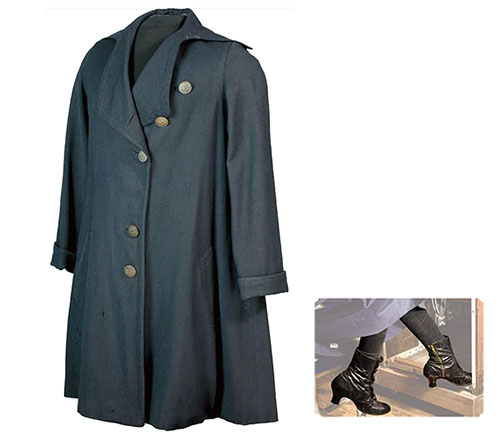
Uniform Overcoat and Boots Worn by Adel Hoppock, 1918. | GGA Image ID # 23783a80b2
Who Was Adele Hoppock?
Adele Hoppock (1897–1967) was one of the "Hello Girls," the bilingual American female telephone operators who served the U.S. Army Signal Corps in France during World War I. Her multilingual abilities and education led her to a key role supporting the American Expeditionary Forces and world leaders.
Early life and education
- Born in 1897, Hoppock was the daughter of Mr. and Mrs. Arthur W. Hoppock.
- She attended Wenatchee High School and later enrolled at the University of Washington.
- Fluent in both French and Spanish, she was an active member of both language clubs at the university.
- She was a college senior and honor student when she joined the Signal Corps.
- She received her college degree early in 1918 so she could leave for Europe to serve as a telephone operator.
World War I service
- Before deploying, she spent a month training in California, then traveled to France with the "Hello Girls".
- Hoppock served as a chief operator at General Headquarters of the American Expeditionary Forces and later at First Army Headquarters.
- She helped ensure the success of telephone service during the St. Mihiel salient and Verdun offensives.
- Her colleague, Grace Banker, praised Hoppock as one of the "loyal and devoted" First Army Girls whose service made the telephone service a success.
- After the war, Hoppock was part of the special group of operators who remained in France to assist with the six-month 1919 Paris Peace Conference, handling calls for world leaders.
Later life
- Hoppock married Colonel Marmion Mills and later went by the name Adele Louise Hoppock Mills.
- She and her family eventually settled in the Seattle area.
- Hoppock passed away in 1967.
Reflections
Adele Hoppock was one of the "Hello Girls," the first women to serve in the U.S. Army as telephone operators. Her service in a war-torn Europe demonstrated her courage and patriotism, paving the way for future generations of women in the military.
Adele Hoppock wrote that she was not afraid of the work but, being stationed somewhere in France where it was not busy. She wrote “There is not a girl among us who would not give anything she could to the U.S. We are so proud to be in the service and we feel as though it is our privilege, nay our duty, to do our utmost. Adele articulates the very foundations of service and Army values.
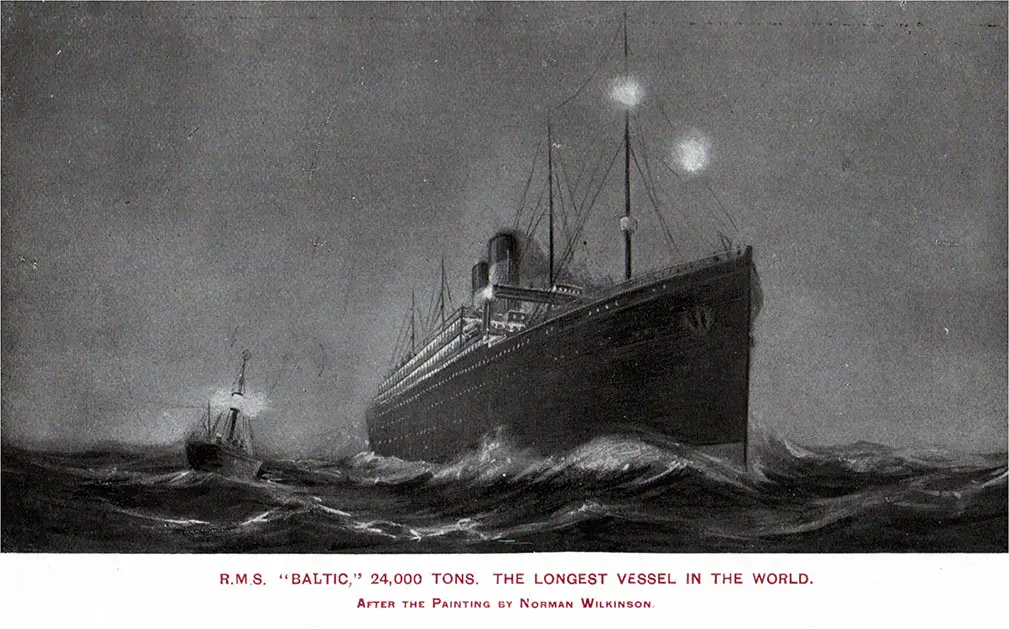
The third group that included Chief Operator Nellie F. Snow and Adele Louise Hoppock made the crossing on the White Star Liner RMS Baltic on April 25, 1918. | GGA Image ID # 2378ac0182. Click to View a Larger Image.
✨ Most Engaging Content
The description of Adele Hoppock “in her new navy blue uniform” is more than a detail — it is the visual proof that the Hello Girls stood shoulder-to-shoulder with enlisted men in service to the nation. This image of uniformed women boarding transports bound for France captured the imagination of the American public and provided the legal foundation for the argument that they were indeed U.S. Army soldiers.
Nearly 60 years later, those very uniforms were cited in congressional testimony as evidence that the Hello Girls had been issued standard Army attire and were under military command — helping secure their long-awaited recognition as veterans in 1977.
🖼️ Noteworthy Image(s)
- Exhibit R Document (1918): The official clipping from the 1918 campus report verifying that Adele Hoppock departed for France wearing the authorized U.S. Army Signal Corps uniform — the same uniform later cited in congressional hearings to prove the Hello Girls’ veteran status. | GGA Image ID # 2377c66268
- Uniform Overcoat and Boots (1918): Photograph of Adele Hoppock’s authentic Signal Corps outercoat and field boots, preserved as tangible proof of her Army-issued attire. These garments embody the professionalism and military discipline of the Hello Girls. | GGA Image ID # 23783a80b2
- White Star Liner RMS Baltic (1918): The transport ship on which Adele Hoppock and Chief Operator Nellie F. Snow sailed for England on April 25, 1918. This image of the Baltic underscores the transatlantic scale of the Signal Corps’ operations and the courage of the women who crossed in wartime conditions. | GGA Image ID # 2378ac0182
📘 Mini Dictionary for Civilians
- Signal Corps: A U.S. Army branch responsible for establishing and maintaining communications during war and peace — including telegraph, telephone, and radio operations — and the unit to which the “Hello Girls” belonged.
- RMS Baltic: A 24,000-ton White Star Line ocean liner launched in 1903. Requisitioned by the U.S. Government during WWI, she carried troops and personnel, including the third group of U.S. Army Signal Corps telephone operators led by Chief Operator Nellie F. Snow and Adele Louise Hoppock, to England in April 1918.
- Uniform Artifacts: Physical clothing and equipment issued by the U.S. Army to personnel, serving as legal and historical evidence of military status. Adele Hoppock’s preserved overcoat and boots were later cited in congressional testimony as proof of Army enlistment.
- Uniform Recognition: The formal acknowledgment that specific attire, insignia, or equipment constitutes proof of military service — a factor central to the Hello Girls’ long battle for veteran status.
🎓 Essay Prompts for Students
- Discuss how the Hello Girls’ uniforms influenced the debate over their military status and eventual recognition as veterans.
- How did Adele Hoppock’s experience represent the changing role of women in the U.S. Army during World War I?
- Why was the question of uniforms and insignia so important to Congress when determining veteran status in 1977?
- Compare the Hello Girls’ use of uniforms with other historical examples where attire symbolized authority or inclusion in military service.
🪶 Citation Block
Chicago: “[Exhibit R]: Affidavit of Gertrude Hoppock: Termination of Services – Wears Uniform of U.S. Signal Corps, 6 May 1918.” Recognition for Purposes of VA Benefits, Hearing Before the Committee on Veterans’ Affairs, U.S. Senate, 95th Cong., 1st Sess. (1977), p. 374.
APA: United States Senate. (1977, May 25). Exhibit R: Wears Uniform of U.S. Signal Corps – 1918. Hearing Before the Committee on Veterans’ Affairs, 95th Congress, First Session, p. 374. Washington, DC: U.S. Government Printing Office.
MLA: “[Exhibit R]: Affidavit of Gertrude Hoppock: Termination of Services – Wears Uniform of U.S. Signal Corps, 6 May 1918.” Recognition for Purposes of VA Benefits, Hearing Before the Committee on Veterans’ Affairs, U.S. Senate, 95th Cong., 1st Sess., 1977, p. 374.
Student Citation: “[Exhibit R – Wears Uniform of U.S. Signal Corps (1918)]” in Recognition for Purposes of VA Benefits, U.S. Senate Hearing, 95th Congress (1977), p. 374. Retrieved from the Gjenvick-Gjønvik Archives (ggarchives.com).
Bibliography
"[Exhibit R]: Affidavit of Gertrude Hoppock: Termination of Services - Wears Uniform of U.S. Signal Corps, 6 May 1918," in Recognition for Purposes of VA Benefits, Hearing before the Committee on Veterans' Affairs, United States Senate, Ninety-Fifth Congress, First Session on S. 247, S. 1414, S. 129, and Related Bills. Washington, DC: US Government Printing Office, 25 May 1977. p. 374.
Carolyn Prickett, Leadership Case Studies from Women Serving during World War I, Master’s Thesis, U.S. Army Command and General Staff College, Fort Leavenworth, KS, June 2017.
Adele Louise Hoppock Mills, Find a Grave, https://www.findagrave.com/memorial/32545038/adele_louise-mills.
