
Exhibit W: Telephone Operator Request Soldiers Bonus by State of Washington - 1920
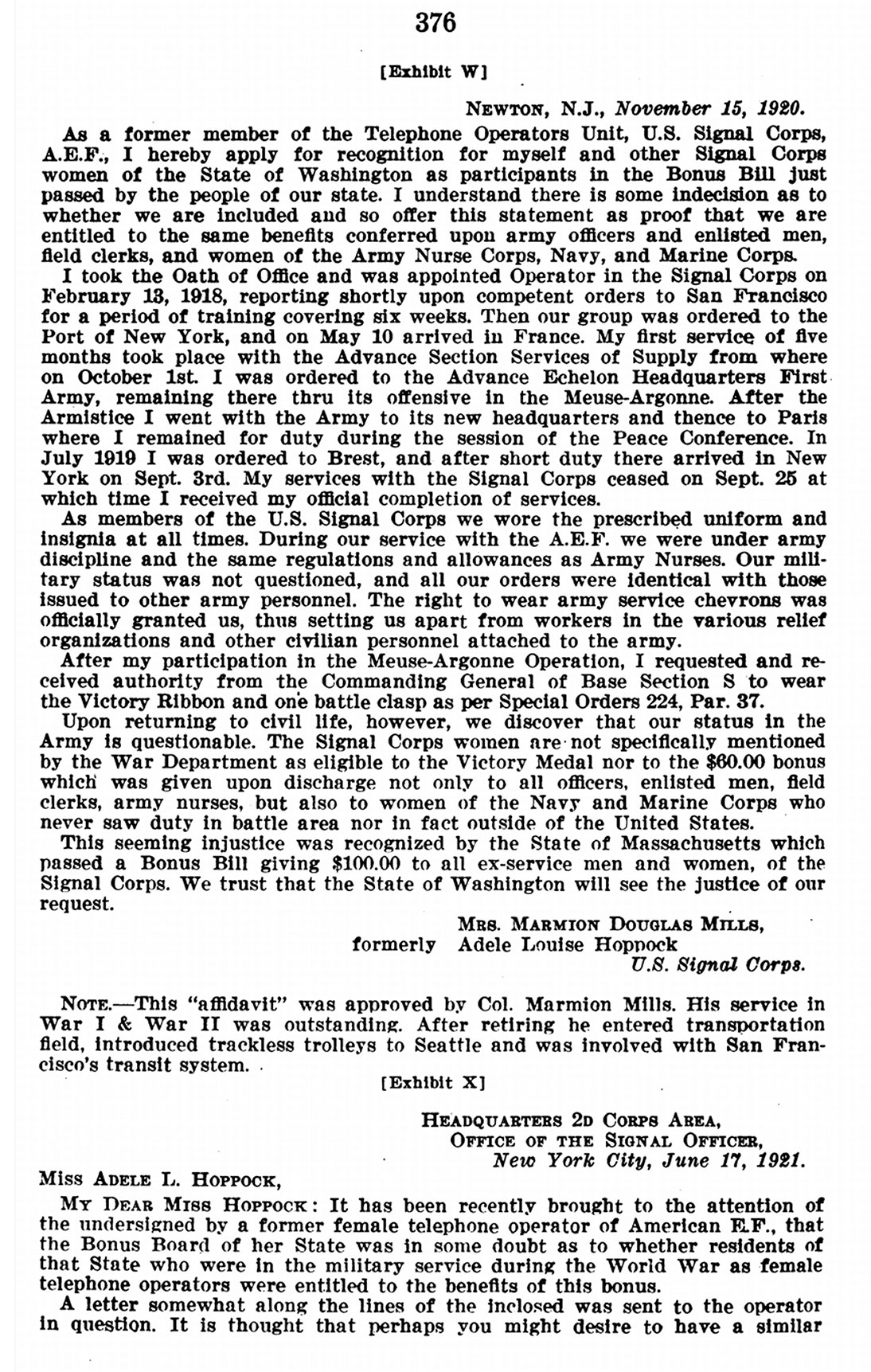
Exhibits W and X, Adele Louise Happock (Mrs. Marion Douglas Mills) Request for Recognition by the State of Washington, in Recognition for Purposes of VA Benefits, Hearing before the Committee on Veterans' Affairs, United States Senate, Ninety-Fifth Congress, First Session on S. 247, S. 1414, S. 129, and Related Bills. Washington, DC: US Government Printing Office, 25 May 1977. | GGA Image ID # 237205e4d8. Click to View a Larger Image.
📖 Foreword
Telephone operators who served with the U.S. Army Signal Corps during World War I were denied veterans' benefits, including the state "soldiers' bonus" approved in Washington in 1920 Note 1. Many operators were initially told their service would be treated as military enlistment, but the Army later classified them as civilian employees—an administrative decision that excluded them from military compensation and pensions Note 2.
Washington State's 1920 veterans' bonus
In 1920, Washington voters approved Referendum 2—the Veterans' Equalized Compensation Act—authorizing compensation for eligible World War I veterans Note 1.
Eligibility: Benefits were intended for Washington residents who served in the U.S. armed forces, typically requiring standard proof of service (e.g., honorable discharge). Note 3
Application window & proof: Applications were taken in the early 1920s; discharge documents and similar records were generally required to verify qualifying service Note 3.
Basis of payment: Compensation was commonly calculated by length of qualifying service—hence the "equalized" framing Note 1.
The "Hello Girls" were excluded
The Signal Corps telephone operators ("Hello Girls") served overseas in uniform and under military discipline but were deemed civilian contract employees rather than enlisted soldiers Note 2. Without an honorable discharge or equivalent military separation record, they were ineligible for the state bonus and other veterans' benefits Note 3.
Recognition came decades later
After a sustained campaign by surviving operators and advocates, federal action in 1977–1978 recognized their service for veterans' status; surviving members later received Honorable Discharges and World War I Victory Medals Note 4.
The Exhibit W letter also references Massachusetts' earlier bonus payments as a fairness benchmark; coverage of Signal Corps women under state bonus acts varied by state and typically turned on whether authorities treated their service as military and issued an honorable discharge Note 5.
📖 Review & Summary
What this document is: Exhibit W preserves a November 15, 1920 request by Adele Louise Hoppock (U.S. Army Signal Corps telephone operator) asking the State of Washington to include Signal Corps women in its newly approved World War I veterans' bonus program Note 1.
Core issue: Although operators took the oath, wore uniforms, followed orders, served under military discipline, and even received authorization to wear the Victory ribbon with a battle clasp, the Army later classified them as civilian contract employees rather than enlisted soldiers Note 2. Without an honorable discharge—the standard proof of service—many state and federal benefits were out of reach Note 3.
Hoppock's argument: Her letter marshals concrete service evidence (oath, orders, uniform/insignia, service chevrons, campaign insignia) and a fairness comparison: Massachusetts had already granted a $100 bonus to Signal Corps men and women, demonstrating that states could recognize this cohort Note 5.
- Context in Washington: Voters approved the 1920 Veterans' Equalized Compensation Act (Referendum 2), a length-of-service bonus requiring standard military documentation at application Note 1.
- Why operators were excluded: The War Department's civilian classification left operators with certificates of service, not honorable discharges, preventing straightforward eligibility Note 2 Note 3.
- Policy variance across states: Hoppock's Massachusetts example shows how differing state interpretations could produce opposite outcomes for the same service group Note 5.
Outcome & legacy: The request highlights the long administrative struggle that followed WWI. Only decades later did the federal government recognize the "Hello Girls" as veterans, leading to honorable discharges and WWI Victory Medals Note 4.
Why it matters: Exhibit W is a concise, primary-source window into how classification decisions—and the paperwork they generate—can determine access to benefits. It's useful for studying gender, military bureaucracy, state policy variation, and the eventual path to recognition for the Signal Corps telephone operators.
[Exhibit W]
Newton, N.J., November 15, 1920.
As a former member of the Telephone Operators Unit, U.S. Signal Corps, A.E.F., I hereby apply for recognition for myself and other Signal Corps women of the State of Washington as participants in the Bonus Bill just passed by the people of our state.
I understand there is some indecision as to whether we are included and so offer this statement as proof that we are entitled to the same benefits conferred upon army officers and enlisted men, field clerks, and women of the Army Nurse Corps, Navy, and Marine Corps.
I took the Oath of Office and was appointed Operator in the Signal Corps on February 18, 1918, reporting shortly upon competent orders to San Francisco for a period of training covering six weeks.
Then our group was ordered to the Port of New York, and on May 10 arrived in France. My first service of five months took place with the Advance Section Services of Supply from where on October 1st I was ordered to the Advance Echelon Headquarters First Army, remaining there through its offensive in the Meuse-Argonne.
After the Armistice I went with the Army to its new headquarters and thence to Paris where I remained for duty during the session of the Peace Conference.
In July 1919 I was ordered to Brest, and after short duty there arrived in New York on Sept. 3rd. My services with the Signal Corps ceased on Sept. 25 at which time I received my official completion of services.
As members of the U.S. Signal Corps we wore the prescribed uniform and insignia at all times. During our service with the A.E.F. we were under army discipline and the same regulations and allowances as Army Nurses.
Our military status was not questioned, and all our orders were identical with those issued to other army personnel. The right to wear army service chevrons was officially granted us, thus setting us apart from workers in the various relief organizations and other civilian personnel attached to the army.
After my participation in the Meuse-Argonne Operation, I requested and received authority from the Commanding General of Base Section S to wear the Victory Ribbon and one battle clasp as per Special Orders 224, Par. 37.
Upon returning to civil life, however, we discover that our status in the Army is questionable. The Signal Corps women are not specifically mentioned by the War Department as eligible to the Victory Medal nor to the $60.00 bonus which was given upon discharge not only to all officers, enlisted men, field clerks, army nurses, but also to women of the Navy and Marine Corps who never saw duty in battle area nor in fact outside of the United States.
This seeming injustice was recognized by the State of Massachusetts which passed a Bonus Bill giving $100.00 to all ex-service men and women, of the Signal Corps. We trust that the State of Washington will see the justice of our request.
Mrs. Marmion Douglas Mills, formerly Adele Louise Hoppock
U.S. Signal Corps.
Note.—This “affidavit” was approved by Col. Marmion Mills. His service in War I & War II was outstanding. After retiring he entered transportation field, introduced trackless trolleys to Seattle and was involved with San Francisco’s transit system.
✨ Most Engaging Content
"We trust that the State of Washington will see the justice of our request." With those words, Adele Louise Hoppock—one of the U.S. Army Signal Corps' "Hello Girls"—asked Washington State to include its women telephone operators in the 1920 veterans' bonus Note 1.
- They served like soldiers—then were told they weren't. Operators took the oath, trained under orders, wore uniforms, worked under military discipline, and served at AEF Headquarters and in battle zones—yet were later categorized as civilian employees Note 2.
- Paperwork decided pay. Lacking an honorable discharge, the operators could not meet standard proof-of-service requirements for state compensation Note 3.
- Fairness by comparison. Hoppock points to Massachusetts' earlier $100 bonus as a precedent for recognizing Signal Corps women—highlighting how state policy varied with how authorities classified their service Note 5.
- Recognition—at last. Decades later, surviving operators were finally recognized for veterans' status and awarded Honorable Discharges and WWI Victory Medals Note 4.
📘 Mini Dictionary for Civilians
- Veterans' Equalized Compensation (Soldiers' Bonus)
- A state payment to qualifying WWI veterans, "equalized" by length of service; in Washington, authorized by 1920 Referendum 2 Note 1.
- Certificate of Service vs. Honorable Discharge
- Operators received certificates (civilian documentation), not military discharges—blocking eligibility for many veterans' benefits Note 3.
- Services of Supply (SOS), Advance Section
- The forward logistics/communications area supporting the American Expeditionary Forces (AEF) near active operations.
- Advance Echelon, First Army
- Forward headquarters of the AEF's First Army during major offensives such as the Meuse–Argonne.
- Victory Ribbon & Battle Clasp
- Insignia associated with the World War I Victory Medal; a battle clasp marked service in specific campaigns.
- AEF (American Expeditionary Forces)
- The U.S. Army formation deployed to Europe in World War I.
🎓 Essay Prompts for Students
- Source Analysis: How does Hoppock construct a fairness argument in Exhibit W? Identify at least two rhetorical strategies and link them to the requested policy outcome Note 5.
- Policy & Documentation: Explain how the operators' classification as civilians and the lack of an honorable discharge shaped their access to Washington's bonus program Note 2 Note 3.
- Comparative States: Using Massachusetts as a comparator cited in Exhibit W, discuss how differences in state policy or interpretation could change outcomes for the same veterans' cohort Note 5.
- Timeline Essay: Trace a mini-timeline from recruitment, oath, and overseas duty to the 1977–1978 federal recognition. Where did administrative classification most strongly affect life outcomes for the operators Note 4?
- Evidence & Corroboration: Draft a paragraph that would strengthen Hoppock's request using only evidence available in this collection (e.g., uniform, orders, discipline, campaign insignia). Cite specific details from the transcript and End Notes Note 1 Note 2.
🪶 Citation Block (Chicago, APA, MLA + Student)
Chicago (Notes & Bibliography)
Footnote: 1. U.S. Congress, Senate, Committee on Veterans' Affairs, Recognition for Purposes of VA Benefits, 95th Cong., 1st sess., hearing on S. 247, S. 1414, S. 129, and related bills (Washington, DC: U.S. Government Printing Office, May 25, 1977), 376.
Bibliography: U.S. Congress. Senate. Committee on Veterans' Affairs. Recognition for Purposes of VA Benefits: Hearing before the Committee on Veterans' Affairs, United States Senate, Ninety-Fifth Congress, First Session on S. 247, S. 1414, S. 129, and Related Bills. Washington, DC: U.S. Government Printing Office, 1977.
APA (7th ed.)
U.S. Congress, Senate, Committee on Veterans' Affairs. (1977, May 25). Recognition for purposes of VA benefits: Hearing before the Committee on Veterans' Affairs, United States Senate, Ninety-Fifth Congress, first session on S. 247, S. 1414, S. 129, and related bills (p. 376). U.S. Government Printing Office.
MLA (9th ed.)
United States, Congress, Senate, Committee on Veterans' Affairs. Recognition for Purposes of VA Benefits: Hearing before the Committee on Veterans' Affairs, United States Senate, Ninety-Fifth Congress, First Session on S. 247, S. 1414, S. 129, and Related Bills. U.S. Government Printing Office, 25 May 1977, p. 376.
Student Version (concise)
"Exhibit W: Request for Recognition by the State of Washington (Adele L. Hoppock)," in Recognition for Purposes of VA Benefits, Hearing, U.S. Senate Committee on Veterans' Affairs, 95th Congress (Washington, DC: GPO, 1977), p. 376.
"[Exhibit W]: Affidavit of Gertrude Hoppock: Request for Recognition by the State of Washington," in Recognition for Purposes of VA Benefits, Hearing before the Committee on Veterans' Affairs, United States Senate, Ninety-Fifth Congress, First Session on S. 247, S. 1414, S. 129, and Related Bills. Washington, DC: US Government Printing Office, 25 May 1977. p. 376.
End Notes
- Note 1. Washington's 1920 "Veterans' Equalized Compensation" (popularly, the soldiers' bonus) was a voter-approved measure designed to provide state compensation to qualified WWI veterans; payments were typically "equalized" by length of service. ↩︎ ↩︎ ↩︎
- Note 2. During and after WWI, Army administrative rulings treated Signal Corps telephone operators as civilian employees despite their oath, uniforms, and military discipline—an interpretation that initially prevented access to federal and state veterans' benefits. ↩︎ ↩︎
- Note 3. State bonus programs generally required military service documentation (e.g., honorable discharge). Because the operators were not issued honorable discharges at the time, they lacked the standard proof of qualifying service and were excluded under prevailing rules. ↩︎ ↩︎ ↩︎
- Note 4. In 1977–1978, federal action recognized WWI Signal Corps telephone operators for veterans' status; surviving operators subsequently received Honorable Discharges and WWI Victory Medals. ↩︎
- Note 5. The Exhibit W letter cites Massachusetts' $100 bonus as precedent. Eligibility definitions and administrative practice varied across states; whether "Signal Corps women" qualified often hinged on military status and documentation at the time of application. ↩︎
