
[Attachment 4]: Ernest J. Wessen Letter - 1950
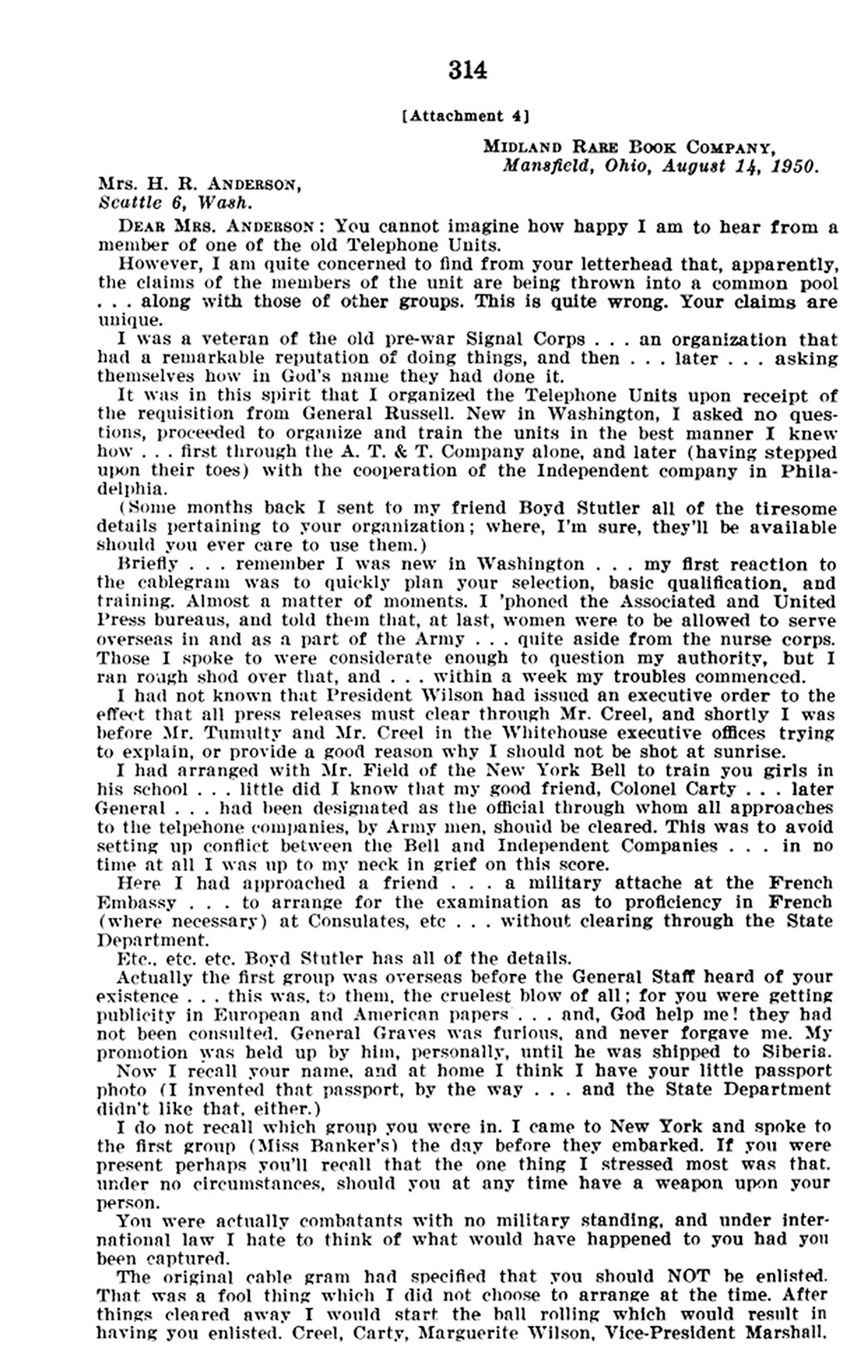
Attachment 4, Part 1: Letter from CAPT Ernest James Wessen, US Army Signal Corps (Ret.) to Mrs. H. R. Anderson Regarding the Hello Girls in World War I. Hearing before the Committee on Venteran's Affairs, United States Senate, Ninety-Fifth Congress, First Session on S. 247, S. 1414, S. 129, and Related Bills, Washington DC: US Government Print Office, 25 May 1977. | GGA Image ID # 2375fcc79a. Click to View a Larger Image.
📖 Review & Summary
This remarkable 1950 letter from Captain Ernest J. Wessen (U.S. Army Signal Corps, Ret.) to Mrs. H. R. Anderson offers a deeply personal and historically significant reflection on the creation of the U.S. Army Signal Corps Telephone Operator Units—better known as the Hello Girls. Wessen, who later achieved national recognition as founder of the Midland Rare Book Company in Mansfield, Ohio, reveals his pride and lingering frustration over the government’s failure to grant these women official military status after World War I.
Writing three decades after the war, Wessen recalls how he organized the first units under intense bureaucratic resistance, secured training through Bell and Independent telephone companies, and even bypassed protocol by announcing the formation of women’s overseas service to the press before Washington had approved it. His tone is both humorous and candid—admitting “I was new in Washington … and up to my neck in grief”—yet his words underscore the innovation and audacity required to make the project succeed.
For historians, teachers, and genealogists, this document bridges two eras: the wartime mobilization of women in 1918 and the long postwar campaign for recognition that continued into the 1970s. Wessen’s appeal for congressional acknowledgment of the Hello Girls’ combat-adjacent service anticipates the eventual 1977 hearings that restored their status as veterans. It is a primary-source cornerstone for anyone studying military gender policy, communications history, or the evolution of women’s rights in uniform.
Ernest J. Wessen
Midland Rare Book Company,
Mansfield, Ohio,
August 14, 1950.
Mrs. H. R. Anderson,
Seattle 6, Wash.
Dear Mrs. Anderson: You cannot imagine how happy I am to hear from a member of one of the old Telephone Units.
However, I am quite concerned to find from your letterhead that, apparently , the claims of the members of the unit are being thrown into a common pool ... along with those of other groups. This is quite wrong. Your claims are unique.
I was a veteran of the old pre-war Signal Corps ... an organization that had a remarkable reputation of doing things, and then . . . later . . . asking themselves how in God’s name they had done it.
It was in this spirit that I organized the Telephone Units upon receipt of the requisition from General Russell. New in Washington, I asked no questions, proceeded to organize and train the units in the best manner I knew how ... first through the A. T. & T. Company alone, and later (having stepped upon their toes) with the cooperation of the Independent company in Philadelphia.
(Some months hack I sent to my friend Boyd Stutler all of the tiresome details pertaining to your organization ; where, I’m sure, they’ll be available should you ever care to use them.)
Briefly ... remember I was new in Washington ... my first reaction to the cablegram was to quickly plan your selection, basic qualification, and training. Almost a matter of moments. I phoned the Associated and United Press bureaus, and told them that, at last, women were to be allowed to serve overseas in and as a part of the Army ... quite aside from the nurse corps. Those I spoke to were considerate enough to question my authority, but I ran rough shod over that, and ... within a week my troubles commenced.
I had not known that President Wilson had issued an executive order to the effect that all press releases must clear through Mr. Creel, and shortly I was before Mr. Tumulty and Mr. Creel in the Whitehouse executive offices trying to explain, or provide a good reason why I should not be shot at sunrise.
I had arranged with Mr. Field of the New York Bell to train you girls in his school ... little did I know that my good friend, Colonel Carty ... later General ... had been designated as the official through whom all approaches to the telephone companies, by Army men, should be cleared. This was to avoid setting up conflict between the Bell and Independent Companies ... in no time at all I was up to my neck in grief on this score.
Here I had approached a friend ... a military attaché at the French Embassy ... to arrange for the examination as to proficiency in French (where necessary) at Consulates, etc. ... without clearing through the State Department.
Etc., etc. etc. Boyd Stutter has all of the details.
Actually the first group was overseas before the General Staff heard of your existence ... this was, to them, the cruelest blow of all; for you were getting publicity in European and American papers'. . . and, God help me! they had not been consulted. General Graves was furious, and never forgave me. My promotion was held up by him, personally, until he was shipped to Siberia.
Now I recall your name, and at home I think I have your little passport photo (I invented that passport, by the way ... and the State Department didn’t like that, either.)
I do not recall which group you were in. I came to New York and spoke to the first group (Miss Banker’s) the day before they embarked. If you were present perhaps you’ll recall that the one thing I stressed most was that, under no circumstances, should you at any time have a weapon upon your person.
You were actually combatants with no military standing, and under international law I hate to think of what would have happened to you had you been captured.
The original cable gram had specified that you should NOT he enlisted. That was a fool thing which I did not choose to arrange at the time. After things cleared away I would start the ball rolling which would result in having you enlisted. Creel, Carty, Marguerite Wilson, Vice-President Marshall, and others upon whose toes I had trod became my very good friends and supporters. Not so with General Graves ... he simply had to say “no!” to any recommendation I might make, and he relished in doing so.
Then came the debacle when they took the Air Service away from the Signal Corps in May, 1918. I was advanced to the executive office; taken out of civilian personnel, and the new duties made it impossible for me to give any attention to the enlistment of the operators ... indeed, it was no longer under my jurisdiction. The man who replaced me was a civilian who had no knowledge of what it was all about.
That’s that ... the big thing is ... you folks were actual combatants, and so recognized by Pershing when he decorated one of your number for bravery under fire.
Following the War I resigned from the Army, and became Chief Investigator of a Subcommittee of the House Committee on Expenditures in the War Department. John McKenzie of Illinois was Chairman, and became my very dear friend ... the best friend I had, in fact.
Later, when Mr. McKenzie became Chairman of the Committee on Military Affairs I went to Washington to see him about correcting your status. He listened to me through ... showed a great deal of concern. He said: “Ernest, there is no doubt in the world but that your telephone operators were combatants, and should have been bona-fide members of the military establishment, but if we provide for this tiny group at this time we will be forced to reopen the cases of thousands of other applicants; all of which have been disposed of.” I think it was the pension bill; which was about to be sent to the White House ; to which he had reference.
Mr. McKenzie showed me stacks of applications from individuals and various women’s groups; which had been rejected often without a hearing. He asked me to wait a couple of years; build up my material, and then present it. But John McKenzie died before this could be done.
I made one more attempt ... a perfectly futile one ... to enlist the sympathy and support of the telephone companies; who had participated in an all out manner during the war. The War was over, and they were not even slightly interested; according to a letter I received from Mr. Estabrook, who had been my contact with the A. T. and T. Company.
A telephone man with no military experience, and who had participated not at all in the organization of the group was, as I now recall, named Captain Vivian. He had been commissioned and sent overseas to serve in a supervisory capacity over your group. Why he should have been commissioned, and you folks not enlisted, is something I’ll never know.
Anyway ... my next attempt ... made around 1927 brought me a letter to the effect that my interests in the matter were not recognized. That Captain Vivian had conceived the idea; organized the groups, and was at that time heading a movement to gain what I had been seeking all those years ... a recognition of your military status. I was quite willing at that point to drop out and did.
Not until I saw the announcement in the LEGION Magazine did I learn that nothing had been accomplished.
Now I am going to be brutally frank with you. ... I have not the slightest interest in the claims of other women’s groups. Your rights are so thoroughly well established ... so clear, so fundamentally sound; that it is a shame they are tied on to, or associated with the claims of any other group.
With the claim completely divorced from those of less deserving groups; with the whole matter properly presented to congress I’m quite certain that you would he granted an enlisted status, and everything else would follow. Too ... I think the whole affair would receive broad and favorable publicity; which, in turn, would force the hand in Washington.
Among that remarkable group of women there must be someone who knows a writer who would take this on for a story in a magazine of broad circulation. Harking back to the superb Isaac Marcosson tribute in the Saturday Evening Post ... 1919, I think, showing how in World War II Mrs. Hobby was touted as the first woman to receive the BSM, how the group has been completely forgotten. ... its organization, etc.
The group must now be widely dispersed geographically ... once that story broke: reprints should be sent to every member of Congress; with follow-ups by all members, and their friends, to specific Congressman.
Best of all ... if the services of a skilled publicity man could be enlisted, and those of a top flight attorney ...
You were a select, outstanding group and so recognized by all commentators familiar with your colorful services. In any group of similar size you will And a few suffering distress; even though full pensions had been provided. I’m not hard-hearted, but I am singularly cold against the claims of those few for my sympathy; when I consider the whole affairs.
I want to see or hear grandchildren say ... “My grandmother was a member of the first women’s combatant unit in the United States Army,” and be able to back up. their claims by reference to the Laws of this country.
Pensions and allowances; membership in military societies and all else would follow legal recognition. You can’t get it ... you cannot get those articles ... you cannot get the help if you are to permit your own little unique group to be used as a spearhead for legislation for infinitely less deserving groups or individuals.
When I wrote Boyd Stutler I told him that I would be very happy to appear, and testify before a Congressional Committee at my own expense; once this thing had gotten that far. My own feeling is that if the matter is tied up with the claims of other groups I want nothing at all to do with it. I think you will find all others feel the same way about it.
Don’t misunderstand my motives ... no one can pay me anything at all for any services I can rendered in this connection. Not only do I seek no publicity ... I abhor it. My colorful business has brought me a national reputation among bookmen. We have been on national radio hook-ups; television, and what have-you. I have declined to permit a nationally known writer to do our story for the Saturday Evening Post ... publicity brings me nothing but grief, and I don’t want it.
It just so happens that I’m prouder of my part in the organization of this group than anything else I’ve done ... I made one very bad blunder, or series of blunders ... I would like to correct it while I’m around. I am going on to 63 years of age. I am the only man now, or ever alive that knew your full story ... the only person that may present the facts in such a manner that Congress will see the great injustice inherent in this whole affairs.
I can well believe that the hurdle which had to he cleared with Congressman John McKenzie ... the opening of the gates to a thousand and one less worthy groups ... not only still exists, and will hamper us, but that, as a matter of fact, we find you aligned with and being used to spearhead their raids on the Treasury.1 That is too bad.
Get out on your own, and I’ll work with you as long as I’m around ... otherwise count me out.
With all good wishes
Sincerely yours,
Ernest J. Wessen
P.S.—If memory serves me, Colonel Stannard’s office, adjoined mine in the Mills Building, at the very time your group came into being.
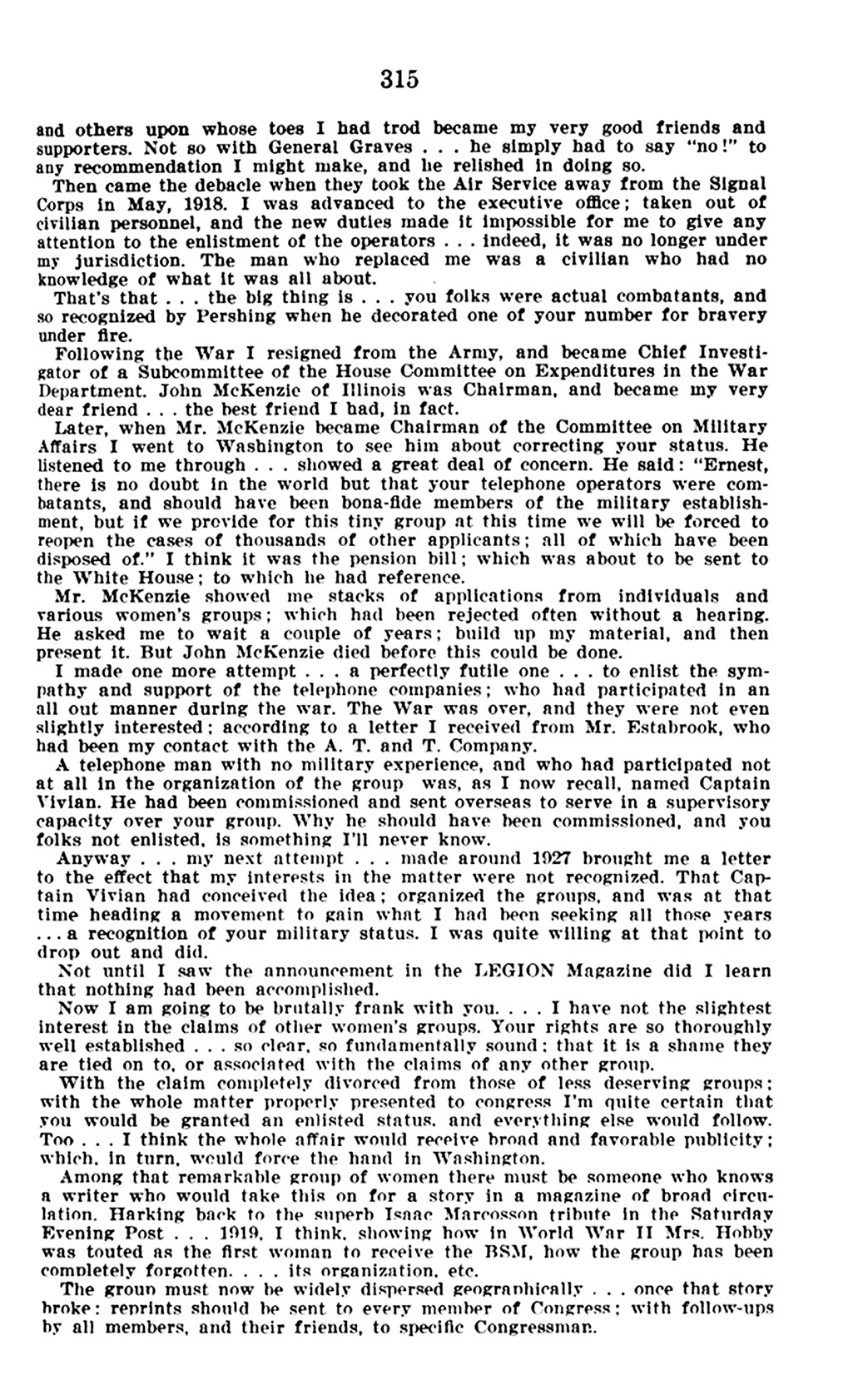
Attachment 4, Part 2: Letter from CAPT Ernest James Wessen, US Army Signal Corps (Ret.) to Mrs. H. R. Anderson Regarding the Hello Girls in World War I. Hearing before the Committee on Venteran's Affairs, United States Senate, Ninety-Fifth Congress, First Session on S. 247, S. 1414, S. 129, and Related Bills, Washington DC: US Government Print Office, 25 May 1977. | GGA Image ID # 23760494ea. Click to View a Larger Image.
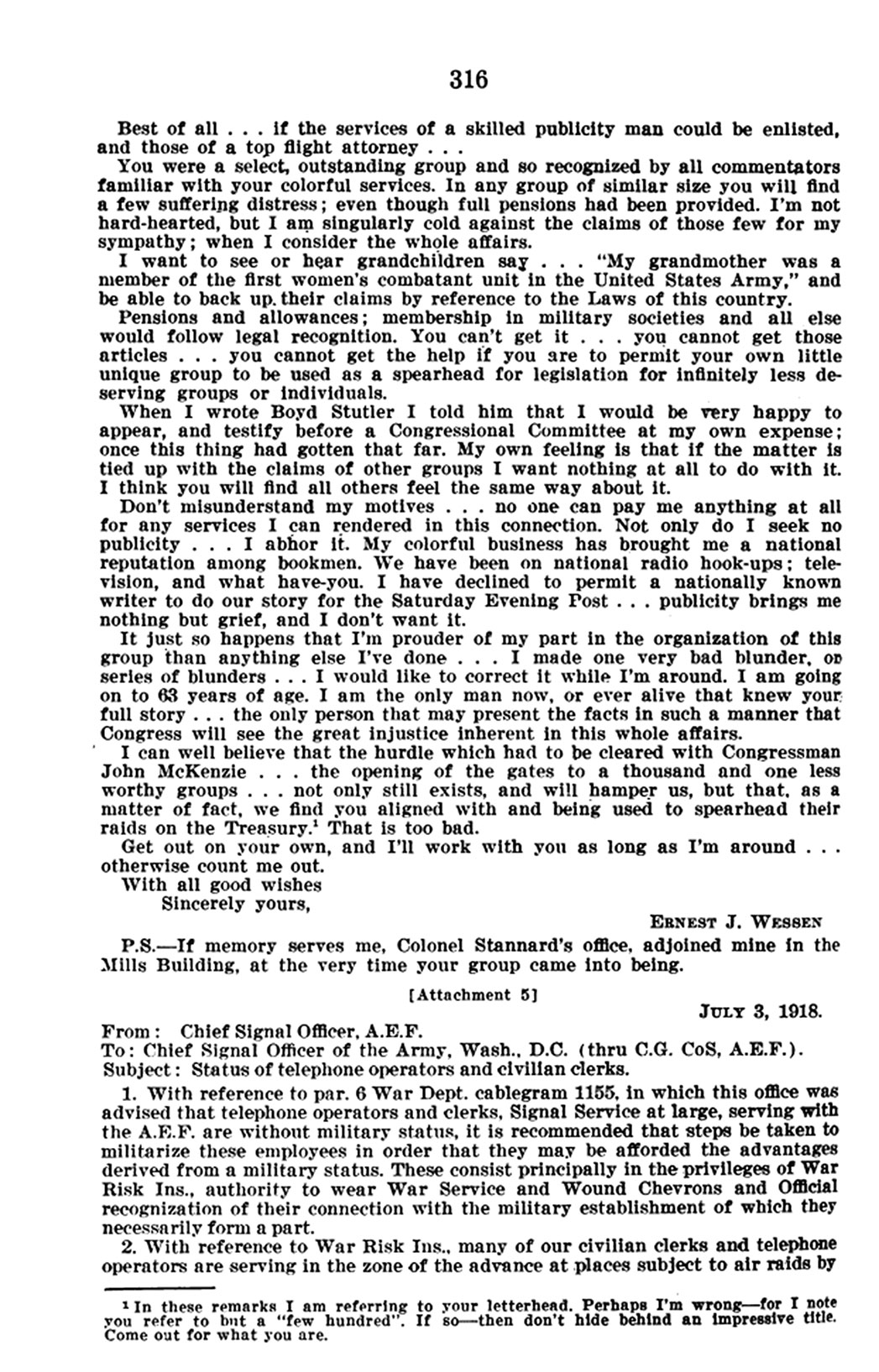
Attachment 4, Part 3: Letter from CAPT Ernest James Wessen, US Army Signal Corps (Ret.) to Mrs. H. R. Anderson Regarding the Hello Girls in World War I. Hearing before the Committee on Venteran's Affairs, United States Senate, Ninety-Fifth Congress, First Session on S. 247, S. 1414, S. 129, and Related Bills, Washington DC: US Government Print Office, 25 May 1977. | GGA Image ID # 2376428724. Click to View a Larger Image.
✨ Most Engaging Content
Perhaps the most gripping passage appears near the close of the letter, when Wessen writes that the Hello Girls were “actually combatants with no military standing, and under international law I hate to think of what would have happened to you had you been captured.” The statement transforms what many viewed as clerical work into an act of front-line bravery, reframing these women as de facto soldiers who risked their lives without the legal protection of rank or uniform.
Equally compelling is his heartfelt admission: “I’m prouder of my part in the organization of this group than anything else I’ve done.” Coming from a man who later became one of America’s foremost rare-book dealers, the remark testifies to the enduring emotional significance of the Hello Girls’ legacy for those who knew them firsthand.
These lines personalize a bureaucratic struggle, turning it into a narrative of conscience, regret, and vindication—ideal material for classroom discussion about ethics, leadership, and historical memory.
🖼️ Noteworthy Image(s)
- Typed Letterhead, Midland Rare Book Company (1950) – The official stationery connects Captain Wessen’s post-military life to his wartime achievements, illustrating how veterans often carried their sense of duty into civilian professions.
- Congressional Hearing Transcript (1977) – The inclusion of this letter in the 95th Congress Veterans Affairs hearing validates its significance as documentary evidence in the fight for recognition of the Hello Girls.
These pages—yellowed type, formal tone, and corrections intact—embody the authenticity of primary sources that form the backbone of historical research.
📘 Mini Dictionary for Civilians
- Signal Corps: A branch of the U.S. Army responsible for communications, including telephone, telegraph, and radio during World War I.
- Combatant: A person lawfully engaged in armed conflict; Wessen’s letter emphasizes that the Hello Girls acted as combatants without formal status.
- General Russell: Major General George O. Squier Russell, Chief Signal Officer who requisitioned female telephone operators for overseas duty.
- Boyd Stutler: A journalist and historian who preserved many early Hello Girls records referenced by Wessen.
- Executive Order: A presidential directive carrying the force of law; Wessen humorously recalls violating one by releasing press information prematurely.
- AT&T and Independent Companies: The two major telephone systems whose cooperation enabled operator training and deployment.
🎓 Essay Prompts for Students
- Leadership under Pressure: How does Captain Wessen’s account demonstrate innovation and defiance of bureaucracy in wartime administration?
- Recognition and Justice: Why did it take until 1977 for the Hello Girls to be officially recognized as veterans, and how does Wessen’s letter foreshadow that struggle?
- Archival Voices: In what ways do personal letters like this deepen our understanding of history compared to official military records?
- Gender and Military Authority: What barriers did Wessen and the women he trained face in legitimizing female service within the U.S. Army?
- Postwar Identity: Discuss how Wessen’s transition from Army officer to rare-book dealer reflects the reintegration of veterans into civilian intellectual life.
Educational Use: These prompts align with secondary and post-secondary curricula in U.S. History, Women’s Studies, Military Ethics, and Primary Source Analysis.
🪶 Citation Block
Chicago Style:
Wessen, Ernest J. “Letter to Mrs. H. R. Anderson, August 14, 1950.” In Hearings before the Committee on Veterans’ Affairs, United States Senate, Ninety-Fifth Congress, First Session on S. 247, S. 1414, S. 129 and Related Bills, pp. 314–316. Washington, DC: U.S. Government Printing Office, 1977. Reprinted by Gjenvick-Gjønvik Archives. https://www.ggarchives.com/MIL/HelloGirls/Stories/Attachment04-ErnestJWessenLetter-1950.html.
APA Style:
Wessen, E. J. (1950, August 14). Letter to Mrs. H. R. Anderson. In U.S. Senate Committee on Veterans’ Affairs (1977), Hearings on S. 247, S. 1414, S. 129 and Related Bills (pp. 314–316). Washington, DC: Government Printing Office. Reprinted by Gjenvick-Gjønvik Archives (2025). Retrieved from https://www.ggarchives.com/MIL/HelloGirls/Stories/Attachment04-ErnestJWessenLetter-1950.html
MLA Style:
Wessen, Ernest J. “Letter to Mrs. H. R. Anderson.” 14 Aug. 1950. Hearings before the Committee on Veterans’ Affairs, U.S. Senate, 95th Cong., 1st sess. Washington: GPO, 1977, pp. 314–316. Reprinted in Gjenvick-Gjønvik Archives, 2025, https://www.ggarchives.com/MIL/HelloGirls/Stories/Attachment04-ErnestJWessenLetter-1950.html.
Student Citation (Short Form):
Ernest J. Wessen to Mrs. H. R. Anderson, August 14, 1950. U.S. Senate Committee on Veterans’ Affairs Hearings, pp. 314–316. Reprinted by GG Archives (https://www.ggarchives.com/MIL/HelloGirls/Stories/Attachment04-ErnestJWessenLetter-1950.html).
"[Attachment 4]: CAPT Ernest James Wessen, (USA, Ret.), Letter - 1950," in Hearing before the Committee on Venteran's Affairs, United States Senate, Ninety-Fifth Congress, First Session on S. 247, S. 1414, S. 129, and Related Bills, Washington DC: US Government Print Office, 25 May 1977, pp. 314-316.
