
How Steamship Fares Were Set in 1900: Ticket Costs, Class Divisions, and Immigrant Travel
📌 Discover how steamship companies determined ticket prices in 1900! Learn about first-class luxury, second-class comfort, and third-class immigrant fares. A valuable resource for historians, genealogists, teachers, and students researching transatlantic travel
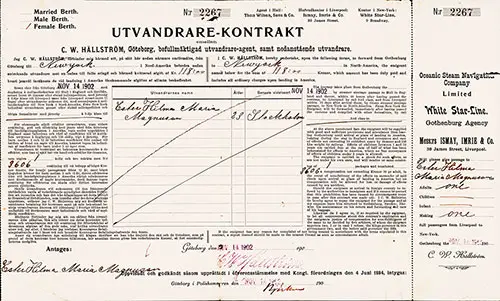
Original Third Class/Steerage Steamship Passage Contract and Ticket from Gothenburg, Sweden to New York, 14 November 1902, on the White Star Line RMS Celtic for Immigrant Ester Hilma Maria Magnuson of Stockholm. The Ticket Included the Detachable Receipt Located on the Right Hand Side (Panel). | GGA Image ID # 1f9ba0f3a7
🚢 How Steamship Lines Determined Rates of Fares in 1900: A Look Into Transatlantic Travel Costs & Class Divisions 🧳⚓
📖 Understanding the Economics of Ocean Travel
The "How Steamship Lines Determined Rates of Fares in 1900" article is a rich historical resource that provides valuable insights into how ticket pricing, class distinctions, and passenger accommodations were structured by steamship companies at the turn of the 20th century. This is a must-read for teachers, students, genealogists, historians, and maritime enthusiasts interested in the economic and social aspects of transatlantic travel during the height of steamship migration.
This section explains the pricing tiers for first, second, and third-class accommodations, the seasonal fluctuations in fares, and the impact of ship design and location on ticket costs. It also presents historical documents, tables of steamship rates, and detailed charts that offer a firsthand glimpse into how people of different social classes traveled across the Atlantic.
View other Steamship Passage Tickets and Contracts
Steamship Rates
Most steamship companies have three grades of prices, which are classified under the headings of winter, intermediate, and summer rates.
In each class, there are rates for a single berth in a room having four berths, a single berth in a room having two berths, special rates for a space of two berths for one person and two persons, and graded rates in all classes for different situations of staterooms on the steamer.
In each case, having decided on the steamship line, you are to patronize, communicate with the company, and ask for circulars telling their rates.
The following table gives the present advertised rates of the principal steamship companies running to ports near Paris, or that are available and desirable, if some short trip is in mind, as good ports of arrival.
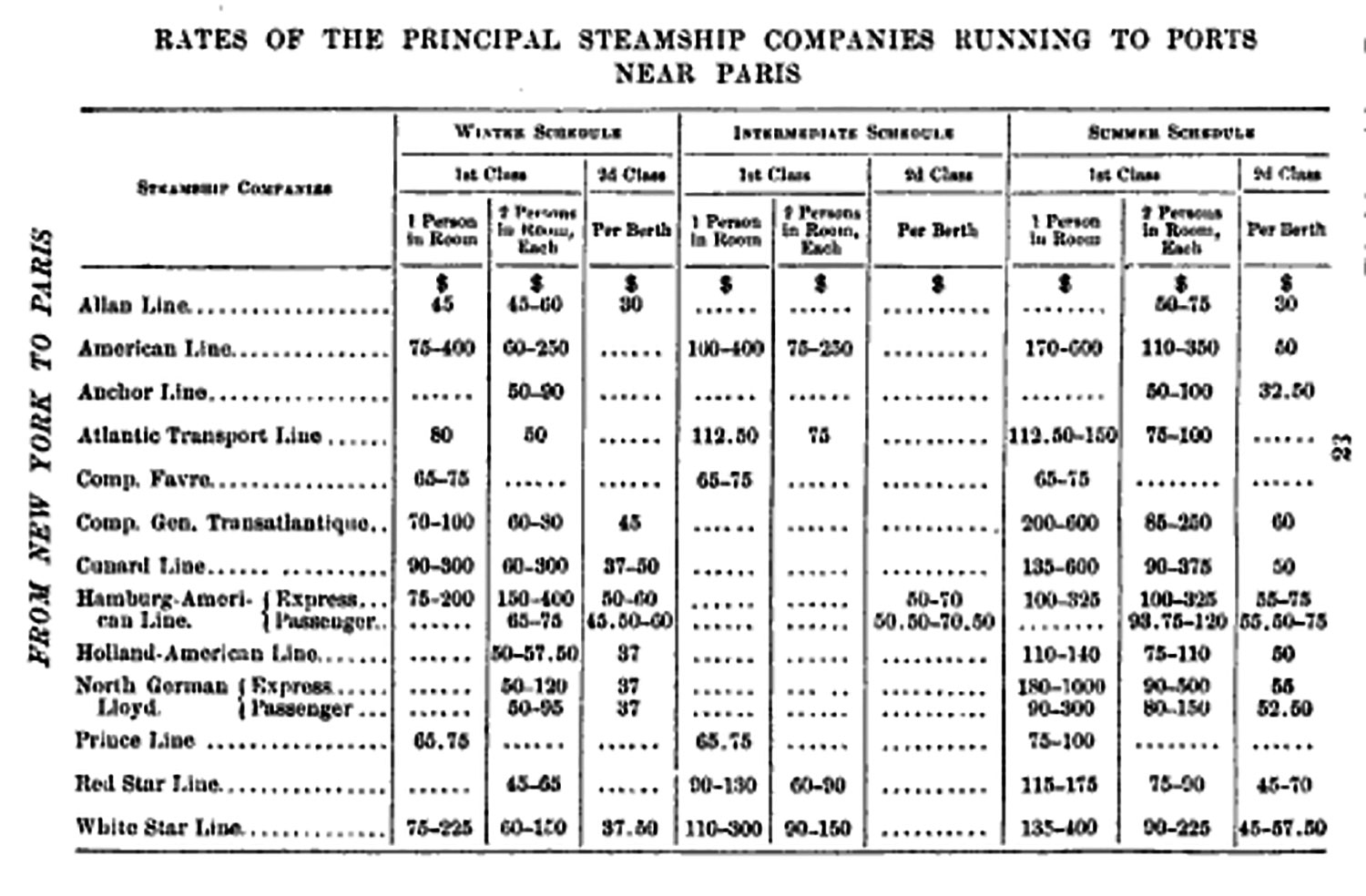
Table of Steamship Rates from New York to Paris. Harper's Guide to Paris, 1900. | GGA Image ID # 1ffc1fe103. Click to View Larger Image.
The variations of prices are caused (1) by the greater or lesser desirability of staterooms or. each steam-ship, owing to situations near or far away from the engine- rooms, on upper or lower decks, or with inside or outside ventilation; (2) by the varied sizes of the steamships of the same line.
In two eases the steamship line has two grades of steamers, called "Express" and "Passenger" lines. This signifies that the large and fast steamers form the "Express" branch of the service, and the smaller and slower constitute the ordinary "passenger" branch of the line.
The company has none where no second-class or intermediate season rates are given. When no room rates for one person are provided, the company has none and requires a single traveler, i.e., go into a room with at least two berths if travel is heavy or give him a room to himself without extra charge if travel is light. All prices are subject to change without notice.
Steamship Companies
There are many steamship companies sailing from Atlantic cities for European ports that might be used as a means, more or less direct, for reaching the Paris Exposition. The following table gives a list of steamship companies, with their New York addresses, together with the ports of arrival in Europe, their docks, days of sailing, etc.
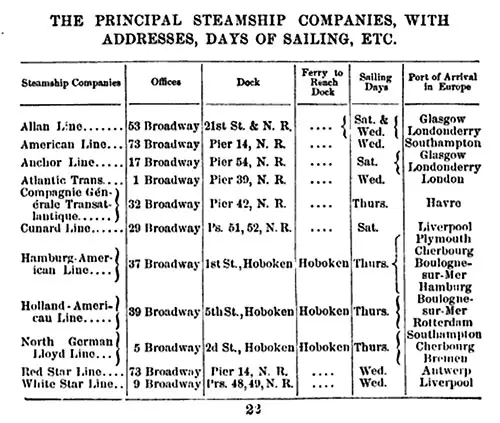
Table of The Principal Steamship Companies with Addresses, Dates of Sailing, Etc., 1900. Harper's Guide to Paris, 1900. | GGA Image ID # 1ffc453dfe
Additional Sources
Sears, J. H., Harper’s Guide to Paris and the Exposition of 1900: A Comprehensive Map and Guide to The City of Paris; A Complete Guide to The Exposition; French Phrases Translated; And Maps Diagrams, And Illustrations, London And New York: Harper & Brothers Publishers, 1900: 21-23
🌍 Most Engaging & Insightful Sections: Why They Matter
💰 Understanding Steamship Pricing: What Determined the Cost of a Ticket?
The pricing structure of steamship tickets in 1900 was far more complex than just first, second, and third-class divisions. This article explains how ticket costs varied based on multiple factors, including:
📌 Key Pricing Factors:
✅ Seasonal Pricing: Steamship fares fluctuated between winter, intermediate, and summer rates 🌤️❄️
✅ Room Type & Berth Count: Prices changed depending on whether a passenger had a single berth in a four-person cabin, a two-person cabin, or a private suite 🚪
✅ Stateroom Location: Rooms closer to the engine rooms, on lower decks, or with interior ventilation were cheaper than those with ocean views and better ventilation 🌊
✅ Express vs. Passenger Liners: Many steamship companies operated both luxury express liners (faster, more expensive) and standard passenger vessels (slower, more affordable) 🚢
💡 Why it’s relevant:
✅ Teachers & students – Learn how economic class affected travel experiences 🏛️
✅ Genealogists – Understand the travel conditions of ancestors who crossed the Atlantic 🧳
✅ Historians – Gain insights into the steamship industry’s pricing strategies 💼
📊 Historical Steamship Rate Charts: A Window Into 1900 Travel Costs
The article includes a fascinating table from Harper’s Guide to Paris (1900) listing steamship fares from New York to Paris. This rare historical data provides a real-world snapshot of early 20th-century travel costs.
📌 Noteworthy Insights:
✅ Comparison of fares across different lines (Cunard, White Star, French Line, North German Lloyd, etc.)
✅ Seasonal pricing breakdown (e.g., summer vs. winter rates)
✅ The financial cost of luxury travel vs. immigrant steerage fares
💡 Why it’s relevant:
✅ Historians & educators – An excellent primary source for studying early 20th-century travel economics 📜
✅ Students writing essays – Use this historical price data to compare past and present travel costs ✍️
✅ Maritime enthusiasts – Understand how ocean liners competed for passengers through pricing strategies ⚓
🛳️ Steamship Lines & Their Sailing Schedules
This section features a detailed table listing the major steamship companies, their New York headquarters, and their European destinations. It highlights the top transatlantic carriers of 1900, including:
📌 Key Steamship Lines Mentioned:
✅ Cunard Line – Known for its fast and luxurious ocean liners ⚡
✅ White Star Line – The company behind the Titanic and Olympic-class vessels 🚢
✅ French Line & North German Lloyd – Major European competitors providing service to Paris and beyond 🇫🇷🇩🇪
✅ Hamburg-American & Red Star Line – Carriers that served immigrant-heavy routes 🧳
This historical reference is incredibly valuable for genealogists tracing immigration records, as it shows which steamship lines carried passengers to specific European ports.
💡 Why it’s relevant:
✅ Genealogists – Trace ancestral migration routes by identifying which steamship lines carried immigrants 📜
✅ Maritime historians – Explore the dominant players in the transatlantic shipping industry in 1900 ⚓
✅ Students & researchers – A great primary source for essays on immigration and ocean travel 📝
For More Information:
📸 Noteworthy Images & Their Importance
📷 "Original Third Class/Steerage Steamship Passage Contract and Ticket (1902)"
A historical immigration document that provides a firsthand look at a real third-class ticket from Sweden to New York 🧳
📷 "Table of Steamship Rates from New York to Paris (1900)"
A rare primary source document showing how much it cost to sail across the Atlantic in 1900 💰
📷 "Table of Principal Steamship Companies (1900)"
A detailed directory of major ocean liner companies, their sailing schedules, destinations, and headquarters ⚓
🔎 Research & Essay Writing Using GG Archives
🔹 Unlike modern blogs, GG Archives is a historical reference site. Readers cannot leave comments, but students, teachers, and researchers are encouraged to use this material in their essays and projects.
🔹 The steamship fare data, company directories, and ticket records in this article provide a wealth of primary source material for maritime history essays, genealogical research, and classroom learning.
🔎 ✍️ Need sources for an essay? Use the GG Archives for authentic historical documents, ship records, and passenger data! 📜🚢
🚢 Final Thoughts: A Must-Read for Ocean Travel Historians & Researchers
This detailed exploration of steamship fares, travel conditions, and passenger class distinctions in 1900 offers rare insights into how transatlantic voyages were priced and marketed.
📌 Who Should Use This Resource?
✔️ Teachers & students – A primary source-rich article for essays on early 20th-century travel & immigration 📚
✔️ Genealogists – Discover steamship fare structures and sailing routes relevant to family history research 🧳
✔️ Historians & maritime buffs – A fascinating glimpse into the economics of ocean liner travel in the Golden Age of Steam ⚓
🚢 💡 Dive into history and explore how travelers in 1900 navigated ticket pricing, class divisions, and ocean liner choices! 🌍
Repository Information
The Gjenvick-Gjønvik Archives (GG Archives) is cataloged with the Library of Congress under MARC Org Code: WiMfGGA and ISIL: US-wimfgga.
Current location:
N91W16562 Pershing Ave, #1
Menomonee Falls, Wisconsin 53051-2170, USA
Note: Historic addresses listed in earlier MARC records include Marietta, GA and Woodstock, GA. These appear in authority files but are no longer active.
