
RMS Majestic Passenger List - 6 September 1922
🔎 Enhanced Passenger List
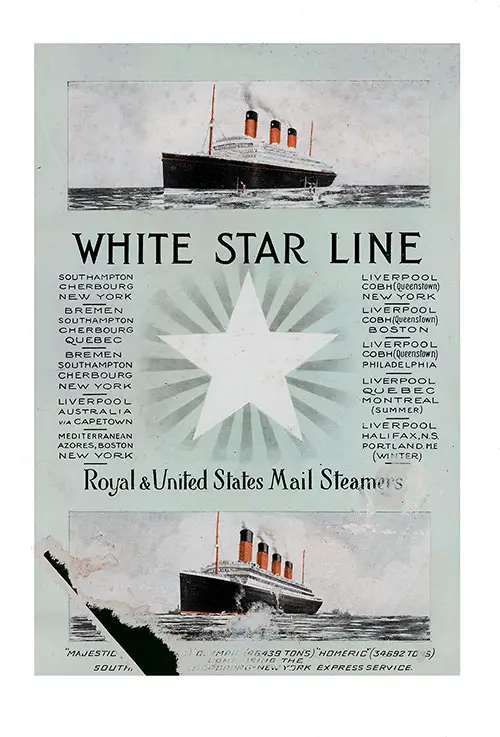
Front Cover, Second Class Passenger List for the RMS Majestic of the White Star Line, Departing 6 September 1922 from Southampton to New York via Cherbourg, Commanded by Captain Sir Bertram Hayes. | GGA Image ID # 13c88888e9 (Return to TOC)
Original 1922 White Star Line Second Class Passenger List from the RMS Majestic, then one of the world's largest and most famous ocean liners, sailing Southampton–Cherbourg–New York under Captain Sir Bertram Hayes.
Includes a filled-in Track Chart and Memorandum of Log, making this more personal and voyage-specific than an unused passenger list.
📖 Overview
This is an original Second-Class Passenger List for the RMS Majestic of the White Star Line, departing 6 September 1922 from Southampton to New York via Cherbourg, commanded by Captain Sir Bertram Hayes, K.C.M.G., D.S.O., R.D.
The front cover promotes White Star's prestigious Southampton–Cherbourg–New York Express Service, featuring the Majestic, Olympic, and Homeric. The back cover includes both a North Atlantic Track Chart and Memorandum of Log, filled in by the original passenger.
This is an especially appealing document because it combines:
- A major White Star Line ship
- The early postwar transatlantic travel boom
- A large Second-Class passenger roster
- A filled-in voyage log and chart
- Strong genealogical and research value
Senior Officers and Staff
- Commander : Sir Bertram Hayes, K.C.M.G., D.S.O., R.D.
(Commodore R.N.R., and Commodore White Star Line Fleet) - Asst. Commander : E. L. Trant (Commander R.N.R., Retd.)
- Chief Engineer: J. Wolff, O.B.E
- Surgeon: J. C. H. Beaumont, L.R.C.P. & S. (Edinburgh), L.F.P.S. (Glasgow)
- Asst. Surgeon : G. B. H. Jones, M.R.C.S. (Eng.), L.R.C.P. (London)
- Purser: C. B. Lancaster
- Purser: B. O. Bartlett, R.D. (Paymaster Lr. Commander R.N.R.)
- Assistant Purser : W. H. Haywood
- Chief Steward: J. O. Jennings
🌟 Distinguished & Noteworthy Passengers (VIP Highlights)
This Second-Class passenger list includes a wide range of passengers with strong genealogical and historical research potential. Several names stand out as especially notable or worth further research:
- J. M. Bartels — likely Julius Murray Bartels, New York stamp dealer and auctioneer known in philatelic circles.
- Hans A. Bluntschli — likely Hans Bluntschli, Swiss anatomist and primatologist.
- Mrs. Otis B. Boise — connected to American musical and expatriate cultural circles.
- Isabelle Bronk — likely Dr. Isabelle Bronk, professor of French at Swarthmore College.
- Stanwood Cobb — educator, author, and prominent American Baha'i.
- Fannia M. Cohn — pioneering labor educator and ILGWU leader.
- Alzada Comstock — economist and Mount Holyoke professor.
- Flora J. Cooke — progressive education leader associated with the Francis W. Parker School.
- Ernest T. DeWald — art historian, Princeton professor, museum director, and later Monuments Man.
- Sebastian Messmer — Catholic bishop and later Archbishop of Milwaukee.
- George Wharton Pepper — Philadelphia attorney, legal scholar, and U.S. Senator.
- William W. Price — early White House press corps pioneer.
- Dr. Bruno Roselli — Italian scholar and Vassar professor.
- Arthur Stanley — British politician and humanitarian.
- Janet Speakman — nurse, relief worker, traveler, and social reform figure.
Second Class Passengers
- Mr. Lazarus Abelson
- Mrs. Rebecca Abelson
- Mr. Isaac Abelson
- Miss Sarah Abelson
- Miss Esther Abelson
- Hermann Adler (Note 1)
- Sarah Adler
- Mr. Joseph Adler
- Mrs. Emma Adler
- Mrs. Pauline Alexis
- Mr. Joseph E. Allard
- Miss Clara Alther
- Mr. William Alway
- Miss Elizabeth Amen
- Mr. Emil Andersen
- Mrs. Augusta Andersen
- Mr. Elinor Anderson
- Mrs. Regina Anderson
- Master Elimer Anderson
- Miss Anna Anderson
- Mr. Carl Anderson
- Mr. Edward Andries
- Mrs. Alida Andries
- Miss Gertrude Anger
- Mrs. Katherine Aphold
- Mr. N. Arnaez
- Mr. Francis F. Atkins
- Mrs. Guseppina Baccala
- Miss Alde Baccala
- Miss Elizabeth D. Bache
- Mr. Andrew J. Backa
- Mrs. A. J. Backa
- Mr. Carl W. Backus
- Mr. Henry W. Backus
- Mrs. H. W. Backus
- Mr. Baer
- Mrs. Baer
- Miss E. Barr
- Mrs. E. Barry
- Mr. J. M. Bartels (Note 2)
- Mr. William Barth
- Miss Alanette Bartlett
- Miss May T. Bassett
- Mr. Henry Bauer
- Mrs. Helen Bauer
- Mr. Harry P. Becken
- Miss Vera Bel
- Mr. Joseph Bell
- Mrs. William Bell
- Mr. Frederick W. Benjamin
- Prof. Charles E. Bennett
- Mr. Alex Berenson
- Mr. Jacob Berger
- Mr. Koppel Berger (Note 3)
- Mr. William Berger
- Mrs. Mollie Berger
- Miss Ruth Berger
- Master Benjamin Berger
- Mr. Samuel Berkowitz (Note 4)
- Miss Dora Berkowitz
- Mr. M. Berlin
- Mr. P. F. Berry
- Mrs. Berry
- Miss E. Berrz
- Mrs. Mary E. Betzer
- Mr. Emanuel Biedermann
- Miss Flora Biedermann
- Mr. Joseph Biggs
- Mr. Sidney W. Binns
- Mr. J. Bloom
- Mr. Hans A. Bluntschli (Note 5)
- Mrs. Otis B. Boise (Note 6)
- Miss Margaret G. Boise
- Miss Laura J. Bomford
- Mr. Lucien Bonte
- Mr. Leon Bonte
- Miss Mary E. Booth
- Mr. Wm. C. Borden (Note 7)
- Mrs. Borden
- Mr. Fred Boyce
- Mrs. Ellen Boyce
- Miss Blanche Brackett
- Mrs. Ellen Bradley
- Mr. Lew Bregman
- Mrs. Bregman
- Miss B. Bregman
- Rev. Dr. August C. Breig
- Mrs. Marie Brening
- Mr. Robert Brening
- Miss Therese Brening
- Miss Dina Brening
- Miss Isabelle Bronk (Note 8)
- Dr. George Broodman
- Mrs. M. G. Brooks
- Miss Margaret Brooks
- Mr. Gordon Brown
- Miss Anne F. Brown (Note 9)
- Miss Lydia L. Brown
- Mr. Peter Brughelli
- Mr. Ernie Burch
- Mrs. Burch
- Mr. Stanton Burch
- Mrs. Burch
- Miss Kate Bushouse
- Mrs. A. A. Busse
- Mrs. Rose Butler
- Mr. Albert R. Button (Note 10)
- Mrs. Albert L. Button
- Mrs. Grace E. Byers
- Master George M. Byers
- Master David K. Byers
- Mr. Ascanio Carderelle
- Miss Ruth F. Carlson
- Miss Hattie M. Carmichael
- Mrs. Robert Christie
- Mr. Wm. A. H. Church, Jr.
- Miss Virginia Church
- Mrs. Theckla K. Clark
- Miss Jeannette Clarke
- Dr. Thomas A. Clay
- Mrs. Lillian Clift
- Master Edwin Clift
- Miss Catherine Clift
- Mrs. Nancy Coates
- Mr. Stanwood Cobb (Note 11)
- Mrs. Nayan Cobb (Ida Nayan Whitlam)
- Miss Jeanne Cochenet
- Miss Lucie Cochenet
- Mr. Alfred Codman, Jr.
- Miss F. M. Cohn (Note 12)
- Miss Alzada Comstock (Note 13)
- Mrs. Hilda Conrad
- Mr. Benjamin E. Conrad
- Master Geoffrey Conrad
- Miss Helen M. Cook
- Miss Flora J. Cooke (Note 14)
- Mrs. Hannah Coombe
- Miss F. E. Cox
- Mr. John H. Creighton
- Mrs. Creighton
- Mr. Bondy Croner (Note 15)
- Mr. G. E. Cullen
- Mrs. Cullen
- Mr. Shirley Culver
- Miss Dorothy Dann
- Mr. Harry De Boer (Note 16)
- Miss M. Deisling
- Mr. Michel Derzynski
- Mrs. Rosalie de Somer
- Mr. Ernest T. Dewald (Note 17)
- Mr. Joseph J. Dias
- Mr. Robert Dixcon
- Mr. John Doerig
- Mr. M. J. Dougherty
- Mrs. W. T. Downing (Note 18)
- Miss Downing
- Miss Ruth Drake
- Miss Barbara Drakslova
- Miss Annie Drew
- Mr. David Duncan
- Mrs. Isabel Duncan
- Mr. Michael J. Dunne (Note 19)
- Mrs. Dunne
- Miss M. D. Dushane
- Mrs. H. G. Eades
- Mrs.. W. Easton
- Mr. Philip Eberman
- Mr. David Edmunds
- Mr. Nathan Eischner
- Mr. J. Eliot
- Miss M. Ely
- Miss Elizabeth K. English
- Mr. John Erickson
- Mrs. Sophia Erickson
- Miss Agnes Erickson
- Mr. Gustaf Eriksson (Note 20)
- Miss Walborg Eriksson
- Mr. Fred A. Ernst
- Mrs. Ernst
- Miss Marie M. Esch
- Miss Ruth M. Esch
- Miss Ada M. Escott
- Mr. Paul Exanoff
- Mr. Erle Fairfield
- Miss Terezia Fanesali
- Mr. John Feldman
- Mrs. Feldman
- Miss Rosalie Feldman
- Mr. Frank Ferrario
- Mr. Maurice Firth
- Mr. Max Fixler
- Mr. John Flach
- Mrs. Mary A. Flach
- Mr. Simon Fleschner
- Mrs. H. Float
- Mrs. Victoria Foley
- Mr. Victor E. Francois (Note 21)
- Mrs. Matilda Francois
- Mr. S. Franghakis
- Mrs. Elizabeth Frederick
- Mr. Bernhard Friedberg
- Mrs. Helen Friedberg
- Mr. William Friedman
- Mrs. Mary Friedman
- Master Herbert Friedman (Note 22)
- Mr. Christian Gantsel
- Mrs. Ané Gantsel
- Mr. Fred J. Gerber
- Mr. Everett L. Getchell
- Mrs. Maude Getchell
- Mrs. Agnes Gibson
- Miss Agnes Gibson
- Mrs. Margaret M. Gimblett
- Miss Eunice Goddard
- Mr. Harold Golder
- Mr. George F. Goodson
- Mr. Wm. Goodson
- Mrs. Mary Goodson
- Mr. Morris Gorlin
- Mr. Harry Gorlin
- Mr. Alfred Graw
- Miss Mildred Gray
- Mr. Stephen Greene
- Mr. George W. Griffith
- Miss Henrietta Groner
- Mr. Louis Groner
- Miss Gulden
- Mr. Siegfried Guthman
- Miss Grace Guthrie
- Mr. M. B. Gwinn (Note 23)
- Mrs. M. B. Gwinn
- Mr. Jesse J. Haas
- Mrs. Edith Haas
- Mr. Arthur H. Hall
- Miss Mary M. Hallock
- Mr. J. Halloman
- Mr. Joseph Halpern
- Mrs. Rose Halpern
- Master Harold Halpern
- Miss Ruth Halpern
- Miss Hilda Hamman
- Miss Hilda Hammann
- Miss Eleanor Hammett
- Mrs. Eliz. L. Hammond
- Miss Jenny Hansen
- Rev. S. M. Hargett
- Mr. Russel Harris
- Miss Fannie N. Harrison
- Miss Elizabeth R. Harter
- Miss E. Harton
- Miss Harton
- Miss Ola M. Hartshorn
- Miss Margery Hast
- Mr. Albert B. Hastings (Note 24)
- Mrs. Hastings (Margaret)
- Mr. William S. Hayes
- Mrs. Hayes
- Mr. Benjamin Hebald
- Mrs. Hebald
- Mr. Ralph Hebald
- Miss May Hebald (Note 25)
- Mr. Herman Heidenrich
- Mr. Frank Heindrich
- Miss L. E. Hemington
- Mr. Wm. Wilson Henderson
- Mr. Ernest Henry (Note 26)
- Miss Herdman
- Mrs. Fannie Herrick
- Miss Marjory P. Herrick
- Mr. Abraham Hershgold
- Mr. Charles Hewlett
- Rev.John J. Hilmenga (Note 27)
- Miss Miriam B. Hilton
- Mr. Frank Hofmeister
- Mr. H. W. Hogden
- Mr. Martin Hoimark
- Dr. Anna Holm
- Mr. Oscar Holmlund
- Mrs. Helen Holmlund
- Mr. Percy F. Hook (Note 28)
- Mrs. Kate Hopkins
- Mr. Nathan Horn (Note 29)
- Mrs. Horn
- Mr. Samuel Horowitz
- Mr. Isaac F. Hoskins
- Rev. J. W. Houch
- Mr. W. Howland
- Miss Frances S. Hundley
- Miss Mary W. Hundley
- Miss Florence Hyde
- Miss S. Inzeberg
- Mrs. Hattie Irwin
- Mr. Gerard M. Ives
- Mr.Joseph Kaelin
- Mrs. Bertha Kaelin
- Miss S. Kamensky
- Mr. Benjamin Kamin
- Mrs. Kamin
- Mr. Henry Kamin
- Master W. Kamin
- Mr. J. M. Karpass
- Miss E. Keef
- Miss Florence R. Keene
- Mr. Josef Keller (Note 32)
- Mrs. Mabel H. Kendall
- Mrs. E. C. Kennett (Note 33)
- Mr. S. Kenward
- Mr. Szaja Kieselman
- Mrs. Kieselman
- Master Moszek Kieselman
- Mr. Thomas J. Killin
- Mrs. Clar. S. King
- Mr. Harry Kinsport
- Mrs. Olive Kinsport
- Miss M. S. Kisover
- Rabbi Bernat Klein
- Mrs. Helen Klein
- Miss Berta Klein
- Miss Eva Klein
- Mrs. Ida Klein
- Master George Klein (Note 34)
- Miss Helen Klock
- Dr. John D. Klopper
- Mrs. Klopper
- Mr. Leonard Klopper
- Master Robert Klopper
- Mr. Frederick H. Knight
- Prof. E. E. Knight (Note 35)
- Miss C. Marion Kohn
- Mrs. Zoe Kotlezoff
- Master Kotlezoff
- Mr. Frank Kretschner
- Mrs. Louise Kretschner
- Mr. Barend Kroeze
- Mr. Robert Kroeze
- Miss Nettie B. Kroeze
- Mr. Isaac Kronheim
- Mrs. Itka Krupiemia
- Mr. Meyer Krupiemia
- Miss Paja Krupiemia
- Dr. Charles Kullmer (Note 36)
- Mrs. S. E. Lackwood
- Mr. W. P. Ladd
- Mrs. A. Ladd
- Miss M. E. Ladd
- Master John Ladd
- Master Edward Ladd
- Miss Penelope Ladd
- Mr. William Landau
- Mrs. Fanny Landau
- Mrs. Anna Larsen
- Miss Estella Larsen
- Mr. E. C. Lawrence (Note 37)
- Mr. George Lee
- Mrs. Emma Leighton
- Mrs. Jessie Levering
- Mr. Wilson Levering
- Master Wilson Levering
- Miss Sara R. Levi
- Miss Sadie Leviton
- Mr. Emile Levy
- Mrs. Emma L. Levy
- Mr. William E. Hann
- Mr. Arthur Lichstein
- Mrs. Priscilla Lichstein
- Miss Theodora Lichstein
- Miss Marie Lisec
- Mr. B. Lisec
- Mrs. Apolouro Lodyga
- Dr. Louis E. Lord (Note 38)
- Mrs. Frances Lord
- Mrs. Florence Loria
- Miss Marjoria Loria
- Mrs. Jennie Loucks
- Mr. Harry Love
- Miss K. Lovell
- Mr. Basil Lynn
- Mr. James Macintosh
- Mrs. Macintosh
- Mrs. C. MacLean
- Miss Estelle Makover
- Mr. David Mallel
- Miss Clara Manley
- Miss Violet Margot
- Miss Dorothy Martin (Note 39)
- Mrs. Martini and Two Children
- Miss H. Masters
- Mr. Barney Maticka
- Mrs. Cornelia Maticka
- Mr. George J. Matthews
- Miss Margaret Mclntist
- Miss M. McLeod
- Dr. W. T. McMannis (Note 40)
- Miss Elizabeth McNaman
- Mr. Parker McCollester
- Mrs. McCollester
- Mr. Maxwell McCreery
- Mr. John Medd
- Mr. Abraham Melzer
- Mrs. A. Melzer
- Mr. Lester Melzer
- Miss Edith Melzer
- Mr. Herman Menaker
- Mrs. Menaker
- Mrs. Mary Merrill
- Miss Madre Merrill (Note 41)
- Rev. Dr. Sebastian Messmer (Note 42)
- Mr. Gustav Metz
- Miss Mann Alice Metz
- Mr. Louis Meyer
- Miss Freda Meyer
- Mrs. Anna Meyer
- Miss Emma Meyer
- Miss Sophie Meyer
- Mr. Emil Meyer
- Mrs. E. Meyer
- Mr. William Meyer
- Miss Aline Michner
- Mr. Edward Miller
- Mrs. Ellen Miller
- Mr. Harry Miller (Note 43)
- Miss W. G. Miller
- Mr. A. Mitchell
- Miss Lena Moeke
- Mrs. Lena Moeller
- Miss Helen Moeller
- Mr. Harry M. Morgan
- Mrs. Beatrice Morgan
- Mr. Trebor Morgan
- Miss Annie P. Morris
- Mr. Lemel Moses
- Miss Catherine Murphy
- Mr. Joseph Mutinsky
- Mr. Walter Myer
- Mr. Frederick Nadler
- Mrs. Ettie Nadler
- Miss Elena Nearing
- Mr. Nathan Nettle
- Mrs. M. T. Newboy (Note 44)
- Mr. Thomas Newhoff
- Mrs. T. Newhoff
- Mr. Thomas Newhoff
- Mr. C. C. W. Nicol (Note 45)
- Mr. Edward L. Nightingale
- Mr. Olaf Nilsson
- Mr. Frank Norris
- Mrs. Margaret Notovitz
- Miss Ruth Notovitz
- Master Harvey Notovitz
- Mrs. Mary Novotny
- Miss Mary Novotny
- Miss Anna Ochec
- Miss Helen Ochec
- Miss Sheila O'Connell
- Miss Phyllis M. Ogle
- Mr. B. Ohlin
- Miss Pelia Oppenheimer
- Mr. Gustave Orlander
- Mrs. Orlander
- Miss Margaret O'Rourke
- Mr. Herbert Patrick
- Mr. Luigi Pavlivi
- Rev. Boleslaub Pawlowski (Note 46)
- Miss Alice B. Pedersen
- Mrs. B. F. Pepper
- Mr. B. F. Pepper
- Mr. George W. Pepper (Note 47)
- Miss Anne S. Pepper
- Mr. John Perko
- Mrs. Bertha Perko
- Miss Germaine Pernet
- Mr.Joseph T. Peters
- Mrs. Jane Peters
- Mrs. Margaret Peters
- Mr. Isidore Pieran
- Mrs. Charles Platt
- Mr. Charles Platt (Note 48)
- Miss Dorothy Platt
- Miss Elizabeth Platt
- Mr. Morris Poole
- Mr. Walter J. Powell
- Mrs. Annie Powell
- Miss Marjorie G. Powell
- Mr. William W. Price (Note 49)
- Miss Margaret L. Price
- Mr. John C. Quinlan
- Mr. H. Raff
- Mrs. Raff
- Mr. Frederick D. Ramm
- Mr. Ralph Raper
- Mr. Christian Ravn
- Mr. T. T. Read (Note 50)
- Mrs. B. C. Reeder
- Mrs. Josephine Remer
- Miss Virginia Remer
- Miss H. E. Renwick
- Mr. Konrad Reyer
- Mr. Baron C. Renard
- Mr. Harry T. Reynolds
- Mrs. Reynolds
- Mr. Wm. de Rham (Note 51)
- Mr. E. R. Rheiner
- Mrs. Rheiner
- Mr. Joseph Ribstein
- Mrs. Ribstein
- Mr. Paul Ribstein
- Miss Gertrude Richards
- Mrs. W. D. Richards
- Mr. Francisco S. Richardson
- Mrs. Miriam R. Richardson
- Miss Cora M. Riggs
- Mr. William Rinderspacher
- Mr. W. S. Robertson
- Mr. Alson Robinson
- Mrs. Margery Robinson
- Mr. P. J. Rock
- Mrs. Rock
- Miss Florence Rock
- Miss Clara L. Rockwell
- Miss Sylvia Rogers
- Miss Rogers
- Mr. Paul Rogez
- Mr. Alexander Rose
- Dr. Bruno Roselli (Note 52)
- Mrs. Margit Rosenberg
- Miss Evelin Rosenberg
- Miss Dorothea Rosenberg
- Mr. S. Rosenblum
- Mr. Bernat Rosenstein
- Mr. Jacob Roth
- Dr. Alma Rothalz
- Miss Edna Rothalz
- Mrs. Evelyn Rothenberg
- Prof. William T. Rowland
- Miss Blanch C. Ryon
- Miss Helen C. Ryon
- Mrs. Amalia Sairanja
- Master Koloys K. Sairanja
- Dr. M. J. Salamson
- Mr. Sundel Saland
- Mrs. Rachel Saland
- Mr. Isaac Sandler
- Mr. Charles Schneider (Note 53)
- Mr. O. K. Schubert (Note 54)
- Mrs. Schubert
- Mr. Clarence Schubert
- Mr.Joseph Sefsak
- Mrs. Sefsak
- Master Joseph Sefsak
- Master Louis Sefsak
- Mr. Frank Seibert
- Rev. P. H. Seiller
- Miss Harriet Sellner
- Miss Julia Shafer
- Mr. Thomas Sharman
- Mrs. Matilda Sharman
- Master Leroy Sharman
- Mr. Clarence E. Shepard (Note 55)
- Mr. O. E. Sholz
- Mrs. Sholz
- Mr. David Shousz
- Mrs. Elise Sibweizer
- Mr. Philip Silverman
- Miss Amy D. Simmons
- Mrs. H. Sindall
- Miss B. Sindall
- Mrs. M. Singleton
- Miss F. Sloney
- Mr. A. W. Smith
- Mrs. Smith
- Mr. F. R. Smith
- Mrs. Smith
- Miss Margaret Smith
- Mr. August Sokolowski
- Mr. James Sorensen
- Mr. Soren Sorensen (Note 56)
- Mrs. Ani Sorensen
- Dr. Wm. Speakman (Note 57)
- Miss Janet Speakman (Note 58)
- Mr. H. E. B. Speight (Note 59)
- Mrs. M. L. Spencer
- Miss Nellie Staab
- Mr. A. R. Stanley
- Mrs. Stanley
- Miss Marjorie Stanley
- Mr. Arthur Stanley (Note 60)
- Mr. William Stark
- Mrs. Esther Stavisky
- Master Cecil Stavisky
- Master Maurice Stavisky
- Mrs. Florence M. Steadman
- Master Kenneth E. Steadman
- Miss Sylvia F. Steadman
- Mr. Eli Stein
- Mr. Emanuel Steinem
- Mrs. Steinem
- Miss Clare Stevens
- Mr. Samuel Stockhammer
- Mr. R. E. Streeter (Note 61)
- Mrs. A. Stupple
- Miss Alice Stupple
- Miss Winifred Sturdevant
- Mrs. Beckie Surdut
- Miss Eva Surdut
- Miss Bertha Surdut
- Miss Gussie Surdut
- Mrs. Frima Svartzfeld (also spelled Swartzfeld)
- Mr. Erick R. Svenson
- Miss Alma Svenson
- Mr. Martin Svenson
- Mrs. A. Swern
- Mrs. Bernalie Szobel
- Master Derso Szobel
- Master Albert Szobel
- Mr. John Tanner
- Mr. Francis Taylor
- Mr. Harry Tenenbaum
- Mrs. Dora Tenenbaum
- Miss Bertha Tenenbaum
- Miss Anna Tenenbaum
- Miss Mildred Tenenbaum
- Miss Beatrice Tepper
- Mrs. J. O. Tepper (Mrs. Jacob Oscar Tepper)
- Mr. P. H. Theopold (Philip Huntington Theopold (1902-1989))
- Mr. Levi Thomas
- Master David J. Thomas
- Mrs. G. T. Thomsen
- Master Lief T. Thomsen
- Mr. Richard W. Thorington (Note 62)
- Mrs. Amalia Threedy
- Mr. John Tilton
- Mr. William F. Tonkin
- Mrs. Sándorné Toth
- Mr. George H. Trever
- Mrs. Trever
- Mr. Cornelius Twomey
- Mrs. Sadie Twomey
- Mrs. M. F. Valentine
- Mr. Wilbert Van Appledorn
- Miss Sofia M. Van Hengel
- Mr. Henry Van Noord (Note 63)
- Mr. Edward Vekemans
- Mr. A. Verwey
- Mr. Vincenzo Vitti
- Miss Eva M. Volk
- Mrs. Catherine M. Vosbury
- Miss Edna Wagner
- Miss Waldo
- Mr. Ernest J. Walker
- Miss Clara L. Walker
- Dr. Schuler R. Waller
- Mrs. R. Walorska
- Miss A. Walorska
- Mr. Dore Walten
- Mrs. Dore Walten
- Miss Hilda Walten
- Mrs. Ivy Waltz
- Mr. Fremont P. Ward
- Mrs. Flora Ward
- Mr. P. Wasserstein
- Mrs. Wasserstein
- Miss Evelyn G. Webb
- Mr. Allen Wehrli
- Mrs. Cornelia Wehrli
- Mr. Carl T. Weinberg
- Miss Hedwig Weiner
- Mr. Tivadar Welkuz
- Mrs. Bela Welkuz
- Miss Mary Wells
- Mrs. Florence Welton
- Miss Unis M. Welton
- Mr. Himan N. Werntz
- Miss Ida Wessa
- Miss Dagmar Westling
- Miss May Wheeler
- Mrs. Amy White
- Miss Charlotte White
- Miss Florence White
- Mr. J. B. Whitley
- Mrs. Whitley
- Master B. Whitley
- Master Alex. Whitley and Infant
- Miss I. Widick
- Miss Jean Wilcox
- Mr. Arthur Williams
- Mr. John S. M. Williams
- Miss Elizabeth Williamson (Note 64)
- Miss Ada Winslow
- Miss E. B. Winston
- Mr. Hermann Wirshing
- Mr. John Wirshing
- Miss Mercedes Wirshing
- Mr. Samuel Wishnitzer
- Dr. Meyer Wishnoch
- Mr. Josef Witek
- Mrs. Annie Witek
- Master Robt. Witek
- Mr. Sam D. Wohlfeil
- Miss Carrie E. Wolfe
- Mrs. F. Woll
- Miss E. Woll
- Mr. George A. Wood
- Mr. Jack Woodbridge
- Mr. George R. Woods
- Mr. Jim T. Wright
- Mr. Urbain Wybo
- Mrs. Mamie Young
Notes About Second Class Passengers
- Later Generalmajor Hermann Adler (1890-1967) former Waffen SS officer who fought on the Eastern Front. He was a German officer, ultimately holding the rank of Major General , and a military writer . The majority of his works, primarily written during the Second World War, were placed on the list of banned literature in the Soviet occupation zone in 1946. In 1944, Adler took command of the 93rd Air Regiment and shortly thereafter the paratrooper regiment named after him, "Adler". On April 1, 1945, he was promoted to major general. From June to July 1945, he was interned in East Frisia and subsequently held as a British prisoner of war until December 1946. Return
- Likely J. Murray Bartels (born Julius Murray Bartels; July 15, 1871 – October 5, 1944) was a New York City-based dealer and auctioneer of rare postage stamps. He was also well known for his knowledge of United States postal stationery. Return
- Historical records from the early 1900s indicate that a prominent Koppel Berger (often recorded as a hotel proprietor) was a notable figure in early 20th-century news. The "British Officer" Incident (1915): Records show a Koppel Berger operating a hotel in the early 1900s, who notably hired legal counsel to successfully defend his hotel clerk in an infamous 1915 New York police recruitment/forgery case. Return
- Samuel Berkowitz, (1878-1966) a founder and president of the Congregation Children of Israel, born in Rumania. He settled in New York City in 1906. He was a founder also of the Wayfarers Home, which provides lodgings for transients seeking employment. It is supported by local Jewish organizations. Return
- This likely refers to Hans Bluntschli (1877–1962), a renowned Swiss anatomist and primatologist. During the early 1900s, he conducted significant morphological research and expeditions. In the early 1900s, he traveled extensively to the Amazon and Madagascar to collect rare primates and insectivores. The biological and histological specimens he gathered are still highly studied today. A large portion of his collection of serially sectioned Malagasy primates (like the Microcebus) is permanently housed at the American Museum of Natural History. Early in his career, he focused heavily on the jaw muscles of apes and humans, and described the fossil New World monkey Homunculus patagonicus. Return
- Mrs. Otis Bardwell Boise (born Anne "Annie" Châtele / Chatel) was an American socialite and cultural figure active in the arts during the early 1900s. She was the wife of notable American composer and music educator Otis Bardwell Boise. Mrs. Boise moved in the highest social and artistic circles. She and her husband spent significant time in Berlin and Weimar, Germany, in the 1880s and 1890s. She was a respected figure within the American expatriate and academic communities in Europe, famously giving lectures on topics like "Life in Berlin" in the early 1900s. By the early 1900s, the couple relocated to Baltimore, MD, where they lived at 815 Hamilton Terrace and 103 W. Monument Street. Mrs. Boise became a well-known hostess and patron of the arts, frequently chaperoning debutante events. As a bilingual cultural figure, she engaged in literary work, officially copyrighting English translations of foreign operatic works and plays in 1904. After her husband's passing in 1912, she continued to travel internationally as a prominent passenger on trans-Atlantic ocean liners into the 1920s. Return
- Possibly LT COL William Cline Borden, USA, (May 9, 1858 – August 18, 1934) was an American surgeon who was a key planner behind the Walter Reed Army Medical Center. Borden was also dean of the School of Medicine at George Washington University. Return
- Dr. Isabelle Bronk, professor emeritus of French at Swarthmore College and former head of the Department of Romance Languages there. Dr. Bronk, who visited Europe sixteen times, was Professor of French and head of the Romance Languages Department at Swarthmore from 1901 until her retirement, in 1927. She was born in Duanesburg, N. Y., the daughter of Abram Bronk and Cynthia Brewster Bronk, and attended the Brockport (N. Y.) State Normal School, Wellesley College, the University of Leipzig in Germany, the Sorbonne in Paris and College de France. She was a member of the Women's International League for Peace, serving for a time as treasurer of the Delaware County branch; the American Association of University Professors, of which she was chairman of the Swarthmore branch, 1921-22; the American Association of University Women, serving on the council, 1921-23, and as secretary from 1924 until 1926; the Colonial Dames of America, the Modern Language Association of the Middle States and Maryland and the Modern Language Association of Pennsylvania, of which she was vice president, 1923-24. Return
- Likely Miss Anne Brown (1854-1940) in 1876, she began her career as a teacher on the Rock Island Arsenal. Her position included teaching all subjects to the children of the army officers. Brown taught at the Arsenal two years before she moved to New York in 1878. She joined the faculty of Miss Chapman's School located on East Forty-Second Street, NY. I presume that during the two years she spent on the Arsenal, Anne Brown became acquainted with Charles & Mary Deere. Charles and Mary Deere providing financial aid to Anne for opening her own school in 1880. Anne Brown and a fellow teacher at Miss Chapman's, Mille Isaline Ruel, opened their school at 22 West Fifty-Sixth Street, NY. Two years later they moved their school to 711 Fifth Avenue, NY. Anne Brown's school was successful and grew to occupy four adjacent houses on Fifth Avenue. Students were from top families and included the two Deere daughters, Anna and Katherine. Anna graduated in 1882 and Katherine in 1884. In 1902 Anne Brown closed her school. Then two years later she established a day and boarding school called Highcliffe Hall, at Park Hill, Younkers, NY. Anne then chose to retire two years later in 1906 . No information has been found to tell us what she did between 1906 and her death on February 2, 1940. Return
- Possibly In the early 1900s, the notable Rev. Albert R. Button (1851–1934) was a prominent Baptist minister and social reformer known for his leadership in the South Dakota women's suffrage movement. Stationed in Burke, SD, he organized rallies alongside activist Emma Smith DeVoe. Return
- Stanwood Cobb (1881 – 1982) was an American teacher, author and prominent Baháʼí of the 20th century. Dr. Cobb became one of the first American members of the Baha'i Faith, a religion emphasizing the spiritual unity of all humankind. He founded the School of the Nations in Washington D.C. in 1932, which promoted progressive educational concepts and aimed at offering a global curriculum. Return
- Fannia Mary Cohn (ca. 1885–1962) was a trailblazing Jewish-American labor leader, educator, and organizer for the International Ladies' Garment Workers' Union (ILGWU). After immigrating to the U.S. from Russia in 1904, she entered the garment industry, quickly becoming a foundational force in the American workers' education movement Fannia Cohn - Jewish Virtual Library. She made history by becoming the first female vice president of the ILGWU, serving from 1916 to 1925. In 1918, she helped establish and run the ILGWU's Education Department, which became the largest union-sponsored education program in the country, providing working women with access to academic and trade union training. She co-founded the Brookwood Labor College and the Manumit School, firmly believing education was an essential tool to fight inequality and empower women in the workplace. Return
- Alzada Peckham Comstock (November 23, 1888 – January 15, 1960) was an economist who taught at Mount Holyoke College. Her research focused on taxation, and between the world wars she frequently traveled to Europe to study the effect of different economic policies. She became a Guggenheim Fellow in 1926. Her first book, published in 1921, was State Taxation of Personal Incomes, based on her doctoral research. She taught for one year at Barnard College from 1921 to 1922. Return
- Flora Juliette Cooke (1864 – 1953) was an American educator who played a prominent role in the progressive education movement of the early 20th century. As the long-serving principal of the Francis W. Parker School in Chicago, Cooke was instrumental in developing and disseminating the principles of progressive education, which emphasized child-centered learning, hands-on activities, and the integration of the curriculum. She's considered a significant figure in the field of educational reform during this period, due to her innovative approaches to teaching and her commitment to inclusive, democratic education. Return
- Bondy Croner was a New York City real estate developer and apartment building owner in the early 1900s. Born around 1856, he managed and sold properties across Manhattan, including a business and apartment building located at 22 West 75th Street. In January 1927, he testified in a high-profile New York State Supreme Court trial between Broadway producer Philip M. Browning and his wife, appearing as the landlord of the 75th Street apartment where one of the witnesses lived. Return
- Harry DeBoer (1903–1992) was an American labor organizer and Trotskyist. He was born in Crookston, Minnesota, and worked in the Minneapolis coal yards. DeBoer became one of the leaders of the Minneapolis Teamsters Strike of 1934 – a particularly well-organized action that resulted in the shutting down of most commercial transport in the city. A leading member of the Socialist Workers Party, DeBoer was prosecuted together with many other SWP leaders under the Smith Act for opposing the US involvement in World War II. He found guilty and sentenced to one year in prison. In 1987, DeBoer authored the essay "How to Win Strikes: Lessons from the 1934 Minneapolis Truckers Strike" (also translated into Danish and German), in which he sought to disseminate the tactics used in the Minneapolis strike for the benefit of a new generation of socialists. Return
- Lieutenant Colonel Ernest T. DeWald (US Army) (1891–1968) Museum director and eminent scholar of medieval and Renaissance art, Ernest T. DeWald was born in New Brunswick, New Jersey on September 18, 1891. After receiving his Bachelor of Arts from Rutgers University in 1911, he continued his studies at Princeton University, where he received a Master's degree in 1914 and a Ph.D. in 1916. During World War I, he served as a lieutenant in the Infantry and was later appointed Assistant Military Attaché in the American Legations at Berne and Warsaw. Following his return to the United States, he taught briefly at both Rutgers and Columbia. He then became Associate Professor of Art at Princeton in 1925 and full Professor in 1939. In early 1944 DeWald was named Director of the MFAA in Rome. There, he prepared The Soldier's Guide to Rome, a small guidebook designed to familiarize American soldiers with the cultural value of the ancient treasures of Rome. In 1945 DeWald was transferred to MFAA operations in Austria, where he supervised the return to Italy of a collection of paintings and sculptures looted from Monte Cassino by the Hermann Goering Panzer Division and intended for Hitler's planned Führermuseum in Linz, Austria. He returned to his position as Professor of Art at Princeton, where he taught a popular course on Italian painting. Also in 1946, he wrote the introduction to Henry La Farge's book, Lost Treasures of Europe, a photographic documentation of art and architecture lost during the war. In 1947 he was named Director of the Princeton University Art Museum, where he remained until his retirement in 1960. During his tenure as Director, he undertook the cleaning of numerous Old Master paintings in the museum's collection. His own self-taught knowledge of conservation techniques was a product of not only his work as a Monuments Man but his continued correspondence with leading conservator and fellow Monuments Man George L. Stout. Return
- Widow of Walter T. Downing (1865-1918) who was an American architect in Atlanta, Georgia. Several of his works are listed on the National Register of Historic Places. Walter T. Downing was father of John F. Downing, who was also an architect and who continued his father's firm. Return
- Michael Joseph Dunne (1897 – 1977) Served with the 14th (Royal Montreal) Battalion in World War One. He was wounded three times. His wartime experiences were the inspiration for the movie Passchendaele; especially the opening scene. Return
- Gustaf Erikson – The Father of the Swedish Car Industry. As early as 1897, Gustaf Erikson designed Sweden's first car with an internal combustion engine. Since then, at least 150 different car models have rolled out from Swedish garages, bicycle workshops, factories and industries. Gustaf Erikson is the father of the Swedish car industry. At the same time as he graduated from the Technical Elementary School in Örebro in 1878, the first horseless carriages began to roll down in Europe. 18 years later he got his dream job. Return
- Victor Emmanuel François (1866–1944) was a prominent language educator and author in the early 20th century. He is best known for writing widely used French and Latin textbooks, grammars, and language workbooks for American high schools and universities. Return
- Herbert Friedman (1916 – 2000) was an American physicist and astronomer who did research in X-ray astronomy. During his career Friedman published hundreds of scientific papers. One such example is "Ultraviolet and X Rays from the Sun". Friedman worked at the Naval Research Laboratory (NRL) for the entirety of his professional career, from 1940-1980. He was elected to the American Academy of Arts and Sciences and the United States National Academy of Sciences in 1960. He received the Eddington Medal of the Royal Astronomical Society in 1964. That same year, he was elected to the American Philosophical Society. In 1987 he was awarded the Wolf Prize in Physics "for pioneering investigations in solar X-rays". Return
- Montie B. (M. B.) Gwinn was a prominent pioneer businessman and politician in early Idaho. In the 1880s, Gwinn co-founded a highly successful general merchandise store on Front Avenue in Caldwell. The business eventually incorporated as the M. B. Gwinn Mercantile Company. Gwinn was elected as the second Mayor of Caldwell, Idaho. He served consecutive one-year terms in 1894 and 1896. Gwinn was instrumental in the growth of the Owyhee County mining town of DeLamar. By the summer of 1890, he opened a prominent mercantile house there to service the miners. Entering the 20th century, Gwinn's business ventures continued to grow as he diversified his commercial footprint in the Pacific Northwest. Return
- Albert Baird Hastings (1895 – 1987) was an American biochemist and physiologist. He spent 28 years as the department chair and Hamilton Kuhn Professor of Biological Chemistry at Harvard University. After retiring from Harvard, Hastings moved to the Scripps Clinic and Research Foundation (now Scripps Research), where he became the director of the division of biochemistry and helped to establish the institution's emerging program in basic research. In 1966, he became one of the first faculty members at the University of California, San Diego's new medical school. His research focused on the biochemical underpinnings of physiology and included characterizing acid-base homeostasis in blood and pioneering the use of radioactive tracers for studying metabolism. Hastings received a number of honors and awards for his work, including election to the National Academy of Sciences in 1937 and the President's Medal for Merit in 1948 following his wartime service on the Committee for Medical Research. Hastings died of heart failure in 1987 at age 91. Return
- New York socialite and family member of the historic Hebald family, May (Mae) Hebald was born in Manhattan in July 1908. Return
- Ernest Henry (1885–1950) was a mechanical engineer. He developed auto racing engines, and is especially well known for his work for Peugeot and Ballot, who dominated Grand Prix auto racing from 1912 to 1921. His engine design directly influenced Sunbeam Racing cars as early as 1914; the 1921 Grand Prix Sunbeams owe much to his work with Ballot and the 1922 Grand Prix Sunbeams were designed by him. Known for being the creator of first 4-valve DOHC engine. Return
- John J. Hiemenga (1877 – 1974) was a Dutch-American pastor and educator and first President of Calvin College from 1919 to 1925. Hiemenga has also been noted as an expert on Dutch-American dialects, especially in Western Michigan and New Jersey. Return
- The name "Mr. Percy F. Hook" in the early 1900s usually refers to Percy Frederick Hook. Born in 1866, he was a prominent figure in the Y.M.C.A. in Hobart, Tasmania, Australia. Return
- Nathan Horn (1862-1930) A History of Remarkable Achievement How a Young Man, Reaching This Country With But a Solitary Quarter in His Pocket, Has Built Up One of the Largest and Famous Tailoring Establishments in America. Return
- Mme. Adele Jais (often referenced as Madame Jais) was a notable historical figure operating a well-known Parisian boarding house or salon. She is prominently recorded as the landlady and caretaker who assisted the aging parents of the renowned Irish poet W. B. Yeats in the early 1900s. Return
- Possibly Pierre Armand Jacquet (1906 – 1967) was a French chemical engineer and metallurgist. He contributed to electrolytic polishing techniques to produce very smooth metal coatings and also to non-destructive approaches for surface metallographic analysis. Return
- Mr. Josef Keller is historically renowned in the culinary world as the inventor of the Black Forest cherry cake (Schwarzwälder Kirschtorte). He was a prominent German pastry chef who created the iconic dessert in 1915 at Café "Ahrend" in Bad Godesberg. Return
- Mrs. E. C. Kennett (born Emma Cecele Anderson, 1891–1985) was a pioneering female developer and contractor. After her marriage ended, she independently entered the Chicago construction industry to support her children. Between 1923 and 1932, she developed over 150 apartment buildings—including roughly 80 in Chicago's Rogers Park and West Ridge neighborhoods. Return
- George Klein (c. 1915–1969) was a foundational American comic book artist and cartoonist. Though most active from the 1940s through the 1960s, he is renowned for his uncredited but vital inking on Jack Kirby's pencils in 1961's landmark Fantastic Four #1. Return
- Professor E. E. Knight was a pioneer of the California avocado industry. A resident of Central America for many years, he imported superior "hard-shelled" Guatemalan avocado budwood into Yorba Linda, California. In 1914, he introduced several acclaimed varieties, most notably the Queen and Linda avocados. Return
- Dr Charles Julius Kullmer, head of the German Department at Syracuse University for seven years and a member of the faculty since 1905-1942. Dr. Kullmer, widely known in academic circles as a German scholar, had for years carried on astronomical research outside of classroom hours. He was the inventor of the equatorial star finder and for many years gave lectures on popular astronomy at Syracuse University. Return
- Egbert Charles Lawrence was an educator, pastor, and author. In the early 1900s, he served as a prominent minister and educator in upstate New York. He is best remembered historically for his extensive work assisting with mathematical textbooks, as well as authoring several historical and genealogical records tracing the Lawrence family. Return
- Dr. Louis E. Lord (1875–1957) was a prominent American classicist and scholar of Greek. He served as a long-time professor at Oberlin College and played a major role in the leadership of the American School of Classical Studies at Athens (ASCSA) and the Bureau of University Travel. Lord was heavily decorated by the Greek government for his efforts to foster cultural ties and scholarship. He was honored as a Chevalier of the Order of the Redeemer, an Officer of the Order of George I, and a member of the Royal Order of the Phoenix. Return
- Dorothy Martin (1900 – 1992) a.k.a. "Marian Keech", later known as "Sister Thedra", was also an American New Age spiritualist best known for her 1954 prediction of a catastrophic flood and the arrival of extraterrestrials. Her small group of followers, informally known as The Seekers, became the subject of the influential social psychology study When Prophecy Fails (1956), which contributed to the development of cognitive dissonance theory. Martin later founded spiritual organizations and produced channeled writings attributed to non-human intelligences. Return
- Dr. William T. McMannis was a New York City-based physician in the early 1900s. Historical records, including The New York Times archives, show that he maintained a medical practice and treated patients at 612 West 179th Street in Manhattan during the 1910s. Return
- Miss Madre Merrill (1892–1974) was a prominent educator and author who worked primarily at Indiana University and UC Berkeley. In the early 1900s—particularly spanning the 1920s to 1940s—she was highly regarded as a Professor of Spanish and an editor of classic literature. She served as a professor and scholar, known for editing Spanish texts used in American universities during the early-to-mid 20th century, such as Lo Que Pasa En Una Tarde and Enrique Perez Escrich's Fortuna. She was deeply entwined with the architectural and academic community in Berkeley, California. In 1928, a designated Craftsman-style home was built for her at 1544 Le Roy Avenue in Berkeley. Her academic influence lives on through the Madre Merrill Fund at Colorado College, which still provides undergraduate grants and research opportunities in foreign languages today. Return
- Archbishop Sebastian Gebhard Messmer (1847-1930) Following the clerical vocation, he entered the diocesan College of St. George's, near St. Gall, where he became known for his devotion and close application to his studies, and obedience to his superiors. At that school he remained till 1866, and then entered the University of Innsbruck, in the Tyrol, in Austria, where he studied philosophy and theology, remaining there 5 years. Those were years of hard work, yet full of pleasant recollections. On July 23, 1871, he was ordained to the priesthood for the American mission. He had applied for and received an appointment by Bishop Bailey, of Newark, N. J., as professor of theology at the Seton Hall College, South Orange, N. J., which is also a diocesan seminary. There he remained till August 1889, during which time he made himself generally beloved by the thoughtful and kindly interest he manifested to all with whom he came in contact. Bishop Messmer was appointed Bishop of Green Bay, December 14, 1891, but did not arrive here till April 7, 1892. Here a wide and useful, but also hard field of labor awaited him, which for the time seemed to check his literary efforts. But the strong mind that brought order out of the manifold accumulations of a great literary council has already made him fully acquainted with work in the Diocese of Green Bay. Here his influence, always for good, is felt in every nook and corner. The respect which he inspired on his arrival has not abated but is increased as time goes on. To the talents of a pastor and bishop is added the learning of a scholar and literature, which (united with rare business tact and ability to govern) has made him already a conspicuous figure in the Church and State, and has gained him the confidence, good will and love of all classes, denominations and nationalities. Return
- Possibly Harold Arminius Miller (1875–1943), commonly called Harry, was an American race car designer and builder who was most active in the 1920s and 1930s. Griffith Borgeson called him "the greatest creative figure in the history of the American racing car". Cars built by Miller won the Indianapolis 500 nine times, and other cars using his engines won three more. Millers accounted for 83% of the Indy 500 fields between 1923 and 1928. Return
- In the early 1900s, Mrs. M. T. Newboy and her husband, Henry, were notable figures in Louisville, Kentucky baseball history. Mr. and Mrs. Newboy organized, managed, and trained a women's baseball team, with Mrs. Newboy famously recognized as a top "woman baseball expert" in the country at the time. Return
- Mr. C. C. W. Nicol (Carl C. W. Nicol) was an American academic and psychologist. He is best known for his tenure at Oberlin College in Ohio, where he served as an Assistant Professor of Psychology and Philosophy, and later as the Dean of Men in the 1920s. By the 1920s, he had joined the faculty full-time, teaching psychology and acting as a respected campus figure and administrator. Return
- Rev. Boleslaus (or Boleslaub) Pawlowski was a prominent Polish-American Catholic priest who established and led multiple parishes in western Pennsylvania during the early 1900s. His early 20th-century history includes the following milestones: Appointed as the first permanent pastor of the Madonna of Czestochowa Catholic Church in April 1903. Under his leadership, the congregation quickly raised funds and completed a wooden frame church by September. Became the founding pastor of St. Joseph's Parish in 1905. He successfully completed the parish church that same year and led the construction of the rectory and the first parish school by 1907. Return
- In the early 1900s, George Wharton Pepper (1867–1961) was a prominent Philadelphia attorney, law professor, and legal scholar. During this period, he made foundational contributions to constitutional law and legal education, while also taking on major corporate litigation. Return
- Possibly Charles Adams Platt (1861 – 1933) was an American architect, garden designer, and artist of the "American Renaissance" movement. His garden designs complemented his domestic architecture. Return
- William W. Price was a prominent American figure in the early 1900s, best known as the pioneer of the White House press corps and for founding the historic Fallen Leaf Lodge in California. In the late 1890s and early 1900s, William W. Price was a reporter who stationed himself at the White House daily to proactively interview guests coming and going from appointments. This daily stakeout established him as the first reporter recognized with the White House beat. When President Theodore Roosevelt built the new Executive Office building (the West Wing) in the early 1900s, Price's persistent presence led Roosevelt to include a permanent workspace for the press corps. Return
- Thomas Thornton (T. T.) Read (1880–1947) was a prominent mining engineer, metallurgist, and historian of the mineral industry. During the early 1900s, he emerged as a leading authority on mining education, industrial technology, and copper metallurgy in both the United States and East Asia. Return
- Mr. William de Rham (born 1901) was an American socialite, broker, and trustee of the Green-Wood Cemetery. He was heavily integrated into elite New York society during the early 1900s. His descendants and family history are documented in the FamilySearch William De Rham Record and the Getty Museum de Rham Collection of early photographs. Return
- Professor Bruno Rossetti (1887-1970) taught Italian at Adelphi from 1911 until returning to his native country to fight in the First World War, after which he ultimately taught at Vassar from 1919-1933. In 1922, Prime Minister Mussolini bestowed honors on Roselli for his service abroad, and King Victor Emmanuel III praised Henry Noble MacCracken, Vassar's president, for fostering the learning of Italian in America. The Italian leadership, it seems, felt very proud of Roselli and the work he pursued in Poughkeepsie. His rhetoric grew more political as Roselli grew more secure and comfortable at Vassar and as Mussolini succeeded in Rome. In a paean to the victorious Fascists in the Miscellany News on November 18, 1922, he extolled the virtues of the new ruling party. "They are lovable boys in spite of all their fierceness, these 'Camicie Nere,' " he wrote. "They are young, and therefore their musketeerish methods strike no false chord." Further evidence of Roselli's working for the Fascists emerges in a 1920 New York Times report of the remarks at the New York Vassar Association's annual luncheon of "Professor Bruno Roselli, Italian exchange professor at Vassar, sent by the Italian Government to lecture here." Sharing the podium with former United States Ambassador to Turkey, Henry Morgenthau and President MacCracken, Roselli implored American women to stay alert and informed about politics and international affairs, urging them "not to forget the lessons learned during the war, and not to return to the slothful ways considered right prior to 1914." Return
- Charles Schneider (June 28, 1898 – August 6, 1960) was a French businessman. He served as the Chairman of Schneider Electric from 1942 to 1960. Return
- Oscar K. Schubert (often known as O. K. Schubert) was a prominent early 1900s Wisconsin businessman, known for owning a men's clothing store on Wilson Street in Madison, Wisconsin. During the height of World War I in 1918, a major advertising boycott was launched against the Capital Times newspaper by local business associations due to the paper's anti-war stances. O. K. Schubert became the first major break in the boycott when he purchased a full-page advertisement in the paper for a "workingmen's sale". The ad generated his biggest business day in twenty-two years, forcing him to hire five extra clerks to handle the crowds. Outside of his clothing store, Schubert is well-known in local architectural history for commissioning a home at 932 Spaight Street in Madison, WI. Built in 1906–1907, the home was designed by the renowned architectural firm Claude & Starck and is considered a prime example of Craftsman-style residential architecture. The home still stands today and was later documented in the Wisconsin Historical Society. Return
- Clarence Erasmus Shepard (1869–1949) was a prominent early 20th-century architect renowned for his work in the Prairie School style. He began his career as a draftsman in Frank Lloyd Wright's studio in Chicago from 1902 to 1905 before moving to Kansas City in 1907, where he designed over 600 homes. Return
- Soren C. Sorensen, First Lieutenant (Infantry), 28th Infantry Regiment, 1st Division, American Expeditionary Forces, was the recipient of the Distinguished Service Cross and Silver Star in World War I for actions taken during May 27 – 31, 1918 at Cantigny, France. First Lieutenant Sorensen although wounded early in the attack and suffering great pain, refused to leave his post and continued in command of his company throughout the entire action; his courage and resolution contributed greatly to the successful defense of the sector. Return
- William William Speakman (1865-1930), a prominent Philadelphia ophthalmologist. Return
- Janet Speakman (1895-1971) was the daughter of William William Speakman and Anna Travilla Speakman (1866-1945). Janet Speakman earned a degree as a registered nurse in December 1921, training in Meadville General Hospital. In February 1922 she began a six-month tour in a maternity hospital is France. In the fall of 1923, she went to Russia for a year of relief work with the American Friends Service Committee. On her return to the U.S., she worked at Hahnemann Hospital in Philadelphia. Janet visited Russia a second time in 1926, traveling with a delegation led by Christian evangelist Sherwood Eddy. Earlier she had studied music and voice in Philadelphia, and on her return to the United States she prepared a slide presentation on Russia and worked as a private duty nurse for several years. Her father's health was failing, and Janet nursed him until is death in February 1930. In 1930 she visited Cuba. She studied social work in New York City in 1930-1931, residing in the International House on Riverside Drive, and worked briefly as a caseworker. She attended National Conference on Social Work in 1935 in Montreal, Canada. In the mid-1930s, she traveled widely in Europe for about 15 months and became interested in socialism, peace efforts, and spiritualism. In July August 1937 she traveled with the American Seminar organized by Sherwood Eddy. In 1937-1939 travels included several months in Germany and Italy. In the summer of 1939 she witnessed Hitler rallies, and she ended her travels in Italy, intending to travel to Yugoslavia. On her return to the United States at the end of 1939, Janet suffered emotional and health issues. Return
- Harold E. B. Speight (1883–1966) was a prominent Unitarian minister, educator, and author. Born in England, he came to prominence as a clergyman, serving notably as the minister of Boston's historic King's Chapel from 1921 to 1927 before transitioning to a distinguished career in higher education as a professor and dean. Return
- Sir Arthur Stanley (1869 – 1947) was a British Conservative politician, humanitarian, and Chairman of the Joint War Organisation of the British Red Cross Society and the Order of Saint John of Jerusalem in England during World War I and World War II. Return
- Randolph Elwood Streeter (1847 – 1924), often referred to as R. E. Streeter, was one of the founding fathers of the Pastoral Bible Institute[1] and a member of the editorial board of that church's The Herald of Christ's Kingdom magazine. Return
- Richard Wainwright Thorington, Sr. (born ~1898) was an attorney and civic leader. He notably served as a WWI American Field Service ambulance driver with the French Army, later becoming an honorary counsel for the Republic of Korea and a senior partner at a Philadelphia law firm. Return
- Henry Van Noord was a prominent Michigan businessman who, alongside his brother Robert, operated the VanNoord and Sons Elevator and Lumber Company in Hudsonville, Michigan, during the early 1900s. Founded by their father, Sybrant, the business was a cornerstone of the West Michigan agricultural and building supply trade. Return
- In the early 1900s, Miss Elizabeth Williamson was a notable figure in British art, primarily known as the subject of two famous paintings by the pioneering artist Annie Louisa Swynnerton. "Miss Elizabeth Williamson on a Pony" (1906): A prominent oil on canvas painting currently held in Tate that captures her as a young girl. "Miss Elizabeth Williamson" (1906): A smaller half-length portrait emphasizing playful, spontaneous sunlight by the same artist. Elizabeth hailed from an influential social circle. Her great-grandmother was the prominent society hostess and arts philanthropist Mrs. Charles Hunter, and her mother was Phyllis Hunter, who was painted by John Singer Sargent. Return
🧬 Genealogical & Historical Value
Second Class passenger lists are especially valuable because they often document travelers who are less visible in elite Saloon lists but more socially and geographically diverse.
This list provides excellent research value for:
- Genealogists tracing immigrant and return-travel families
- Historians studying post-WWI migration and transatlantic travel
- Researchers of Jewish, Central European, Scandinavian, British, and American family histories
- Scholars interested in women educators, clergy, labor leaders, academics, and professionals
- White Star Line and RMS Majestic collectors
The large passenger roster makes this a substantial source document rather than merely a decorative maritime collectible.
Information for Second Class Passengers.
Landing Arrangements at New York. Should the Steamer arrive at the New York Wharf after 8:00 pm, Passengers may land if they wish to do so and have their baggage passed by the Customs Authorities immediately on arrival, but those who prefer to remain on board may do so and have the whole of their Baggage passed the following morning not earlier than 7 o'clock.
Breakfast will be served to those who remain on board overnight.
Uniformed representatives of the American railroads meet all steamers on arrival at New York. Railroad tickets may be purchased and baggage checked from the steamship Pier to any point along the Lines of the Pennsylvania, New York Central, Erie, Lehigh Valley, and connecting railroads.
Public Telephones
With Booths and Operators, on our New York Piers
Meals WILL Be SERVED AS FOLLOWS :
When One Sitting
- Breakfast: 8:00 am to 10:00 am
- Luncheon: 12:30 pm
- Dinner: 6.30 pm
When Two Sittings
- Breakfast: 7.30 am and 8:30 am
- Luncheon: 12:00 noon and 1:00 pm
- Dinner: 6:00 pm and 7:00 pm
The Bar opens at 8:00 am, and closes at 10.30 pm
Lights are extinguished in the Dining Saloon at 11:00 pm, Lounge, Reading, and Writing Room, and Smoking Room at 11:30 pm
Smoking is strictly prohibited in any of the Staterooms, Reading and Writing Room, or Dining Saloon.
Seats at Table. Passengers who have not previously arranged for seats at table to be reserved should apply for same to the Saloon Steward.
Medical Attendance. The Surgeon is Authorised To Make Customary Charges, Subject in Each Case To The Approval of The Commander, for Treating Passengers at Their Request for Any Illness Not Originating On The Voyage. in The Case of Sickness Developed On The Voyage NO Charge WILL Be MADE, and MEDICINE WILL Be PROVIDED Free in ALL CIRCUMSTANCES.
Letters, &C., for Passengers will be brought on board before the Passengers land.
Passengers should personally ascertain whether there is any mail for them before disembarking and they are invited to leave their addresses with the Saloon Steward for any later despatches to be re-directed. Postage Stamps can be obtained from the Saloon Steward, who will take charge of Cable Despatches and Telegrams for transmission.
Charges PAID on Board. Passengers are requested to ask for a Receipt on the Company's Form for any additional Passage Money, Chair or Steamer Rug Hire, or Freight paid on Board.
Library. Books can be obtained on applying to the Library Steward.
Deck Chairs and Steamer Rugs can be hired on application at a charge of 7/6 each for the voyage.
Valuables. The particular attention of Passengers is drawn to the ticket conditions regarding the carriage and custody of articles specified in Section 4281 of the revised Statutes of the United States, but Passengers can, and are accordingly advised to, protect themselves by insurance. The Line has provided a safe in the office of the Purser in which Passengers may deposit money, jewels, ornaments, documents or other valuables for safe keeping and a deposit receipt will be issued by the Purser.
Exchange of Money. The Purser is prepared, for the convenience of Passengers, to exchange a limited amount of English, and American money, at rates which will be advised on application.
Baggage. Questions relating to Baggage should be referred to the Ship's Baggage Master. Trunks, Chairs, etc., which Passengers may desire to leave in charge of the Company should be appropriately labeled and handed to the Baggage Master on the Wharf at New York. and such articles will be stored entirely at owner's risk. It is for Passengers themselves to see all their Baggage is passed by the U.S. Customs Authorities on landing.
Dogs. Passengers are notified that dogs cannot be landed in Great Britain unless a license has previously been procured from the Board of Agriculture, London. Forms of license must be obtained by direct application to the Department before the dog is taken on board at New York.
Travellers' Cheques, payable in all parts of Europe, can be purchased at all the principal offices of the White Star Line. These Cheques are accepted on board White Star steamers in payment of accounts,but the Pursers do not carry funds to enable them to cash same.
Deck Games and Amusements. Deck Quoits, Shuffleboard, Bull Board and other games are provided on deck under the charge of a Quartermaster.
Chess, Draughts, Dominoes, etc., may be obtained on application to Saloon Steward.
Gymnasium.—Fully supplied with modern appliances, located on Deck D, and is open for exercise by Ladies, Gentlemen and Children during the following hours :-
- Gentlemen ... from 6:00 am to 9 a.m
- Ladies ... from 10:00 am to 12 noon
- Ladies and Gentlemen from 12 noon to 1:00 pm
- Children ... ... from 2:00 pm to 3.30 p.m
- Ladies and Gentlemen from 3.30 pm to 7p.m
No charge is made for the use of the appliances. Tickets obtainable at the Purser's Office, " E " Deck.
Passengers'Quarters. Second Class Passengers are not allowed to enter First or Third Class compartments, or vice versa, as complications might arise under the Quarantine Regulations.
Barber. The Barber is authorized to make the following charges : (s. d. - Shiilings Pennies)
- Shaving 0 9
- Hairdressing 1 0
- Shampooing ... 0 9
- Singeing 0 9
- Face Massage 1 6
- Scalp Massage 1 0
- Tonic Dressing ... 3
The Barber is allowed the privilege of selling various souvenirs and small articles on his own account.
Picture Postcards. Picture Postcards of the steamer can be obtained gratis on application on Board.
Postal Information.
High Seas Mail.—On all British steamers British Postage Stamps and rates are used when mailing letters for European points, and such letters should be posted in the ship's letter box in the ordinary way.
The mail bag is closed a few hours previous to arrival. Full particulars can be obtained at the Enquiry Office upon application.
for Letters Mailed in The United States.
Rates on letters to points in the United States, Canada, and British Colonies, and to Great Britain and Ireland, two cents an ounce or fraction thereof.
The above rates apply to letters to England, Ireland, Scotland, and Wales; the Bahamas, the Barbadoes, British Guiana, British Honduras, the Dominican Republic, the Dutch West Indies, the Leeward Islands, Newfoundland, Trinidad (including Tobago). New Zealand; and the Windward Islands (including Grenada, St. Vincent, the Grenadines, and St. Lucia).
Rates on letters to all other countries—five cents for the first ounce. and three cents for each additional ounce or fraction.
Rates on postal cards to all countries (except United States, Canada, Cuba, Mexico, and Panama, one cent to each)—two cents each; on return or reply cards, four cents each.
Canadian Postal Rates.
Letters to points in Canada, United States and Mexico, three cents for the first ounce, two cents for each additional ounce (War Tax included); rated to points in Great Britain and all other places within the Empire, four cents for the first ounce, three cents for each additional ounce(War Tax included), rates to other countries, ten cents for the first ounce, five cents for each additional ounce.
Postal Cards to points in Canada, Great Britain, and all other places within the Empire, United States and Mexico, two cents each (War Tax included); rates to other countries, six cents each.
Canadian Newspapers to points in Canada, Great Britain and certain places within the Empire, United States and Mexico, one cent for four ounces.
Printed Matter to points in Canada, United States and Mexico, one cent for two ounces; rates to other countries two cents for two ounces.
Literature for the Blind to points in Canada, United States, Mexico and Newfoundland free; rates to all other countries one cent per lb.
Commercial Papers to all countries other than Canada, ten cents for the first ten ounces, two cents for every additional two ounces.
Samples to points in Canada, United States, and Mexico one cent per two ounces; rates to all other countries four cents for the first four ounces, two cents every additional two ounces.
Acknowledgment of Receipt of Registered Articles to points in Canada and all other countries, ten cents if requested at the time of submitting the article, 20 cents if requested after posting the article.
Wireless Telegram Rates.
This Steamer is fitted with Marconi's system of Wireless Telegraphy and also with Submarine Signalling Apparatus.
Long Range Wireless Service.
This vessel is fitted with special long range wireless apparatus which will enable the ship to communicate with the shore throughout the voyage across the North Atlantic Ocean.
The wireless rate for messages directed through the wireless stations in the United Kingdom is 10d. (10 Pennies) per word, land telegraph or cable charges additional, and for messages through the special wireless stations in North America the wireless rate is 11 1/2 d. (11 1/2 Pennies) per word, land telegraph or cable charges additional.
Ordinary Wireless Service.
When the ship is nearing the American and Canadian shores, messages can also be forwarded through the ordinary wireless coast stations situated on the Atlantic seaboard at the following rates :
for United States. The Wireless rate via New York, New London, Siasconsett, Newport, or Chatham, is calculated at 11 1/2 d. per word; every word in the address, text, and signature counted; landline charges additional; all fees must be prepaid.
The Wireless rate via Cape Race, Sable Island, Cape Sable, is calculated at is. 3 1/2 d. per word; every word in the address, text, and signature counted; landline charges additional; all fees must be prepaid.
for Canada. The Wireless rate via Cape Race, Sable Island, Cape Sable is calculated at 1s. 3 1/2 d. per word; every word in the address, text, and signature counted; landline charges additional; all fees must be prepaid.
The Wireless rate via Montreal, Quebec, Grosse Isle, Father Point, Cape Bear, Pictou, is calculated at 3d. per word; every word in the address, text, and signature counted; landline charges additional; all fees must be prepaid.
The Wireless rate via Clarke City, Fame Point, Harrington, Heath Point, Camperdown, Grindstone Island, North Sydney, St. John, Belle Isle, Cape Ray, Point Rich, Point Armour, is calculated at 6 1/2 d. per word; every word in the address, text, and signature counted; land tine charges additional; all fees must be prepaid.
for United Kingdom. The rate via Valentia, or other stations in the United Kingdom, is 10d. per word; every word in address, text, and signature counted; landline charges additional; all fees must be prepaid.
Ship To Ship. The General rate for messages exchanged between British Ships is 8d. per word, and for messages exchanged with foreign ships the general rate is 10d. per word, but as Dutch, Belgian and certain other vessels apply a ship tax with a minimum of ten words, the charges on these vessels will be calculated as follows :-
- For less than 10 words .. 4s. 2d. plus a charge of 5d. per word
- For 10 words or more .. 10d. per word
Ocean N Letters. The Marconi Company have inaugurated an "Ocean Letter" service, by which messages may be sent from one ship to another going in an opposite direction, for delivery by Registered Post from the first port of call of the latter vessel.
For an " Ocean Letter " sent to a British Ship controlled by the Marconi Company, the rate is (inclusive of wireless, postage and registration) 7s. 6d. for 30 words plus 2d. for each additional word up to a maximum of 100 words.
For an " Ocean Letter " sent to a foreign ship the rate is 9s. 41d. for the first 30 words, plus 2 1/2 d. for each additional word, up to a maximum of 100 words. This class of message must contain full Postal Address.
Time On Shipboard.
On the voyage from Europe, owing to the alteration in time as the ship proceeds Westward, it is necessary to put the clock back every 24 hours. The alteration in time is made at about midnight, and the clock is usually put back from 35 to 45 minutes on each occasion, the exact amount of time depending upon the distance the ship is estimated to make by noon the next day. During the first 24 hours, however, owing to the change from Mean Time to Apparent Time, the alteration is likely to be consider- ably more than 45 minutes, especially while Summer Time is in use.
Upper Berths
Passengers OCCUPYING Upper Berths CAN OBTAIN STEPS for GETTING in or OUT of SAME On APPLYING To The Steward or StewardESS.
Innovation Trunks.
Passengers are advised that it is not always possible to arrange for the placing of Innovation Trunks in the passenger accommodation in a position where they are easily accessible, also that there is frequently difficulty with regard to the landing of such packages owing to their exceptional size. They are therefore recommended to me steamer trunks in preference.
The " Majestic " carries an Orchestra of skilled musicians, which will play daily at the undermentioned times and places :
- 11:00 am to 12 noon and 2.30 pm to 3.30 pm : Second Class Dining Saloon
Recovery of U.S. Head Tax
This Tax can be recovered by Passengers, if same has been paid, provided they inform the U.S. Immigration Inspector on arrival at New York of their intention to leave the United States within 60 days (the time prescribed by U.S. Law), and obtain from him Transit Certificate Form 514.
It is also necessary for Transit Certificate Form 514 to be handed to the transportation company when completed, in time to allow same to be placed before the Immigration Authorities in Washington within 120 days of passenger's arrival in the United States.
Unless this regulation is complied with the Tax cannot be recovered.
White Star Line RMS Homeric
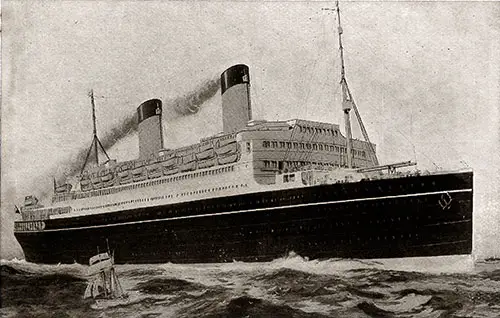
The White Star Line RMS Homeric, 34,356 Tons. RMS Majestic Passenger List, 6 September 1922. | GGA Image ID # 1dd083841d
A masterpiece of the Shipbuilders' art, a triumph of technical skill, the " HOMERIC " is one of the World's finest ships, and with her gross tonnage of 34,356, length of 775 feet, and breadth of 83 feet, is one of the largest also Sailing in CONJUNCTION with The RMS "Majestic," 56,551 Tons (The Largest Steamer in the World) and the RMS "Olympic," 46,439 Tons, MAINTAINING A Weekly Express Mail Service Between Southampton, Cherbourg and New York
Some Facts about the White Star Line and White Star-Dominion Line
The Steamers of the White Star Line and White Star-Dominion Line will take you with comfort and expedition to and from
- Southampton-Cherbourg-New York
- Liverpool-Cobh (Queenstown)-New York
- Bremen-Southampton-New York
- Liverpool-Cobh (Queenstown)-Boston
- Liverpool-Cobh (Queenstown)-Philadelphia
- Liverpool-Quebec-Montreal
(Summer Service) - Liverpool-Halifax, N.S.-Portland, Me.
(Winter Service)
- New York, Boston, and Mediterranean Ports
(Via AZORES and Madeira)
- Liverpool-CAPE TOWN-Australia
- London-New Zealand
(Via PANAMA CANAL)
- Winter Cruises to the SUNNY
West Indies, The Mediterranean & Egypt
Throughout the World the Steamers of the Organization are renowned for their EXCEPTIONAL SIZE, Great STEADINESS. SOLID COMFORT, and EXCELLENT Service
White Star Line and White Star-Dominion Line Fleet
Steamship Propulsion Tons Remarks
- Majestic Quadruple Screw 56,551 The Largest Steamer in the World.
- Olympic Triple Screw 46,439
- HOMERIC Twin Screw 34,356
- Adriatic Twin Screw 24,541
- Baltic Twin Screw 23,884
- Cedric Twin Screw 21,073
- Celtic Twin Screw 21,026
- Ceramic Triple Screw 18,495
- Arabic Twin Screw 16,786
- Regina Triple Screw 16,500
- Doric Twin Screw 16,500 Building
- Pittsburgh Triple Screw 16,322
- Megantic Twin Screw 14,878
- Cretic Twin Screw 13,518
- Suevic Twin Screw 12,686
- Runic Twin Screw 12,663
- Corinthic Twin Screw 12,367
- Athenic Twin Screw 12,366
- Ionic Twin Screw 12,352
- Medic Twin Screw 12,222
- Canopic Twin Screw 12,097
- Persic Twin Screw 12,221
- Haverford Twin Screw 11,635
- Canada Twin Screw 9,472
- Vedic Twin Screw 9,302
- Rimouski Twin Screw 9,281 Completing
- Cufic Twin Screw 8,304
- Zealandic Twin Screw 8,090
- Tropic Twin Screw 8,230
- Bardic Twin Screw 8,010
- Gallic Twin Screw 7,912
- Nomadic Twin Screw 1,260
- Traffic Twin Screw 640
- Magnetic Twin Screw 619
Grand Total 522,598 Tons.
Fleet of OVER HALF A MILLION Tons.
Associated Companies
Associated with the White Star Line and White Star-Dominion Line are :-
The Red Star Line - Antwerp-Cherbourg-New York Calling at Southampton (Westbound) and Plymouth (Eastbound)
The American Line - Hamburg-New York
The Atlantic Transport Line - London-New York
The Leyland Line - Liverpool To Boston and New Orleans West Indies. Mexico, and CENTRAL America
White Star Line Company S Offices in America
- New York • 1, Broadway
- Atlanta • 68, North Broad Street
- Baltimore • 127, East Baltimore Street
- Boston • 84, State Street
- Chicago • 14, North Dearborn Street
- Cleveland • Swetland Building
- Dallas • Cotton Exchange Building
- Detroit • 1265, Griswold Street
- GALVESTON • Cotton Exchange Building
- Halifax • 93, Hollis Street
- HOUSTON • Hermann Building
- Minneapolis • 121, South Third Street
- MOBILE • Water and St: Francis Streets
- Montreal • 211, McGill Street
- New Orleans • St. Charles and Common Streets
- Norfolk • Flat Iron Building
- Philadelphia • 1319, Walnut Street
- PITTSBURG • 338, Sixth Avenue
- Portland, ME • 1, India Street
- Quebec • 53, Dalhousie Street
- San Francisco • 550, Market Street
- Seattle, WASH. • 619, Second Avenue
- St. John, N.B • 147, Prince William Street
- St. Louis • 1101, Locust Street
- Toronto • 41, King Street East
- Washington • 1208, F Street, N.W
- Winnipeg • 286, Main Street
TELEGRAPHIC Address for Each of The ABOVE Offices IMMERCO."
📖 Passenger List Contents
- Front Cover
- Inside Front Cover: RMS Homeric Image and Information
- Title Page
- Information for Second Class Passengers
- Information for Second Class Passengers
- Postal Information
- Wireless Telegram Rates
- Time on Shipboard
- Approximate Distances
- Information for Second Class Passengers
- Listing of Senior Officers and Staff, Listing of Second-Class Passengers, (Abelson-Bache)
- Listing of Second-Class Passengers, (Backa-Carmichael)
- Listing of Second-Class Passengers, (Christie-Fixler)
- Listing of Second-Class Passengers, (Flach-Hofmeister)
- Listing of Second-Class Passengers, (Hogden-Kroeze)
- Listing of Second-Class Passengers, (Kronheim-Michner)
- Listing of Second-Class Passengers, (Miller-Reeder)
- Listing of Second-Class Passengers, (Remer-Speakman)
- Listing of Second-Class Passengers, (Speieght-Wasserstein)
- Listing of Second-Class Passengers, (Webb-Young) and Landing Arrangements at New York
- Corrections (Blank) and Public Telephones
- Some Facts About the White Star Line and White Star-Dominion Line Including Routes
- White Star Line and White Star-Dominion Line Fleet List and Associated Companies
- Sailing Schedule – Southampton-Cherbourg-New York
- Sailing Schedule – Liverpool-Cobh (Queenstown)-New York Service
- Sailing Schedules – Liverpool-Cobh (Queenstown)-Philadelphia Service, Liverpool-Cobh (Queenstown)-Boston Service, and Bremen-Southampton-New York Service
- Sailing Schedules – Liverpool-Quebec-Montreal Service and Liverpool-Halifax-Portland, ME Service
- Sailing Schedule – Mediterranean Service
- Red Star Line Sailing Schedule - Antwerp-New York Service and American Line Sailing Schedule – Hamburg-New York Service
- White Star Line Company Offices in America | Telegraphic Address
- Inside Back Cover – RMS Olympic (Image)
- Back Cover: White Star Line North Atlantic Track Chart and Memorandum of Log, Filled in By Original Passenger
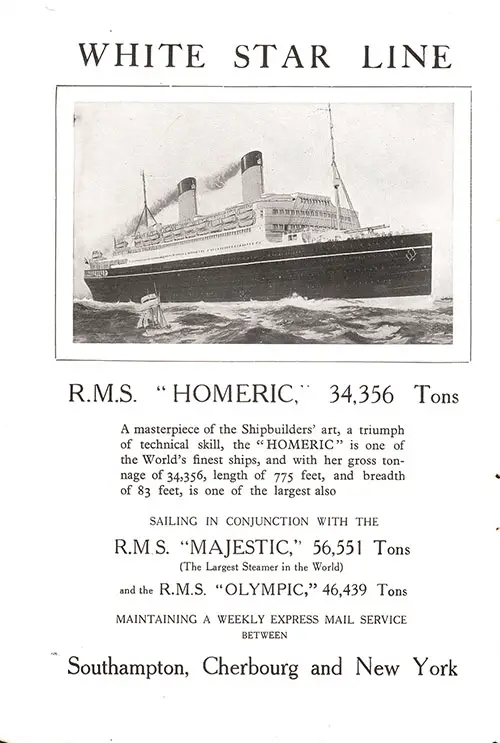
RMS Homeric, 34,356 Tons, A Masterpiece of the Shipbuilders' Art. RMS Majestic Second Class Passenger List, 6 September 1922. | GGA Image ID # 23c081f343 (Return to TOC)
Title Page, RMS Majestic Second Class Passenger List, 6 September 1922. | GGA Image ID # 23c08669fe (Return to TOC)
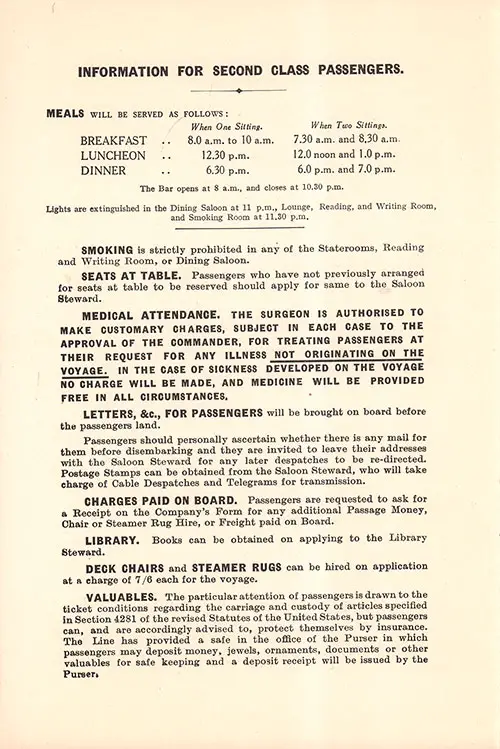
Information for Second Class Passengers, Part 1, RMS Majestic Second Class Passenger List, 6 September 1922. | GGA Image ID # 23c0a9a6ff (Return to TOC)
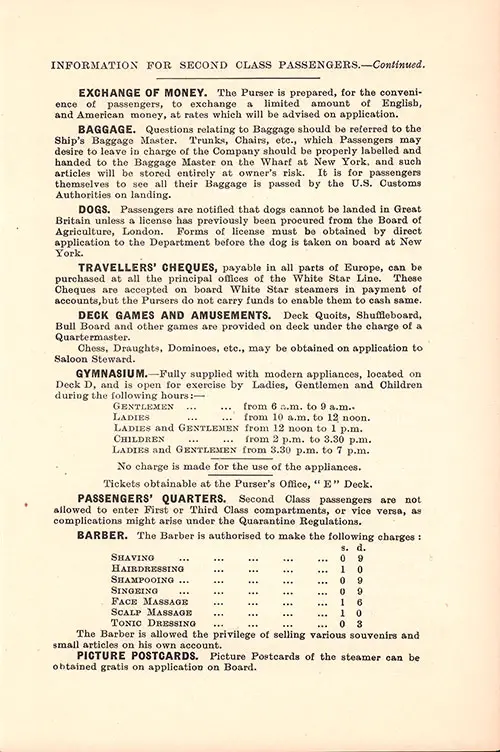
Information for Second Class Passengers, Part 2, RMS Majestic Second Class Passenger List, 6 September 1922. | GGA Image ID # 23c0b0cacd (Return to TOC)
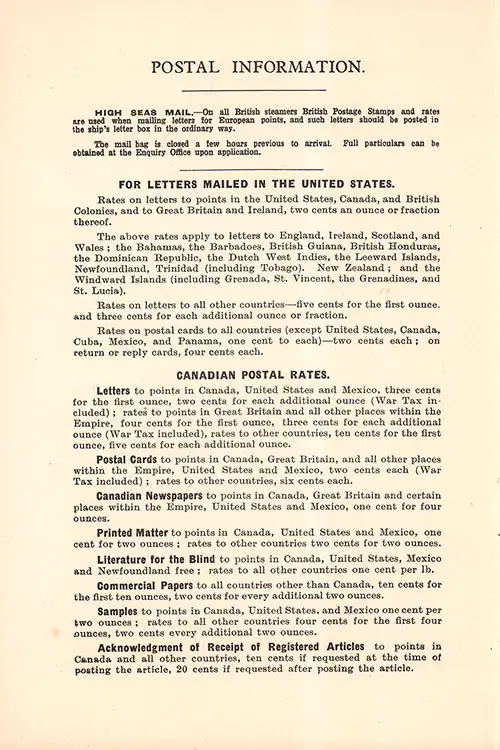
Postal Information: High Seas Mail, Letters Mailed in the United States, and Canadian Postal Rates. RMS Majestic Second Class Passenger List, 6 September 1922. | GGA Image ID # 23c1155e46 (Return to TOC)
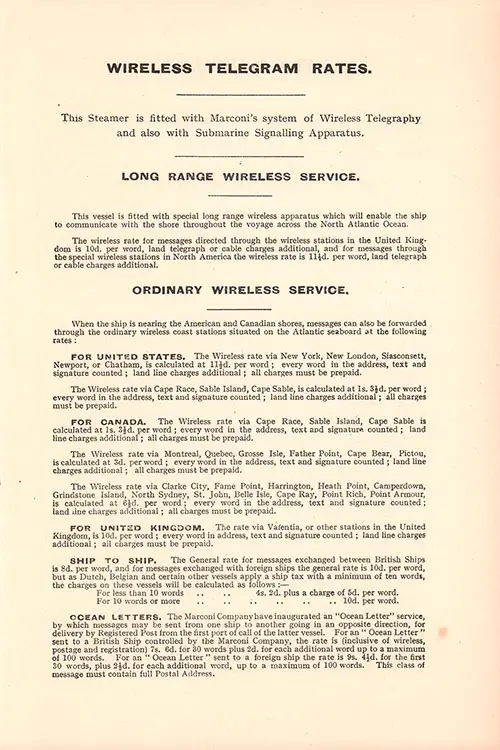
Wireless Telegram Rates, Long Range and Ordinary Wireless Services, and Ocean Letters. RMS Majestic Second Class Passenger List, 6 September 1922. | GGA Image ID # 23c139da2a (Return to TOC)
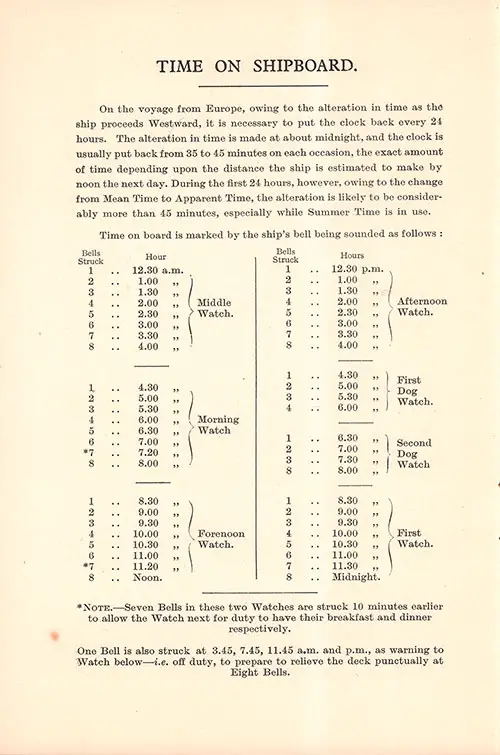
Time on Shipboard. RMS Majestic Second Class Passenger List, 6 September 1922. | GGA Image ID # 23c172a64e (Return to TOC)
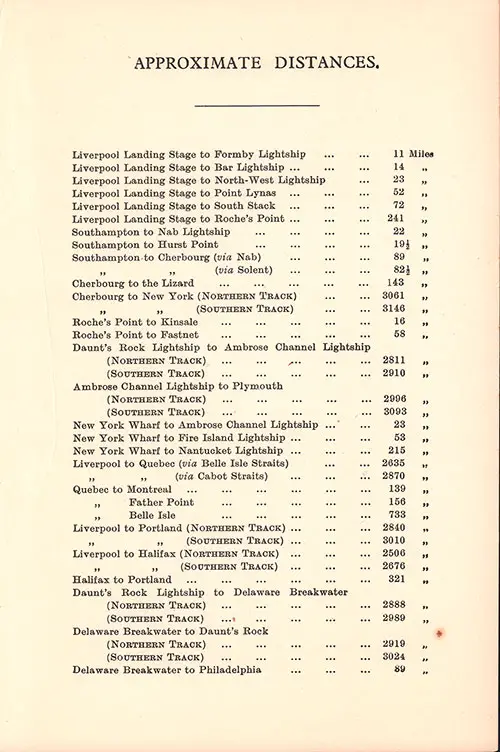
Approximate Distances in Miles Between Ports and Other Geographical Points. RMS Majestic Second Class Passenger List, 6 September 1922. | GGA Image ID # 23c22d1d97 (Return to TOC)
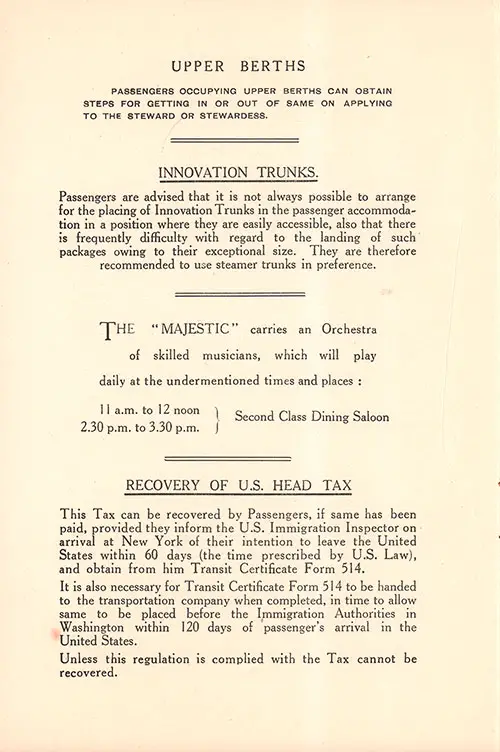
Information for Second Class Passengers, Part 3. RMS Majestic Second Class Passenger List, 6 September 1922. | GGA Image ID # 23c26ffa35 (Return to TOC)
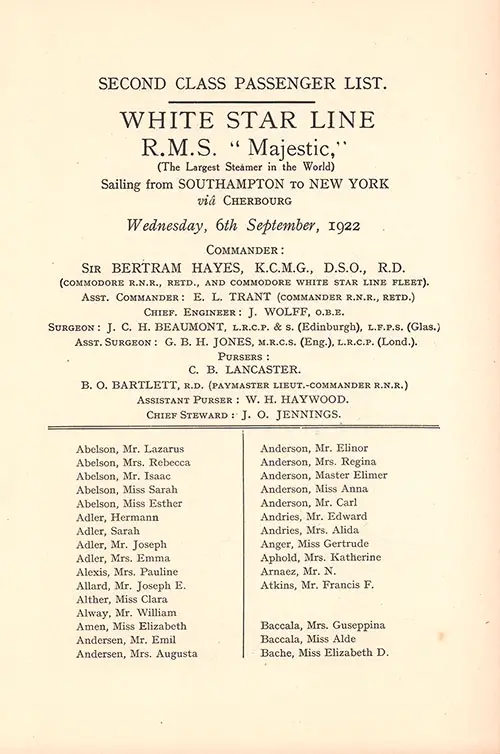
Senior Officers and Staff and Listing Second Class Passengers, Part 1. RMS Majestic Second Class Passenger List, 6 September 1922. | GGA Image ID # 23c2d4d53d (Return to TOC)
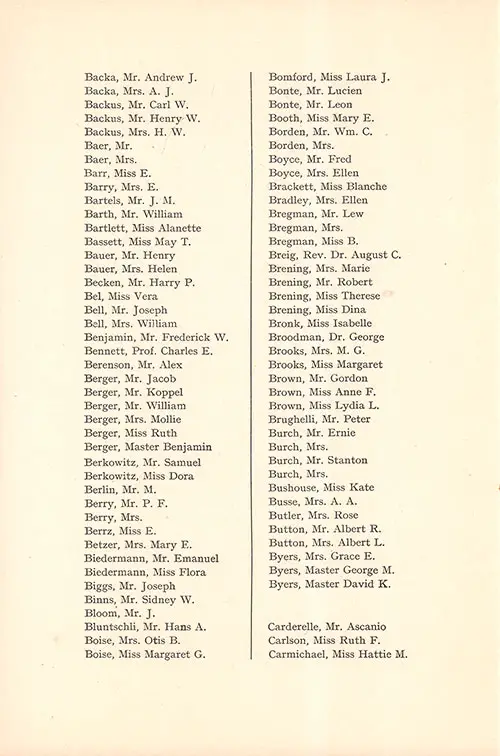
Listing Second Class Passengers, Part 2. RMS Majestic Second Class Passenger List, 6 September 1922. | GGA Image ID # 23c2d976aa (Return to TOC)
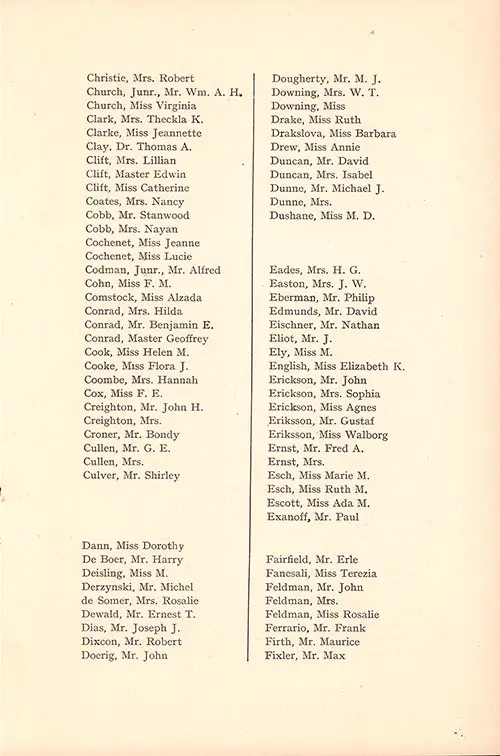
Listing Second Class Passengers, Part 3. RMS Majestic Second Class Passenger List, 6 September 1922. | GGA Image ID # 23c32080ac (Return to TOC)
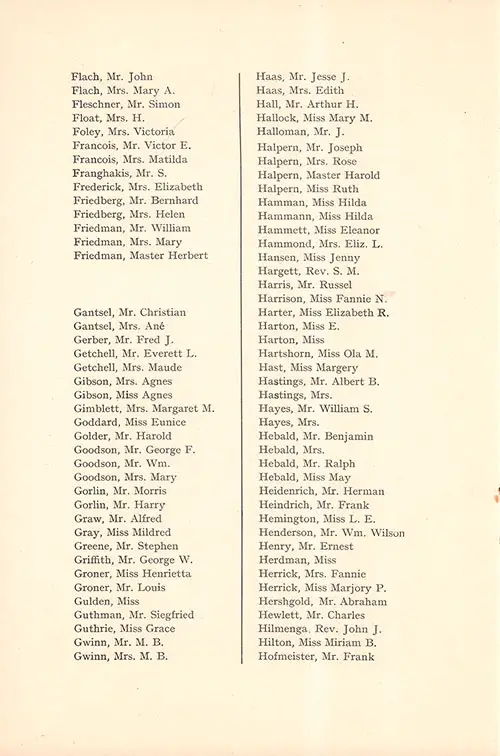
Listing Second Class Passengers, Part 4. RMS Majestic Second Class Passenger List, 6 September 1922. | GGA Image ID # 23c3b91780 (Return to TOC)
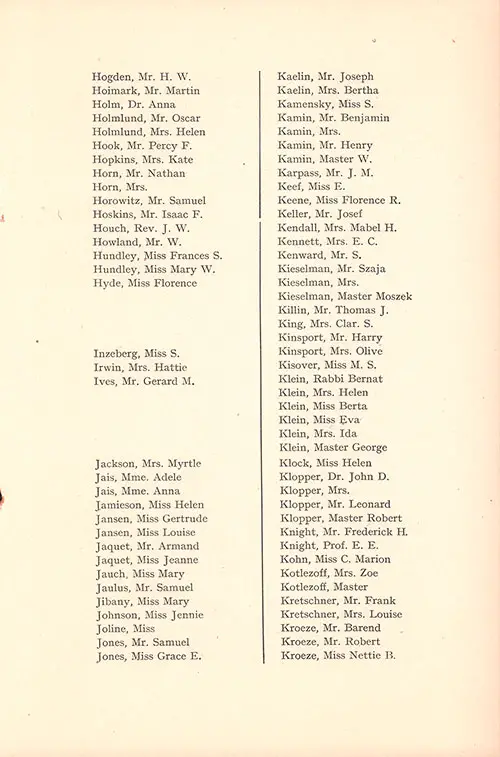
Listing Second Class Passengers, Part 5. RMS Majestic Second Class Passenger List, 6 September 1922. | GGA Image ID # 23c45a8730 (Return to TOC)
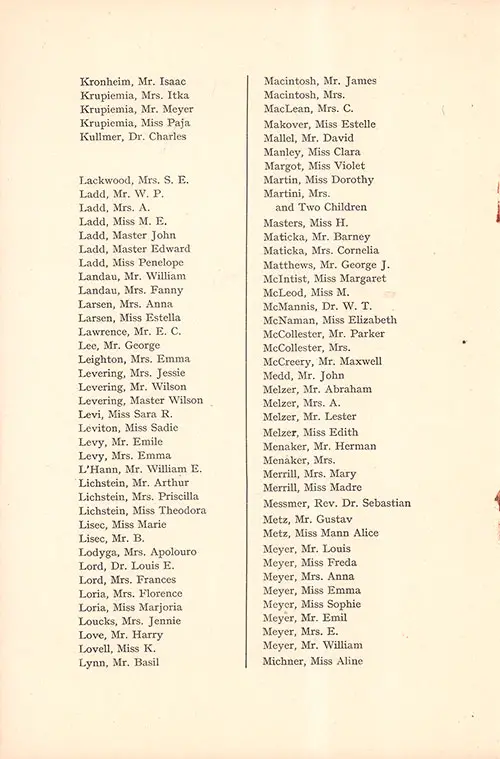
Listing Second Class Passengers, Part 6. RMS Majestic Second Class Passenger List, 6 September 1922. | GGA Image ID # 23c4c9c4b6 (Return to TOC)
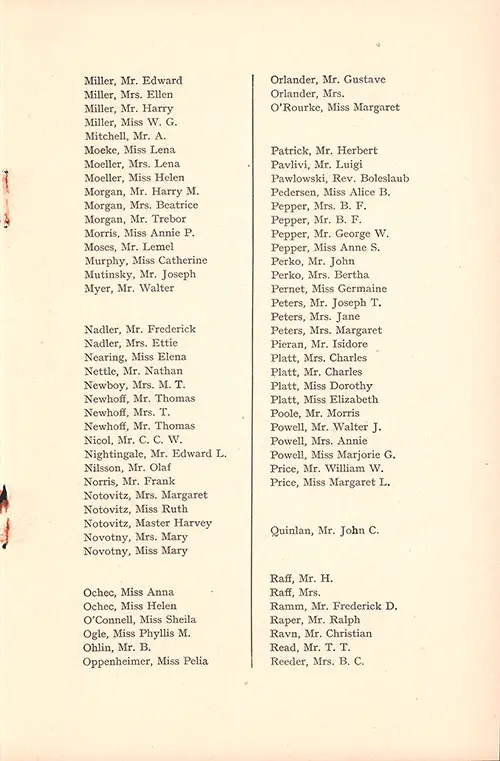
Listing Second Class Passengers, Part 7. RMS Majestic Second Class Passenger List, 6 September 1922. | GGA Image ID # 23c4cebfaf (Return to TOC)
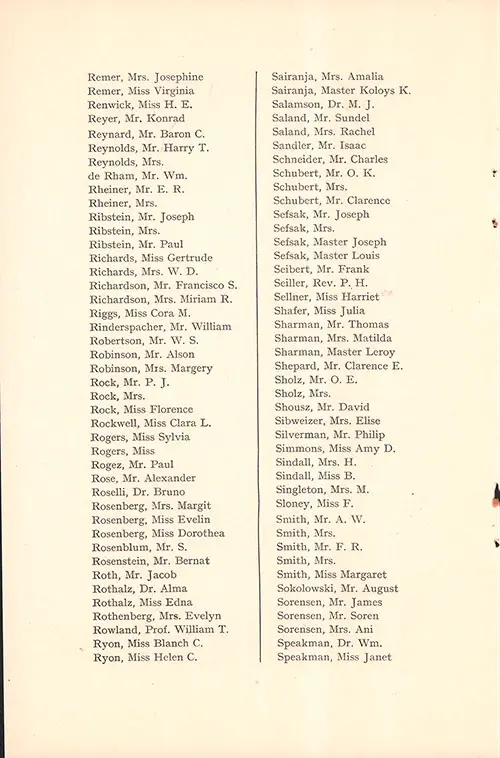
Listing Second Class Passengers, Part 8. RMS Majestic Second Class Passenger List, 6 September 1922. | GGA Image ID # 23c50fbccb (Return to TOC)
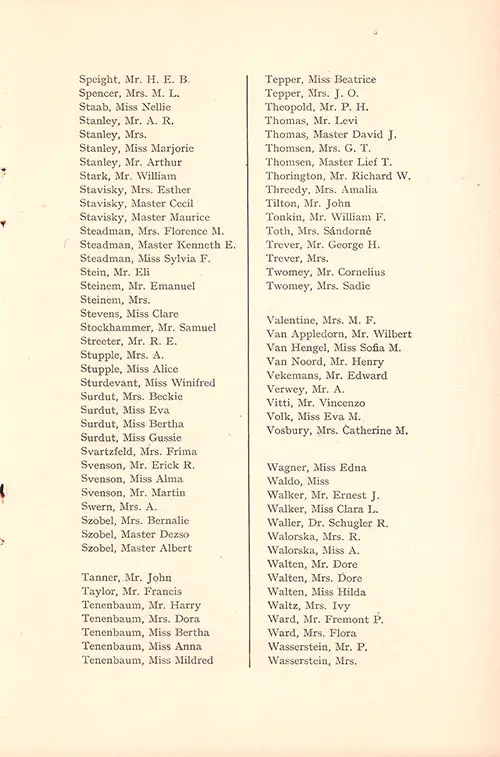
Listing Second Class Passengers, Part 9. RMS Majestic Second Class Passenger List, 6 September 1922. | GGA Image ID # 23c520f355 (Return to TOC)
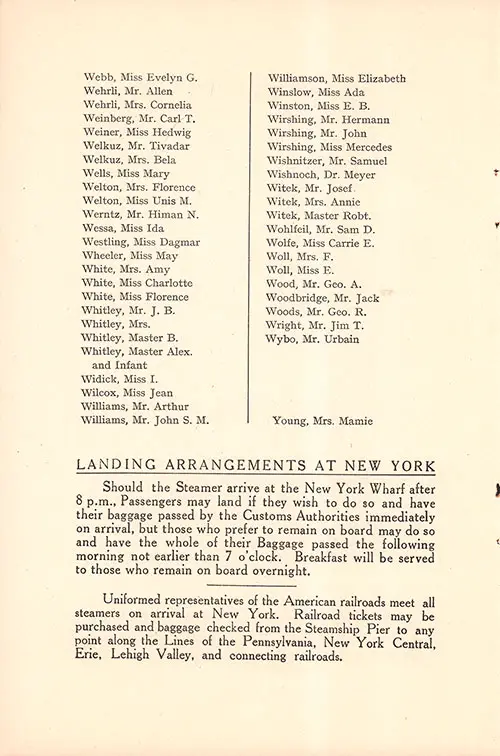
Listing Second Class Passengers, Part 10 and Landing Arrangements at New York. RMS Majestic Second Class Passenger List, 6 September 1922. | GGA Image ID # 23c53e7555 (Return to TOC)
-IFP-500.jpg "GGA Image ID # 23c577f372")
Corrections (Blank) and Public Telephones Information. RMS Majestic Second Class Passenger List, 6 September 1922. | GGA Image ID # 23c577f372 (Return to TOC)
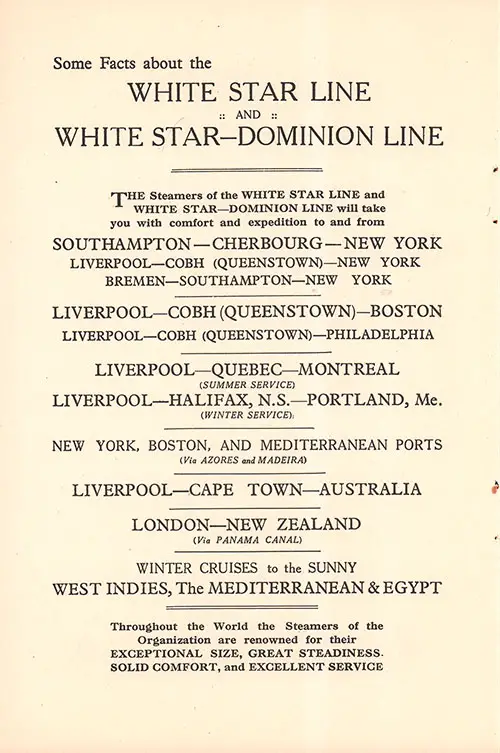
Some Facts About The White Star Line and White Star-Dominion Line (Routes). RMS Majestic Second Class Passenger List, 6 September 1922. | GGA Image ID # 23c57d722c (Return to TOC)
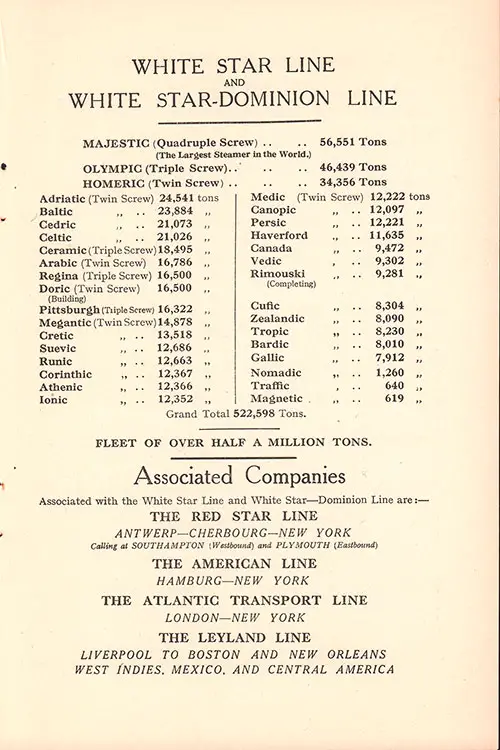
White Star Line and White Star-Dominion Line Fleet List and Associated Companies. RMS Majestic Second Class Passenger List, 6 September 1922. | GGA Image ID # 23c591f7eb (Return to TOC)
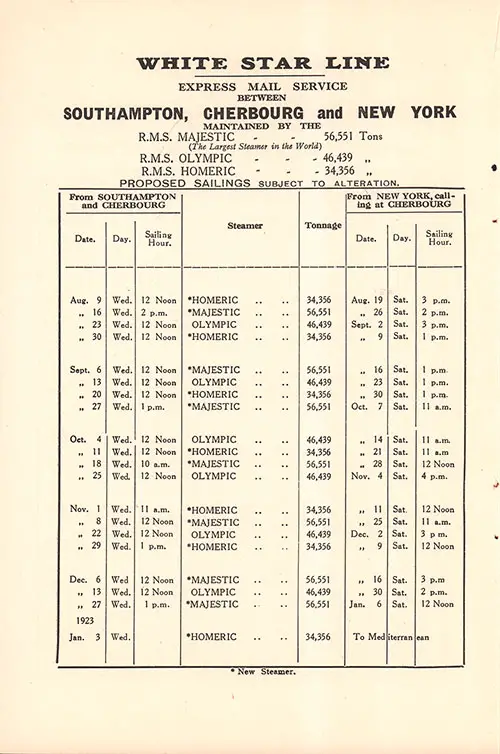
White Star Line Proposed Sailings, Liverpool-Cobh (Queenstown)-New York Service from 5 August 1922 to 30 December 1922. Ships Include the Adriatic, Baltic, Cedric, and Celtic. RMS Majestic Passenger List, 6 September 1922. | GGA Image ID # 23c60ad789 (Return to TOC)
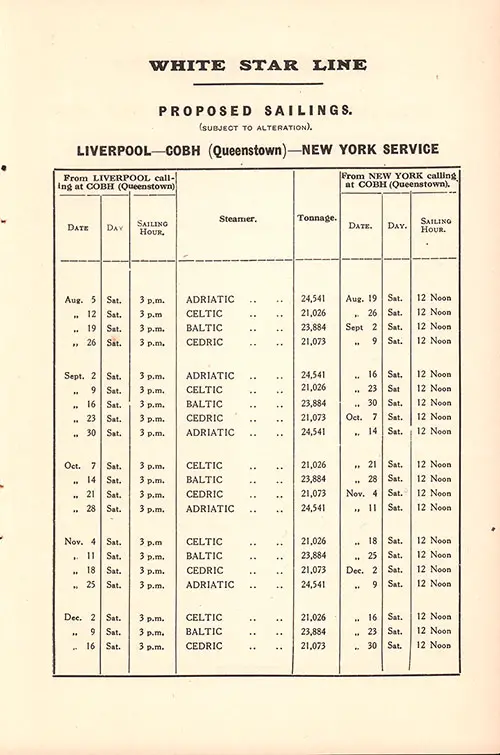
White Star Line Proposed Sailings, Liverpool-Cobh (Queenstown)-New York Service from 5 August 1922 to 30 December 1922. Ships Include the Adriatic, Baltic, Cedric, and Celtic. RMS Majestic Passenger List, 6 September 1922. | GGA Image ID # 23c6e4d40b (Return to TOC)
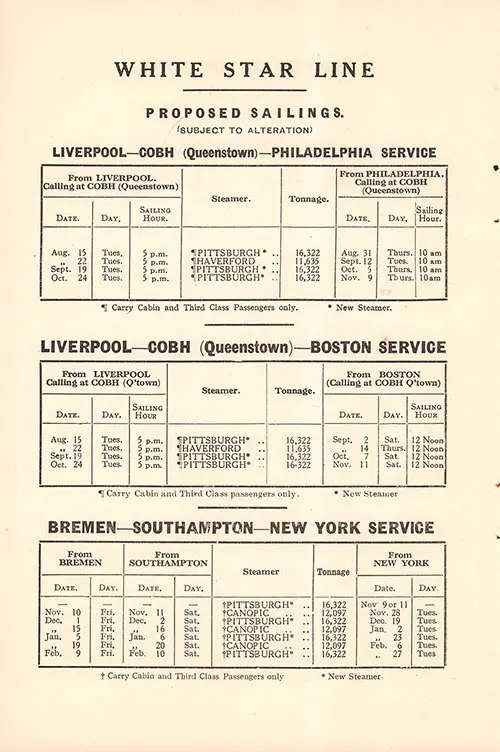
Sailing Schedules, Liverpool-Cobh-Philadelphia, Liverpool-Cobh-Boston, and Bremen-Southampton-New York Service, 15 August 1922 to 27 February 1923. Ships Included the Canopic, Haverford, and Pittsburgh. RMS Majestic Second Class Passenger List, 6 September 1922. | GGA Image ID # 23c7a96d55 (Return to TOC)
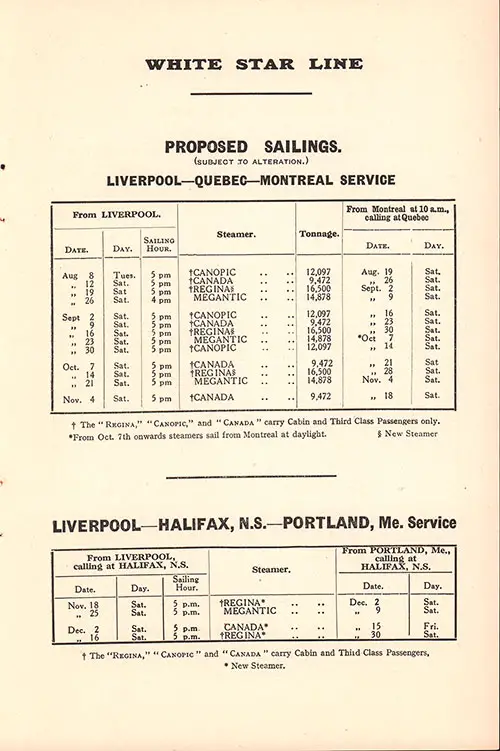
Sailing Schedules, Liverpool-Quebec-Montreal and Liverpool-Halifax-Portland, ME Service, from 8 August 1922 to 30 December 1922. Ships Included the Canada, Canopic, Megantic, and Regina. RMS Majestic Second Class Passenger List, 6 September 1922. | GGA Image ID # 23c8149008 (Return to TOC)
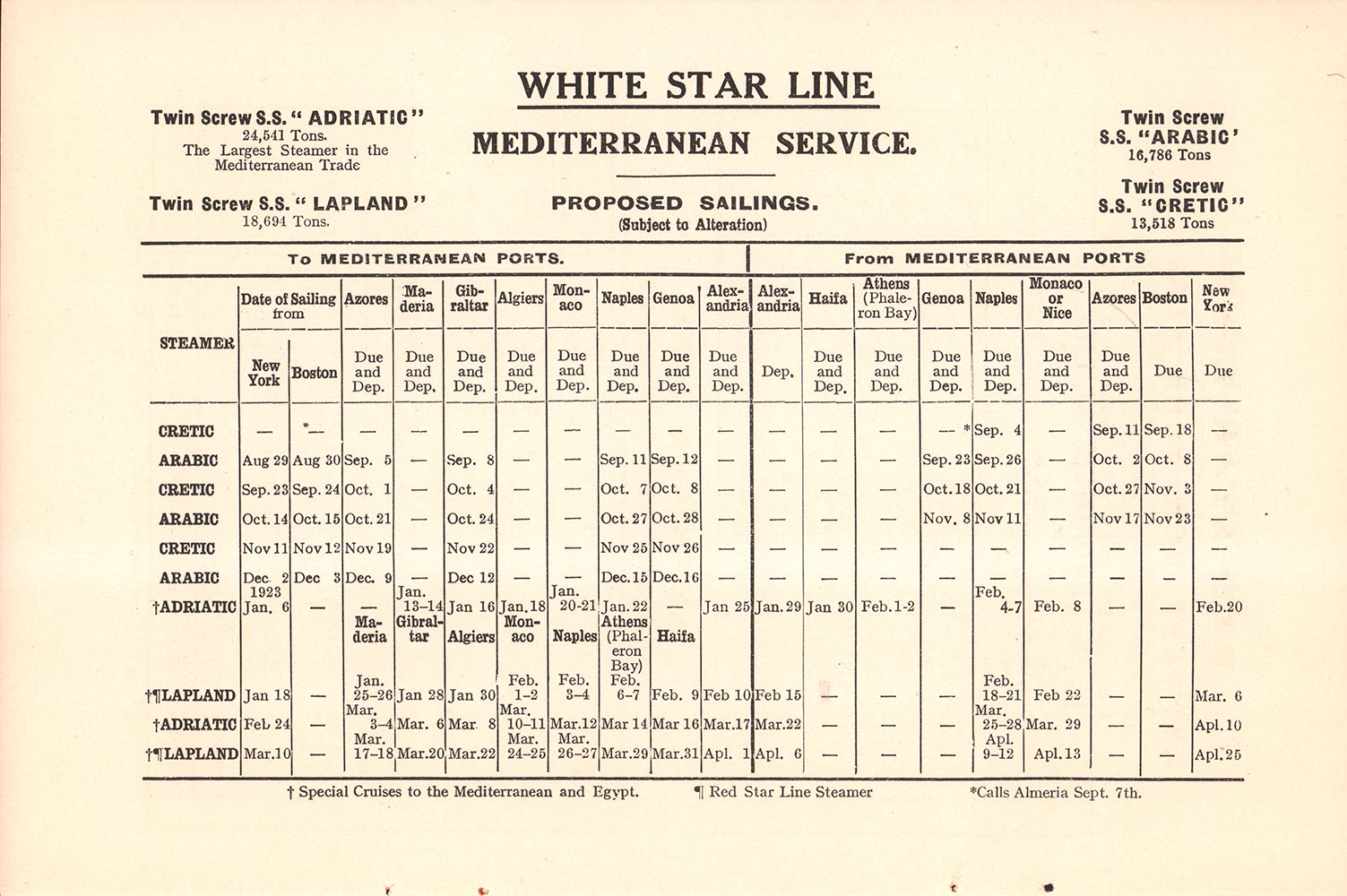
White Star Line Mediterranean Service Proposed Sailings from 29 August 1922 to 13 April 1923. Ships Included the Adriatic, Arabic, Cretic, and Lapland. Ports Included New York, Boston, Azores, Madeira, Gibraltar, Algiers, Monaco, Naples, Genoa, Alexandria, Haifa, Athens (Phaleron Bay), and Nice. RMS Majestic Passenger List, 6 September 1922. | GGA Image ID # 23c79fe9e8. Click to View Larger Image. (Return to TOC)
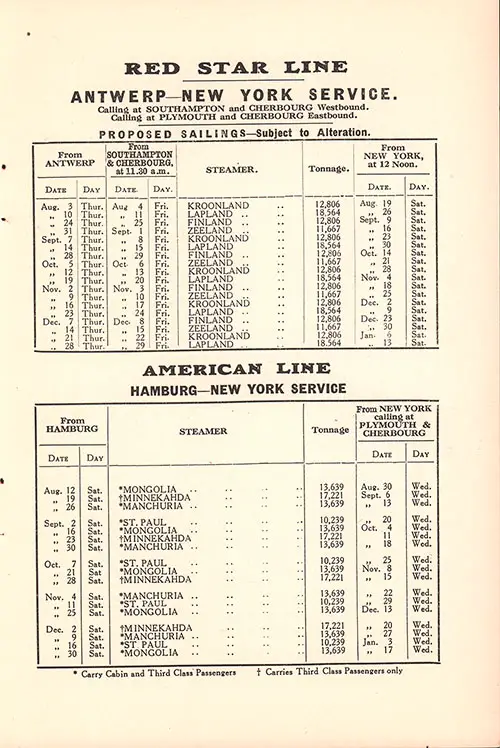
Sailing Schedules - Red Star Line Antwerp-New York Service and American Line Hamburg-New York Service, From 3 August 1922 to 17 January 1923. Ships Included the Finland, Lapland, Manchuria, Minnekahda, Mongolia, Kroonland, St. Paul, and Zeeland. RMS Majestic Second Class Passenger List, 6 September 1922. | GGA Image ID # 23c83f3a42 (Return to TOC)
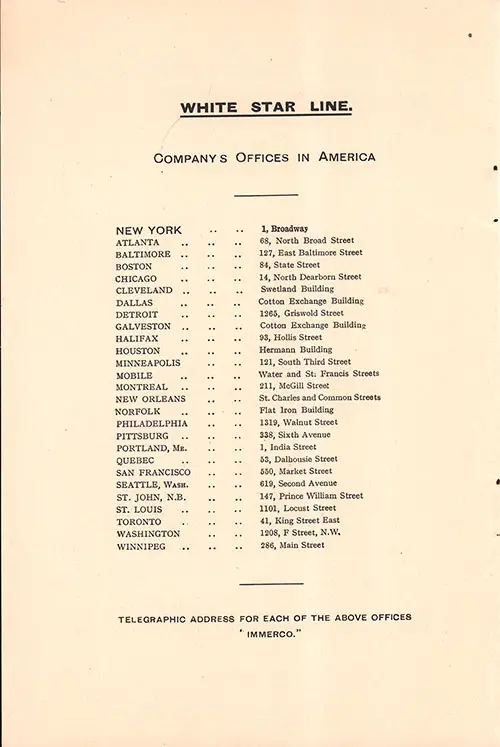
White Star Line Company Offices in North America. RMS Majestic Second Class Passenger List, 6 September 1922. | GGA Image ID # 23c868dd86 (Return to TOC)
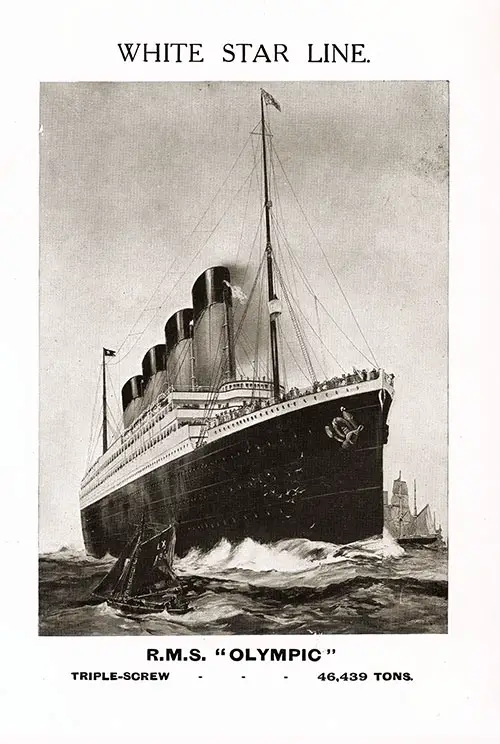
White Star Line RMS Olympic Triple-Screw - 46,439 Tons. RMS Majestic Passenger List, 6 September 1922. | GGA Image ID # 1dd125d119 (Return to TOC)
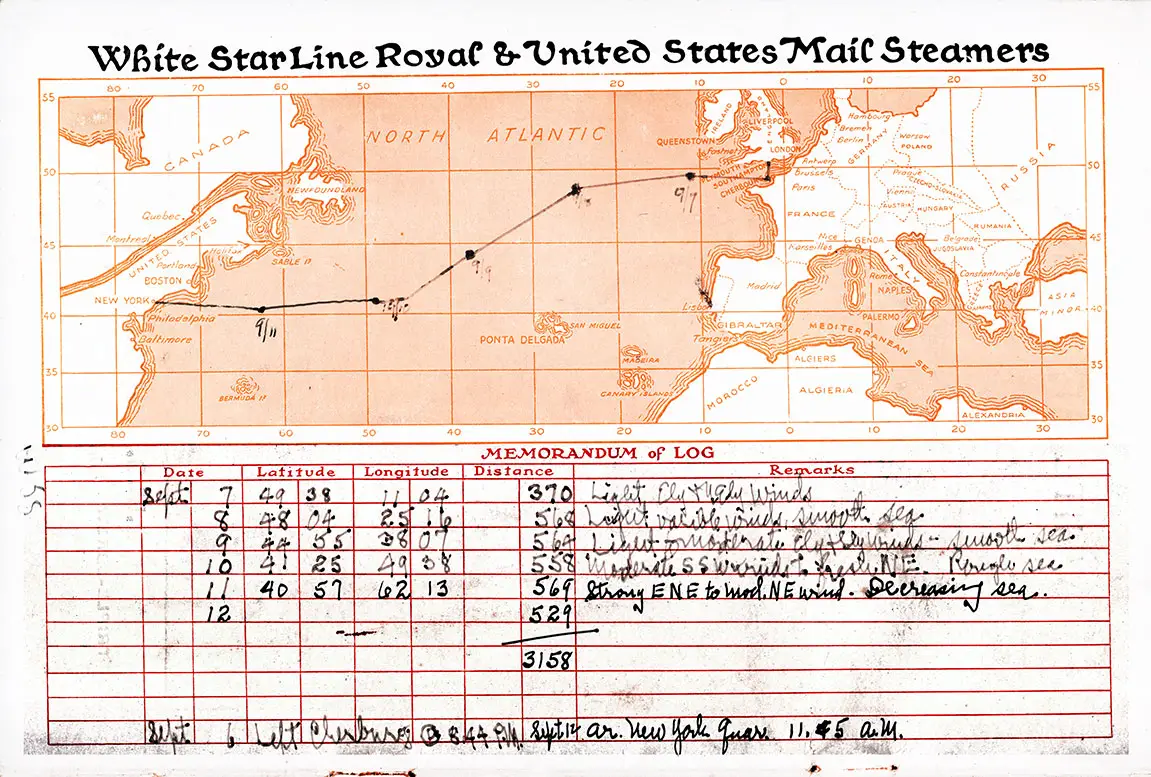
Track Chart and Memorandum of Log Filled in by Passenger. RMS Majestic Passenger List, 6 September 1922. | GGA Image ID # 1dd15f4943. Click to View a Larger Image. (Return to TOC)
🚢 About the Ship
The RMS Majestic was one of the great transatlantic liners of the 1920s and a centerpiece of White Star Line's postwar fleet.
Originally built in Germany as the SS Bismarck, she was transferred to Britain after World War I and completed for White Star Line as the RMS Majestic. When she entered service in 1922, she was widely promoted as the world's largest ship.
The Majestic became part of White Star's celebrated express service alongside the RMS Olympic and RMS Homeric, competing directly with Cunard's great liners for transatlantic passengers.
🌍 About the Steamship Line
The White Star Line was one of the most famous steamship companies in maritime history, best remembered for ships such as the Oceanic, Olympic, Titanic, Majestic, and Homeric.
By 1922, White Star was rebuilding its prestige after World War I, and the Majestic became a powerful symbol of renewed luxury, scale, and transatlantic confidence.
📏 Document Specifications
- Ship: RMS Majestic
- Line: White Star Line
- Date: 6 September 1922
- Route: Southampton to New York via Cherbourg
- Class: Second Class
- Commander: Captain Sir Bertram Hayes, K.C.M.G., D.S.O., R.D.
- Format: Passenger list booklet
- Back Cover: Filled Track Chart and Memorandum of Log
- Dimensions: 13 cm W x 19.7 cm H
- Pages: 32 Including Covers
- Language: English (UK)
- Binding: Two Staples (Removed to Prevent Rusting)
Last Updated: June 2026
📜 Research note: Some names and captions were typed from originals and may reflect period spellings or minor typographical variations. When searching, try alternate spellings and cross-check with related records. ⚓
Curator’s Note
For over 25 years, I've been dedicated to a unique mission: tracking down, curating, preserving, scanning, and transcribing historical materials. These materials, carefully researched, organized, and enriched with context, live on here at the GG Archives. Each passenger list isn't just posted — it's a testament to our commitment to helping you see the people and stories behind the names.
It hasn't always been easy. In the early years, I wasn't sure the site would survive, and I often paid the hosting bills out of my own pocket. But I never built this site for the money — I built it because I love history and believe it's worth preserving. It's a labor of love that I've dedicated myself to, and I'm committed to keeping it going.
If you've found something here that helped your research, sparked a family story, or just made you smile, I'd love to hear about it. Your experiences and stories are the real reward for me. And if you'd like to help keep this labor of love going, there's a "Contribute to the Website" link tucked away on our About page.
📜 History is worth keeping. Thanks for visiting and keeping it alive with me.
Repository Information
The Gjenvick-Gjønvik Archives (GG Archives) is cataloged with the Library of Congress under MARC Org Code: WiMfGGA and ISIL: US-wimfgga.
Current location:
N91W16562 Pershing Ave, #1
Menomonee Falls, Wisconsin 53051-2170, USA
Note: Historic addresses listed in earlier MARC records include Marietta, GA and Woodstock, GA. These appear in authority files but are no longer active.
