
RMS Germanic Saloon Passenger List, 22 July 1896 – Liverpool to New York via Queenstown
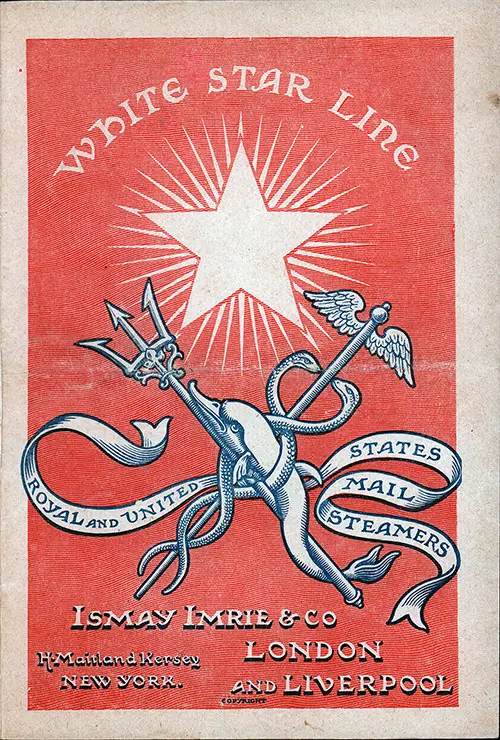
Front Cover, Saloon Passenger List for the RMS Germanic of the White Star Line, Departing 22 July 1896 from Liverpool to New York via Queenstown (Cobh), Commanded by E. R. McKinstry, R.N.R. | GGA Image ID # 13c41467d8
Senior Officers and Staff
- Captain: E. R. McKinstry, R.N.R
- Surgeon: J. Fourness-Brice
- Purser: H. J. Thorpe
Saloon Passengers
- Mr. W. H. Allan
- Miss Ellen Arthur
- Rev. John Barbour
- Mr. W. A. J. Bell
- Rev. R. E. W. Besant
- Mrs. Besant
- Miss Boyle
- Miss H. Boyle
- Rev. T. Bradbury
- Mr. J. Bradshaw
- Rev. J. Brosnan
- Mr. A. S. Caldwell
- Mr. Brown Caldwell
- Mr. J. R Callender
- Mr. W. M. Camp
- Mrs. Camp
- Mrs. Carpenter
- Mr. F. Carrington
- Mr. B. Stuart Chambers
- Mr. L. D. Clarke
- Miss M. W. Clifford
- Mr. A. Crawford
- Mr. Dater
- Mr. G. A. Davison
- Mr. H. Denning
- Mr. H. Denning, Jr.
- Rev. W. H. Dodge, D. D
- Mr. G. H. Easdale
- Mr. F. E. Fennessy
- Mr. Ben Fish
- Mr. R. G. Fisher
- Captain Forwood
- Mr. Anderson Fowler
- Mr. L. G. Freedman
- Rev. E. G. Gauge
- Mr. A. D. Garrett
- Mrs. Garrett
- Mr. W. Giblin
- Mr. W. P. Gill
- Mr. John Gilmore
- Dr. Charles Good
- Mr. Gostenhofer
- Mr. B. Graf
- Mrs, Graf
- Mr. J. Grierson
- Mrs. D. C. Haldeman
- Mr. W. Halley
- Mr. R. W. Harris
- Mr. Alexander Harvey
- Miss H. Hawthorne
- Mr. John Hayes
- Rev. C. R. Hemphill
- Mr. Drayton Hillyer
- Mrs. Hillyer
- Mr. H. W. Hixon
- Mr. Hoesli
- Mr. T. Holford
- Mrs. Holford, Infant, and Nurse
- Mrs. Holmes
- Mr. R. M. Howison
- Mr. V. B. Hubbell
- Rev. T. F. Hughes
- Mr. H. Hutchinson
- Mr. George Irving (Note 1)
- Mr. E. R. Jones
- Mr. Hugh Kershaw
- Mr. W. L. Kingman
- Miss Kingsmill
- Mr. A. Kitz
- Mrs. Kitz
- Miss Knapp
- Mr. Emil Kornbeck
- Mr. C. W. Kranshaar
- Mr. B. T. Lacy
- Mr. William Laidlaw (Note 2)
- Mr. Paul Libby
- Mr. Alexander Lifton
- Rev. H. D. Lindsay
- Mr. Sydney Lockhart
- Mr. G. A. Marshall
- Miss A. E. Mason
- Mr. A, H. Masten
- Mrs. Masten
- Miss Masten
- Dr. J. M. Maxwell
- Mr. H. Maynard
- Mr. H. C. Meyer
- Mr. J. McElhatton
- Mr. G. A. McGillivray
- Mr. R. T. McGusty
- Mr. J. McNaughton
- Mr. Malcolm McPherson
- Mr. H. Melvill
- Mr. Harold Money
- Mr. David Moodie
- Mr. A. E. Moore
- Mr. Charles Moore (Note 3)
- Mr. C. C. Moore
- Dr. Northrop
- Mr. L. G. O'Reilly
- Mr. J. P. Palmer
- Mrs. Palmer and Child
- Mr. Walter Palmer
- Mrs. Palmer
- Mr. John Parry
- Mr. R. Paton
- Miss M. G. Patterson
- Mr. R. Pearce
- Mrs. Pearce
- Mr. S. H. Pearce
- Miss A, V. Pike
- Rev. S. B. Pond
- Mrs. S. B. Pond
- Mr. T. Radcliffe
- Mr. H. Robbins and Manservant
- Miss Robinson
- Miss Robinson and Maid
- Mr. N. Rooney
- Dr. Newton M. Shaffer
- Mr. J. Simister
- Mr. H. Van Sinderin
- Mrs. Van Sinderin
- Mr. J. T. Spaulding
- Mr. A. R. Steven
- Mr. T. Stewart
- Mr. J. S. Stewart
- Mr. J. R. Stitt
- Mr. Charles Stoddart
- Mr. T. Taylor
- Mr. W. A. Thomas
- Mr. William Todd
- Mr. Reginald Tower
- Mr. H. S. Turtle
- Mr. E. de Wolfe Wales
- Mr. J. H. Walsh
- Mr. R. B. Walsh
- Mr. C. Waterson
- Mrs. Wedel and Infant
- Mr. P. F. Welsh
- Miss A. A. Wheeler
- Mr. Henry White and Manservant
- Mrs. White
- Miss White and Maid
- Mr. H. T. Williams
- Mr. J. H. Williams
- Mrs. Willis
- Master Willis
- Mr. G. E. Wilson
- Mr. B. B. Wolfe
- Rev. J. Wood
- Miss Nora Wood
- Miss Wynkoop
- Mr. A. G. Yates
- Mr. T. R. Young
Passenger List Notes
- George Henry Irving (5 October 1874 - 11 September 1961) was an American film actor and director who made over 200 films from 1914 until his retirement in 1954. Irving was initially an Actor-director until he switched exclusively to acting in the mid-1920s and became a character actor until the late 1940s. He mostly played reputable and stern persons in films, he is best known for his roles as lawyer Peabody in Bringing Up Baby and as Robert Wentworth in Coquette.
- William Grant Laidlaw (1 January 1840 – 19 August 1908) was a U.S. Representative from New York.
- Charles Leonard Moore (1854–1925) was an American poet and essayist, born in Philadelphia. He became a lawyer and 1878-79, served as United States Consul at San Antonio, Brazil.
Information for Passengers
- BREAKFAST from 8:30 until 10:00 o'clock.
- LUNCHEON at 1:30.
- DINNER at 7:00 o'clock.
The Bar closes at 11 p.m. and the Smoke Room at 11.30 p.m.
Divine Service in the Saloon on Sundays at 10:30 a.m.
PLEASE apply to Second Steward for Seating Accommodation at Table.
Letters for Passengers on-board outward-bound Steamers at Queenstown, mailed on the day the Steamer sails from Liverpool, must be registered and addressed thus :
c/o The Commander,
M_____________ Passenger per R.M.S. _______________, Queenstown.
Telegrams must be addressed to care of "ISMAY, Queenstown," otherwise a charge of 5/- extra is made if addressed to the steamer direct.
Cablegrams and Telegrams should be handed to the Saloon Steward an hour before arrival at Queenstown.
The Saloon Steward will supply Stamps, Telegraph Forms, Books of Reference, and Railway Timetables of the principal Companies.
Questions relating to Baggage should be referred to the Second Steward, who is the Ship's Baggage Master; Trunks, Chairs, or Rugs which passengers may desire to leave in charge of the Company, should be properly labelled and handed to the Second Steward.
Deck Chairs can be hired at a charge of 4/- each for the voyage, 48 hours' notice being necessary in London, or 12 hours at the Head Office, Liverpool.
The Company will not be responsible for Valuables or Money unless given in charge of the Purser, who will give a receipt for the same on the Company's Form.
Passengers are requested to ask for a Receipt on the Company's Form, for any additional Passage Money or Freight paid on board.
Saloon Passengers joining the White Star Mail Steamers at Queenstown can leave Euston, London, at 8:20 p.m., or Liverpool at 11:10 p.m. on the day of sailing; Holyhead, by Mail Steamer, 2:35 a.m. Thursday; and from Kingstown, by the Special American Mail Train, 6:00 a.m., arriving at Queenstown 10:55 a.m. Thursday.
N.B.—Cotton is not carried on the Passenger Steamers of the White Star Line.
This saloon-class passenger list from the RMS Germanic, dated 22 July 1896, captures a mature White Star Line liner at work on one of the busiest migration and business routes in the world: Liverpool → Queenstown (Cobh) → New York. Commanded by Captain E. R. McKinstry, R.N.R., the voyage sits late in Germanic's career, when she had already spent more than twenty years carrying a mix of wealthy tourists, professionals, clergy, and returning Americans across the Atlantic.
Built in 1874 for the White Star Line, Germanic later passed into other hands and was eventually renamed Ottawa and then Gulcemal (Gülcemal) before being scrapped in 1950, giving her an unusually long and varied life in service.
This passenger list, with its annotated track chart and memorandum of log on the back cover, preserves not just who sailed, but how this particular crossing unfolded day by day.
Ship & Voyage Context ⚓
- Ship: RMS Germanic
- Operator: White Star Line
- Launched: 1874 at Harland & Wolff, Belfast
- Route for this voyage: Liverpool – Queenstown (Cobh) – New York
- Date of departure: 22 July 1896
- Class represented: Saloon (First Class)
By the mid-1890s, Germanic belonged to an earlier generation of transatlantic steamers—but White Star continued to use her for premium saloon travelers alongside emigrants in lower classes. She represents the solid, reliable workhorse of the line: not as glamorous as later giants like Olympic and Titanic, but essential to the company's rise.
This voyage, therefore, offers a snapshot of late-Victorian transatlantic society, when steam travel was firmly established, but before the truly huge "floating palaces" of the Edwardian era.
Notable Passengers & Biographical Highlights ⭐
While many names in the saloon list belong to businessmen, clergy, and families whose stories lie in local records, several passengers connect directly to national or international history. These make the Germanic's July 1896 crossing especially attractive for researchers.
Diplomats & International Figures 🌍
Mr. Reginald Tower
- Very likely Sir Reginald Tower (1860–1939), a British diplomat whose career spanned postings across the globe. He later served as Envoy Extraordinary and Minister Plenipotentiary to Argentina (1910–1919), after earlier service in the diplomatic corps beginning in the 1880s.
- His presence on Germanic underscores the ship's role as a tool of diplomacy and imperial administration, ferrying officials between Britain and the Americas.
Mr. Henry White and Manservant, Mrs. White, Miss White
- The passenger listing shows Mr. Henry White traveling in saloon class with his family and personal staff—exactly the travel profile of a senior diplomat.
- It is very likely (though not absolutely provable from the list alone) that this is Henry White (1850–1927), one of the United States' most prominent career diplomats, later Ambassador to Italy and France and a member of the U.S. peace delegation at the Treaty of Versailles
- If so, this list captures White during the height of his European assignments, moving between posts and Washington.
These diplomatic figures make the passenger list especially compelling for scholars of Anglo-American relations, imperial history, and international diplomacy.
Medicine & Academia 🩺📚
Dr. Newton M. Shaffer (listed as Dr. Newton M. Shaffer)
- A leading American orthopedic surgeon, Newton Melman Shaffer (1846–1928) helped establish orthopedics as a distinct specialty in the United States.
- He served as professor of orthopedic surgery at Cornell University Medical College and was associated with institutions such as the New York Orthopaedic Dispensary and Hospital.
- Shaffer authored influential works on orthopedics and was a key figure in the evolving treatment of spinal and joint deformities.
His presence on the Germanic connects this crossing to the history of modern surgery, rehabilitation, and medical education.
Business & Industrial Leaders 💼
Mr. Arthur G. Yates
- Likely Arthur G. Yates (1847–1919) of Buffalo, New York, a prominent industrialist and utility executive. Yates led companies including Buffalo General Electric and had major interests in coal and rail transport.
- His career illustrates the tight links between energy, transportation, and urban growth in the Gilded Age United States.
Mr. William Laidlaw
- While the passenger list simply records Mr. William Laidlaw, this surname was associated with shipowners, merchants, and investors in Britain and Canada. His presence in saloon class hints at the commercial connections and capital networks behind North Atlantic trade.
Mr. Arthur H. Masten & Mrs. Christina M. Masten, Miss Elizabeth M. Masten
- The Mastens, traveling as a family group, represent the professional middle and upper-middle classes who increasingly used transatlantic liners for both business and leisure, rather than emigration alone.
Religion & Public Life ✝️
The Germanic's saloon list is unusually rich in clergy, underlining how steamship travel served conferences, missionary work, and lecture circuits:
- Rev. W. H. Dodge, D.D. – A doctor of divinity, likely a senior Protestant minister engaged in preaching tours or denominational meetings.
- Rev. John Barbour, Rev. Thomas Bradbury, Rev. John Brosnan, Rev. Edwin G. Gauge, Rev. Henry D. Lindsay, Rev. Sylvanius B. Pond, Rev. John Wood, and others – collectively, they form a mini-census of late-Victorian clergy, across Anglican, Presbyterian, and other Protestant traditions.
- Their travel patterns reflect how the Atlantic became a religious highway, carrying sermons, social reform ideas, and denominational connections between Britain, Ireland, and North America.
For classroom work, this concentration of ministers is a great entry point into religion, migration, and transatlantic networks in the 1890s.
Culture & Society 🎭
Mr. George Irving
- Very likely George Henry Irving (1874–1961), who became a well-known American stage and film actor, later appearing in early Broadway productions and in numerous Hollywood films.
- If this identification is correct, the Germanic passenger list preserves an early transatlantic journey of a future entertainment figure, illuminating the movement of actors and artists between Europe and the United States.
Mrs. Augusta Holford, Infant Alberto, and Nurse; Mrs. Martha Wedel and Infant; Mrs. Cynthia B. Palmer and Child; the White family with maids and manservant, and others
- These entries show family travel with domestic staff, highlighting class distinctions and the practical demands of long voyages for upper-class passengers.
Most Engaging Content in This Passenger List ✨
Several features make this particular Germanic list especially engaging for visitors and researchers:
- Dense Cluster of High-Status Travelers
- Diplomats, physicians, clergy, business leaders, and affluent families appear side by side. When you map their careers, you see international diplomacy, cutting-edge medicine, and Gilded Age industry converging on the same deck.
- Transatlantic Diplomatic Network in Motion
- The likely presence of Reginald Tower and Henry White means this list documents future ambassadors and ministers literally in transit between old-world and new-world postings. That's a powerful visual for students learning how diplomacy operated before air travel.
- Medical Innovation at Sea
- With Dr. Newton M. Shaffer aboard, this voyage links directly to the rise of orthopedics and modern surgical practice. His inclusion can anchor lessons on science, medicine, and technology in the late 19th century.
- The Human Story in the Details
- Family groups (Holfs, Palmers, Wedels; the Whites with staff; infants noted by name) show that these crossings were not just about business—they were deeply personal journeys involving children, nurses, and extended kin.
Noteworthy Images 🖼️
Based on the description and typical White Star presentation, this passenger list includes several visually compelling elements:
- Front Cover Design
- A classic White Star Line cover, with bold typography and company branding, immediately anchors the document in the golden age of British steamship advertising.
- Saloon Passenger Pages
- The double-page roster of saloon passengers presents a carefully typeset list in alphabetical or grouped format, often with subtle typographic hierarchy for clergy and titled individuals.
- Annotated Atlantic Track Chart & Memorandum of Log (Back Cover)
- The real showpiece is the "Passenger Annotated Track Chart and Memorandum of Log" on the back.
- Here, the original traveler has filled in daily positions, distances, and perhaps weather notes, turning a printed template into a personalized record of the crossing.
- For students, this is almost like a 19th-century "flight tracker" combined with a travel diary—highly visual, easy to interpret, and perfect for mapping exercises. 🗺️
Placed together on your page, these images will help readers move from names and data to an imaginative sense of being aboard Germanic in 1896.
Why This Voyage Matters for Teachers, Students, Historians & Genealogists 🎓
For Teachers & Students (Middle School through College)
- Primary Source for Gilded Age Travel:
Use the list to discuss who could afford saloon class, how they traveled, and why. Students can compare clergy, diplomats, and business travelers to understand social and economic hierarchies. - Mapping & Math Activities:
The annotated track chart and log can be turned into mapping projects—plotting the Germanic's progress on a blank Atlantic map, estimating speed, or comparing the route to modern air or sea travel. - Interdisciplinary Work:
- History: Anglo-American relations, imperial diplomacy, migration.
- ELA: Biographical research on selected passengers, creative writing ("a day aboard Germanic").
- Social Studies: Religion and reform, industrialization, technology.
For Historians
- Microhistory of an Atlantic Crossing:
The passenger mix offers insight into class, profession, and mobility on a single voyage, ideal for case studies in transnational history. - Network Analysis:
Names like Tower, White, Shaffer, and Yates link to diplomatic, medical, and industrial networks that shaped the late 19th and early 20th centuries.
For Genealogists
- Precise Names, Dates, and Routes:
The list provides full surnames, initials, family groupings, and a firm voyage date, ideal for correlating with U.S. arrivals, passport applications, and naturalization records. - Clues in Honorifics & Titles:
Identifiers such as Rev., Dr., Captain, D.D., and references to maids, nurses, and manservants give hints about occupation, status, and household structure that don't always appear in official passenger manifests.
Key Facts About RMS Germanic 🛳️
- Builder: Harland & Wolff, Belfast, for the White Star Line
- Launched: 1874; entered service on the Liverpool–New York route
- Role: Primarily a transatlantic passenger and emigrant ship, carrying thousands between Europe and North America over several decades
- Later Career: Sold and renamed Ottawa and later Gulcemal (Gülcemal), serving under Ottoman and later Turkish ownership. She remained in service—remarkably—for many decades before being scrapped in 1950.
This passenger list thus preserves a moment when Germanic was still a frontline North Atlantic liner, not yet relegated to secondary routes.
Final Thoughts – Why This Passenger List Matters 🧭
The RMS Germanic Saloon Passenger List – 22 July 1896 is far more than a printed program for a single voyage:
- It documents a working White Star liner during a high-traffic era on the Liverpool–Queenstown–New York corridor.
- It brings together diplomats, doctors, clergy, entrepreneurs, and families, offering a ready-made roster for research into international diplomacy, medical history, religion, and business.
- Its annotated track chart and memorandum of log transform the piece from a static list into a personalized record of the crossing, filled out by a passenger who wanted to remember each day's progress across the Atlantic.
- For educators, it's a near-perfect teaching artifact: visually rich, data-heavy, and packed with names that lead outward into primary sources, biographies, and wider historical narratives.
In short, this passenger list is a compact, primary-source time capsule of Gilded Age transatlantic life—and a standout piece within the GG Archives' broader collection of ocean-travel ephemera. ✨
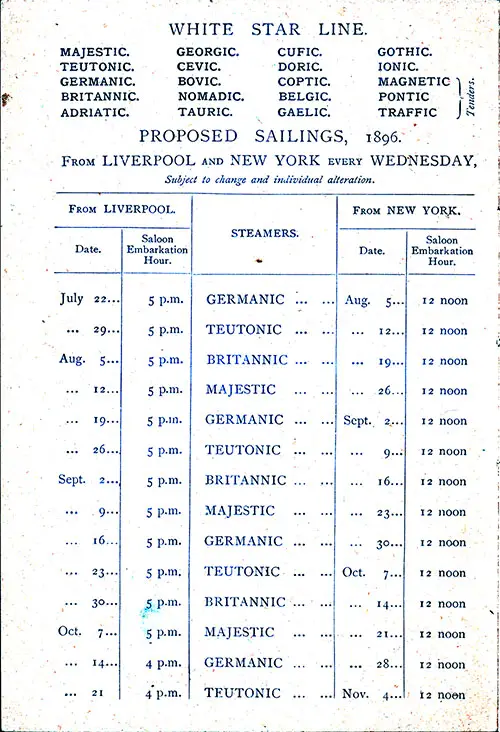
White Star Line Sailing Schedule, 22 July 1896 to 4 November 1896 from Liverpool to New York every Wednesday. Steamships included the Britannic, Germanic, Majestic, and Teutonic. Also included passenger ship fleet list. RMS Germanic Saloon Passenger List, 22 July 1896. | GGA Image ID # 23802fc999
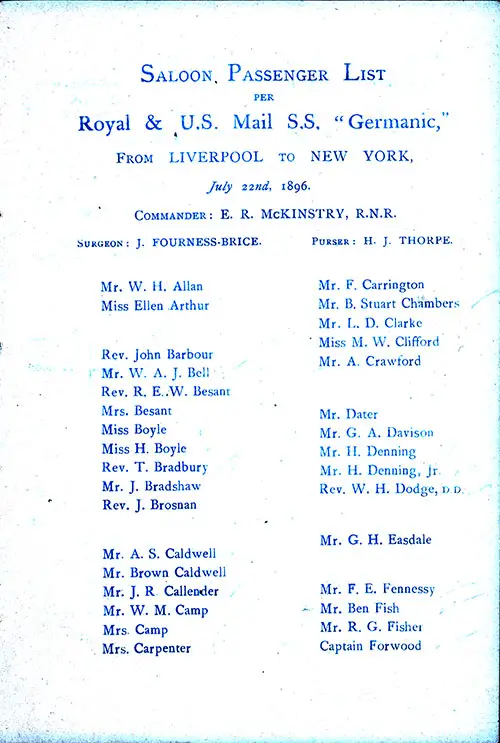
Title Page Including List of Senior Officers and Saloon Passengers, Part 1 of 4, Allan-Forwood. RMS Germanic Saloon Passenger List, 22 July 1896. | GGA Image ID # 23801fdcd6
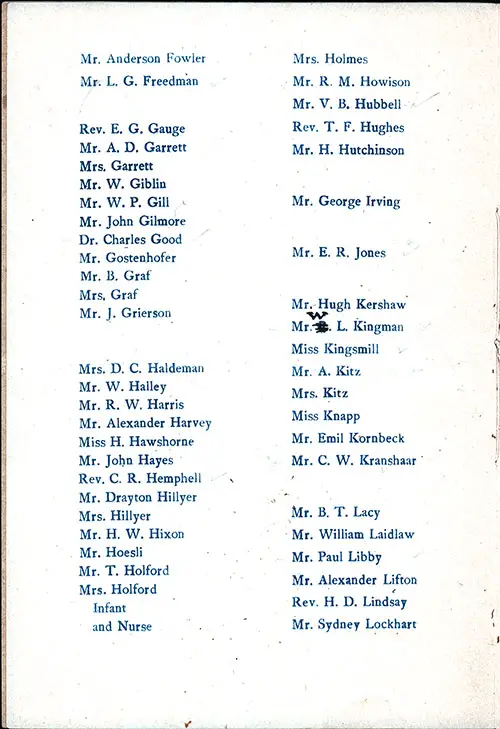
List of Saloon Passengers, Part 2 of 4, Fowler-Lockhart. RMS Germanic Saloon Passenger List, 22 July 1896. | GGA Image ID # 2380383220
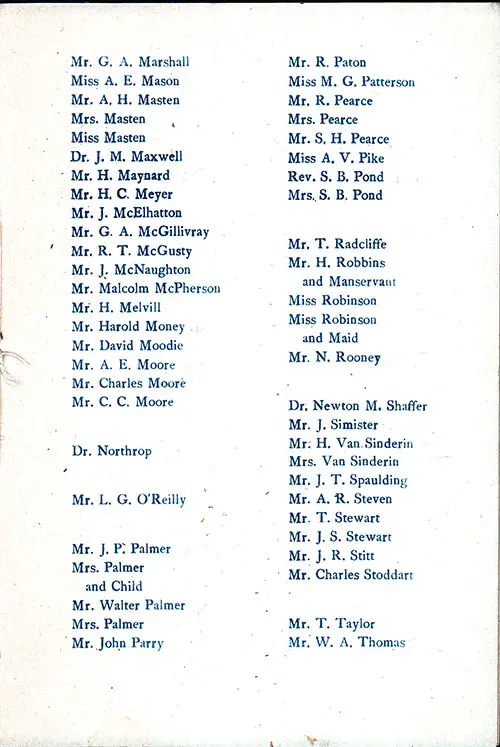
List of Saloon Passengers, Part 3 of 4, Marshall-Thomas. RMS Germanic Saloon Passenger List, 22 July 1896. | GGA Image ID # 2380563828
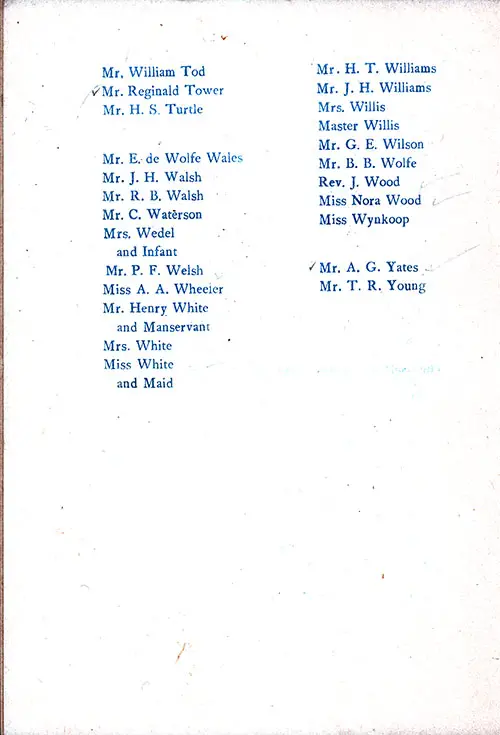
List of Saloon Passengers, Part 4 of 4, Tod-Young. RMS Germanic Saloon Passenger List, 22 July 1896. | GGA Image ID # 2380712cae
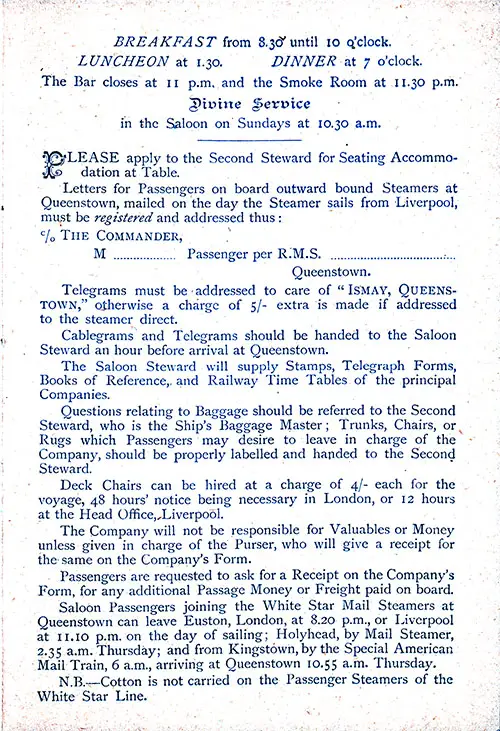
Information for Saloon Passengers, RMS Germanic Saloon Passenger List, 22 July 1896. | GGA Image ID # 2380dd658d
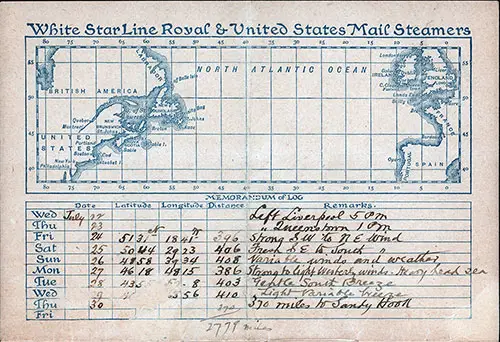
Track Chart and Memorandum of Log, Annotated by the Original Passenger, SS Germanic Passenger List, 22 July 1896. | GGA Image ID # 1ffa7631c3
📜 Research note: Some names and captions were typed from originals and may reflect period spellings or minor typographical variations. When searching, try alternate spellings and cross-check with related records. ⚓
Curator’s Note
For over 25 years, I've been dedicated to a unique mission: tracking down, curating, preserving, scanning, and transcribing historical materials. These materials, carefully researched, organized, and enriched with context, live on here at the GG Archives. Each passenger list isn't just posted — it's a testament to our commitment to helping you see the people and stories behind the names.
It hasn't always been easy. In the early years, I wasn't sure the site would survive, and I often paid the hosting bills out of my own pocket. But I never built this site for the money — I built it because I love history and believe it's worth preserving. It's a labor of love that I've dedicated myself to, and I'm committed to keeping it going.
If you've found something here that helped your research, sparked a family story, or just made you smile, I'd love to hear about it. Your experiences and stories are the real reward for me. And if you'd like to help keep this labor of love going, there's a "Contribute to the Website" link tucked away on our About page.
📜 History is worth keeping. Thanks for visiting and keeping it alive with me.
Repository Information
The Gjenvick-Gjønvik Archives (GG Archives) is cataloged with the Library of Congress under MARC Org Code: WiMfGGA and ISIL: US-wimfgga.
Current location:
N91W16562 Pershing Ave, #1
Menomonee Falls, Wisconsin 53051-2170, USA
Note: Historic addresses listed in earlier MARC records include Marietta, GA and Woodstock, GA. These appear in authority files but are no longer active.
