
SS Furnessia Saloon Passenger List, Glasgow to New York via Moville — 7 December 1883
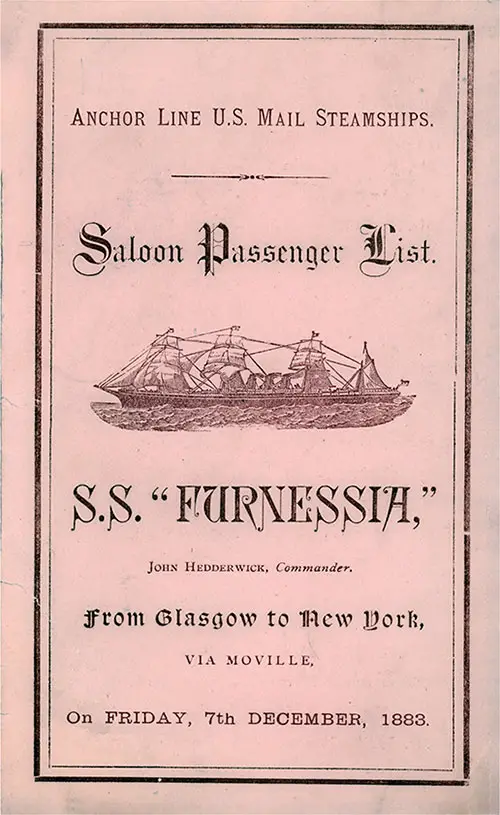
Front Cover of a Saloon Passenger List for the SS Furnessia of the Anchor Line, Departing Friday, 7 December 1883 from Glasgow to New York via Moville, Commanded by Captain John Hedderwick. The Image Features a Document Related to the U.S. Mail Steamships, Specifically Highlighting a Saloon Passenger List for the SS “Furnessia." Passenger List Has Some Issues With Discoloration. The Front Cover Prominently Displays U.s. Mail Steamship Designation, Underlining the Furnessia’s Role in Both Passenger Service and Transatlantic Mail Delivery—a Central Selling Point for Travelers Who Valued Reliable Communication. | GGA Image ID # 1730b289e4
🚢 Review and Summary — SS Furnessia Passenger List (7 December 1883)
Introduction & Voyage Overview
The Furnessia, launched in 1880, was known for her iron hull, single screw propulsion, and comfortable saloon accommodations, catering to well-heeled passengers while still transporting many emigrants in steerage. This voyage connected the cultural centers of Scotland, Ireland, and England with the commercial and immigrant hub of New York City, a route of critical importance for transatlantic commerce, migration, and tourism.
On 7 December 1883, the SS Furnessia sailed from Glasgow, calling at Moville (Ireland) before crossing the North Atlantic to New York. Passengers on this winter sailing included businessmen, clergy, medical professionals, and international travelers from Canada, Scotland, England, the United States, Italy, China, and Cuba. Commanded by Captain John Hedderwick, a respected Anchor Line master, this journey would have taken roughly 10–12 days depending on winter weather and sea conditions.
🛳 Key Ship Features — SS Furnessia
- Launched: 1880 by the Anchor Line
- Owner/Operator: Anchor Line (Glasgow)
- Type: Iron-hulled passenger liner, single screw
- Service: Transatlantic passenger & mail, plus emigrant transport in steerage on many voyages
- Typical Routes: Glasgow–New York (often via Moville), sometimes Liverpool connections
- Known for: Reliability, solid engineering, and an attractive profile in Anchor Line advertising
The Furnessia was marketed as a safe, steady, and comfortable ship rather than a record-breaker—ideal for families, clergy, and professionals making regular crossings. As a U.S. Mail Steamship, she held contracts to carry official mail, reinforcing her reputation for regular schedules and dependable service.
⚓ Senior Officers and Staff
- Commander: Captain John Hedderwick
Captain John Hedderwick – Veteran Anchor Line captain with a reputation for safe, punctual crossings. - Surgeon: R. D. Bradford
Dr. R. D. Bradford – Provided medical care in an age before widespread shipboard refrigeration or modern antibiotics, when even a mild illness could turn serious mid-ocean. - Purser: John Mathieson
John Mathieson – Responsible for passenger accounts, ticketing, and onboard amenities. - Stewardess: Mrs. Ramsay
Mrs. Ramsay – Attended to the comfort of women and children in the saloon cabins.
These officers were responsible for navigation, health, accounts, and passenger comfort—particularly in the saloon class, where expectations for service were significantly higher than in steerage.
Saloon Passengers
- Mr. John Anderson
Guelph, Ont - Mrs. Anderson
Guelph, Ont - Mr. T. J. Brew
New York - Mr. John Black
Glasgow - Mr. Foster Black
New York - Mr. William Bryan
Portrush - Mr. John Carmichael
Edinburgh - Mrs. Carmichael, Infant,
and Nurse
Edinburgh - Mr. John H. Cockburn
New York - Mr. S. W. Connell
Hamilton, Ont - Dr. Chiola
Naples - Mrs. M. Gerneau
New York - Mr. H. W. S. Gordon
Edinburgh - Mrs. Laidlaw
Glasgow - Mr. E. McVeagh
Glasgow - Mrs. D. J. Mitchell
New York - Master Brady Mitchell
New York - Mrs. Virginia P. Marwick
New York - Mr. W. B. Newson
Liverpool - Miss Annie L. Park
New York - Mr. John E. Roberts
New York - Mr. Donald Ross
Chicago - Mr. John Roxburgh
City Rapids, Iowa - Rev. R. G. Seymour
New York - Dr. H. R. Smith
China - Mrs. Smith and Infant
China - Mrs. M. J. Thomson
Glasgow - Mr. A. A. Wood
New York - Pusto G. Garcia Parid
Cuba (Handwritten Entry)
👥 Notable Passengers & Social Context
This passenger list reflects a fascinating cross-section of late 19th-century transatlantic society:
Religious Figures
Rev. R. G. Seymour (New York) – A Baptist minister and denominational figure likely traveling in connection with church work, speaking engagements, or transatlantic religious networks. Clergy like Seymour often appear in saloon lists as they moved between Britain, the Continent, and North America for conferences and fundraising.
Medical Professionals
Dr. Chiola (Naples) – An Italian doctor traveling westward, possibly connected to Mediterranean medical practice or consultative work in the U.S.
Dr. H. R. Smith (China) – Traveling with Mrs. Smith and an infant, almost certainly a medical doctor returning from service in China, very likely in missionary, consular, or treaty-port medical work. His appearance on a Glasgow–New York sailing underlines how truly global networks of medicine and mission had become by the 1880s.
Transnational Travelers
Pusto G. Garcia Parid (Cuba) – Entered by hand, suggesting a late booking or special accommodation. The spelling strongly suggests a Spanish/Cuban name, possibly a merchant, planter, or professional traveling between Cuba and the United States in a period of intense colonial and political tension under Spanish rule. The handwritten nature of the entry makes him one of the more intriguing figures on the list.
🌍 North Atlantic Professionals & Return Travelers
John Anderson & Mrs. Anderson (Guelph, Ont) – Canadians traveling via Scotland, showing the multidirectional nature of late 19th-century routes.
Donald Ross (Chicago), John Roxburgh (City Rapids, Iowa) – Likely tied to the booming economy of the American Midwest (railroads, grain, milling), returning from business or family visits in Britain.
New York passengers (e.g., John H. Cockburn, John E. Roberts, Virginia P. Marwick) – A mix of residents of the city at the heart of U.S. finance, shipping, and immigration, reinforcing Furnessia's role as a bridge between British and American urban centers.
Rev. R. G. Seymour (New York)
Baptist minister & denominational officer 🙏📜
The most persuasive match is Rev. Robert G. Seymour, D.D., a well-known late-19th-century Baptist clergyman:
Denominational role. Listed as “Missionary and Bible Secretary” of the American Baptist Publication Society (ABPS), headquartered in Philadelphia, in a standard reference for Baptist clergy at the turn of the century. That job title typically meant nationwide travel to churches and associations—very consistent with a December transatlantic crossing.
Divinity Archive
Earlier pastorate. Contemporary newspapers place Rev. Dr. Robert G. Seymour in New England pulpits in the 1880s; for example, he is cited in Massachusetts coverage and program notices as a visiting preacher and lecturer (again, the pattern of mobility).
Why this matters to the list: If this is the same R. G. Seymour (and the clerical title aligns), you’re seeing a national Baptist figure traveling during a burst of post-1880s denominational expansion—exactly the kind of person who appears in saloon-class manifests heading to speaking tours or fundraising circuits.
Dr. H. R. Smith (China)
Presbyterian medical missionary 🏥⛪️🇨🇳
“Dr. H. R. Smith — China” lines up convincingly with Dr. Horace R. Smith, a Presbyterian medical missionary serving at Weixian/Weihsien (Shandong) in the early 1880s:
Posting & timing. A mission roster notes Dr. Horace R. Smith at Weixian in early 1883, then departing later that year—perfectly timed for a December 1883 Atlantic crossing listed with wife and infant (the passenger list shows “Mrs. Smith and infant”).
Wikipedia
Context. Presbyterian medical missions in Shandong were ramping up clinical work and dispensaries in the 1870s–80s; physicians often returned home on furloughs to recruit staff and raise funds—again matching a winter sailing.
Why this matters to the list: Dr. Smith represents the medical-missionary vanguard—trained Western physicians bringing hospital care to North China and building cross-Pacific networks. His appearance turns the manifest into a snapshot of global faith-based medicine in motion.
“Pusto G. Garcia Parid (of Cuba)” — a tricky one 🕵️♂️🇨🇺
This entry is tantalizing—but the wording looks like a handwritten, possibly mis-read line. A few clues:
No direct press or directory hits for “Pusto G. García Parid/Parid” in 1880s New York–Cuba traffic, and nothing obvious in Cuban elite lists under that exact spelling. (I searched “Pusto,” “Justo,” “Fausto,” and surnames Parid/Pardi/Pardo/París, plus García variants, without a firm match.)
Most likely transcription fixes:
Given Spanish naming patterns, “Justo G. García Pardo” or “Fausto G. García Pardo” would be common and plausible.
“Parid” could well be “Pardi” or “Pardo,” depending on the clerk’s hand.
First name “Pusto” is rare to nonexistent; “Justo” (Justus) is frequent in Cuban records.
📚 Historical Relevance for Educators & Researchers
The 7 December 1883 voyage is valuable for:
Teachers & Students
- An excellent primary source for classroom use on topics such as transatlantic travel, communication before wireless telegraphy, and the role of mail steamers.
- The U.S. Mail designation provides a strong hook for discussions of how people stayed connected before phones and email.
Genealogists
- Direct documentation of named individuals, with places of residence (Ontario, New York, Chicago, Iowa, Naples, China, Cuba, etc.).
- Ideal for verifying family stories of a December 1883 crossing on the Anchor Line.
Historians
- Concrete evidence of global mobility—the same ship carrying travelers associated with China and Cuba alongside British and North American passengers.
- Useful for research on religious networks, medical missions, and business travel in the late Victorian era.
Maritime & Ephemera Collectors:
- A desirable piece combining Anchor Line branding, U.S. Mail Steamship status, and named passengers with international connections.
📜 Condition
This is an original 1883 passenger list with honest age and handling:
- Some discoloration / browning, particularly on the front cover, as visible in the images.
- Interior pages show typical age toning but remain clean, legible, and intact.
- No handwriting from the original owner (except the printed inclusion of the handwritten-style Cuban name in the list).
Overall, this is a sound, presentable example of an 1883 passenger list with some cosmetic flaws but strong content and structure.
Grade: Good (G) – based mainly on discoloration; structurally solid and highly displayable, especially front cover.
💭 Final Thoughts — Why This Passenger List Matters
The SS Furnessia’s 7 December 1883 crossing is more than a manifest—it’s a snapshot of an interconnected world. A Scottish clergyman, a Neapolitan doctor, an American businessman, a Cuban traveler, and a physician from China all shared the same dining saloon. These lists humanize the era’s grand ships, making it clear that the North Atlantic was a thoroughfare of ideas, faith, medicine, commerce, and migration.
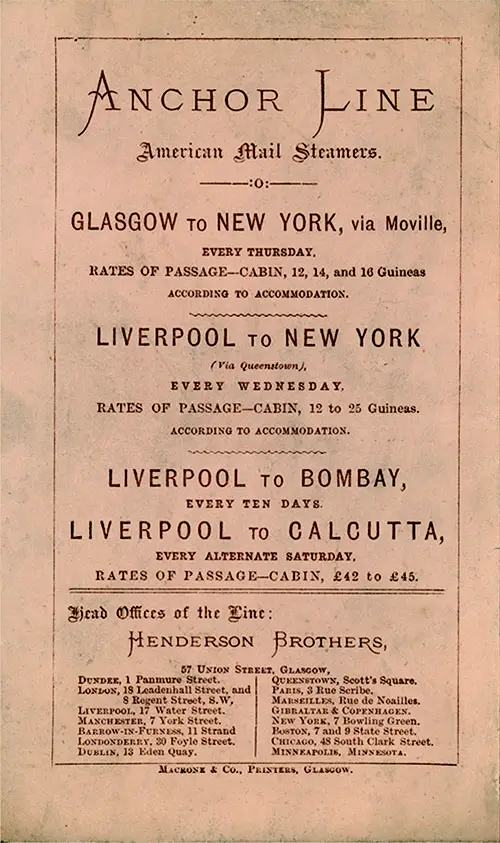
Back Cover SS Furnessia Saloon Passenger List, 7 December 1883. Textual Content Includes Anchor Line Service Routes Along With Offices and Agencies. The Back Cover Lists Anchor Line Routes and Agencies, Reminding Passengers of the Company’s Reach Across Britain, Europe, and America. | GGA Image ID # 1fc58ef22c
Last Updated: 16 January 2026
📜 Research note: Some names and captions were typed from originals and may reflect period spellings or minor typographical variations. When searching, try alternate spellings and cross-check with related records. ⚓
Curator’s Note
For over 25 years, I've been dedicated to a unique mission: tracking down, curating, preserving, scanning, and transcribing historical materials. These materials, carefully researched, organized, and enriched with context, live on here at the GG Archives. Each passenger list isn't just posted — it's a testament to our commitment to helping you see the people and stories behind the names.
It hasn't always been easy. In the early years, I wasn't sure the site would survive, and I often paid the hosting bills out of my own pocket. But I never built this site for the money — I built it because I love history and believe it's worth preserving. It's a labor of love that I've dedicated myself to, and I'm committed to keeping it going.
If you've found something here that helped your research, sparked a family story, or just made you smile, I'd love to hear about it. Your experiences and stories are the real reward for me. And if you'd like to help keep this labor of love going, there's a "Contribute to the Website" link tucked away on our About page.
📜 History is worth keeping. Thanks for visiting and keeping it alive with me.
